
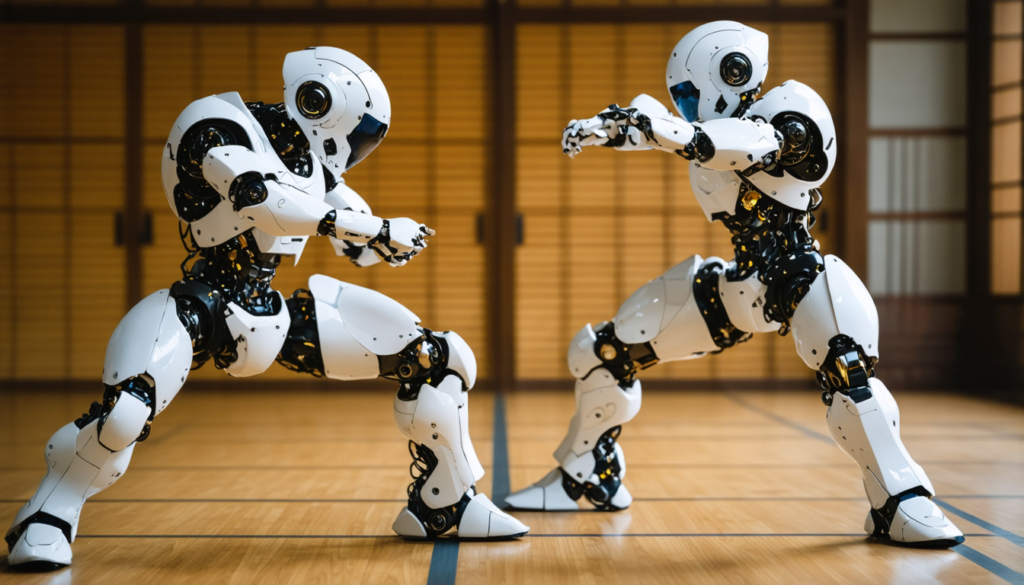
In 2026, humanoid robotics takes spectacular new steps every day. While these machines now master complex gestures, a recent viral video surprised more than one observer. It shows a humanoid robot from the Chinese brand Unitree, called G1, in the middle of a simulated martial arts training. What seemed to be an exemplary demonstration suddenly turns into an incident, when an unusual blow strikes the sensitive parts of the teleoperator guiding the robot. This unexpected scene illustrates how handling and simulation in robotics can prove more difficult than they seem, and reminds us that despite technological advances, caution is always necessary. The G1 charms with its dexterity, but also raises questions about safety and the still fragile relationship between humans and intelligent machines.
At the heart of an experience mixing artificial intelligence and simulation of complex movements, this unexpected shock illustrates a central dilemma in training robots capable of reproducing human gestures. While robotics progresses thanks to learning by imitation, it sometimes struggles to integrate the real parameters of human physical reaction. This shocking video, now widely shared, reveals an often overlooked aspect of robotic development: the transmission of movements inevitably linked to physical risks. Under the watchful eye of cameras, the Unitree G1 robot performs each gesture with precision, but its involuntary “strike” causes the teleoperator to stagger. More than an anecdote, it is a concrete testimony of the current challenges of humanoid robotics.
- 1 Humanoid robot training: a technical and human challenge
- 2 Robotic simulation: a mirror of human gestures, between advances and limits
- 3 The Unitree G1: a striking example of humanoid robot in full evolution
- 4 Robot reaction: a response without understanding, a mechanical mimicry
- 5 Concrete risks of humanoid robotics in research environments
- 6 Toward safer and more intuitive humanoid robotics
- 7 The key role of the shock video in robotic safety awareness
- 8 Outlook for 2026 and beyond: essential developments in humanoid robotics
Humanoid robot training: a technical and human challenge
The training of humanoid robots like Unitree’s G1 relies on advanced technologies, notably human motion capture and their faithful reproduction by mechatronic mechanisms. The teleoperator uses special suits or sophisticated controllers to transmit their gestures, in order to train the robot for precise and fluid imitation.
Beyond mere execution, the artificial intelligence embedded in the robot analyzes in real time the received data to adjust balance, speed, and force of movements. Yet, coordinating these parameters remains highly complex. When the human simulates kicks or martial arts combinations, the robot simply reproduces exactly what is sent. This means that if there is an impact gesture, it is also transcribed in its mechanical execution.
This highly technical learning method presents several challenges:
- Perfect synchronization between human command and robotic reaction, which requires very low latency.
- Management of mechanical constraints, as the humanoid must withstand accelerations and forces without deteriorating.
- Control of unexpected reactions, especially in confined environments where the margin of error is unforgiving.
- Physical safety of operators, often very close to the robot in action, who may suffer impacts or collisions.
For example, in the G1 training video, the confined space increases the risk of impact. The robot, faithfully reproducing a kick, turns so precisely that it unintentionally strikes the sensitive parts of the teleoperator. This fact illustrates that fine mechanics are not yet perfectly adjusted to human realities and that the risk factor is significant, even in a simulation setting. So, how is the industry trying to evolve in the face of these complex challenges?
Robotic simulation: a mirror of human gestures, between advances and limits
Simulation is at the heart of the development of humanoid robots. In order for them to integrate sequences of complex movements, they must first observe, learn, and reproduce human gestures. Learning by imitation, often supplemented by an artificial intelligence system, allows a gradual refinement of the robot’s motor abilities.
In practice, simulation consists of simultaneously capturing posture, speed, force, and direction. These parameters are then transcribed and executed by the robot according to its own mechanical constraints. The goal is to achieve, in a controlled space, an action fluidity that makes the presence of the machine forgotten.
However, this mirror relationship is not without risks. The viral video is a glaring proof. The robot reproduces to the letter a martial arts movement — a technique that, in a human, sometimes leads to a painful shock when applied precisely and correctly. But in a robotic environment, where physical sensitivity is absent, the transmission becomes paradoxical.
Some crucial points should be retained:
- Robotics imitates without feeling: The robot merely copies data, without perceiving pain or the threshold of sensitive parts.
- Artificial intelligence does not yet have the ability to modulate impact: AI learns the gestures but cannot yet adjust force according to the human empathic filter.
- The risk of physical accidents is therefore real: Poor synchronization or too confined a space can cause unexpected collisions.
This form of extreme rigor in simulation raises many questions about the future of robotics. Designers must imperatively integrate advanced algorithms capable of introducing a form of self-correction or anticipation of accidents. Without this, incidents like the one showing the unusual blow to the sensitive parts will remain frequent.
The Unitree G1: a striking example of humanoid robot in full evolution
Launched in early 2025, the Unitree G1 robot symbolizes a new generation of humanoids accessible to universities, research centers, and companies specialized in R&D. Offered at around $13,000, this robot combines a robust chassis with advanced sensors and artificial intelligence software that enable a wide range of complex movements.
Its main mode of learning remains teleoperation. The teleoperator, equipped with a motion capture suit or a manual device, controls the G1 in real time. This system allows flexibility in sequence programming, as well as data collection intended to later improve the robot’s autonomy through reinforcement learning.
The case of the filmed accident, however, illustrates the limits of this technology. The G1 here merely replicates the command received, with flawless mechanical precision. The problem is that there is no filter for physical action. If the gesture requires an impact, it is fully reproduced, causing the direct shock on the teleoperator.
Unitree, with its expertise, should now work on integrating additional safety mechanisms:
- Improved proximity sensors to anticipate collisions.
- Artificial intelligence capable of differentiating a training gesture from a real shock.
- Force limitation protocols during high-risk movements.
- Better defined training spaces to reduce accidents caused by the environment.
This example places the G1 at the crossroads of technological and human challenges, highlighting the necessity of a cautious approach so robotics can progress safely.
Robot reaction: a response without understanding, a mechanical mimicry
When the G1 robot nearly collapses at the same time as the teleoperator after the unusual blow received to the sensitive parts, it seems almost humorous. Yet, this reaction is only the consequence of a programming that follows the orders to the letter without subjective analysis or feeling.
Humanoid robotics today is still far from being able to simulate genuine consciousness or pain perception. The robot feels no shock; it simply does what it is asked. Its “imitation” of a fall or imbalance is a logical consequence of mechanical loss of balance caused by the impact movement.
However, this image sparked strong interest in the scientific community and the general public. It highlights the current limits of artificial intelligence in robots: the ability to imitate without understanding or real control of risky situations.
This mechanical reaction can be analyzed as follows:
- Strict execution: The robot exactly obeys instructions, reproducing every movement without discernment.
- Absence of feeling: No sensory system to react to pain or imminent danger.
- Mirror fall: The human loss of balance causes a fall of the robot, mechanically imitating human behavior without understanding its causes.
This reality clearly illustrates the complexity of managing the human factor in robotic simulation and calls for futuristic innovations that could equip robots with the ability to prevent and self-defend against accidents.
Concrete risks of humanoid robotics in research environments
The case of the unusual blow to the teleoperator’s sensitive parts highlights an often underestimated aspect of robotic work environments: physical safety. As humanoid robots are increasingly used in research institutes and development companies, risks related to training and simulation are very real.
In these contexts, human-machine interactions can cause various problems:
- Mechanical collisions due to calculation errors or timing offsets between command and execution.
- Excessive forces exerted by robots trained to reproduce impacts without power regulation.
- Lack of safety protocols specially adapted to risky gestures involving sensitive parts of the human body.
- Poorly adapted environments where the workspace is too limited to train safely.
The table below illustrates the main risks and their consequences in laboratories and robotic training centers:
| Type of Risk | Main Causes | Possible Consequences | Recommended Preventive Measures |
|---|---|---|---|
| Unintentional Collisions | Delay between command and movement, confined space | Physical injuries, equipment damage | Emergency stop systems, proximity sensors |
| Unregulated Impacts | Faithful reproduction without moderation | Physical pains, serious accidents | Force limitation, self-correction algorithms |
| Lack of safety protocols | Absence of specific rules for sensitive parts | Increased risk of injury during physical training | Creation of specific standards and risk training |
| Confined environments | Insufficient space for movements | Frequent shocks, operator and robot falls | Adapted layouts, expanded training zones |
This observation calls on robotics stakeholders to strengthen controls, improve algorithms, and review training conditions to ensure optimal safety for users and the machines themselves.
Toward safer and more intuitive humanoid robotics
The G1 robot training experience has generated many questions about the need to evolve robotic systems. For humanoid robots to become true partners of humans and not potential sources of injury, several avenues must be explored:
- Diversification of sensors: Installing devices capable of detecting proximity to sensitive zones and modulating force.
- Improvement of AI: Developing algorithms incorporating risk awareness, allowing real-time adaptation of gestures.
- Modular design: Creating robots with flexible internal mechanisms, able to absorb shocks and stop in case of anomaly.
- Increased operator training: Training teleoperators on physical risks related to simulation and the importance of rigorous control.
- Strict testing and certifications: Implementing industrial standards for humanoid robotics, defining minimum safety criteria.
These directions are essential to reconcile the power of robotics with human fragility. The stakes are all the more crucial as applications soon touch all fields, from medical to industrial to education.
The key role of the shock video in robotic safety awareness
Viral videos like that of the G1 in training, receiving a blow to the teleoperator’s sensitive parts, play an important role beyond initial amusement. These images have become valuable tools to alert the scientific community and the general public about the risks related to advanced robotics.
Indeed, the shock video allows:
- To concretely show the physical stakes involved in training a humanoid robot in confined spaces.
- To urge manufacturers to strengthen safety and review protocols before robots become widespread.
- To educate future operators and researchers on best practices through a vivid and memorable example.
- To spark societal debate on the relationship between humans and intelligent machines, between control, trust, and caution.
Beyond the shock caused by the scene, this video reminds us that robotics must always advance with rigor and responsibility. It is a warning signal, calling for heightened vigilance in the face of future developments.
Outlook for 2026 and beyond: essential developments in humanoid robotics
While 2026 sees the G1 and its competitors take their place in laboratories and institutes, evolutionary prospects are moving towards better integration of safety principles and intelligent control. Incidents from the video highlight certain technical and organizational flaws.
The next stages in humanoid robotics envision:
- Artificial emotional intelligence, capable of identifying risky situations and adapting mechanical responses based on human context.
- Improved command interfaces, facilitating better two-way communication between human and robot.
- Mixed reality simulation, combining virtual reality and real physics to anticipate errors and train in safe conditions.
- Development of intelligent materials, less rigid and more responsive to shocks, ensuring better protection.
These innovations aim to transform humanoid robotics from a purely technological sector into a true reliable partner, able to collaborate safely with its users. Caution remains the cornerstone of this transition between mechanical prowess and human protection.




