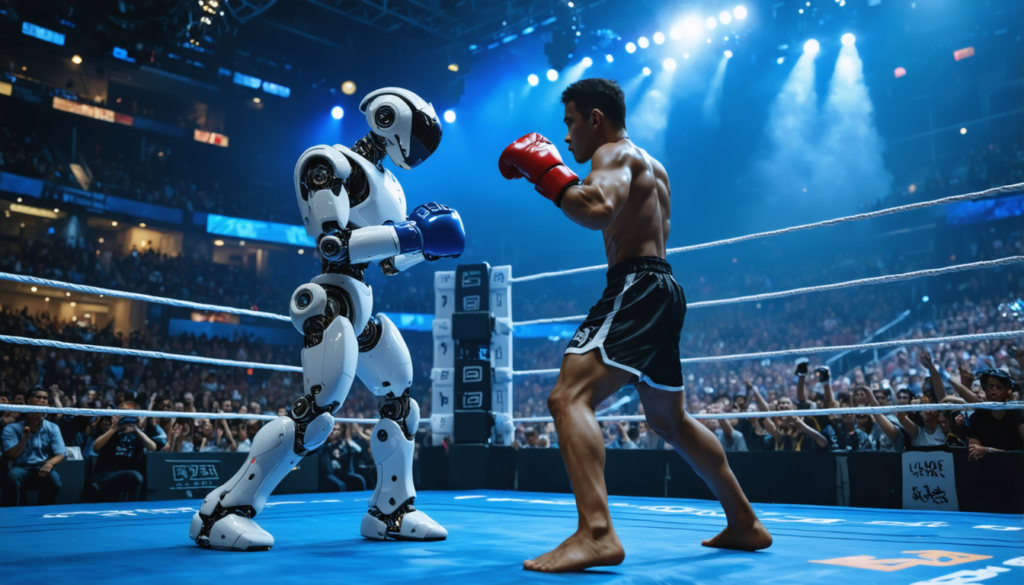
The world of robotics is reaching a spectacular new milestone with the appearance of a humanoid robot capable of evolving in the arena of a combat sport like kickboxing. This technological advancement by Unitree Robotics perfectly illustrates the fascinating union between mechanical performance and artificial intelligence. With an impressive height of 1.82 meters, the H2 robot combines power, speed, and agility to compete with human fighters and other robots, thus transforming kickboxing into a true innovation laboratory. From mastering strikes to balancing on the ring, the integration of this new invention redefines the limits of robotic competition and tomorrow’s sports entertainment.
At the heart of this revolution, the H2 succeeds the previous G1 model, already famous for its extraordinary flexibility and accessible price, and establishes itself as a true colossus of combat robots. Thanks to a sophisticated architecture and the latest advances in artificial intelligence, this robot does not merely repeat preprogrammed movements; it anticipates and adapts its combat strategies in real time. With an arsenal of mastered kicks and knees and spins that would make many athletes envious, this new player in sports robotics marks a major milestone at the crossroads of technical progress and popular appeal for combat sports.
- 1 Unitree H2: the ultimate expression of robotic technology applied to kickboxing
- 2 The iconic fight: Unitree H2 versus G1, a duel of robotic titans
- 3 The benefits of artificial intelligence for robotic combat
- 4 A new era for combat sports between robots and humans
- 5 The economic and industrial impact of sports robotics
- 6 Technical and ethical challenges posed by robotics in combat sports
- 7 Future perspectives: robotics, combat sports, and innovations to come
Unitree H2: the ultimate expression of robotic technology applied to kickboxing
The development of humanoid robots for sports purposes has represented an ambitious technological and scientific challenge for several years. With the H2, Unitree Robotics elevates this ambition to a new level by offering a robot that combines robust mechanics and advanced artificial intelligence capable of controlling complex movements with exemplary precision. Its design is inspired both by human anatomy and the specific demands of kickboxing, a sport requiring both strength and rapid reaction times.
Robotics applied to combat sports must contend with particularly high dynamic and balance constraints. Indeed, every kickboxing move, whether a flying kick or a quick dodge, involves perfect weight distribution and instant management of applied forces. The H2 excels in this regard thanks to an architecture that integrates 31 degrees of freedom, with 7 joints on each arm and 6 per leg, allowing exceptional range and fluidity of its movements.
This sophisticated joint configuration gives the H2 remarkable adaptability. For example, during a high kick, the robot must not only generate significant torque – up to 360 N·m in its leg joints – but also maintain its balance on the other leg. This mechanical feat is reinforced by a structure that allows the robot to support up to 15 kilograms while maintaining its stability. Thus, far from being a simple demonstration gadget, the H2 presents itself as a true modular and versatile platform capable of evolving in various sports contexts, even extreme ones.
Moreover, the integration of the NVIDIA Jetson AGX Thor processor in its EDU version offers impressive computing power, estimated at 2070 TOPS (Tera Operations Per Second), paving the way for high-level embedded artificial intelligence. With such a setup, the H2 can analyze and react in real time to its environment, modulate its technique, and anticipate opponent actions without perceptible latency. This combination of hardware power and intelligent software transforms this robot into a true competitor.
The iconic fight: Unitree H2 versus G1, a duel of robotic titans
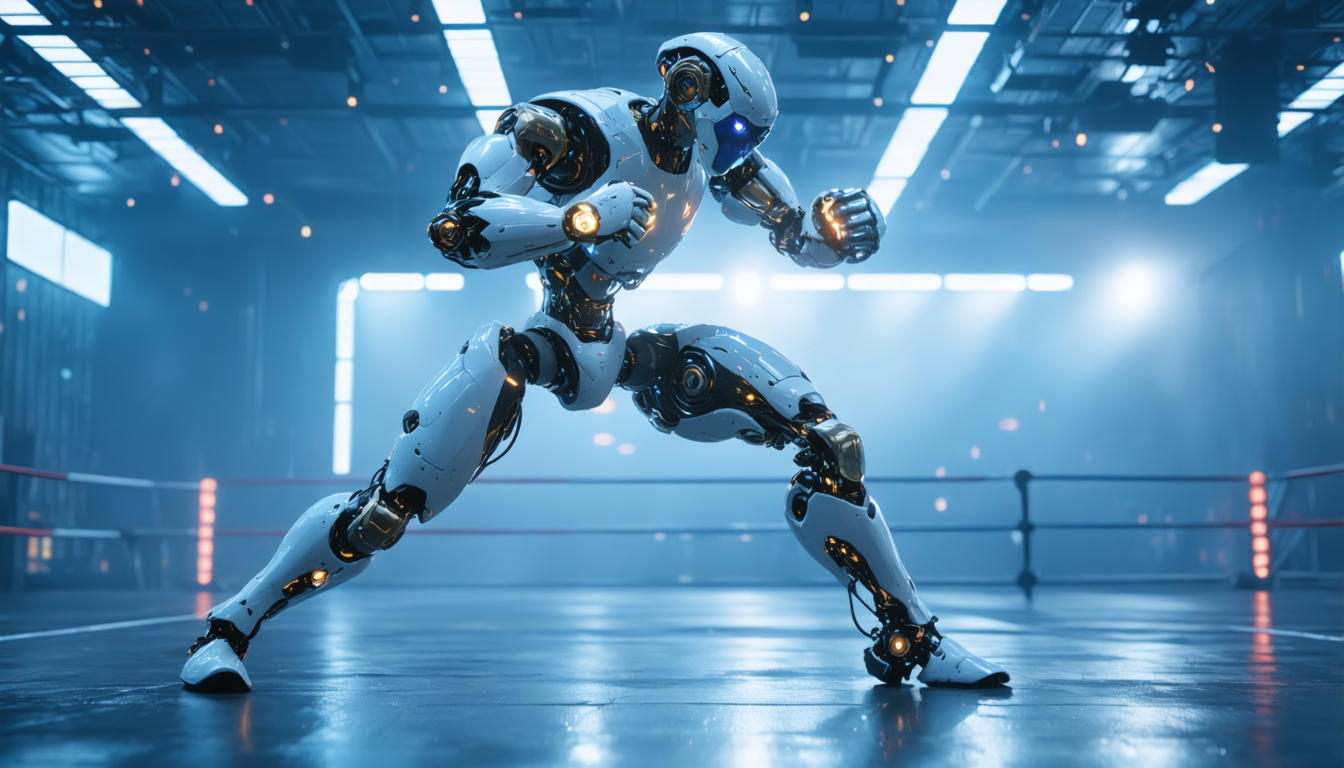
The highlight moment of the H2 presentation is undoubtedly its confrontation with the G1, the previous Unitree Robotics model. These two robots, although related in their design, illustrate the rapid progress of humanoid robotics in recent years. While the G1 remains known for its flexibility and competitive cost, the H2 reveals raw strength coupled with exceptional control, illustrated by a spectacular knee strike that literally lifts the G1 off the ground.
This demonstration of power is not a mere strength exercise but a showcase of the advanced motor control developed by the H2. Weighing 70 kilograms, the robot combines agility and stability on the ring. It shows the ability not only to deliver powerful strikes but also to withstand attacks thanks to a perfectly balanced structure and a state-of-the-art sensory logging system. The fight between H2 and G1 opens a new era for robotic combat sports, where each hit is no longer just proof of mechanical power but also of gestural intelligence.
This robotic duel also illustrates progress in terms of energy independence. With a runtime of nearly three hours, the H2 allows extended fights without interruption, a major asset for competitions of this type. This contrasts sharply with earlier generations of sports robots, where energy efficiency drastically limited the duration of matches and the intensity of performances.
The confrontation between these two Unitree Robotics icons already attracts the interest of a wide audience, both from the technology world and combat sports enthusiasts. This symbiosis between robotics and sports entertainment demonstrates that innovation in this sector is no longer solely about industrial research but now penetrates the field of entertainment and professional competition.
The benefits of artificial intelligence for robotic combat
Artificial intelligence (AI) continues to radically change the approach to humanoid robotics. In the context of kickboxing, AI is not only used to execute preprogrammed movements but also to analyze, learn, and optimize combat strategies in real time. The H2, with its NVIDIA Jetson AGX Thor processor, uses AI models capable of high-speed processing, allowing it to adapt its techniques according to opponent reactions and unforeseen events on the ring.
The embedded algorithms employ machine learning and deep learning to break down gestures, anticipate attacks, and continuously improve combinations of strikes. For example, if a robot or human opponent adopts a particular style, the H2 can adjust its guard, modulate the speed of its strikes, or choose the best position to dodge or counterattack.
It is no longer a question of fixed sequences but of genuine tactical intelligence. During fights, the AI integrates data from numerous sensors (gyroscopes, accelerometers, cameras), allowing the robot to maintain its balance even when destabilized by a powerful blow. This recovery ability is a key element highlighting the revolutionary nature of this new invention in the field of robotic combat sports.
Furthermore, this advancement opens possibilities to train robots in virtual environments, where different strategies are tested before being applied in the real ring. This greatly shortens learning cycles and improves the robot’s efficiency from its very first public appearances.
A new era for combat sports between robots and humans
With the rise of these robots capable of executing kickboxing techniques, the boundary between robotic competition and human combat is gradually blurring. The impressive demonstrations of the H2 illuminate a future vision where matches between humans and highly sophisticated robots could be seen, combining physical performances and intellectual strategies.
Robotic combat sport could become a discipline in its own right, with specific rules adapted to machines’ capabilities. For example, fights would emphasize precision of strikes and strategy rather than brute force, thereby highlighting programming work and the quality of embedded artificial intelligences. High-level competitions, similar to those already organized in China and broadcast worldwide, allow testing the limits of this technology in official and secure settings.
The question of safety remains paramount, and innovations in sensor and shock absorption systems ensure risk-free interaction between robots and humans. Moreover, this coexistence could boost the popularity of combat sports by attracting an audience passionate about technological innovations and futuristic spectacles.
The economic and industrial impact of sports robotics
The sports robotics industry is experiencing exponential growth thanks to innovations such as Unitree Robotics with the H2. At $29,900, this robot remains affordable compared to other technological giants like Boston Dynamics, whose robots cost several hundred thousand dollars. This pricing strategy democratizes the use of robots in sports, research, and training, while stimulating investment in innovative projects.
Robotics applied to combat sports also opens opportunities in athlete training simulation, biomechanical research, or the creation of new technologically advanced entertainment formats. The economic benefits include:
- Development of new industrial sectors specialized in the design and maintenance of sports robots
- Stimulation of applied artificial intelligence research for fine management of complex movements and autonomous decision-making
- Creation of international events and esports competitions around robot matches, attracting sponsors and spectators
- Innovation in user interfaces enabling advanced control or real-time analysis of robotic performances
Beyond these figures, this new invention broadens the horizons for both consumer and professional robotics, offering varied outlets ranging from the video game world to military and industrial applications.
Technical and ethical challenges posed by robotics in combat sports
Despite impressive progress, the development of robots like the H2 raises considerable challenges, both technical and ethical. Technically, maintaining dynamic balance during complex movements, managing heat dissipation in powerful motors, or optimizing autonomy are still evolving issues. The precision required to avoid harming opponents when the robot begins interacting with humans demands constant advances in sensors and safety systems.
On the ethical front, the introduction of robots into combat sports raises several questions. One of the main debates concerns the very nature of sport and competition: where is the boundary between technological performance and human effort? Many experts wonder how to preserve the soul of sport in the face of this increase in machine power.
Furthermore, the question of responsibility in case of accident during a robotic fight is complex. Who is liable in the event of injury? The manufacturer, the programmer, or the operator? These questions call for strict regulation, likely to define a clear legal framework for these new sporting practices.
Future perspectives: robotics, combat sports, and innovations to come
The innovations observed with the Unitree H2 are only the beginnings of a profound transformation of the sports and technological fields. On the horizon, future prototypes could incorporate ultra-light materials, embedded renewable energy systems, and even more advanced versions of artificial intelligence, capable of true tactical creativity.
These robots could also serve as training platforms for athletes, offering ultra-realistic simulations of varied opponents or adapting to different fighting styles. Technological evolution finally allows envisioning augmented reality fights, mixing virtual and physical worlds, where humans and robots would interact in hybrid environments.
International collaborations between universities, research centers, and robotics companies are already underway, accelerating this development. It is likely that in a few years, robot kickboxing competitions will reach a maturity level that will earn them a place on the global media stage as a full-fledged sport, captivating both technology enthusiasts and combat sports fans alike.
| Characteristic | Unitree H2 | Unitree G1 | Boston Dynamics Atlas |
|---|---|---|---|
| Height | 1.82 m | 1.60 m | 1.50 m |
| Weight | 70 kg | 50 kg | 80 kg |
| Degrees of freedom | 31 | 21 | 28 |
| Torque in legs | 360 N·m | 220 N·m | 350 N·m |
| Autonomy | 3 hours | 1.5 hours | 2 hours |
| Approximate price | $29,900 | $16,000 | Several hundred thousand $ |