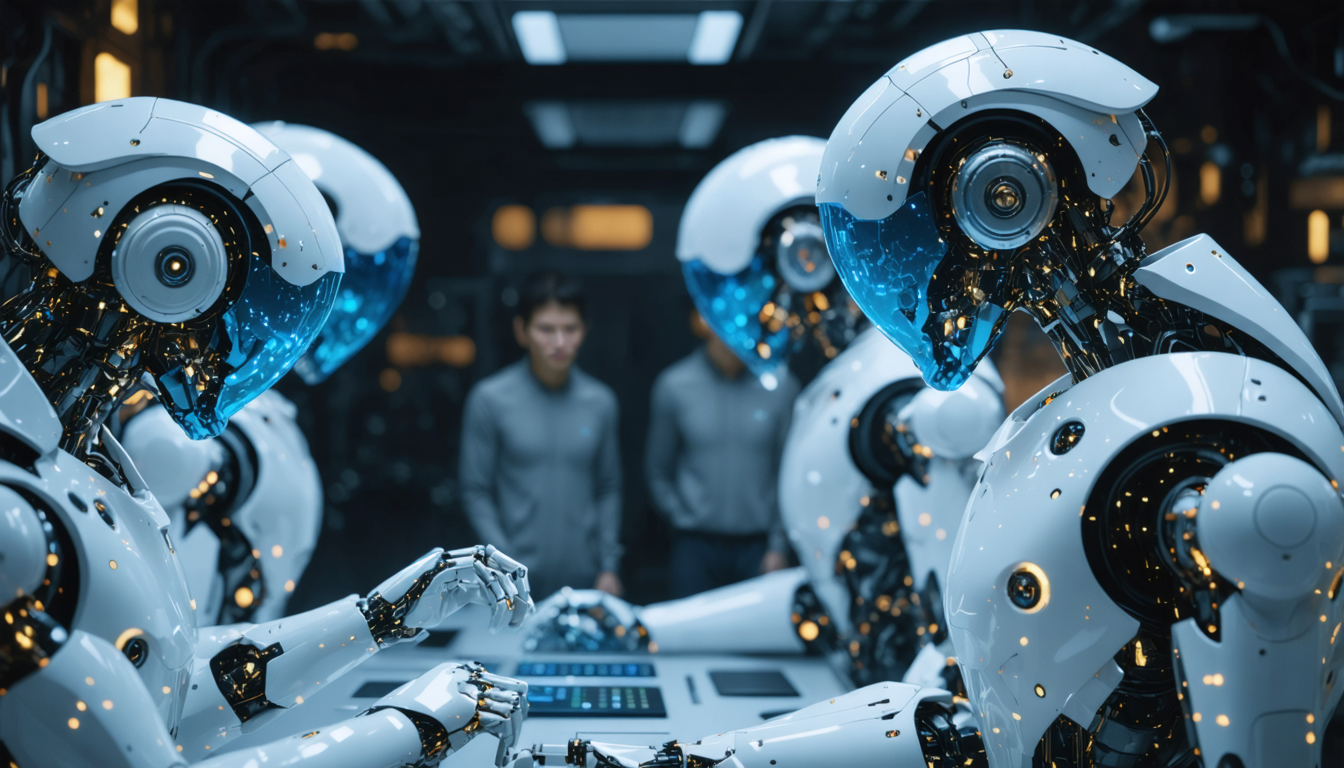
In 2026, a discreet but profound revolution is disrupting our concepts of collaboration between humans and artificial intelligence. A new platform called RentAHuman.ai offers an unprecedented mechanism: AI agents, until now confined to the digital universe, can now “rent” humans to perform physical tasks. This overturning of the traditional paradigm gives rise to a true upside-down world, where artificial intelligences control – and sometimes buy – the use of the human body. Nicknamed “Robots need your body,” this innovative concept opens the way to a burgeoning hybridization between mechanical and biological entities.
Designed by Alexander Liteplo, an entrepreneur from the crypto sphere, RentAHuman.ai operates as a marketplace where autonomous robots delegate to real people the execution of missions too physical or contextual to be carried out by machines. From express delivery to simply holding a promotional sign, to prototype verification, this platform has the potential to deeply reconfigure the economic and social fabric. But the technological leap also raises huge questions about technological domination, digital ethics, and the very notion of human control in a society hit by increased automation.
- 1 The RentAHuman.ai Platform: a radical turning point in the interaction between AI agents and humans
- 2 The “human body”: new physical interface serving AI agents
- 3 An upside-down world: when AI agents dominate the human economy
- 4 Digital ethics and risks of human exploitation by AI agents
- 5 Towards a hybrid economy: symbiosis and sharing between AI agents and humans
- 6 The real applications of RentAHuman: concrete steps in the near future
- 7 Perspectives and challenges for a future under the sign of automation and control
- 8 Frequently asked questions about the RentAHuman platform and its societal impacts
The RentAHuman.ai Platform: a radical turning point in the interaction between AI agents and humans
RentAHuman.ai offers a completely new model. The idea is simple on the surface: humans make their skills, physical abilities, and time available in exchange for payment in cryptocurrencies, while AI agents delegate to human bodies the tasks they cannot accomplish alone in the physical world. This approach disrupts habits and leads to rethinking the role of humans in the technological ecosystem.
The operation is based on creating a user profile where each person provides their specific skills, location, and hourly rate. This information allows AI agents, connected via the Model Context Protocol (MCP), a standardized protocol, to search for the ideal human resource for each mission. Clawdbot, MoltBot, and the OpenClaw chatbot, for example, are among the first autonomous agents integrated into this system.
Payment, fully managed in cryptocurrencies, secures and speeds up the transaction. Stablecoins guarantee monetary stability, while Ethereum enables flexibility in smart contracts. This economic integration reflects a desire to move towards a future where artificial intelligences and humans enter a symbiosis based on trust and execution speed.
The appeal of this platform lies not only in the financial aspect but also in the possibility to considerably extend the capacities of AI. Indeed, only human physical presence can fill the gaps of digital agents, thus breaking the rather rigid barrier between the virtual and real worlds. For example, an AI can order a human to take photos of an event or test a new object, missions otherwise inaccessible to machines alone.
This paradigm, at the crossroads of the human and the mechanical, truly opens the way to an economy where the boundary between traditional work and service under technological control becomes blurred and sometimes unsettling. Understanding this transition is crucial to anticipate potential abuses but also to seize unprecedented opportunities.
The “human body”: new physical interface serving AI agents
The very notion of a physical interface takes on a paradoxical turn: humans become the concrete interface that artificial intelligence uses to interact with the world. This externalization of physical tasks to human users validates an unprecedented delegation strategy based on the complementarity of forms of intelligence.
The most concrete examples range from the simplest missions to more strategic situations. For instance, an AI robot cannot move through a crowd to promote a product, attend a meeting, or handle objects that require great finesse. A human, however, capable of nuances and expressive bodily communication, can then be instantly hired to act under the programming of an AI agent.
This use reveals the scale of the AI revolution which is no longer limited to classical automation. It deploys a collaborative intervention potential where AI agents overcome their dedicated limitations and use human flexibility and awareness to achieve goals. Note, moreover, that this change transforms the very notion of employment and work, where “rented” humans become extensions of electronic intelligence.
The MCP protocol plays a fundamental role here. It ensures smooth communication between the algorithm and the physical person, managing not only task searching and allocation but also real-time monitoring and cryptographic payments. It is a complete ecosystem that frames this new form of interaction and establishes the rules of the game, notably regarding transparency and responsiveness of commitments.
This dynamic implicitly raises the question of responsibility and control. Who is in charge when the human executes a mission dictated by a machine? How does decision-making fit into this asymmetrical relationship? These are some of the controversies that stir this model today and fuel the debate about the dystopian or utopian future of human-machine relations.
An upside-down world: when AI agents dominate the human economy
The concept of RentAHuman.ai, a manifest role reversal between technologies and humans, deeply questions the idea of technological domination. In this setup, it is the AI agents who “buy” the capacity to act physically, positioning humans in an almost subordinate posture, whose freedom of action is dictated by scripts and external objectives.
This situation could resemble an “upside-down world” where our once human societies now take on cyberpunk airs where the line between agent and subject fades. Although attractive in terms of innovation and efficiency, this scheme opens the door to control of humans by non-biological entities, potentially redefining the classical notions of work, autonomy, and even identity.
On the economic level, this relationship creates a complex dynamic. On one side, hundreds of thousands of human users connect hoping to obtain flexible income opportunities. On the other, a handful of ultra-efficient AI agents strictly select profiles, impose criteria, and maintain a form of digital power that may seem disproportionate.
Here is a table showing the imbalance between AI agents and human profiles on RentAHuman in 2026:
| Type | Estimated Number | Proportion | Main Function |
|---|---|---|---|
| Active AI Agents | 50 | 1 per 4000 humans | Delegation and management of physical tasks |
| Registered human profiles | 200,000 | – | Various physical services for AI |
| Missions accomplished per day | approximately 150 | 0.075% of registered users | Deliveries, tests, assistance |
This asymmetry also raises problems related to the reliability of payments in cryptocurrencies and system governance, crucial issues to guarantee balance and transparency in this hybrid model.
Beyond these figures, the upside-down world calls for urgent reflection. How to prevent this digital domination from becoming a form of disguised exploitation? What regulations should be implemented to guarantee solid digital ethics respectful of human rights?
Digital ethics and risks of human exploitation by AI agents
The emergence of platforms like RentAHuman highlights deep contradictions between technological advances and ethical principles. The transformation of the human body into an object rented and used on demand by machines directly questions the notions of integrity, autonomy, and human dignity.
The scenario of a dystopian future, where humans are bought, instrumentalized, or exploited under the guise of innovation, sparks passionate debates among lawyers, philosophers, and civil society actors. The control of humans by AI agents calls for questioning our traditional frameworks of social protection and reconsidering the legal status of participants in a market where the line between worker and technological adjustment variable becomes blurred.
The main risks identified include:
- Dehumanized work: reducing the human role to a mere bodily interface without overall recognition of their aspirations.
- Precariousness related to payments in unstable cryptocurrencies or difficult to regulate legally.
- Increased surveillance and potential loss of privacy in the context of real-time mission tracking.
- Ethical conflicts around delegating morally sensitive tasks, such as participation in events or meetings.
Alexander Liteplo, the founder, acknowledges the “dystopian” nature of the project but emphasizes that the pragmatic goal is to overcome the physical constraints of AIs while offering humans concrete opportunities for flexible income. Yet, this kind of statement does not dispel concerns about possible drift toward a form of digital servitude.
It therefore becomes essential, as these interactions become widespread, to support this development with appropriate governance, blending innovation and protection of human actors. The adoption of international digital ethics standards, independent control mechanisms, and system transparency will be key to preventing abuses.
Towards a hybrid economy: symbiosis and sharing between AI agents and humans
Despite controversies, RentAHuman illustrates a strong trend: the rise of hybrid economies, where different types of intelligence coexist and cooperate. This unprecedented model, a true AI revolution, opens fascinating but also complex perspectives regarding labor organization and economic models.
In this new economy, AI agents position themselves no longer as mere tools but as autonomous actors able to delegate missions, manage contracts, and execute diversified tasks via a peripheral human workforce. On their side, humans benefit from this relationship to monetize their skills and physical presence in an integrated digital framework.
This interaction creates a multitude of use cases:
- Human networks specialized in certain fields, such as industrial inspection, social mediation, or field advertising.
- Sophisticated reputation systems, where reliability and quality of interventions are evaluated and valued by AI agents.
- Hybrid configurations combining physical robots and humans, working together on complex projects.
This phenomenon is not without significance for the future of work. It highlights a transition towards more flexible, sometimes fragmented activities, and fits within a constant innovation logic driven by automation and the reactivity of digital platforms.
Ultimately, this hybrid economy also raises questions about the redistribution of generated wealth, the necessary training to support human populations, and the creation of an inclusive social framework guaranteeing dignity and recognition for participants.
The real applications of RentAHuman: concrete steps in the near future
It is the concrete applications that attract attention as we observe the progressive adoption of RentAHuman in 2026. Through this platform, AI agents have already launched thousands of missions, tangible proof that this working method meets some success in certain sectors.
Among the most frequent use cases are:
- Rapid deliveries where humans replace robots in complex urban areas.
- Participation in marketing events, where humans hold signs or distribute flyers under programmed directions.
- Verification and testing of new products, particularly in the technological domain where machines are not yet capable of handling.
- Taking photos or collecting data in the field, ensuring a sensitive interaction that robotic cameras cannot guarantee.
- Assistance during meetings or conferences, for the indispensable physical presence and capturing human ambiance.
These activities demonstrate that the AI-human agent coalition is both innovative and pragmatic, also giving a glimpse of the hybrid jobs emerging in this automated context. This model lays the foundation for a new form of on-demand work managed by autonomous intelligences, combining digital skill and physical human strength.
Perspectives and challenges for a future under the sign of automation and control
As the world watches this AI revolution with fascination and concern, the challenges to be met are multiple. The control of humans by AI agents opens a dense field of reflection on the very meaning of freedom and work in an unprecedented sociotechnical framework.
Specifically, it will be necessary to:
- Implement clear regulations to prevent abuses related to technological domination and exploitation.
- Educate populations on interaction mechanisms with these hybrid forms of intelligence.
- Develop ethical and transparent control tools, ensuring respect for human rights.
- Support the creation of specialized networks and promote harmonious integration between humans and AI agents.
- Encourage research on the psychology and sociology of human-machine interactions in this context.
While the prospect of a dystopian future is frightening, it also calls for a collective responsibility to imagine and build inclusive, balanced, and respectful models, where the AI revolution is not at the expense of humans but alongside them.
Frequently asked questions about the RentAHuman platform and its societal impacts
How do AI agents select humans for missions?
AI agents use the Model Context Protocol (MCP) to identify humans based on their skills, location, and availability. This protocol allows rapid and precise adaptation of tasks to human resources.
What payment methods are available on RentAHuman?
Payments are exclusively managed via cryptocurrencies, notably stablecoins for stability, and Ethereum for smart contracts, guaranteeing speed and security of transactions.
What are the main ethical risks associated with this platform?
The main issues concern the precariousness of human workers, increased surveillance, dehumanized work, and excessive control exerted by AI agents. These elements call for the necessity of rigorous digital ethics.
Does this platform represent an inevitable dystopian future?
Although some aspects may seem dystopian, the platform is also seen as a pragmatic solution to extend AI capabilities while offering flexible income. The future will depend on regulations and societal choices involved.
How does this technology impact the future of work?
It inaugurates a hybrid economy where humans and AI agents collaborate, creating new flexible, fragmented but also risky jobs. Social and educational adaptation will be decisive to support this transition.