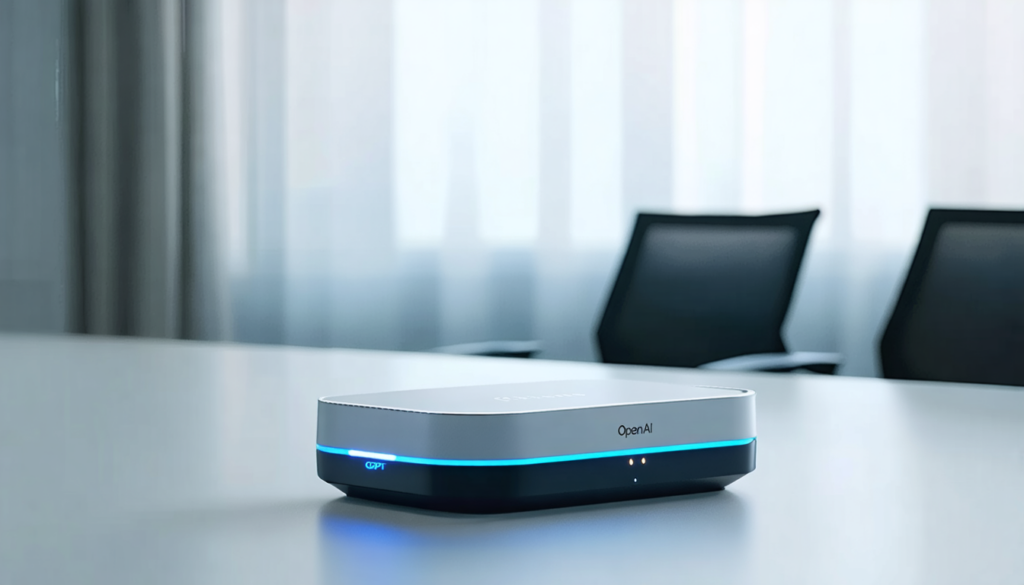
OpenAI, a pioneer in artificial intelligence, is about to take a major new step by unveiling its first physical device integrating ChatGPT, far beyond the simple text interface that made it famous. This innovation aims to radically transform the way we interact with virtual assistants, putting audio and voice recognition at the heart of the experience. With the strategic acquisition of the start-up founded by Jony Ive, former iconic designer of Apple, OpenAI is now directing its efforts towards more discreet technologies, less dependent on screens, and deeply integrated into our daily lives. This shift to a dedicated device propels ChatGPT into a new dimension, where voice becomes the main vector of exchange, opening the way to unprecedented uses.
This new device, whose release is expected at the end of 2026 or the beginning of 2027, also marks a profound overhaul of ChatGPT’s voice models. Audio processing will be redesigned to offer improved naturalness and expressiveness, enabling smoother and more dynamic conversations, close to human dialogue. OpenAI is betting on this feature to rethink not only its product but also the very relationship users maintain with artificial intelligence, in a technological context where screen saturation challenges our digital habits.
- 1 OpenAI and ChatGPT: the birth of a revolutionary voice-centered device
- 2 Technological innovations and Jony Ive’s involvement in the design of the OpenAI device
- 3 Revolution in ChatGPT’s voice model: towards a more human artificial intelligence
- 4 An ecosystem of smart products around the first OpenAI device
- 5 The expected launch and implications for the virtual assistant market
- 6 Why voice is establishing itself as the future of interaction with smart devices
- 7 The importance of balancing technological innovation and respect for privacy
OpenAI and ChatGPT: the birth of a revolutionary voice-centered device
The shift that OpenAI is about to take is one of the most significant developments in the field of consumer artificial intelligence since the very emergence of ChatGPT. Indeed, while the company was until now mostly recognized for its high-performance language models primarily used via text interfaces, it is now redirecting its strategy towards the audio pillar. This transformation is visible in the complete reorganization of the technical teams that took place recently: engineering, product, and research work hand in hand to accelerate the development of voice technologies.
This priority given to audio reveals a clear ambition. OpenAI seeks to overcome the classic limitations of current voice assistants by offering a more natural interaction, more sensitive to conversational nuances. For example, the future device will be able to simultaneously manage the speech of the user and its own, understand spontaneous interruptions, and handle overlapping exchanges – weak points usually encountered with Alexa, Siri, or Google Assistant, which struggle to offer fluid conversation without cognitive interruption.
In this context, ChatGPT becomes a true “living” virtual assistant, capable of anticipating, reacting in real time, and above all placing the user at the center of the experience. This evolution is not just technical but profoundly cultural, as it invites rethinking the place of AI in our daily interactions, moving from a passive machine to an almost human presence that understands and adapts to our needs.

Technological innovations and Jony Ive’s involvement in the design of the OpenAI device
The acquisition of the start-up io Products, founded by Jony Ive, former iconic Apple designer, represents a major turning point in the design of OpenAI’s device. This operation, valued at around 6.5 billion dollars, reflects the company’s desire to combine technological power and aesthetic excellence to create a product that is both high-performance and discreet.
Jony Ive, known for having designed some of Apple’s most iconic devices, brings his expertise here to imagine innovative and less intrusive formats. The explored avenues evoke a minimalist device, worn discreetly, which could for example take the form of a high-tech necklace equipped with cameras and sensors, or a smart speaker without a screen, perfectly integrated into the living environment. This approach reflects a strong desire to reduce dependence on ubiquitous screens and minimize the impact of technologies in daily life, without giving up their advanced functionalities.
This design philosophy also fits into the broader industry trend of promoting less invasive objects, more focused on the essentials, and which better respect the user’s privacy and well-being. The partnership between OpenAI and Ive reflects this ambition to push the limits of technology to build a more human, intuitive, and aesthetic experience. The future connected device will therefore be less of a gadget than a true intelligent companion, ready to accompany every moment of the day.
Envisioned features of the OpenAI device
- Advanced audio functionality: smooth and natural conversations, managing interruptions and simultaneous exchanges.
- Minimalist and portable design: discreet shape, wearable daily without discomfort.
- Interconnection with an ecosystem: future network of OpenAI devices designed for a coherent experience.
- Support for next-generation language models: integrated ChatGPT version 9a for better accuracy and expressiveness.
Revolution in ChatGPT’s voice model: towards a more human artificial intelligence
Until now, ChatGPT was mostly known for its precise and rich text interactions. However, the next major version, planned by the end of the first quarter of 2026, will offer a radically redesigned voice model. This new system incorporates a completely renovated architecture, specially optimized for audio. The goal: to deliver a more natural, expressive voice, capable of sustained and smooth dialogues, like a real human conversation.
Thanks to these advances, ChatGPT will be able to simultaneously listen and speak at the same time as the user, manage interruptions with ease, and even understand overlapping audio exchanges, which is often problematic with other voice assistants. This ability opens the door to a more dynamic and spontaneous conversational experience, reducing frustration linked to choppy responses or dead times.
This major evolution is the result of significant investments in research applied to conversational artificial intelligence. OpenAI also integrates real-time contextual understanding mechanisms, improving the relevance and coherence of responses. The impact on the user is twofold: better voice recognition and an interaction that feels more authentic, thus creating a stronger bond between machine and human.
Concrete example: imagine a user talking to their OpenAI assistant while preparing a meal. The voice model understands that they want to change the subject by interrupting an explanation and can respond immediately without interruption, giving the impression of a natural, smooth dialogue without delay.
These innovations place OpenAI at the forefront of voice artificial intelligence, offering a virtual assistant that surpasses the limitations inherited from previous generations.
An ecosystem of smart products around the first OpenAI device
The first physical device signed OpenAI will not be a simple isolated gadget, but the entry point of a true ecosystem of connected innovations. Several concepts are already being discussed internally to enrich the user experience and offer different forms of intelligent assistants, adapted to various uses and contexts.
Among the envisaged options, we find notably:
- Smart connected glasses serving as a discreet interface to access ChatGPT by voice, while offering light visual contextual assistance.
- Body-worn devices – such as a high-tech necklace – integrating sensors and cameras to better understand the environment and anticipate user needs without requiring a screen.
- Screenless smart speakers designed for living spaces, offering quick and natural access to ChatGPT, with a strong focus on sound quality and interaction quality.
This diversity reflects OpenAI’s strategy to offer multiple experiences, centered on voice and the discreet presence of artificial intelligence, with a concern for digital sobriety, a growing concern for consumers and experts.
The table below summarizes the main expected features of OpenAI’s future devices:
| Device | Main feature | Design | Target audience |
|---|---|---|---|
| High-tech necklace | Voice interaction, discreet image capture | Minimalist and portable | Mobile and urban users |
| Connected glasses | Voice and visual assistance | Light and ergonomic design | Professionals and creatives |
| Smart speaker | High-quality voice assistants without a screen | Simple design, home integration | Home use |

The expected launch and implications for the virtual assistant market
OpenAI’s shift to a dedicated physical device marks a key moment in the technological landscape. Until now, players like Apple, Amazon, or Google dominated the voice assistant segment through their hardware and software ecosystems. With this new product, OpenAI aims to redefine standards, betting on the performance of its artificial intelligence models and a renewed user experience.
This launch thus marks:
- A new era for virtual assistants: shifting towards rich and frictionless voice interaction, OpenAI’s product promises to disrupt uses by creating a more natural dialogue.
- A significant reduction in dependence on screens, fitting into a trend towards digital sobriety and technological well-being.
- A strong boost for the audio interface sector, which until now struggled to evolve compared to text and image.
- A major competitive challenge for industry giants, forced to adopt or integrate these innovations to stay relevant.
The implications of this launch will therefore go beyond the device itself. It could well redefine how millions of users approach their relationship with artificial intelligence, while stimulating technological innovation in the sector.
Why voice is establishing itself as the future of interaction with smart devices
The trend toward voice as the preferred interface is not new, but it is experiencing a revival, notably thanks to OpenAI’s advances and the increasing performance of language models. Unlike tactile or visual interactions, voice allows a more immediate, natural, and contextual exchange.
In 2026, several factors explain this renewed interest:
- Screen saturation in daily life, causing visual fatigue and fragmentation of attention.
- The need for more discreet technology, capable of adapting rather than monopolizing attention, as advocated by the design of the new OpenAI device.
- Improvements in voice models, which now allow much finer and more expressive linguistic comprehension and production.
- The desire for accessibility, making interfaces more intuitive for all ages and profiles, including people with disabilities.
Voice as a channel of interaction is thus establishing itself as a way to reconnect with technology in a more human, attentive, and adaptive manner. The next generation of OpenAI devices perfectly illustrates this promising future.
The importance of balancing technological innovation and respect for privacy
While the first OpenAI device marks a spectacular technological advance, it also raises crucial questions about privacy and personal data management. Indeed, voice technologies capture and analyze a continuous flow of information, which requires robust security and confidentiality mechanisms.
OpenAI is aware of these challenges, especially since a collective awareness about data protection has emerged in recent years. The device’s design integrates several features intended to ensure full user control:
- Options for managing voice data allowing users to choose what is stored or shared with servers.
- Preferential local processing for certain interactions, limiting exchanges with the cloud.
- Advanced encryption of transmissions to guarantee confidentiality of exchanges.
- Transparency regarding the use of data and algorithms employed, with regular updates.
These measures aim to establish an essential climate of trust to encourage massive adoption of the new product. They reflect OpenAI’s commitment to combine innovation and responsibility, which could become a model for the entire technology industry.