
While the business world has been multiplying investments in artificial intelligence technologies for several years, 2026 seems to be the decisive year when the real impact of this innovation could finally manifest. After a period of constant experimentation and often disappointing promises, signals converge towards a more mature and strategic adoption of AI tools. This transition is accompanied by a profound digital transformation, marked by increased automation and an evolution of working methods. Investors, business leaders, and industry specialists expect from this “pivotal year” a true revolution enabling the achievement of the much-anticipated productivity gains, while renewing uses and economic models in a future economy.
At the heart of this dynamic, artificial intelligence technology continues to evolve to adapt to the specific needs of organizations. This evolution is driven by major innovations that make it possible to integrate intelligent agents into business processes, consolidate the most effective solutions, and better master specialized models. This technological advancement not only improves the reliability and relevance of projections but also surpasses the initial limits associated with AI adoption in environments that are often complex and highly regulated.
Exploring the prospects of 2026, it is crucial to understand how this year represents a strategic crossroads where artificial intelligence could finally become a decisive lever for business growth. Thus, this period is conducive to reflection on the evolution of investments, the transformation of operational models, and how this digital revolution is redefining the contours of competitiveness and innovation across all sectors.
- 1 The shift in investments in artificial intelligence: a strategic concentration in 2026
- 2 How artificial intelligence accelerates digital transformation in business
- 3 2026: the pivotal year for conquering productivity through AI
- 4 The emergence of intelligent agents: the new frontier of AI in business
- 5 Radical innovations reshaping the technological future of businesses
- 6 Human challenges at the heart of the technological revolution in business
- 7 Ethical and regulatory challenges in the massive adoption of AI in business
- 8 The future of artificial intelligence in businesses: towards sustainable and strategic integration
The shift in investments in artificial intelligence: a strategic concentration in 2026
For several years, billions of euros have been invested in artificial intelligence tools intended to transform the daily work of companies. However, results have often fallen short of expectations, with a majority of organizations only seeing marginal productivity gains. A recent MIT study reveals that nearly 95% of companies use AI solutions that bring them little or no tangible return on investment. This observation highlights the need for a rationalization of approaches and better selection of adopted technologies.
2026 marks a major turning point, where investors are becoming increasingly demanding and selective, refocusing their funding on truly effective tools. This concentration comes with a budget reorientation, favoring technologies that best meet the specific needs of companies rather than multiplying often scattered pilot projects. According to Rajeev Dham of Sapphire, this trend signals a decisive shift towards an “AI-First strategy” that values return on investment and sustainable value creation, rather than mere experimentation.
This new investment phase rests on several key pillars:
- Supplier consolidation: Companies now prioritize technological partners capable of offering complete expertise and integrated solutions, facilitating the management and performance of AI tools.
- Customized and supervised models: The focus is on specialized models, configured to address the specific business particularities of each organization, with increased supervision to ensure reliability and compliance.
- Optimization of human resources: There is an ongoing shift of labor costs toward automation by AI, enabling maximized efficiency while redefining employee roles.
- Focus on strategic solutions: Investments now target tools offering proven competitive advantages, fostering differentiation in the market.
This dynamic shows an accelerated maturation of the AI ecosystem, which will begin to deliver concrete and measurable economic results. Companies able to leverage this strategic concentration of investments will gain a lasting advantage for their digital transformation and competitiveness.

How artificial intelligence accelerates digital transformation in business
Digital transformation is now inseparable from any modern development strategy. Artificial intelligence occupies a central place in this revolution by offering unparalleled analysis, automation, and interaction capabilities. In 2026, companies are crossing a key milestone by integrating AI not only as a one-time tool but as a true driving force behind their processes and strategic decisions.
This deep integration manifests in several areas:
Intelligent automation and productivity improvement
Automation is no longer limited to simple task repetition. Thanks to intelligent agents capable of learning, adapting, and interacting with users, companies optimize their workflows smoothly. These agents intervene in resource management, predictive maintenance, CRM, and data management, freeing employees from low value-added tasks.
Concrete examples of innovation in business
In the banking sector, for example, some institutions have deployed sophisticated chatbots capable of handling complex cases and offering personalized advice in real-time. In industry, predictive analytics platforms detect anomalies before they cause production stoppages, thus significantly reducing costs.
But innovation goes further, with AI models integrated into the decision chain. These systems analyze a large volume of data to anticipate market trends, thus adapting commercial and marketing strategies in real-time dynamics. This illustrates a digital transformation amplified by AI tools fostering a more agile and responsive organization.
This integration does not come without challenges. Data sovereignty management, infrastructure security, and adaptation of human resources are factors requiring constant attention. The success of this transformation will therefore depend as much on technology as on companies’ ability to support cultural and organizational change.
2026: the pivotal year for conquering productivity through AI
Despite massive investments made since the advent of tools like ChatGPT, most companies have not yet seen their productivity truly take off thanks to artificial intelligence. However, 2026 could represent a decisive milestone in this quest for operational gains.
An in-depth study reveals that companies are finally starting to benefit from significant returns on investment, mainly because:
- Solution rationalization: Companies avoid multiplying pilot projects and focus on already proven technologies.
- AI model maturation: These models gain relevance and reliability, particularly in specialized applications.
- Improved supervision: Strengthened human oversight ensures that tools integrate perfectly into business processes without negatively impacting quality.
- Skills development: Internal teams are increasingly trained to use AI as a lever and not merely as a gadget.
Operational benefits generate not only better time management but also a notable improvement in the quality of services and products delivered. For example, in customer relations, AI tools anticipate needs and personalize interactions on a previously impossible scale.
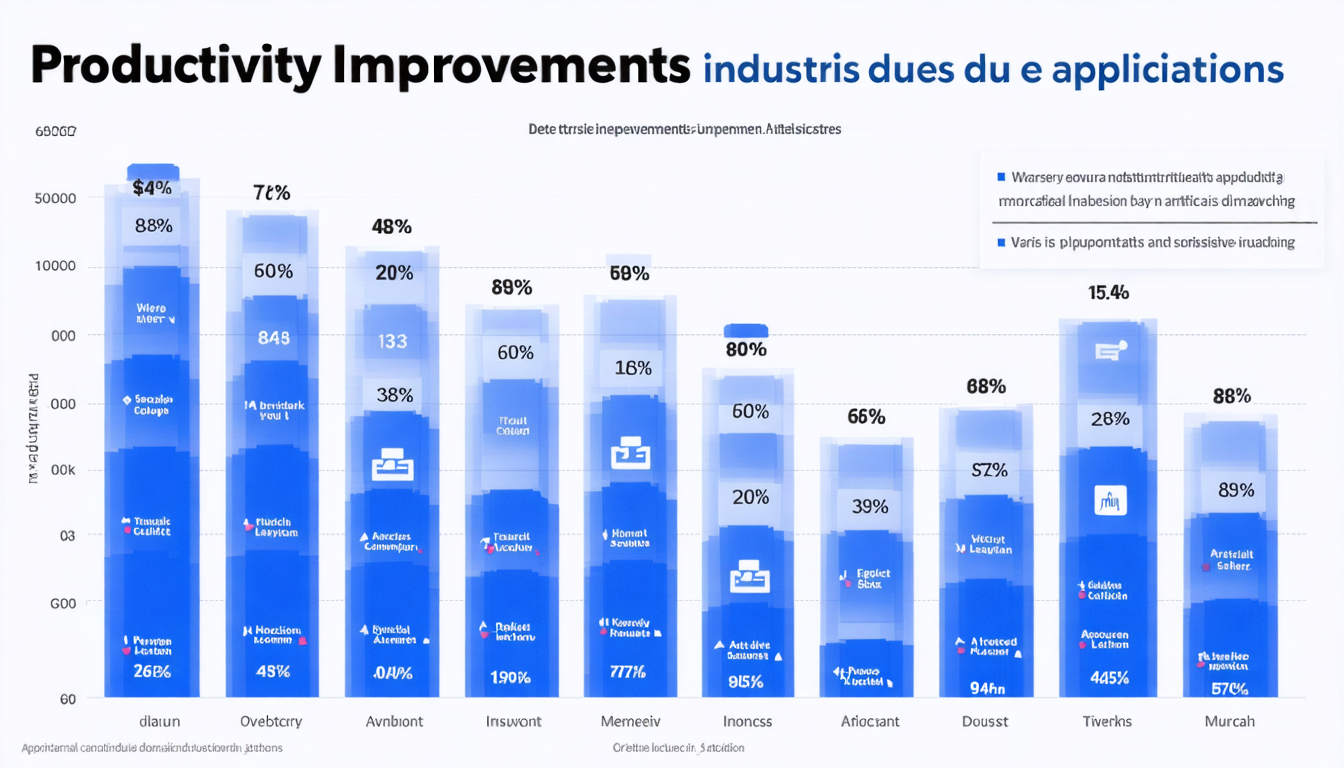
To illustrate this progress, here is a comparative table of results before and after adopting intelligent agents across different industries:
| Sector | Productivity before AI | Productivity after AI | Gains in % | Impact on quality |
|---|---|---|---|---|
| Finance | 75% | 90% | +20% | Notable improvement |
| Manufacturing industry | 65% | 85% | +31% | Defect reduction |
| Customer service | 70% | 88% | +25% | Increased personalization |
| Logistics | 60% | 82% | +37% | Optimization of deadlines |
These figures demonstrate the progressive ability of artificial intelligence to transform operational performance and open the way to a future where continuous process optimization will be the norm.
Remaining challenges to overcome
Despite this legitimate enthusiasm, some companies still struggle to cross the threshold. The reasons are multiple: complex integration, resistance to change, lack of expertise, or fear of human disruption. These challenges call for a pragmatic approach where technology adapts to humans and not the other way around. Success at this stage is crucial for artificial intelligence to become a true driver of digital transformation tailored to each organization.
The emergence of intelligent agents: the new frontier of AI in business
One of the major innovations of 2026 concerns the development of intelligent agents capable of interacting autonomously and collaboratively with knowledge workers. These agents, endowed with shared memory and a natural interface, promise a revolution in how teams approach their daily tasks.
These agents no longer just execute precise commands; they anticipate, propose solutions, learn from previous interactions, and collaborate with humans to increase their efficiency. This symbiosis marks a significant evolution in the human-machine relationship.
For example, in a consulting firm, an intelligent agent can simultaneously collect and analyze a large amount of client data, provide personalized recommendations, and automatically adjust reports based on consultant feedback. It thus becomes a true “AI colleague” facilitating work and improving the quality of deliverables.
This trend meets the expectations expressed by many investors and experts who see in these universal agents the key to organizational decompartmentalization and the enhancement of human talents. The gradual adoption of these tools is already underway, with applications in finance, healthcare, logistics, and many other sectors.
Radical innovations reshaping the technological future of businesses
Beyond improvements to existing tools, 2026 also marks the emergence of radical innovations that promise to disrupt the entrepreneurial technological landscape. These innovations are based on advances in voice intelligence, quantum computing, and predictive systems, offering unprecedented prospects for infrastructure management, industrial production, and environmental monitoring.
For example, the integration of voice intelligence as the primary interaction mode facilitates more natural and expressive communication between users and systems. Marcie Vu of Greycroft emphasizes that this saves time and improves accessibility, especially for mobile workers or those in multitasking environments.
Quantum computing is also becoming concrete with realistic roadmaps enabling some companies to plan their mid-term integration. This technology paves the way for exponential computing capabilities essential for processing ever-larger and more complex data sets.
Finally, predictive systems play a crucial role in proactive maintenance, production process optimization, or intelligent natural resource management, contributing to better sustainability and reduced operational risks.
These innovations are destined to become essential components of companies’ digital infrastructures, reinforcing the integration of artificial intelligence into all aspects of professional life.
Human challenges at the heart of the technological revolution in business
While technology evolves rapidly, the success of this digital transformation fundamentally depends on the men and women implementing it. Skills development, acceptance of new tools, and redefinition of roles are unavoidable issues.
Antonia Dean of Black Operator Ventures warns against using AI as a mere Band-Aid to reduce errors or compensate for organizational weaknesses. To overcome this pitfall, it is necessary to encourage an innovation culture where collaboration between humans and “AI colleagues” is optimized and respectful.
This also implies a significant effort in continuous training, change management support, and gradual integration of technologies into business processes. Many cases show that the most successful organizations are those combining technological power with adapted human management, thus valuing the creative and strategic potential of teams.
Moreover, this coexistence between artificial intelligence and human collaborators opens the door to new forms of work, more agile and focused on solving complex problems, leaving repetitive and analytical tasks to machines.

Ethical and regulatory challenges in the massive adoption of AI in business
The artificial intelligence revolution does not proceed without raising crucial ethical, privacy, and regulatory questions. In 2026, as adoption accelerates, companies must navigate an evolving legal framework while ensuring responsible use of these technologies.
Data sovereignty remains a major issue, especially in strictly regulated sectors such as finance, healthcare, or public services. Implementing reliable AI involves not only securing this data but also guaranteeing algorithm transparency and auditability.
Issues of algorithmic bias and fairness are also central to debates. Ensuring that AI-assisted decisions do not reproduce or amplify discrimination is an essential objective to maintain the trust of clients, partners, and employees.
Regulators themselves are adapting their frameworks to support this revolution, with guidelines encouraging ethical and responsible use. Companies expected to massively adopt AI must integrate these principles into their governance to limit legal and reputational risks.
The future of artificial intelligence in businesses: towards sustainable and strategic integration
While 2026 is seen as the pivotal year for AI to finally revolutionize the business world, this transformation can only be effective if it is conceived in the long term. Beyond immediate gains, it is about integrating artificial intelligence into a comprehensive strategy of continuous innovation, focused on the customer and value creation.
The most dynamic startups succeed in identifying specific weaknesses in AI-driven workflows and work to optimize this product-market fit. This detailed understanding is essential to ensure customer loyalty and the sustainable development of solutions.
Beyond the technological aspect, it is rigorous execution, commercial traction, and the ability to attract top talent that will make the difference. These companies represent a model to follow for those – big or small – who wish to join this new era where artificial intelligence will be a fundamental lever of competitiveness.
The coming months will reveal the first significant successes resulting from this transition, laying the groundwork for a future where technology, humans, and strategy converge to reinvent the entrepreneurial world.