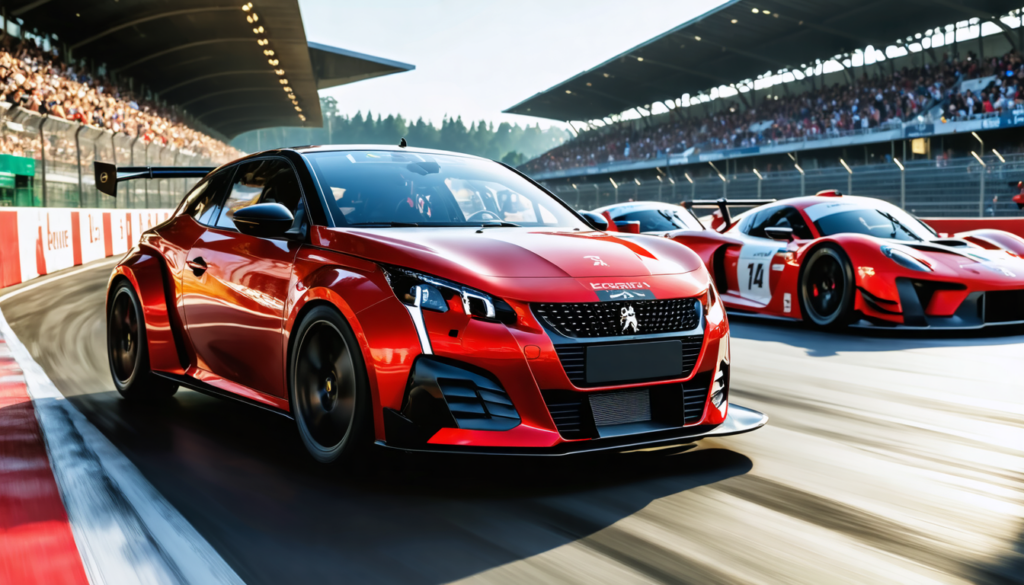
At the heart of a weekend dominated by the fervor of the 24 Hours of Le Mans, a city car managed to capture attention far beyond what many would have imagined. The Peugeot E-208 GTI, a compact and sporty electric vehicle, took the spotlight in an almost paradoxical way compared to the giants of motorsport competition such as the Peugeot 9X8. This silent and modern racer, proud heir to the legendary GTI badge, stood out not only for its performance but also for its ability to attract an audience as passionate as that drawn by the endurance race. Without taking part in the race, the little lioness imposed her presence and style, becoming a true unexpected star in the circuit village. Its bold design, powerful electric powertrain, and close ties to Peugeot’s sporting history thrilled enthusiasts and experts alike, marking a form of electric rebirth in the sporty automotive landscape. Thus, the Peugeot E-208 GTI is no longer just another electric model; it symbolizes a new era where driving pleasure combines with technological innovation and the preservation of the GTI spirit.
- 1 Peugeot E-208 GTI: an unexpected star that redefined attention at Le Mans
- 2 Return of the GTI badge: an electric rebirth for an automotive myth
- 3 Peugeot Sport and the challenge of electric dynamics with the E-208 GTI
- 4 An upcoming electric competition: rivalry between Peugeot and Lancia
- 5 Le Mans 2025: an exceptional showcase for the Peugeot E-208 GTI
Peugeot E-208 GTI: an unexpected star that redefined attention at Le Mans
During the prestigious 24 Hours of Le Mans event, the on-track duel between the Peugeot 9X8 and their competitors kept motorsport fans on edge. However, in the shadow of these endurance racers, a new star appeared in the circuit village: the Peugeot E-208 GTI. This electric vehicle, although absent from the race, presented itself with a presence capable of diverting the gaze of regulars and the media, breaking the usual codes of attention given to racing cars.
Unlike the 9X8, whose performance is judged by lap time and endurance tenacity on the track, the E-208 GTI seduces through its accessible approach and expressive design. Its positioning in the village, just steps away from the pits, encouraged interactions. Visitors were able to discover this sporty city car from every angle, appreciating the aesthetic and technical details it offers. This positioning made the E-208 GTI an object of curiosity, a style and innovation icon within a universe traditionally dedicated to raw performance and endurance.
Its impact at Le Mans is also explained by the symbolism it carries. The Peugeot E-208 GTI revives a mythical badge that marked the history of French compact sports cars. In an automotive world where electrification is overtaking thermal engines, this model offers a new vision combining environmental respect, advanced technologies, and driving pleasure. The enthusiasm it generates is thus a strong sign of evolution in the very perception of motorsport competition and the expectations of enthusiasts.
- Accessibility: The E-208 GTI is a car you could encounter and drive daily, far from the elitist aspect of endurance prototypes.
- Attractive design: Its sculpted lines and lowered stance ensure a captivating look, revealing a strong sporty identity.
- Historical symbol: The resurrection of the GTI badge, 41 years after the legendary 205 GTI, revives the brand’s spirit.
- Electric technology: The adoption of a high-performance electric powertrain fits into a forward-looking approach for sports cars.
- Interaction with the public: Positioned in a strategic location, the E-208 GTI was able to engage directly with visitors, reinforcing its impact.
| Aspect | Peugeot E-208 GTI | Peugeot 9X8 |
|---|---|---|
| Type | Sporty electric city car | Endurance prototypes |
| Power | 280 hp | Over 500 hp (combined thermal + electric engines) |
| Use | Road and daily driving pleasure | Endurance racing |
| Range | 350 km (54 kWh battery) | N/A (pit-stop charging) |
| Target audience | Enthusiasts and general public | Motorsport fans |
Return of the GTI badge: an electric rebirth for an automotive myth
The GTI label has always evoked sportiness, agility, and a fiery character in Peugeot’s automotive history, particularly with the 205 GTI, an icon of the 1980s. The introduction of the Peugeot E-208 GTI marks a turning point not only by bringing back the badge into the Peugeot range but also by its opening towards a 100% electric powertrain. This bold choice illustrates the brand’s ability to reinvent its symbols to meet current and future requirements.
The mechanics of the E-208 GTI share components with other Stellantis electric vehicles, such as the Abarth 600e or the Alfa Romeo Junior Elettrica Veloce, demonstrating technical synergy within the group. Equipped with an engine delivering 280 horsepower and 345 Nm of torque, it ensures performance worthy of a modern sporty city car. The 54 kWh battery guarantees a satisfactory range of 350 km, suited to daily trips and even some longer getaways.
The mechanical differential on the front axle, a technical point often overlooked in electric vehicles, demonstrates Peugeot Sport’s commitment to offering a precise and dynamic driving experience. This attention to traction control allows efficient management of the high torque delivered by the electric motor, avoiding excessive understeer and optimizing behavior on winding or slippery roads.
- Controlled power: 280 hp, ideal for a compromise between sportiness and range.
- Cutting-edge technology: Mechanical differential for better road holding.
- Competitive range: 350 km, adapted for daily use.
- Technical convergence: Sharing engines with other Stellantis models, guaranteeing reliability.
- Eco-responsibility: Transition to electric in a traditionally sporty segment.
| Characteristic | E-208 GTI Value | Implication |
|---|---|---|
| Electric motor | 280 hp and 345 Nm | Performance and responsiveness |
| Battery | 54 kWh | Sufficient range for daily use |
| Mechanical differential | Present on the front axle | Better traction and handling |
| Top speed | About 230 km/h | Compromise between performance and safety |
| Weight | About 1,570 kg | Stability and dynamism on the road |
Peugeot Sport and the challenge of electric dynamics with the E-208 GTI
The transition to electric raises challenges for GTI model regulars, known for their lively character and authentic driving pleasure. Peugeot Sport worked to design the E-208 GTI while preserving this DNA and adapting it to the constraints of a powerful electric powertrain. Engineers had to work on managing the instant torque to offer a controlled experience without losing the aggressiveness essential to the GTI badge.
Driving a high-performance electric car on uneven road surfaces can reveal limits, especially in managing the front axle. The E-208 GTI, thanks to its mechanical differential, aims to harness this power precisely, but initial impressions indicate that a certain mastery will be required from the driver, who will sometimes have to compensate for sharp reactions, especially on bumpy roads.
- Torque control: Delicate work on electronics and mechanics to channel the power.
- Sharpened chassis: Expertise from Peugeot Sport to ensure uncompromising dynamic behavior.
- Road behavior: Suited to liveliness but requires good handling skills.
- Comparison to thermal GTIs: A challenge to preserve the sporty essence despite the electric powertrain.
- Focus on the driver experience: Sensations and pleasure prioritized in the design.
| Key point | Detail | Impact on driving |
|---|---|---|
| Instant torque | 345 Nm on front axle | Requires precise management, may be lively |
| Chassis | Tuned for balance and dynamism | Sporty and engaging behavior |
| Suspensions | Adapted for bumpy road management | Relative comfort despite sporty character |
| Electronic systems | Specific driving aids | Effective cornering stabilization |
| Steering | Compact wheel for precision | Greater maneuverability in dynamic driving |
An upcoming electric competition: rivalry between Peugeot and Lancia
The Peugeot E-208 GTI is not alone on the sporty electric market. An interesting duel is forming with the upcoming Lancia Ypsilon HF, another model based on similar technical grounds. This face-off promises to be decisive in establishing a new benchmark in the segment of dynamic electric city cars. Peugeot Sport, drawing on its experience with GTIs and competition expertise, will have to defend its positioning against Lancia’s ambitious comeback.
This rivalry is fueled by two visions of electric performance and a historic competition that is revived in the modern context. The Peugeot E-208 GTI leverages its notoriety and driving expertise, while Lancia bets on a revival and refined design to allure a clientele seeking novelty and prestige.
- Competition on the technical base: Both cars share the same platform, making the technical debate even more intense.
- Brand identity: Peugeot plays on its GTI heritage, Lancia on its glorious return.
- Commercial ambitions: Each aims to conquer a rapidly growing segment.
- Innovation vs tradition: Duel between electric modernity and brands’ historical values.
- Market impact: Stimulating the category of sporty electric city cars.
| Criterion | Peugeot E-208 GTI | Lancia Ypsilon HF |
|---|---|---|
| Powertrain | Electric, 280 hp | Electric, similar expected power |
| Style | Sporty and muscular | Refined and elegant |
| Target | GTI and technology enthusiasts | Luxury-accessible and design lovers |
| Positioning | Sport and accessible performance | Prestige and sophistication |
| Innovation | Mechanical differential, sharpened chassis | Advanced comfort-focused technologies |
Le Mans 2025: an exceptional showcase for the Peugeot E-208 GTI
The 24 Hours of Le Mans is not just an endurance competition, but a true theater where the future of the sports car is played out. In 2025, the presence of the Peugeot E-208 GTI in the circuit village perfectly illustrated this role, offering a striking contrast with the brutality and technicality of the 9X8 on track. It was an opportunity for Peugeot to take a symbolic step towards a new form of sportiness, combining pleasure and ecological reason.
This exhibition allowed visitors to delve into the new generation GTI universe, where the silence of the electric motor does not prevent character and passion. It also reinforced the innovative image of Peugeot Sport capable of managing multiple fronts in motorsport, from endurance to accessible sporty electric vehicles.
The growing notoriety of the Peugeot E-208 GTI at Le Mans, combined with its intrinsic qualities, makes it an example of the transition towards sustainable and high-performance mobility, perfectly in line with the expectations of enthusiasts and the general public.
- Valorization of the Peugeot Sport brand: Diversification in motorsport.
- Visibility with a targeted audience: Motorsport fans and electric vehicle enthusiasts.
- Dissemination of innovations: Presentation of E-208 GTI technologies in a prestigious context.
- Strong symbolism: Return of the GTI badge in a globally recognized automotive event.
- Ecological commitment: Concrete illustration of a sporty and electric alternative.
| Exhibited element | Impact at Le Mans 2025 | Benefit for Peugeot |
|---|---|---|
| Peugeot E-208 GTI | Attention capture and interactions | Reinforcement of modern and sporty image |
| Peugeot 9X8 | Less remarkable race performance | Maintenance of presence in endurance |
| Electric technologies | Presented to the general public | Perpetuation of energy transition |
| GTI badge | Rebirth and strong symbolism | Loyalty of historical and new fans |
| Circuit village | Privileged exhibition location | Direct interaction with customers |