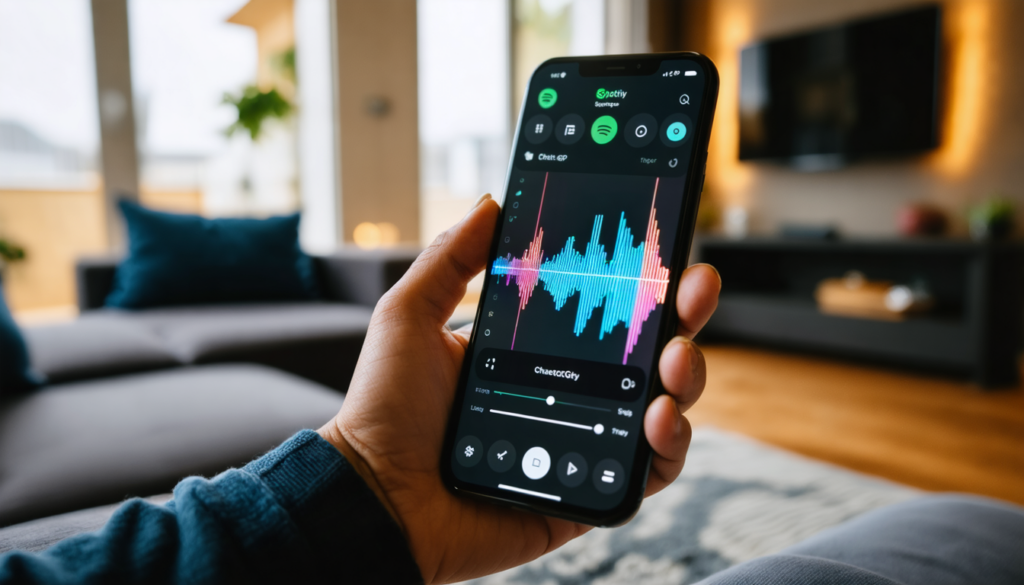
Spotify revolutionizes the musical experience in 2025 by integrating ChatGPT technology directly into its platform. This innovation radically transforms the way users create and discover their playlists, simply using a natural language prompt. Gone are the long searches for the perfect song: now, you just need to express your desires to the artificial intelligence, which composes an ultra-personalized music selection, like a virtual DJ tuned into your most precise tastes.
This innovation, called Prompted Playlist, is much more than mere automation. It is based on the detailed listening history of Premium subscribers to build playlists unlike any other, even explaining each chosen track. However, this feature is currently accessible only in New Zealand and in English, inviting music lovers worldwide to wait before fully enjoying it. Yet Spotify is betting big on this project, promising a worldwide expansion in 2026 that could well redefine music technology as we know it.
- 1 How the ChatGPT integrated into Spotify works for personalized playlists
- 2 Prompted Playlist: Spotify’s new flagship feature for online music
- 3 Advanced personalization thanks to the analysis of your listening history
- 4 Current limitations and future prospects for the ChatGPT-Spotify integration
- 5 The impact on music discovery and the artist ecosystem thanks to artificial intelligence
- 6 How to effectively use ChatGPT on Spotify to create your own playlists
- 7 The advantages of the voice assistant and integrated music technology in Spotify
How the ChatGPT integrated into Spotify works for personalized playlists
The deployment of ChatGPT within Spotify is primarily based on a natural interaction with the user. You only need to write or say a prompt in everyday language for the voice assistant to understand the mood, style, or theme of the desired playlist. Whether it’s an “energetic mix for a workout session” or a “musical journey mixing jazz and electro,” the artificial intelligence analyzes the request and draws from online music to generate a tailor-made playlist.
This music generation is not limited to assembling tracks at random. Thanks to precise music recommendation based on listening history, ChatGPT personalizes each selection taking into account the user’s past preferences and specific tastes. For example, if you have a strong affinity for certain artists or genres, they will be harmoniously included in the generated playlist.
Another important feature is the ability to refine the prompt after each result. If the first playlist does not perfectly meet expectations, the dialogue can continue to refine the selections. This immersive interaction transforms Spotify into a real vocal assistant for musical creation, far from simple classic algorithms.
This capacity to adapt in real time gives everyone unprecedented control over their music. Imagine requesting a playlist “relaxing with rare and little-known acoustic tracks” or a compilation “dynamic mixing Latin sounds and 90s pop.” The artificial intelligence understands you and produces a perfectly calibrated soundtrack, at every moment.
Prompted Playlist: Spotify’s new flagship feature for online music
Prompted Playlist is the core function of this integration, a beta trial highlighting the power of dialogue with a musical AI. Spotify offers a list of sample prompts, encouraging users to explore an infinite range of styles and express their most precise desires. This inspiration guides curious music lovers who want to discover new musical horizons, sometimes even unlikely combinations.
Users can experiment with requests such as:
- “Soft and melancholic playlist for a rainy evening”
- “2010s hip-hop hit with a touch of funk”
- “Energetic selection for outdoor running”
- “Discovery of emerging indie artists”
This list helps reveal the richness of possibilities offered, far from simple automatic and static recommendations. Moreover, the service offers the possibility to refresh a created playlist at regular intervals, for example daily or weekly, thus ensuring a constant freshness in the tracks offered.
In practice, Prompted Playlist acts somewhat like a personal DJ who understands your emotions, tastes, and current needs, relying on cutting-edge musical technology to provide you with a smooth and intuitive experience. According to several experts, this feature would represent a major advance in the field of music recommendation immersed in the world of artificial intelligence.
Advanced personalization thanks to the analysis of your listening history
One of the pillars of generating personalized playlists via ChatGPT on Spotify is the thorough consideration of listening history. Since registration, each user sees their tastes meticulously recorded: from favorites to more atypical listens, including repeatedly replayed tracks. This personal database is the pool from which the artificial intelligence draws to create its tailor-made work.
This process goes beyond classic music recommendation as the AI analyzes frequency, context, and sometimes even the duration of listening to tracks. For example, a user who listens to ballads in the evening and dynamic tracks in the morning will be offered playlists adapted to those specific moments. The system thus makes every musical experience unique and rich in emotions.
Beyond the data, Spotify ChatGPT includes an original mechanism: for each chosen track, the AI provides a brief explanation for its inclusion. This kind of personalized justification adds a playful and instructive dimension, reflecting a more human and transparent approach than the usual opaque algorithms.
This technology invites a new qualitative approach to online music, where the viewer becomes a full participant in the construction of their sound universe. Understanding why a particular track was selected brings us closer to an almost intimate experience with music.

Current limitations and future prospects for the ChatGPT-Spotify integration
Despite its immense potential, the Prompted Playlist feature currently concerns only Spotify Premium subscribers and is geographically limited to New Zealand, as well as to use in English only. This exclusivity generates eager anticipation among users in other countries, eager to enjoy what promises to be a revolution in the musical voice assistant.
Spotify is nonetheless reassuring regarding the rapid evolution of this technology and plans a broader worldwide availability starting in 2026. This global deployment phase will undoubtedly be accompanied by new technical and linguistic improvements, aiming to popularize this mode of music generation based on prompt interaction.
The challenges remain significant: ensuring the smoothness of natural conversations, managing the diversity of languages and dialects, meeting the specific expectations of millions of users with varied musical profiles. Especially as the protection of personal data related to listening histories must remain a priority to maintain subscriber trust.
In summary, this integration opens the way to unprecedented personalization in music technology. It could disrupt not only the way of listening but also how artists and creators reach their audiences, thanks to affinity targeting based on a fine analysis of musical preferences.
The impact on music discovery and the artist ecosystem thanks to artificial intelligence
The artificial intelligence integrated into Spotify via ChatGPT does not just provide tailor-made listening: it also plays a crucial role in discovering emerging and unknown artists. By refining recommendations according to each user’s profile, the AI makes visible talents often drowned in the vast volume of online music.
For artists, this technology represents a powerful showcase: their works can appear precisely before listeners likely to truly appreciate them. This granular targeting fosters a more balanced interaction between creators and consumers, more qualitative than simple mass exposure.
Spotify has also integrated tools allowing creators to better understand how their tracks are presented via AI, and to adjust their strategies to reach a more targeted audience. The future thus looks more promising for independents, who can thanks to this competitive technology compete with major record labels for listeners’ attention.
This revolution redefines traditional roles in the music industry, placing the listener at the center while offering artists better visibility adapted to real tastes. It is a new era where online music relies closely on personalization and quality, rather than sheer quantity.
How to effectively use ChatGPT on Spotify to create your own playlists
To make the most of this innovation, it is essential to adopt some good practices when formulating prompts. First, favor precise and descriptive natural language, clearly expressing the mood, style, or activity associated with your playlist. For example, rather than saying “music,” prefer “lounge tracks for a relaxing evening with friends.”
Then, don’t hesitate to experiment by playing with emotions, mentions of eras, or even genre combinations. A prompt like “melodious acoustic stroll with a touch of contemporary folk” will help the AI better understand your expectations.
You can also ask for thematic playlists related to a specific event: a family meal, a focused work session, an intense workout, or even a distant trip. The more complete your description, the more faithful the playlist will be to your desires.
Finally, be interactive: if the first proposal does not satisfy you, rephrase, specify, or ask for a variation. Each prompt optimization improves the quality of musical generation, thanks to ChatGPT’s contextual memory.
- Clearly express the desired mood
- Specify one or more musical genres
- Include a context or activity
- Experiment with unexpected blends
- Use the progressive refinement feature
The advantages of the voice assistant and integrated music technology in Spotify
The integration of ChatGPT into Spotify offers much more than a simple conversational interface. It provides a musical voice assistant capable of interpreting complex requests with impressive precision. This music technology thus smooths the user experience and strengthens their involvement in creating personalized playlists.
The voice assistant can, for example, instantly respond to varied requests ranging from searching for an artist to creating a compilation adapted to a specific moment. Music generation on demand also facilitates the discovery of new or rare content, thanks to the AI’s ability to browse Spotify’s vast music catalog.
This service perfectly illustrates the rise of voice assistants in online music. They offer an intuitive alternative to classic methods and allow natural and fast access to your favorite tracks. The process thus becomes more human, interactive, and oriented towards immediate satisfaction.
Moreover, using AI reduces time lost manually searching for titles or navigating sometimes tedious menus, making listening smoother and more enjoyable. This advancement benefits both casual listeners and demanding music lovers, offering a tailor-made experience for every profile.

| Advantages of ChatGPT integration in Spotify | Detailed description |
|---|---|
| Enhanced personalization | Creation of playlists adapted to listening history and desires expressed via prompt. |
| Natural interaction | Use of everyday language to create or modify playlists effortlessly. |
| Dynamic discovery | Improved visibility for artists thanks to precise targeting of listeners. |
| Time saving | Less manual searching, quick access to desired music. |
| Enhanced user experience | Continuous dialogue with the voice assistant to refine selections. |
How to access the ChatGPT feature on Spotify?
To use this feature, you must be a Spotify Premium subscriber and be located in a region where Prompted Playlist is available, such as New Zealand. You then just have to connect your Spotify account to ChatGPT and submit your prompts.
Can I use this feature in my language?
For now, Prompted Playlist is available in English only. Spotify plans a multilingual deployment in the future, notably for 2026.
Does the AI use my listening history to create playlists?
Yes, the artificial intelligence analyzes your listening history in order to adapt music selections to your tastes and habits.
Can I automatically refresh my playlists?
Absolutely, you can schedule regular updates of your playlists, for example daily or weekly, to always benefit from adapted new content.
What are the benefits for artists?
Artists benefit from better targeted visibility, their music being offered to listeners most likely to appreciate it, thanks to the AI’s fine analysis of preferences.