At a time when cyberattacks are becoming increasingly ingenious, the protection of information systems is an absolute priority for organizations. In this context, SIEM – Security Information and Event Management – establishes itself as a central solution, integrating massive data collection, in-depth analysis, and rapid response to incidents. This technology, which combines security information management and real-time event monitoring, transcends traditional methods to offer proactive and targeted defense. The major challenge lies in its ability to transform a considerable mass of logs into relevant and actionable intelligence, thereby enabling security teams to effectively prevent and counter cyber threats.
The SIEM market now reaches several billion dollars, driven by growing demand from companies eager to strengthen their IT security. Leaders such as Splunk, IBM QRadar, and Microsoft Sentinel dominate this ever-evolving sector. Their shared goal is to provide comprehensive network visibility, rapid attack detection, and optimal incident management to avoid any compromise. In this universe where every piece of data holds strategic importance, SIEM proves to be much more than a simple log collector: it is a true central brain at the heart of modern cybersecurity.
- 1 Understanding SIEM Technology: Foundations and Operations for Enhanced IT Security
- 2 The Benefits of SIEM for Data Protection in Enterprises
- 3 SIEM Architecture: Key Components for Reliable and Scalable Cybersecurity
- 4 Practical Use of SIEM: Use Cases and Solutions Adapted to Current Cybersecurity Challenges
Understanding SIEM Technology: Foundations and Operations for Enhanced IT Security
SIEM, or Security Information and Event Management, is a solution that merges two historically separate approaches. Security Information Management (SIM) ensures the collection and long-term archiving of activity logs, while Security Event Management (SEM) analyzes data in real time to detect anomalies or potential incidents. This dual function gives SIEM a unique ability to meet immediate needs while ensuring complete traceability for in-depth analysis.
Its operation is based on several key steps:
- Data Collection: SIEM aggregates and centralizes streams coming from various sources – servers, applications, network equipment, detection systems – to create a single source of truth.
- Normalization: It transforms heterogeneous data into a standardized format, making joint analysis possible despite source diversity.
- Aggregation: It groups similar events to reduce noise and focus attention on significant incidents.
- Correlation: The analysis engine cross-references events to identify suspicious patterns based on predefined or adaptive rules, revealing attacks often invisible to the human eye.
- Alert Generation: Detected incidents trigger qualified notifications addressed to analysts, accompanied by the necessary context for fast and relevant intervention.
For example, an unusual succession of abnormal connections followed by a modification of critical files may correspond to a hacking attempt. SIEM identifies this pattern, reports it, and facilitates incident response.
| Step | Description | Objective |
|---|---|---|
| Collection | Aggregation of data from multiple sources | Create a centralized repository for a global view |
| Normalization | Conversion of logs into standardized formats | Enable harmonized and consistent analysis |
| Aggregation | Grouping of similar events to reduce noise | Focus on relevant threats |
| Correlation | Analysis and cross-referencing of events according to rules | Detect complex attack patterns |
| Alert Generation | Notification of qualified incidents with context | Allow fast and appropriate response |
This continuous process, often enhanced by artificial intelligence, makes SIEM indispensable for monitoring, network monitoring, and incident management in a dynamic environment. Its extended capabilities offer exhaustive visibility into IT activity, a sine qua non condition to anticipate and effectively neutralize threats.

The Benefits of SIEM for Data Protection in Enterprises
Investing in a SIEM solution represents a real lever for performance in organizations. First, its primary role is to optimize threat detection proactively, through continuous monitoring and intelligent data analysis. This mechanism significantly speeds up intervention, thereby reducing the chances that a cyberattack causes irreversible damage.
Here are the main advantages of a SIEM:
- Complete Visibility: Comprehensive monitoring of traffic, from user activity to critical equipment, ensuring no blind spots.
- Reduced Detection and Response Time: Rapid identification of incidents allowing intervention before the threat spreads.
- Facilitated Regulatory Compliance: Automated report generation to demonstrate compliance with standards such as GDPR or PCI-DSS.
- Intelligent Prioritization: Hierarchization of alerts according to their severity to optimize security teams’ efforts.
- Increased Operational Efficiency: A centralized environment helps coordinate and document incident response actions.
In a concrete case, a large company in the banking sector was able to detect and block a targeted intrusion using advanced evasion techniques thanks to the SIEM correlation engine. This early alert prevented a massive leak of sensitive data within minutes.
| Benefit | Impact | Concrete Example |
|---|---|---|
| Complete Visibility | Reduction of blind spots and better understanding of behaviors | Constant monitoring of users and network equipment |
| Rapid Response | Reduction of exposure time to threats | Automatic blocking of targeted attack before compromise |
| Facilitated Compliance | Respect for legal standards and simplified auditing | Automated generation of GDPR and PCI-DSS reports |
| Prioritization | Optimization of human resources for critical incidents | Filtering of false alerts and priority treatment |
| Increased Efficiency | Smooth coordination of security teams | Centralized documentation for post-incident analyses |
Beyond its traditional functions, the latest SIEM solutions now integrate advanced behavioral analysis and artificial intelligence tools. These allow, for example, the detection of suspicious internal behaviors, a crucial challenge at a time when internal threats represent a growing share of risks. Thus, SIEM contributes not only to external defense against massive attacks but also to fine monitoring of users and privileges within organizations.
SIEM Architecture: Key Components for Reliable and Scalable Cybersecurity
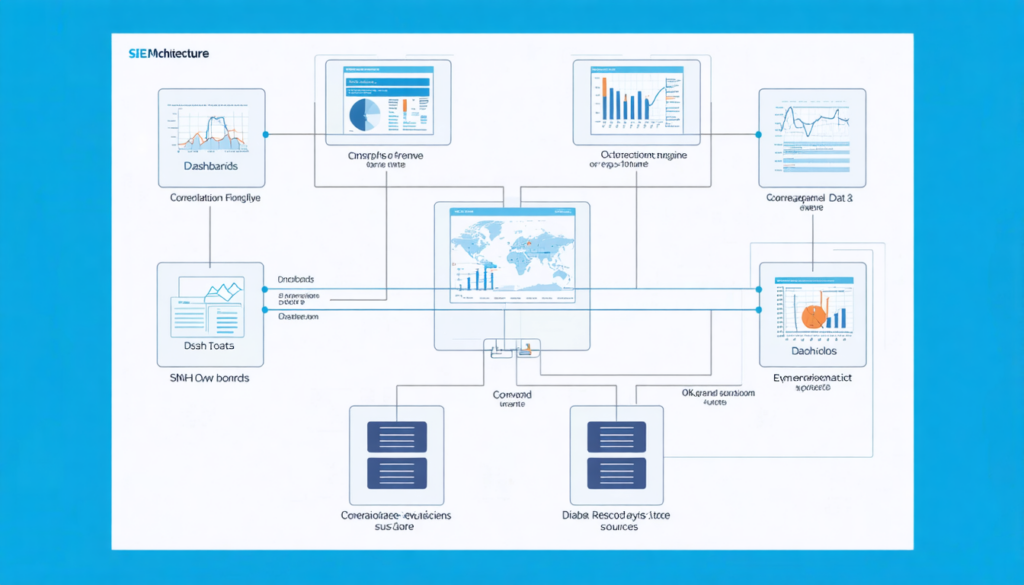
The robustness of a SIEM system depends on the quality of its architecture. This relies on several essential components that collaborate in a coordinated manner to ensure optimal security:
- Diversified Data Sources: firewalls, antivirus, intrusion detection systems, endpoints, business applications, and cloud platforms provide an indispensable wealth of information.
- Correlation Engine: the true brain of the system, it applies complex rules and algorithms to deeply analyze events and detect sophisticated attacks.
- Dashboards and Reporting: visual interfaces that allow security teams to view alerts, observe trends, and generate regulatory or activity reports.
- Automation and AI: the integration of machine learning technologies reduces false positives, refines detections, and automates certain responses via SOAR mechanisms.
- Secure History and Storage: preservation of logs over long periods, secured and accessible for forensic investigations.
A robust architecture not only guarantees performance but also smooth evolution with new threats and regulatory requirements. Companies should thus favor modular and flexible solutions capable of integrating new data sources and adapting to the specificities of their hybrid and multicloud environments.
| Component | Function | Contribution to Cybersecurity |
|---|---|---|
| Data Sources | Collection of heterogeneous information | Complete representation of activity |
| Correlation Engine | In-depth event analysis | Detection of complex attacks |
| Dashboards and Reporting | Visualization and data synthesis | Support for decision-making and compliance |
| Automation and AI | Optimization of detections and responses | Reduction of alert fatigue |
| Secure Storage | Archiving of logs and histories | Forensic exploration post-attacks |
By involving all these elements, a SIEM not only performs in threat detection today but also prepares the ground for future challenges in data protection and infrastructure security.

Practical Use of SIEM: Use Cases and Solutions Adapted to Current Cybersecurity Challenges
In a constantly changing digital world, companies face increasingly sophisticated threats such as advanced persistent threats (APT) or insider threats. SIEM then acts as a key tool to identify these risks and support the defense strategy of Security Operations Center (SOC) teams.
Some practical use cases:
- Monitoring Advanced Persistent Threats (APT): Detect long-term abnormal behaviors, often invisible to conventional systems.
- Detection of Insider Threats: Identification of abnormal accesses or massive suspicious data transfers performed by malicious or negligent employees.
- Protection of Cloud and Hybrid Environments: Centralization of logs from platforms such as AWS or Azure for unified supervision.
- Operational Support for SOC Analysts: Sorting and prioritizing alerts, offering a complete history to analyze incidents and prepare targeted actions.
A real case illustrates the efficiency of this technology: an international distribution company detected via its SIEM a stealth intrusion attempting to manipulate user access privileges. Behavioral analysis revealed the anomaly and enabled quick blocking of the threat, thus avoiding a major compromise.
| Use Case | Challenge Encountered | Benefits Provided by SIEM |
|---|---|---|
| APT | Long-term hidden threat | Behavioral analysis detecting subtle anomalies |
| Insider Threats | High risk of data leakage | Monitoring of access and sensitive file transfers |
| Cloud Environments | Multiplication of entry points | Centralization of cloud logs for unified vision |
| SOC Support | Shortage of cybersecurity experts | Prioritization of alerts and effective forensic analyses |
The diversity of these applications highlights SIEM’s flexibility, capable of adapting to sector-specific needs and the technical complexities of modern infrastructures. It thus becomes a pillar in the overall IT security strategy, supporting incident response through continuous, intelligent, and contextualized monitoring.