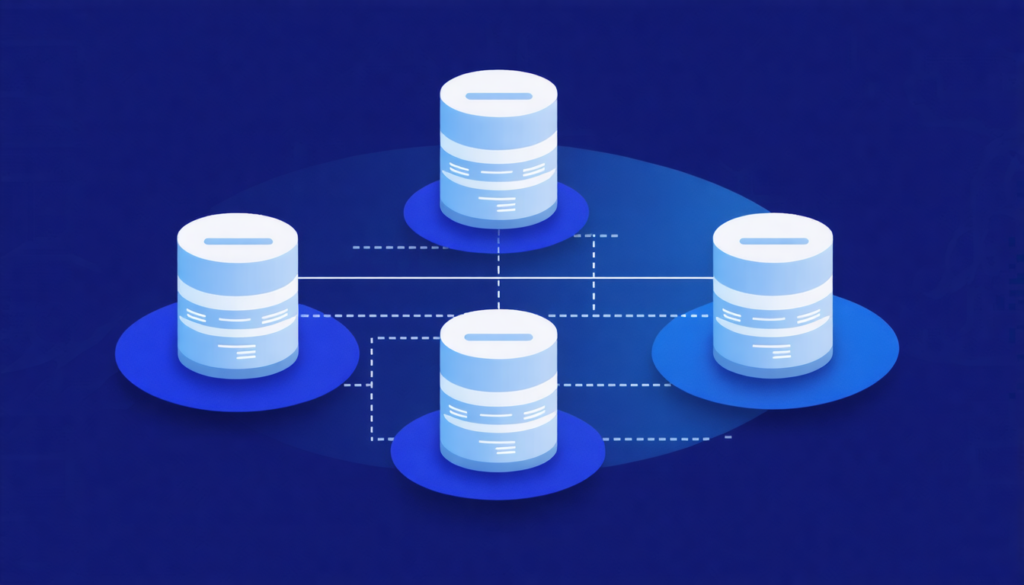
Faced with the explosion of data volumes generated daily by companies, traditional methods of managing and organizing databases are reaching their limits. The need for efficient, fast, and scalable data management requires new innovative approaches. Sharding has thus established itself as a key technique for data distribution, allowing performance optimization and ensuring the essential scalability for large distributed databases. By breaking data into smaller, autonomous, and independent fragments called shards, this method offers improved parallel processing, better high availability, and enhanced security. Sharding now goes beyond simple technical optimization to become an essential strategic lever in managing modern IT infrastructures.
Companies leverage sharding to lighten the load on a single server by distributing work across multiple nodes, thereby facilitating system maintenance and scalability. This horizontal data distribution prevents bottlenecks and significantly reduces response times for critical applications. While the concept is far from new, its adoption accelerated with the rise of Big Data, distributed databases, and blockchain. Today, many platforms, ranging from e-commerce websites to cloud giants, use sharding to anticipate activity spikes and ensure a smooth and continuous user experience.
- 1 Understanding Sharding: Principle and Operation of Data Distribution
- 2 The Major Advantages of Sharding for Performance and Scalability
- 3 Challenges and Complexities of Sharding: Anticipate to Better Manage Distributed Databases
- 4 Sharding and Security: Reducing the Impact of Cyberattacks through Optimal Distribution
- 5 List of Key Benefits of Sharding in Modern Database Management
Understanding Sharding: Principle and Operation of Data Distribution
Sharding is based on a simple but powerful principle: dividing a single database into multiple independent pieces, called shards, each containing a distinct portion of the data. Each shard is hosted on a different server or node in a cluster, which operates as an autonomous entity with its own database engine. This approach significantly improves data management, allows parallel query processing, and reduces the load on each machine.
To better visualize this system, consider an international e-commerce platform that stores billions of records: orders, invoices, products, customer profiles, etc. Instead of piling all this data onto a single server, which would eventually become saturated, each type of information can be partitioned and placed on separate servers. For example, one server for orders, another for billing, and a third for client sessions. This distributed architecture enables gradual scaling and simplified maintenance without global downtime. The effectiveness of sharding also depends on the careful choice of partition keys to evenly distribute data and optimize access.
It is also important to differentiate sharding from simple partitioning or replication. Partitioning can be vertical (splitting tables by columns) or horizontal (splitting tables by rows) but does not necessarily imply distribution across several autonomous servers. Sharding, on the other hand, remains an advanced form of horizontal partitioning, where each shard is a complete database, offering fully decentralized management.

The Major Advantages of Sharding for Performance and Scalability
In the era of Big Data, where databases must ingest and deliver massive volumes of information in real time, sharding has become an essential technical solution. It improves performance by enabling parallel processing, where each shard handles its own data without waiting for responses from others. This decentralization reduces latency, increases read/write speeds, and makes it possible to manage millions of concurrent queries.
Another obvious benefit is horizontal scalability. Unlike vertical scaling (where a single server is enhanced by adding memory, CPU, etc.), horizontal scalability via sharding simply consists of adding additional servers to accommodate new shards. This approach is more economically viable and flexible because it avoids the physical limits associated with a single powerful machine. Companies like Amazon, Google, or Netflix extensively exploit these distributed architectures to ensure constant availability even during peak hours, while keeping costs under control.
The table below summarizes these sharding advantages in a modern architecture context:
| Aspect | Impact of Sharding | Concrete Example |
|---|---|---|
| Performance | Parallel processing accelerates queries | E-commerce sites handling millions of simultaneous orders |
| Scalability | Adding new servers without interruption | Cloud platforms increasing capacity during peaks |
| Costs | Distributed infrastructure less expensive than an overpowered monolithic server | Startups optimizing their IT budget |
| Maintenance | Easy isolation of problems and updates per shard | Reducing production downtimes |
| High Availability | Improved redundancy and fault tolerance | Critical financial applications remaining active continuously |
Sharding, by optimizing data distribution, thus acts as a driver for the efficiency of distributed databases while guaranteeing a smooth user experience, even under heavy load.
Challenges and Complexities of Sharding: Anticipate to Better Manage Distributed Databases
Despite its many advantages, sharding is not a constraint-free solution. The main difficulty lies in the very design of the architecture and the management of exchanges between shards. In 2025, as databases handle increasingly heterogeneous data — structured and unstructured — the complexity of partitioning increases.
A common question concerns the geographical distribution of customer data: how to manage the same user present in multiple regions? Or how to ensure data consistency when a query touches multiple shards? These questions require engineers to choose appropriate strategies, sometimes at the expense of increased application complexity.
NoSQL architectures have largely established themselves in this context, offering native sharding mechanisms and better flexibility. However, adapting a classic SQL database to sharding mode may require developing proprietary solutions, as well as optimization work on keys and indexes.
Moreover, dependence on inter-shard communications is a critical factor. Maintaining a server involving an unavailable shard can paralyze part of the operations if the design is not sufficiently resilient. It is therefore essential to plan a redundant architecture with load balancing and replication mechanisms to ensure high availability.
In summary, sharding demands rigorous planning, advanced expertise, and a thorough understanding of the data to be distributed. Nevertheless, when well implemented, it turns Big Data challenges into opportunities to push the limits of distributed database management.

Sharding and Security: Reducing the Impact of Cyberattacks through Optimal Distribution
In 2025, sharding also takes on a strategic dimension in cybersecurity. While a monolithic architecture can render all data vulnerable in the event of a breach, sharding helps significantly reduce the “blast radius”, that is, the potential impact of an attack.
By splitting the database into isolated shards, each fragment acts as an independent bastion. If a hacker manages to compromise a less sensitive shard, the attacker remains confined to that limited space, without automatically accessing other portions of data. This favorable segmentation also facilitates applying specific security policies per shard and offers more granular access management.
Furthermore, data separation facilitates compliance operations with recent regulations such as GDPR or industry standards requiring strict control over client data. It becomes easier to audit, encrypt, or delete targeted data without impacting the entire system.
This increased resilience is particularly appreciated in SaaS and cloud environments, where high availability and client isolation are non-negotiable requirements. Sharding thus allows for a more robust architecture against current threats while maintaining optimal performance.

List of Key Benefits of Sharding in Modern Database Management
- Optimization of parallel processing: each shard independently processes a portion of the data, accelerating queries.
- Facilitated horizontal scalability: simple addition of new servers to extend capacity.
- Reduction of infrastructure costs: avoiding the use of expensive, overpowered servers.
- Improvement of high availability: possibility to isolate failures on distinct shards.
- Strengthening of security: limitation of the blast radius in case of cyberattack.
- Simplified management of distributed data: ease of targeted updating and auditing.
- Adaptability to heterogeneous data: optimal support for both SQL and NoSQL databases.
What is sharding?
Sharding consists of dividing a database into several smaller pieces, called shards, to improve system management, performance, and scalability. Each shard is hosted on a separate server.
Why use sharding?
Companies adopt it to manage large volumes of data, accelerate processing, reduce costs, and ensure better high availability of their distributed databases.
What is the difference between sharding and partitioning?
Sharding is an advanced form of horizontal partitioning with distribution over several servers. Classic partitioning can be vertical or horizontal but does not necessarily distribute across multiple machines.
Does sharding improve data security?
Yes, by isolating data into independent fragments, sharding reduces risks linked to cyberattacks by limiting their spread across all data.
What are the main difficulties of sharding?
Challenges include architecture complexity, managing communications between shards, and adapting to heterogeneous data. Rigorous planning is necessary.