
A spectacular breakthrough has just upended our perceptions of the scope of quantum internet. For a long time, the major challenge remained the maximum distance at which two quantum computers could communicate without loss of information. Until now, this barrier was limited to a few kilometers, confining quantum internet to strictly local use. But a technological feat announced by researchers from the University of Chicago has just revolutionized this constraint: they have succeeded in establishing a quantum link over 2,000 kilometers, an achievement that already far surpasses previous records. This technique paves the way for a quantum network capable of connecting two distant points like Chicago and Salt Lake City, with secure and tamper-proof transmission thanks to quantum cryptography. Beyond that, it signals a colossal technological leap, dreamed of for decades, that could extend quantum communications continent-wide and, eventually, worldwide.
This progress takes place in a context where quantum technology is increasingly establishing itself as a key lever for the digital future. Indeed, given the limits of classical processing, quantum communication offers unprecedented solutions both for security and transmission speed. Moreover, the implementation of a quantum internet is not only a question of pure science; it also impacts the strategy of large companies, cybersecurity policies, and the development of industrial applications previously unimaginable. The announcement of these 2,000 kilometers crossed, soon to be doubled or even doubled again, marks a crucial step toward the global quantum internet of tomorrow, a true infrastructure of data and trust.
- 1 The fundamental principles of quantum internet to understand this technological leap
- 2 The technical breakthroughs that made it possible to push quantum communication distance to 2,000 kilometers
- 3 An ultra-secure quantum network: quantum cryptography at the heart of the revolution
- 4 Perspectives 2025: towards a global quantum internet and its technological challenges
- 5 Profound transformations of the technological sector induced by quantum internet
The fundamental principles of quantum internet to understand this technological leap
To appreciate the magnitude of this breakthrough, it is essential to dive into the foundations of the quantum technology that supports this revolutionary network. Unlike the classical internet based on binary bits, the quantum internet operates thanks to qubits, information units capable of existing simultaneously in multiple states thanks to the phenomenon of superposition. This property, far from being a mere mathematical curiosity, allows parallel management of information, conferring exponential potential to calculations and communications.
Another essential concept for quantum communication is quantum entanglement. Albert Einstein described this phenomenon as “spooky action at a distance”: two entangled qubits share an instantaneous link, no matter the distance separating them. For example, measuring the state of a qubit in Germany will immediately influence the state of its companion in San Francisco. This link is used to establish secure transmission, as any interception attempt disrupts this entanglement, making it impossible to spy without being detected.
The following table illustrates the major differences between traditional and quantum computing:
| Characteristic | Classical Bit | Quantum Qubit |
|---|---|---|
| Basic Unit | 0 or 1 | Superposition of 0 and 1 |
| State | Deterministic and unique | Probabilistic until measurement |
| Computational Potential | Linear | Exponential |
This mechanism makes it possible to envisage quantum networks with unmatched robustness and security, but until today, the main difficulty was the fragility of the quantum state during transmission, limited by a phenomenon called decoherence. The greatest technological challenge therefore lies in maintaining these unique properties over significant distances. This challenge, precisely, has been met by the Chicago team, constituting a true turning point in the deployment of quantum internet beyond the experimental framework.
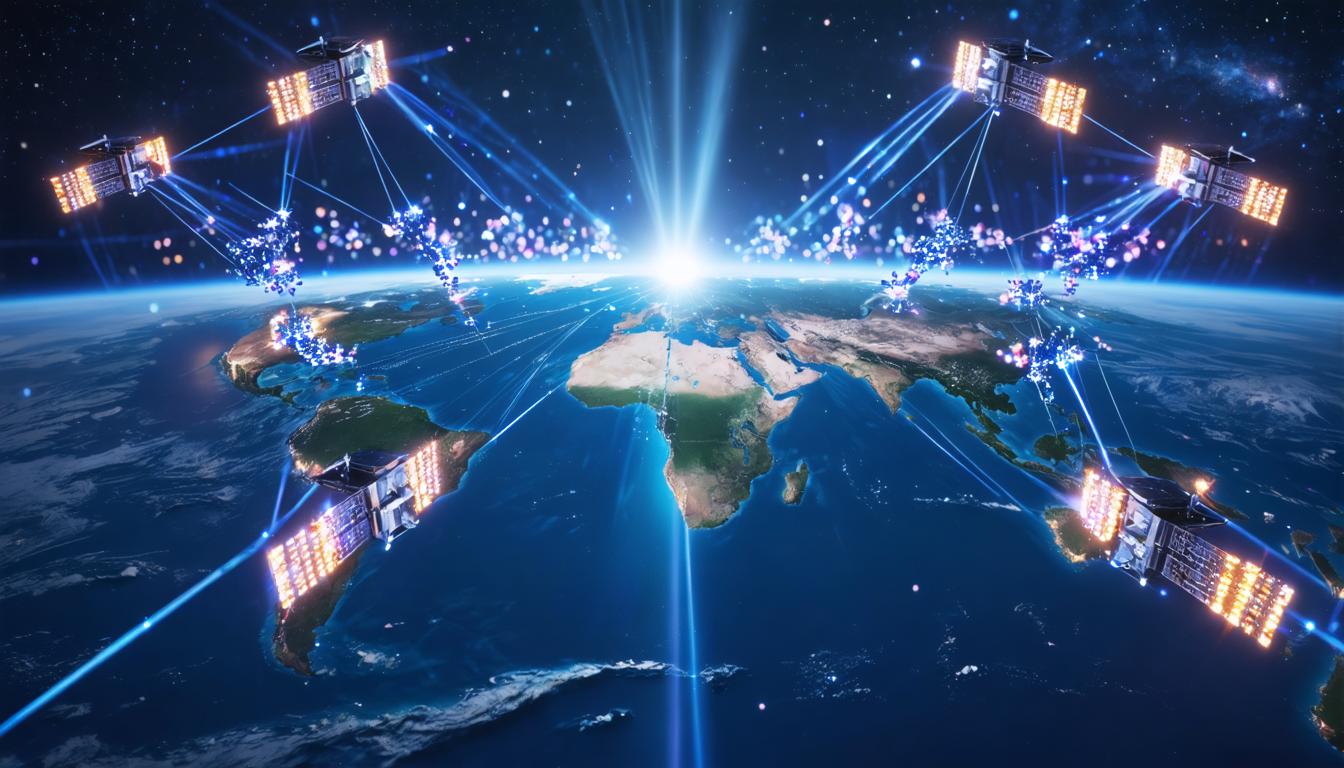
The technical breakthroughs that made it possible to push quantum communication distance to 2,000 kilometers
At the heart of this feat lies an innovation in how quantum data is transmitted. Rather than sending fragile qubits directly over an optical fiber, an indirect and sophisticated process uses pairs of entangled photons. This method greatly reduces vulnerability to decoherence and environmental disturbances, the main causes of the previous ceiling of 15 to 50 kilometers.
The American team thus developed a clever architecture combining the sending of entangled photons through standard optical fibers and the creation of quantum nodes capable of synchronizing this information remotely. This system works by establishing robust entanglement over 2,000 kilometers, exceeding previous trials by more than a hundredfold. Concretely, this leap makes quantum communication between large cities separated by hundreds or even thousands of kilometers possible.
Here is a clear comparison to illustrate the importance of this leap:
| Indicator | State before November 2025 | New record November 2025 |
|---|---|---|
| Maximum entanglement distance | 15-50 kilometers | 2,000 kilometers |
| Network scale | Local (campus, city) | Continental (inter-state) |
| Viability | Experimental, very limited | Proof of concept viable |
It should be noted that this advance does not yet constitute a fully operational large-scale quantum internet. Secure transmission must be accompanied by quantum error correction protocols still under development, and throughput remains below the expectations of classical networks. Likewise, the cost and the need to maintain extreme conditions, such as very low temperatures, still represent major obstacles to rapid adoption.
This quantum technology is expected to transform how digital infrastructures are designed, especially in terms of security and distributed computing, unveiling vast potential for future applications.
An ultra-secure quantum network: quantum cryptography at the heart of the revolution
One of the major attractions of quantum internet lies in quantum cryptography, which guarantees unprecedented security for digital exchanges. Secure transmission exploiting quantum teleportation and entanglement makes any interception impossible without altering the exchanged data, hence an immediate alert for users.
For example, in the banking sector, adopting a quantum network would protect transactions from any external manipulation, a crucial issue at a time when cyberattacks are multiplying in sophistication. Even states and military institutions show growing interest in this security level, aware of the risks related to future quantum computers capable of breaking current encryptions.
This breakthrough also opens the door to complementary use between classical internet and quantum internet. For example:
- Sensitive transactions secured via a quantum channel.
- Web browsing and consultations on a classical network.
- Management of quantum cryptography to protect critical infrastructures.
- Synchronization of sensitive data via quantum teleportation.
Experts emphasize that the gradual integration of hybrid quantum networks will become a standard, making optimal use of quantum wavelengths for flawless transmission of crucial information.

Perspectives 2025: towards a global quantum internet and its technological challenges
The achievement of quantum transmissions over 2,000 kilometers marks a turning point, but the ultimate goal remains the creation of a planetary quantum internet. For this, several challenges remain, notably the development of quantum repeaters capable of restoring signals over very long distances without destroying quantum states, a technological obstacle still in advanced research phase.
Beyond technical aspects, there are also considerable geopolitical and economic stakes. Mastery of these technologies will offer a strategic advantage to whoever holds the key, hence a global race involving the United States, China, and the European Union. The need to define viable international standards also raises the question of cooperation in a context of heightened competition.
Promising applications go far beyond simple security:
- Distributed quantum computing: pooling computing power among several quantum computers to solve complex problems.
- Ultra-precise synchronization: notably for GPS navigation and scientific research where extreme coordination is indispensable.
- Accelerated scientific discovery: complex molecular simulations facilitating rapid design of medicines or innovative materials.
The development of a robust ecosystem of specialists, engineers, and applications is also a major challenge to transform these experimental advances into concrete, widely accessible solutions.
Profound transformations of the technological sector induced by quantum internet
At the heart of this revolution, quantum communication disrupts established models. Extending transmission distances will allow connecting isolated quantum computers, thus creating a quantum network capable of surpassing the limits of individual capacities. This paradigm shift comes with an immediate impact on the fields of cybersecurity, high-performance computing, and artificial intelligence.
Concretely, networking quantum computers accelerates:
- The development of new algorithms adapted to the parallel power of qubits.
- Research on quantum machine learning, paving the way for revolutionary artificial intelligence.
- The discovery of drugs and materials via precise, large-scale quantum simulation.
Another major upheaval: data security. Quantum cryptography undermines current standards based on classical keys, imposing a complete overhaul of digital security protocols. Quantum internet thus guarantees unprecedented secure transmission by strengthening confidentiality against any attempt at espionage or hacking.
This technological leap is, however, accompanied by a necessary effort in investment, infrastructure, and training, profoundly transforming the digital economy. Tech giants, as well as numerous specialized start-ups, are investing massively to establish themselves in this new territory, giving rise to intense international competition.