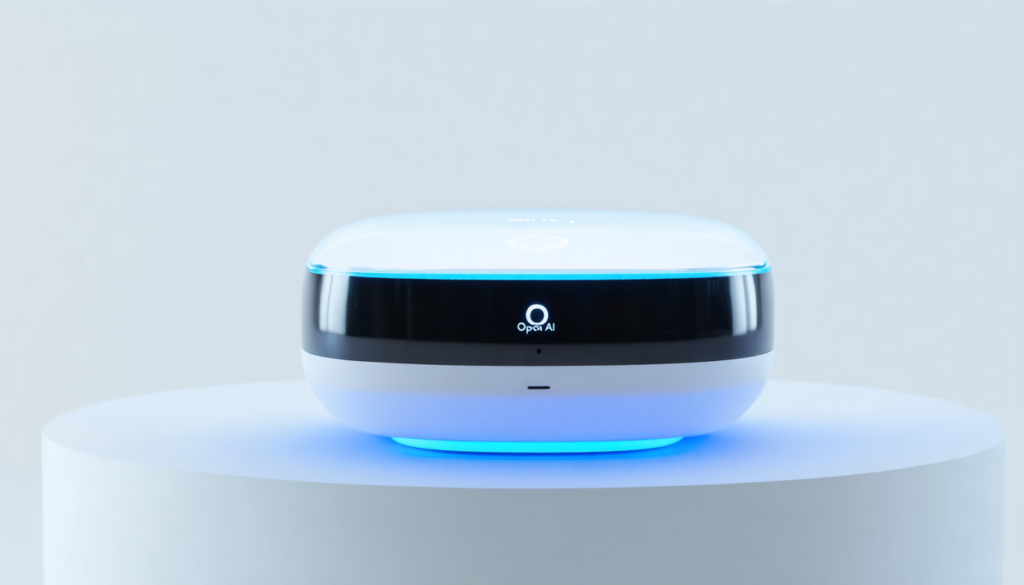
OpenAI takes a major new step by confirming the release date of its first physical ChatGPT device. After months of waiting, speculation, and rumors, this announcement marks an important turning point in the integration of artificial intelligence into our daily lives. The company, which revolutionized the world thanks to ChatGPT and its advances in machine learning, is now preparing to offer a tangible OpenAI product, beyond the classic screen-based interfaces. This device embodies the ambition of innovation driven by user experience, ease of use, and a voice-centered approach, promising to redefine the notion of a voice assistant.
This imminent release takes place in a technological context where artificial intelligence is increasingly infiltrating physical objects. OpenAI, with its recent collaboration with the iconic designer Jony Ive, innovates by combining aesthetics and functionality to create a unique object, designed to naturally integrate into daily life. This product, which is expected to appear on shelves from the end of 2026, could well represent a new era of smart devices intended to replace or complement our traditional smartphones. The promise of a natural, smooth, and intuitive interaction with AI generates understandable enthusiasm, reflecting the rising prominence of AI-driven assistants in original formats.
- 1 A decisive turning point: OpenAI announces its first physical ChatGPT device and its release date
- 2 The challenges of designing a physical device in the age of artificial intelligence
- 3 An OpenAI product designed to revolutionize user experience through the voice assistant
- 4 Rumors and prospects around the Sweetpea project: an innovative audio gadget for 2026
- 5 Impact on the smart device market and prospects for OpenAI
- 6 Jony Ive and the aesthetic and functional vision of the OpenAI device
- 7 Towards a new era: OpenAI imposes artificial intelligence in the physical world
A decisive turning point: OpenAI announces its first physical ChatGPT device and its release date
OpenAI is leaving the purely digital services sphere for the first time with the official announcement of the imminent release of its first physical device. This first product is not just a technological novelty but a revolution in the way of interacting with ChatGPT and machine learning.
After dominating the field of voice assistants via software interfaces, OpenAI intends to take a further step by materializing this technology in a concrete object, designed for daily use. It was at the World Economic Forum in Davos that Chris Lehane, OpenAI’s director of international affairs, confirmed the approximate release date, mentioning a launch in the second half of 2026.
This timeline gives substance to the many speculations circulating for several months, instilling some credibility to a project long kept secret. The choice of a renowned event like Davos for this announcement highlights the strategic stake and the interest this product raises on a global scale. However, Lehane also emphasized that, despite this timeframe, OpenAI retains the possibility of adjusting its launch schedule depending on development progress.
The company is therefore proceeding cautiously, aware that introducing a new device poses demanding technical and strategic requirements, especially since this is a first model intended for the general public. This caution suggests that the public presentation of the device could precede its actual commercialization, allowing feedback and improvements before broader availability.
This step towards hardware clearly demonstrates OpenAI’s desire to increase its impact in daily uses through innovation, embodying a natural evolution of conversational technology towards more intuitive and integrated forms. This migration from software interface to physical object promises to amplify the presence of machine learning in our immediate environment, transforming the ChatGPT assistant into a true technological companion.
The challenges of designing a physical device in the age of artificial intelligence
Moving from a purely software technology to a physical device poses a set of large-scale technical and design challenges. OpenAI is entering new territory where mastery of hardware is as crucial as the machine learning algorithms that power ChatGPT.
Developing a physical product requires addressing several constraints, notably those related to ergonomics, ease of use, energy consumption, and embedded computing power. The challenge is delicate: the device must be accessible, performant, and capable of processing requests in real time, while maintaining a sleek design and a manufacturing quality up to OpenAI’s ambitions.
According to the most reliable information, the device could adopt an audio format, offering an alternative to popular products like the AirPods. This direction raises the question of the role that voice recognition and voice assistant will play in this new context. The product thus targets users seeking quick and natural access to artificial intelligence, without the barrier of a screen.
The collaboration with industrial specialists in audio equipment production, like Foxconn, demonstrates OpenAI’s desire to draw from proven know-how to ensure impeccable quality. This synergy illustrates the ambition of a product that would not just be a gadget, but a true connected personal assistant, optimized for voice interactions and contextual management.
Designing such a device also requires overcoming complex issues surrounding data protection, security, and privacy. Handling human conversations in a connected device involves strict protocols and increased transparency to earn user trust, an essential parameter in today’s digital age.
Lessons learned from early trials of physical AI devices
The market has already witnessed attempts, not always successful, to introduce physical AI products. The case of the Humane AI Pin, although promising, highlighted the difficulties of reconciling technology and ergonomics in a practical form. These experiences provide OpenAI with valuable insights to refine its approach and avoid the pitfalls of first trials.
Innovation does not only consist of integrating powerful algorithms or cutting-edge machine learning. It is about offering a smooth usage, refined design, and above all, features truly useful in daily life. These technological and human challenges must be overcome for such a product to find its place in an increasingly competitive and demanding market.
An OpenAI product designed to revolutionize user experience through the voice assistant
At the heart of this innovation, the voice assistant occupies a central place. Let’s forget the classic touch and visual interfaces: OpenAI aims to provide a smooth and natural interaction based on voice to simplify everyday life.
The declared goal by Sam Altman, OpenAI CEO, and Jony Ive, the iconic designer associated with the project, is to create a device both sophisticated and intuitive, inviting spontaneous and effortless use. It is a product that, according to them, would be “so simple you’d almost want to caress it,” a sign of a strong sensory approach in design and functionality.
This ambition translates into a focus on artificial intelligence capable of understanding the context of requests, interacting continuously with its user, and adapting to their needs without requiring constant intervention. Machine learning plays a critical role here, allowing the physical ChatGPT to learn and evolve with its owner.
We imagine a technological companion capable not only of executing commands but also anticipating needs, managing schedules, or providing personalized advice, in a less intrusive posture than traditional screens. This vision promises the democratization of AI in a domestic or professional setting where time and interaction fluidity become essential.
This is a significant advance in how technology can be of service, transcending technical complexity in favor of a truly natural experience.
Rumors and prospects around the Sweetpea project: an innovative audio gadget for 2026
In the industry corridors, the project named Sweetpea is drawing a lot of attention. According to leaks relayed by the Chinese blogger Smart Pikachu, known for reliable sources, OpenAI would be developing a device targeting the audio segment, with the ambition to compete with AirPods in terms of design and usage.
Sweetpea would consist of two small audio modules worn on the ears, accompanied by a discreet charging case, in a compact format reminiscent of a small personal accessory. The product would rely on a 2-nanometer chip, promising power and autonomy capable of competing with certain smartphone technologies on the market.
This initiative appears to be part of a broader strategy called Gumdrop, which envisages the release of several complementary physical products by 2028, ranging from domestic objects to a connected pen. This diversification reflects OpenAI’s desire to expand its presence in the hardware environment, multiplying the touchpoints with artificial intelligence.
Sweetpea would thus embody the first realization of a hardware ecosystem designed to deeply integrate AI into daily life, far from screens and classic interfaces. A bold bet that could redefine habits and uses regarding voice assistants and communication.
Expected features of a high-end voice assistant
Here is a list of probable features that could be integrated into Sweetpea and future Gumdrop devices:
- Advanced voice interaction: natural commands, contextual responses, and smooth dialogue.
- Adaptive recognition: personalized learning of user preferences.
- Seamless connection and integration: interaction with other smart home devices.
- Long-lasting autonomy: thanks to chip and battery optimization.
- Compact and discreet design: comfort and elegance for prolonged use.
- Security and privacy: securing exchanges and controlling user data.
Impact on the smart device market and prospects for OpenAI
The launch of the very first physical ChatGPT device by OpenAI is likely to disrupt the landscape of connected objects and voice assistants. While the competition is already well established with giants like Apple, Amazon, or Google, OpenAI’s entry into this field promises to energize the market with an innovative offer centered on advanced artificial intelligence.
Qualcomm, a major player in electronic components, has moreover highlighted the strong potential of AI-powered connected devices, announcing an exponential growth in the sale of smart connected glasses, which could soon reach 100 million units sold, compared to 10 million currently recorded. This dynamism reflects a global desire to make artificial intelligence a fundamental component of modern lifestyles.
The alliance between OpenAI and industrial partners like Foxconn suggests a rise in new uses and form factors, aimed at diversifying user experiences. This context offers OpenAI an opportunity to become a key player in the hardware sector, relying on its software expertise and prominence in artificial intelligence.
| Category | Main player | Current position | Opportunities for OpenAI |
|---|---|---|---|
| Voice assistants | Amazon, Google, Apple | Established leader | Advanced AI innovation and differentiated design |
| AI connected glasses | Qualcomm (manufacturers) | Market in strong growth | Strategic partnerships and hardware integration |
| Smart home objects | Multiple diverse players | Progressive emergence | Expansion of the ChatGPT ecosystem |
Jony Ive and the aesthetic and functional vision of the OpenAI device
OpenAI’s collaboration with Jony Ive, a key figure in industrial design, reveals a strong desire to inscribe this innovation in an approach that is both aesthetic and sensual. Ive, famous for co-designing the iPhone, brings to this project a dimension far beyond simple functionality.
The first teasers and interviews show that the final product neither looks like a classic high-tech gadget nor an additional bulky voice assistant. It is a refined, sleek object designed to integrate naturally into the personal environment, almost like a piece of design.
This aesthetic approach is a key element to attract an audience that now demands technological products as practical as they are pleasant to use and look at. Touch interaction, softness of shapes, and intuitive ergonomics take on crucial importance here, aiming to create an almost sensory connection between the user and the device.
This vision perfectly corresponds to the philosophy developed around ease of use guided by artificial intelligence, where the technique fades away to leave only the user experience. The coherence between design and technology is a major challenge that Jony Ive and OpenAI seem to successfully meet.
Towards a new era: OpenAI imposes artificial intelligence in the physical world
This announcement of a physical OpenAI product fits within a broader movement aiming to democratize AI by making it directly accessible in our daily environments. Beyond simple screen applications, this new range of gadgets materializes the technological evolution of machine learning in a concrete and usable form.
Recent developments reveal that the era of purely software assistants is set to evolve. By envisioning devices like Sweetpea, OpenAI creates a dynamic allowing voice to be freed and human interactions with technology reinvented. This direction transforms AI into an accessible, natural, and omnipresent companion.
The emergence of these devices opens fascinating perspectives in terms of innovation and usage, revolutionizing the relationships between humans and machines. Henceforth, artificial intelligence is no longer confined to a screen but comes into our tangible space, ready to accompany us in every moment of daily life.