
The partnership between Nvidia and OpenAI reaffirms its dynamism in 2026, despite persistent rumors surrounding the massive investment announced last year. This large-scale financial commitment, amounting to up to 100 billion dollars, aims to support the spectacular expansion of infrastructures necessary for the development of artificial intelligence. Through this project, Nvidia not only associates its technological expertise with the success of OpenAI but also asserts its crucial strategic role in the race for innovation in the field of AI.
This alliance’s main objective is the construction of an impressive computing capacity of 10 gigawatts dedicated exclusively to artificial intelligence, thereby strengthening the power of OpenAI’s data centers. It also symbolizes a major economic turning point: never before has a semiconductor company committed such a volume of funding in a technological partnership. This operation fuels desires and raises many questions about its impacts on the market and direct competitors.
In this turbulent context, recent articles have circulated information suggesting that Nvidia might reduce its commitment or even turn its back on OpenAI. However, Jensen Huang, the charismatic CEO of the chip giant, quickly denied these speculations, putting an end to any controversy related to this colossal investment. These official statements thus ease tensions and reaffirm Nvidia’s central place in the technological evolution of artificial intelligence.
- 1 Nvidia’s spectacular commitment: an unprecedented investment in artificial intelligence
- 2 Debunking the rumors: Jensen Huang calms the waters on the financial disengagement rumor
- 3 AI technology strengthened by cutting-edge computing infrastructure: 10 gigawatts of dedicated power
- 4 Fierce competition: Microsoft, Amazon, and SoftBank join the race to fund OpenAI
- 5 Geopolitical and economic stakes linked to this colossal funding
- 6 Innovation perspectives: how the Nvidia-OpenAI partnership is shaping the future of artificial intelligence
- 7 An innovative economic model: massive financing as a lever for growth and influence
Nvidia’s spectacular commitment: an unprecedented investment in artificial intelligence
The global technological landscape is undergoing a profound mutation driven by the exponential development of artificial intelligence. In this context, Nvidia has made a bold strategic decision by announcing an investment that could reach 100 billion dollars in OpenAI. This colossal amount far exceeds traditional funding standards in the sector, reflecting the importance Nvidia places on innovation and leadership in the race for AI technologies.
The investment encompasses both the financing of physical infrastructure, notably data centers, as well as the provision of graphics chips and processors specially optimized for AI. This partnership foresees a total computing capacity of 10 gigawatts, a power that today surpasses the majority of existing data centers worldwide, allowing OpenAI to launch increasingly ambitious projects, notably in advanced language model generation, computer vision, and deep learning.
Beyond the financial aspect, this investment strengthens the technical collaboration between two major players: Nvidia provides its semiconductor expertise, while OpenAI relies on its AI advancements to profoundly transform the use and applications of artificial intelligence. Such synergy promises a sustained pace of innovation with outcomes that could benefit both companies and the general public.
This decision can be compared to that of a patron who finances not only the construction of a spectacular stage but also provides the instruments and artists so that the show is unforgettable. Nvidia thus ensures that its technologies are at the heart of the ongoing digital revolution and maintains a dominant position in this ecosystem.

Debunking the rumors: Jensen Huang calms the waters on the financial disengagement rumor
Despite the partnership’s displayed magnitude, speculations have recently emerged suggesting that Nvidia could revise its investment downward or adjust its financial commitments with OpenAI. These rumors, notably relayed by the Wall Street Journal, mentioned latent tensions between the two groups and highlighted concerns regarding OpenAI’s business strategy.
Faced with this media turmoil, Jensen Huang quickly reacted to dispel any misunderstandings. He called these hypotheses “absurd” and stated that the investment project has never been limited or hindered by any difficulty. By clarifying this, he sent a clear message to investors and the tech community: Nvidia remains fully committed and confident in the success of this initiative.
The CEO’s comments show a perfect grasp of the stakes involved. Indeed, it is not only a financial investment but a long-term strategic commitment to AI innovation. According to him, OpenAI has exceptional potential, and the advances made since the partnership began confirm that the collaboration brings strong and lasting mutual benefits.
This public intervention is also a direct response to speculations that Nvidia might consider other options in the face of the rising power of competitors such as Anthropic or Google. The stated aim is to reinforce the image of a stable partnership despite a highly competitive and shifting environment.
A partnership that continues to strengthen in a hyper-competitive market
Jensen Huang also emphasized that discussions between Nvidia and OpenAI are currently focused on precisely defining the terms of future collaboration, without implying a reconsideration of the partnership. Moving towards a more traditional agreement, involving investment in Nvidia shares, would thus be a form of adaptation rather than a breakup.
This more conventional framework could allow Nvidia to manage financial aspects more calmly while consolidating its leading position in the value chain. This strategy shows the importance for Nvidia to maintain strong influence while adapting to a market dynamic marked by a constant acceleration of innovations.
AI technology strengthened by cutting-edge computing infrastructure: 10 gigawatts of dedicated power
The initial announcement of the partnership mentioned a colossal computing capacity of 10 gigawatts, representing infrastructure capable of processing massive amounts of data at unparalleled speed. Such power is indispensable to support the continuous training of artificial intelligence models that have become increasingly complex and resource-hungry.
The goal is to enable OpenAI to perform large-scale calculations to improve the performance of its AI systems, notably those used in ChatGPT and other applications requiring advanced comprehension and real-time data generation. This type of infrastructure forms the technological foundation necessary for innovation to continue progressing unhindered.
The 10-gigawatt capacity is equivalent to the electrical power needed to supply a small town, but here intended for servers and specialized equipment. This projection illustrates how the transition to more powerful intelligence is synonymous with a major energy and technical revolution.
This energy challenge is all the greater as Nvidia strives to optimize hardware architectures to make them more efficient while still capable of delivering exceptional performance. The challenge is also ecological, as data centers must combine power and sustainability to limit their environmental impact.

The strategic role of infrastructures in the AI revolution
Beyond financial investments, setting up this infrastructure is a key step to guarantee the solidity and competitiveness of the entire AI sector. These state-of-the-art data centers allow not only processing and storing a huge amount of data but also experimenting with new algorithmic architectures under optimal conditions.
The consequences of this progress extend far beyond OpenAI. The hardware advances built around the partnership will leverage several other initiatives in scientific research, healthcare, and even the industrial sector, where artificial intelligence plays an increasingly crucial role.
Fierce competition: Microsoft, Amazon, and SoftBank join the race to fund OpenAI
The Nvidia-OpenAI partnership is not the only movement in this dynamic ecosystem. While Nvidia commits massively, other tech giants do not remain on the sidelines. Among them, Microsoft continues to support OpenAI, although its investment remains below 10 billion dollars, reflecting a more moderate but steady choice.
Amazon, however, appears as a new ambitious player. According to various sources, the company is considering an investment ranging from 20 to 50 billion dollars. This amount could make Amazon the main financial contributor in this new funding round, illustrating the desire to capture a significant share of the artificial intelligence market.
Negotiations between Amazon and OpenAI would be conducted personally between Andy Jassy and Sam Altman, strengthening the idea of a strategic agreement promising considerable influence. This partnership could include intensive use of Amazon’s cloud servers, as well as privileged distribution of ChatGPT subscriptions through the firm’s commercial network.
SoftBank, another major player in technology private equity, is also mentioned as a potential participant in this consortium, illustrating the diversification of funding sources around OpenAI. This competition among technology giants highlights the strategic importance of artificial intelligence in the global digital transformation.
| Company | Investment amount (in billion USD) | Type of commitment | Strategic role |
|---|---|---|---|
| Nvidia | Up to 100 | Infrastructure financing + Shares | Chip supplier, technical leader |
| Amazon | 20 to 50 | Financing + cloud partnership | Cloud provider, commercialization |
| Microsoft | Less than 10 | Traditional financing | Historical partner |
| SoftBank | Not specified | Strategic investment | Private equity |
Geopolitical and economic stakes linked to this colossal funding
Nvidia’s massive investment in OpenAI also carries significant geopolitical and economic consequences. Leadership in the field of artificial intelligence has become a crucial issue for the coming decades, capable of redefining the economic and technological power of nations.
From this perspective, an alliance as powerful as that between Nvidia and OpenAI clearly positions the United States at the forefront of AI innovation. Mastery of technologies and associated infrastructures provides a strategic competitive advantage across several key industrial sectors, ranging from automotive to healthcare, telecommunications, and defense.
This colossal funding also has a strong symbolic dimension: it shows that technological innovation still attracts considerable capital in 2026, despite global economic uncertainties. It reflects hope and confidence in the future of this sector and in the social and economic benefits it can generate.
Moreover, this partnership fits within a context of international rivalries where cutting-edge technologies and artificial intelligence become essential instruments of foreign and economic policy. The ability to build powerful computing infrastructures and master advanced algorithms becomes a major strategic issue.
Innovation perspectives: how the Nvidia-OpenAI partnership is shaping the future of artificial intelligence
At the heart of the project, the avant-garde dimension of artificial intelligence is expressed through a series of innovations of which Nvidia and OpenAI are pioneers. This partnership notably promotes the development of new machine learning models that are increasingly efficient and fast, capable of interpreting unprecedented volumes of data and generating novel applications.
This dynamic creates a virtuous circle where hardware capacity growth fuels algorithmic ingenuity, and vice versa. For example, the latest versions of ChatGPT already benefit from these advances to offer more natural interactions, enhanced reasoning capabilities, and improved contextual understanding.
The range of promised applications is vast: from ultra-precise automatic translation to AI-assisted medical diagnosis, including autonomous driving or artistic creation generated by artificial intelligence. This abundance of uses confirms that AI innovation is now at the center of major transformations across all sectors of activity.
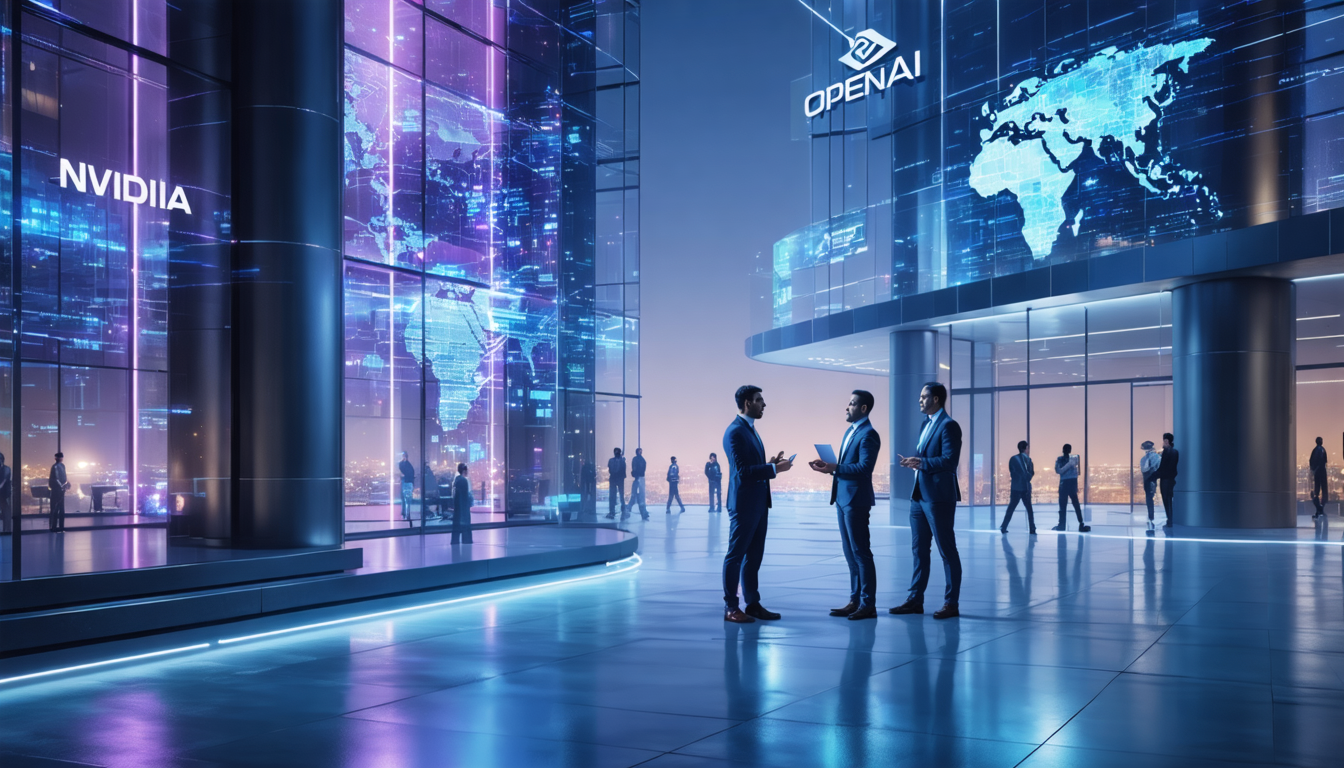
Some key innovations underway thanks to this partnership
- Processor optimization for increased performance in intensive computing
- Improvement of language models capable of understanding and generating multiple languages and dialects
- Development of deep learning algorithms accelerating the training of neural networks
- AI applications in healthcare for predictive analysis and diagnostic assistance
- Eco-responsible AI systems reducing energy consumption while increasing productivity
An innovative economic model: massive financing as a lever for growth and influence
Nvidia’s choice of a massive investment, combined with support from other giants like Amazon or Microsoft, fits into an innovative economic logic. It is no longer simply about acquiring shares or supporting a technological project but about building an ecosystem where massive financing acts as a catalyst to accelerate research, development, and commercialization.
This economic model relies on the convergence between technological power and fundraising capability, offering OpenAI a stable and substantial financial base. It also allows Nvidia to strengthen its influence on the development of artificial intelligence technologies by actively participating in defining strategic directions.
In this dynamic, the partnership goes beyond simple supplier-client relationships. It is a major industrial alliance closely linking hardware and AI software, where massive investments act as an innovation engine. The prospects for creating economic value are thus multiplied, both for the involved companies and for beneficiary sectors.
This financial lever also makes it possible to support ambitious long-term projects requiring exceptional resources, making this partnership a model likely to inspire other companies to engage in AI with similar means to remain competitive.