In a world where artificial intelligence is making great strides, Microsoft lays a new cornerstone by unveiling a revolutionary AI that radically transforms the way robots interact with their environment. This advance, embodied by the Rho-alpha model, marks a turning point in the convergence between natural language instruction programming and machines’ ability to adapt to the chaos of the real world. Gone are the days of robots frozen in rigid sequences, incapable of reacting to the unexpected. Now, thanks to this technological innovation, robots can understand, feel, and modify their behavior nearly in real time, much like a human facing a new situation.
Microsoft achieves a feat by merging vision, language, and tactile perception to give robots a sharp sense of reality. This embedded physical intelligence relies on sophisticated sensors, capable of detecting not only what the robot sees but also what it touches with finesse. Robots then become able to adjust their movements delicately, as when handling a fragile object or reacting to unexpected resistance. The integration of AI into mechanical arms thus paves the way for flexible and intuitive automation, which could disrupt sectors as diverse as industry, logistics, healthcare, or home assistance.
Beyond simple programming, this technology stands out for its ability to learn live, dynamically incorporating human corrections. When the robot makes a mistake, the operator’s intervention is no longer limited to a simple restart or laborious reprogramming: they can adjust the trajectory or the force of movements via intuitive 3D commands, and the AI incorporates this feedback to improve its future performance. This capacity for self-adaptation and continuous progression makes Rho-alpha a true platform for building the robots of tomorrow — smarter, stronger, and more collaborative.
Let us explore in detail the mechanisms, implications, and potential of this innovation that symbolizes the new revolution in the world of intelligent machines controlled by Microsoft, a company that continues to imprint its mark on the universe of artificial intelligence applied to robotics.
- 1 A new era for robots: understanding and executing natural instructions
- 2 Tactile perception: an unprecedented sense for fine and adaptive manipulation
- 3 How Rho-alpha learns and continually improves through human interaction
- 4 Microsoft Magma and the integration of language with visual perception and action
- 5 Comparison table of key features of Rho-alpha and Magma
- 6 Impact on industrial sectors: a revolution in automation
- 7 Microsoft and the long-term vision for robotics serving everyone
- 8 Ethical issues and challenges facing an AI capable of controlling autonomous robots
- 9 Future perspectives: toward a society where robotic AI integrates naturally
A new era for robots: understanding and executing natural instructions
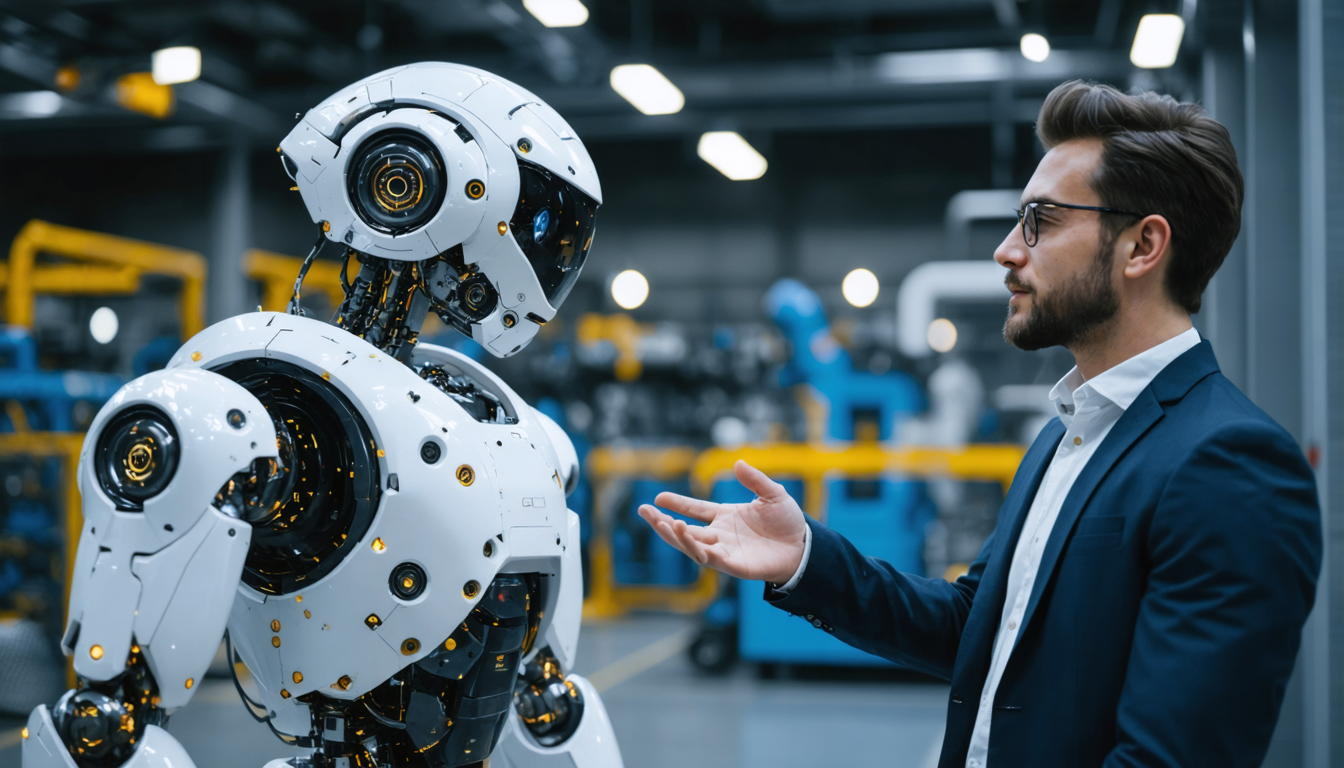
For a long time, industrial robots have been confined to repetitive tasks, based on rigid scripts, in controlled environments. This approach limited their scope to environments without surprises and to precise orders, often coded in machine language or via specialized interfaces. The arrival of Rho-alpha overturns this state of affairs by enabling robots to follow instructions formulated naturally, like in human exchanges, while adapting their behavior to each situation. For example, a simple request such as “pick up this object and place it on the table” no longer requires complex prior programming.
This qualitative leap is based on Microsoft’s AI model’s ability to interpret natural language and transform this understanding into precise robotic commands. The link between receiving an instruction and executing it is established through a close coupling of visual perception, language, and action. This integrated interaction makes Rho-alpha a highly performing experimental model applicable to both humanoid robots and two-arm platforms. These latter, like some tested humanoid prototypes, benefit from increased autonomy in the face of the unexpected, whether it concerns moved objects or unforeseen obstacles.
Microsoft thus capitalizes on the idea of physical intelligence, designed to meet the concrete and shifting needs of the real world, a notion that surpasses the limits of machines confined to a purely digital framework. According to Ashley Llorens, Vice President of Microsoft Research, this evolution fills a historical gap in robotics, where major advancements lagged behind the AI feats in language processing or computer vision. Rho-alpha offers a true symbiosis between these now-mastered skills, opening the door to a new generation of flexible and intuitive automation.
The integration of this type of technology into industrial and consumer robotics promises to radically renew modes of interaction between humans and machines, giving robots the long-awaited key quality of adaptability.
Tactile perception: an unprecedented sense for fine and adaptive manipulation
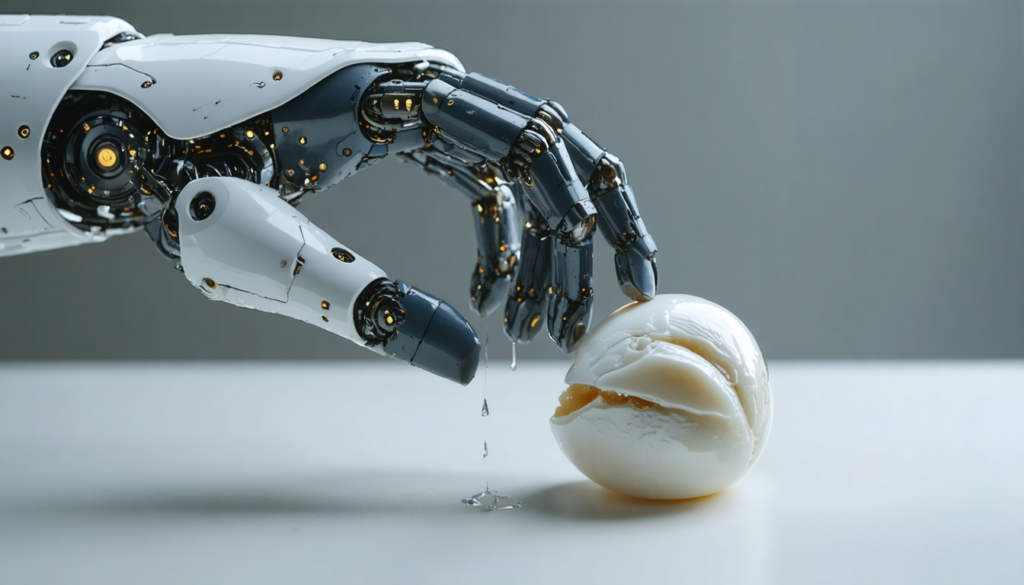
Vision is essential for enabling a robot to identify its action targets, but it is often not enough. Grasping an object, especially when it is fragile or unstable, requires a tactile sensitivity that few machines yet possess. Rho-alpha innovates by integrating this crucial dimension, thereby introducing a finesse still unexplored in robotic manipulation.
Tactile feedback allows the robot to feel the physical characteristics of the object, such as its texture, weight, the sensation of slipping, or resistance to effort. This capability transforms every movement into a dynamic action, capable of evolving based on sensations in real time. Rather than relying solely on a fixed plan, often derived from visual analysis, Rho-alpha adjusts its grip to avoid damaging the object or losing balance. These mechanisms inspire a precision worthy of the human hand and represent a major advance for sensitive applications such as robotic surgery, handling fragile materials in production, or assisting with household tasks.
Microsoft plans to further strengthen this sensory prism by eventually integrating additional force sensors and other perceptual modalities. The challenge is to enable robots to accurately judge the effort deployed to optimize their efficiency and safety. For example, when moving heavy objects or during delicate interactions with humans, this sensory richness is indispensable to react with accuracy and adaptability.
This tactile capability coupled with natural language understanding makes Rho-alpha a unique prototype that continually brings robotics closer to human intelligence. Moving from the virtual to the concrete, Microsoft thus gives life to a robot capable not only of obeying mechanically but also of sensing its environment.
How Rho-alpha learns and continually improves through human interaction
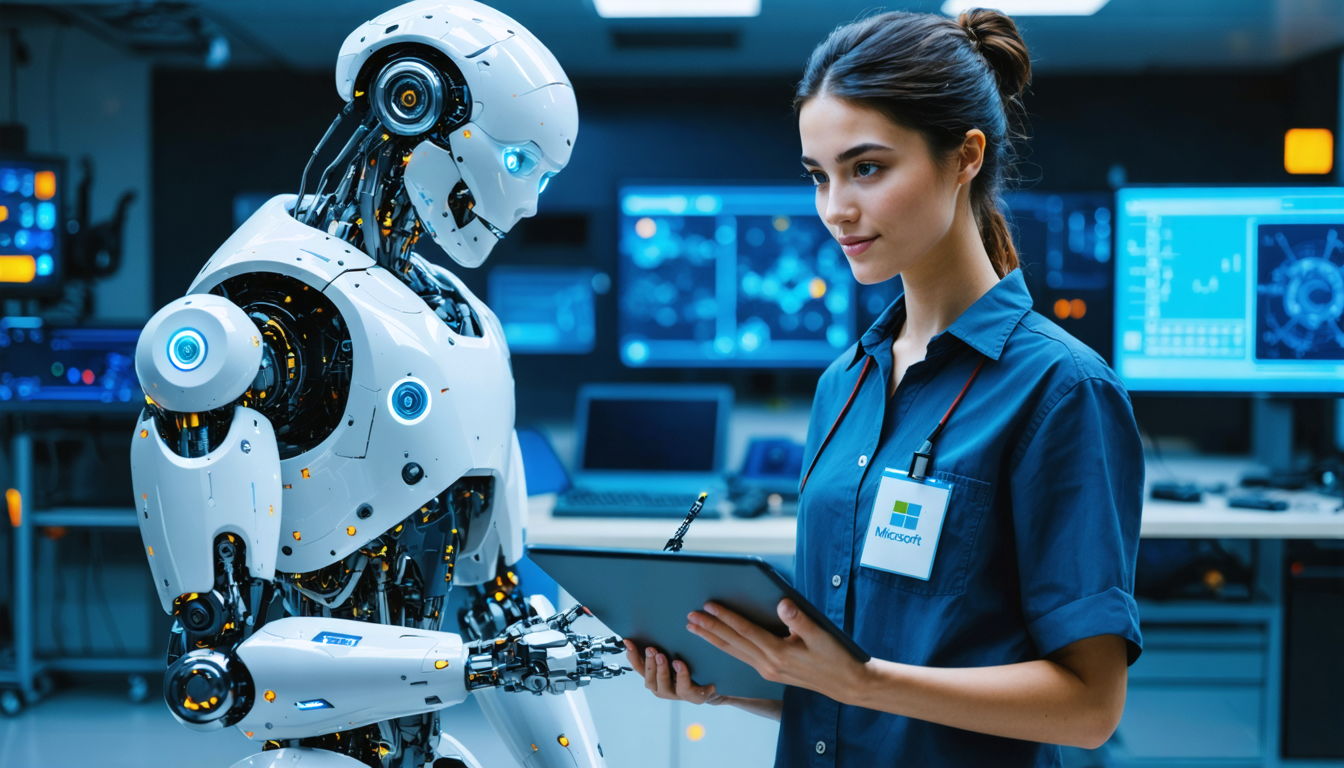
At the heart of this new generation of AI, learning is no longer limited to an initial phase before deployment. Rho-alpha implements a dynamic adaptation capability that allows it to refine its action strategies based on human feedback, and this, on the field. When an error occurs, the robot does not start from scratch but incorporates human corrections into its learning to avoid repeating the same mistakes in the future.
Microsoft has designed intuitive interfaces to facilitate these corrective interactions. For example, thanks to manageable 3D input devices, operators can adjust the trajectory of mechanical arms and the robot instantly memorizes these modifications. This “learning by doing” method guarantees rapid progress without requiring heavy reprogramming. It also illustrates a profound shift toward collaboration between humans and robots based on co-evolution.
This continuous learning system represents a strategic advance in the field of flexible automation, where humans are no longer merely passive spectators or supervisors but active supervisors who guide and improve machine behavior. The technology also supports advanced customization of robots, capable of adapting to end users’ preferences or habits. For example, in a domestic environment, the robot will, after a few interactions, anticipate your tastes to organize or handle objects in a way that suits you.
This adaptability mechanism revolutionizes traditional robotics by combining the power of algorithms with the richness of human experience, making AI not only more effective but also closer to our expectations.
Microsoft Magma and the integration of language with visual perception and action
Rho-alpha does not come out of nowhere. It is part of the continuity of Microsoft’s efforts in developing physical AI. One of the important milestones is the Magma model, a generative artificial intelligence (GenAI) model capable of supervising both software and robotic interfaces. Magma combines linguistic understanding with visual perception to generate coherent and precise actions, a process that renders traditional programming almost obsolete.
Magma exploits a foundational system that merges verbal, spatial, and temporal data, offering a kind of embodied understanding that allows intelligent agents to make decisions in real time and adapt without requiring specific training for each task or environment. This flexibility enables Magma to pilot a wide variety of robots and systems, ranging from simple industrial machines to advanced humanoid robots.
Magma’s innovation also lies in its multi-modality dimension, simultaneously integrating streams of text data, images, motor commands, and other sensory signals. This convergence offers machines a more complete understanding of instructions, for smooth and natural execution, with adjustments during action like a human who revises their gestures in context.
Microsoft’s Foundry platform should soon encompass this technology to make it accessible to a wider audience, especially researchers and developers eager to design intelligent and flexible robots. The rise of Magma thus represents a major step toward democratizing intelligent, easy-to-use, and adaptable control in robotics.
Comparison table of key features of Rho-alpha and Magma
| Features | Rho-alpha | Magma |
|---|---|---|
| Model type | Model focused on physical robotics | Multi-modal generative artificial intelligence model |
| Perception used | Vision, language, touch (tactile) | Vision, language, spatial and temporal data |
| Learning capability | Continuous learning with human corrections | Real-time adaptation without specific training |
| Main applications | Object manipulation, precise gestures, robot autonomy | Wide control of agents and robots, software and physical interface |
| Target audience | Robotics developers, physical AI researchers | Engineers, researchers, software and robotics developers |
Impact on industrial sectors: a revolution in automation
The integration of these new artificial intelligences into robotics will profoundly transform several industrial sectors. The ability of robots to understand natural language instructions and to handle various materials with finesse responds to growing needs for flexible automation, particularly in areas where tasks are complex and poorly standardized.
In logistics, for example, robots controlled by Rho-alpha can manage variable loads while navigating warehouses filled with unexpected items, adjusting their trajectories to avoid moving obstacles or reposition misplaced packages. In healthcare, robots equipped with this technology will be able to assist in delicate interventions, offering increased precision thanks to advanced tactile perception.
The manufacturing industry also benefits from this revolution. Production lines, often designed for strict repetition, can now incorporate more adaptable robots capable of modifying their behavior based on environmental variations or material characteristics. This reduces downtime related to unforeseen events and improves the quality of the final product.
Here is a list of the main advantages that Microsoft’s robotic AI brings to industries:
- Adaptability: ability to handle unplanned situations without human intervention
- Improved precision: thanks to tactile perception and integrated vision
- Continuous learning: constant improvement through dynamic feedback
- Ease of integration: natural language instructions reducing programming complexity
- Simplified human interaction: intuitive interfaces for real-time corrections
These innovations promise to open the way to smarter automation, capable of evolving over time and responding to the growing demands of modern industrial sectors.
Microsoft and the long-term vision for robotics serving everyone
The portability and scalability of Microsoft models like Rho-alpha and Magma reflect a broader ambition: to democratize the use of intelligent robots beyond strictly industrial spaces, reaching areas as varied as homes, public spaces, or even scientific research.
Microsoft aims to embed physical AI at the very heart of mechanical devices, thus creating a constant dialogue between machine and the real world. Freed from their digital confinements, robots become true partners in everyday tasks, capable of understanding the nuances of human communication and adjusting accordingly.
Ultimately, the company anticipates an ecosystem where robots will collaborate with humans in a spirit of complementarity, safety, and trust. This vision relies on high ethical standards and sustainable technology development where robotics primarily serves to enhance human capabilities, without replacing them.
This direction comes with significant efforts to open access to tools via the Foundry platform, designed to ease adoption by researchers, developers, and industrialists. International collaboration around these technologies is expected to speed up their maturation and multiply innovative use cases.
Ethical issues and challenges facing an AI capable of controlling autonomous robots
Every major innovation raises its share of questions, especially when it comes to entrusting artificial intelligences with physical manipulation in the real world. Microsoft engages in an open dialogue on ethical issues related to its technologies, notably safety, transparency, and responsibility.
The automatic control of robots capable of physical interaction poses challenges in terms of supervision and boundary-setting to avoid any unforeseen or inappropriate behavior. Dynamic learning with human feedback mitigates these risks by ensuring continuous control and incorporation of human preferences and instructions, but it does not eliminate all uncertainties.
Legal and regulatory frameworks are therefore under development to govern these new forms of robotic intelligence, with active participation from researchers, public authorities, and major technology companies like Microsoft. The goal is to establish safety standards, ensure the confidentiality of data collected by these machines, and guarantee ethical conditions of use.
For end users, transparency about the AI’s functioning and capabilities is essential to gain their trust. Microsoft also invests in training and raising awareness about the benefits and limitations of its technologies, promoting responsible and informed usage.
Future perspectives: toward a society where robotic AI integrates naturally
With the arrival of Rho-alpha and Magma, robotics crosses a decisive threshold toward intelligent autonomy, where understanding and execution of tasks are done smoothly, naturally, and adaptively. This revolutionary technology continues to evolve thanks to user feedback and research advances, heralding a future where robots will be essential and benevolent actors in our daily lives.
Prototypes of robots capable of perceiving touch, understanding natural language, and communicating through their actions already demonstrate the enormous potential of a more human automation. Microsoft, by combining innovation and pragmatism, is preparing the ground for harmonious collaboration between humans and their machines, a balance eagerly awaited by industries, services, and households.