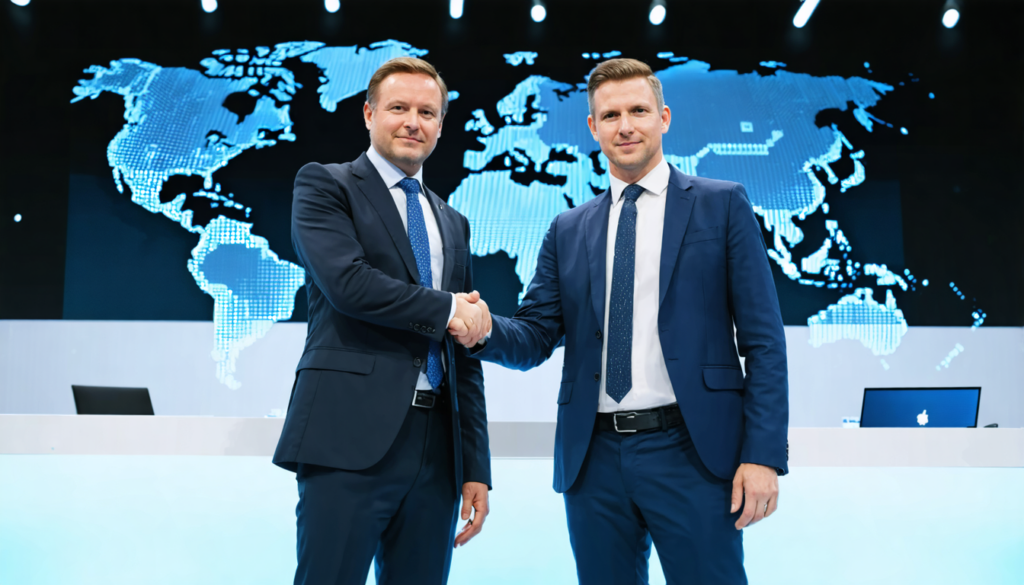
During the India AI Impact Summit held in New Delhi, an event meant to symbolize unity and international collaboration around the rapid rise of artificial intelligence, a surprising incident captured global attention. Sam Altman, CEO of OpenAI, and Dario Amodei, founder and CEO of Anthropic, stood side by side while conspicuously refusing to hold hands, thus breaking the chain of unity staged before Indian Prime Minister Narendra Modi and international cameras. This simple gesture, or rather its absence, revealed a deep rift between two powerful AI players, embodying a strategic and ideological rivalry that now shapes the debates about the future of this disruptive technology. In a global context where AI creeps into the heart of economic, social, and geopolitical infrastructures, this public display of latent tension raises many questions about coexistence, regulation, but also the future direction of artificial intelligence development.
This refusal of symbolic contact goes far beyond the simple protocol of an official photo. It suggests that behind technological advances lies a clash of visions. On one side, OpenAI embodies a dynamic of commercial acceleration and rapid integration into various mass-market sectors, adopting an offensive stance by multiplying partnerships and accessible innovations. On the other side, Anthropic has firmly positioned itself with a more cautious approach, prioritizing safety, risk control, and the implementation of robust safeguards in AI system development. Between these two CEOs, coming from the same technological lineage but now irreconcilable, a marked opposition emerges between economic ambition and ethical concerns.
These central issues came to light in New Delhi. Far from being a mere awkward moment, this symbolic gesture highlights the profound challenges facing the AI ecosystem: the rivalry between rapid growth and regulatory caution, geopolitical tensions around technology control, and the challenge of building lasting trust with governments and the public. This summit, meant to celebrate the alliance of innovation and responsibility, ultimately exposed the divisions that may well redefine the rules of the game in the field of artificial intelligence.
- 1 A symbolic rupture at the global artificial intelligence summit in New Delhi
- 2 OpenAI and Anthropic: a rivalry born from a fundamental disagreement
- 3 The play of symbols: why this avoided gesture is much more than a missed handshake
- 4 The economic and geopolitical stakes fueling this conflict between OpenAI and Anthropic
- 5 The perception of developers and investors in this context of heightened rivalry
- 6 What consequences for regulation and international cooperation on AI?
- 7 Perspectives on the rivalry between the CEOs: beyond symbolic gestures
- 8 How this conflict reveals deep tensions about the future of artificial intelligence
- 8.1 Why did Sam Altman and Dario Amodei avoid shaking hands at the summit?
- 8.2 What are the major differences between OpenAI and Anthropic?
- 8.3 How can this conflict impact international AI regulation?
- 8.4 What is the importance of this conflict for investors and developers?
- 8.5 Is the future of rivalry between OpenAI and Anthropic open to collaboration?
A symbolic rupture at the global artificial intelligence summit in New Delhi
On February 19, 2026, at the fourth edition of the India AI Impact Summit, the international AI stage witnessed an unprecedented episode. This conference, aimed at positioning India as a major player in the global artificial intelligence landscape, brought together the biggest figures in the sector, including Sam Altman of OpenAI and Dario Amodei of Anthropic. Prime Minister Narendra Modi had planned a symbolic ceremony designed to seal the union of key players around a shared vision of responsible AI.
The leaders present were supposed to hold hands while raising their arms, a gesture meant to demonstrate unity and collective commitment to a harmonious technological future. However, when the moment came under the spotlight, the two CEOs standing side by side broke this spirit of collaboration. Instead of a handshake or joined hands, Sam Altman and Dario Amodei raised their clenched fists, interrupting the chain meant to symbolize a unified industry. This difference in gesture was immediately relayed on social media, sparking a flood of analyses, speculations, and reactions.
This public stance triggers a reading beyond simple protocol: it is perceived as the expression of a latent conflict, a strategic rivalry, and above all disagreement on how artificial intelligence should evolve. In a universe where every detail is scrutinized, choosing to avoid any visible contact between these two CEOs is a strong signal, a silent but clear message, rejecting the facade of harmonious collaboration presented to states and the general public. This image thus captured the attention not only of industry observers but also governments who are redoubling efforts to frame and understand the internal dynamics of this rapidly changing industry.
OpenAI and Anthropic: a rivalry born from a fundamental disagreement
To understand the scope of this rupture, we must go back to the roots of the rivalry between these two heavyweights in artificial intelligence. Dario Amodei, former Vice President of Research at OpenAI, left the company in 2021 with several collaborators, including his sister Daniela Amodei, to create Anthropic. This departure was not merely a professional change of course but a reflection of a fundamental disagreement on AI deployment strategy.
While OpenAI chose to accelerate the commercialization of its models, multiplying applications intended for the general public and forging partnerships with large companies, Dario Amodei advocated a more conservative approach, insisting on the necessity to resolutely invest in system safety and reducing risks associated with advanced artificial intelligences. This divide is today at the heart of their public disagreements and their respective business models.
Anthropic quickly built its identity around a strong ethics, emphasizing rigorous control processes and designing its AI, Claude, as a safe, transparent product aligned with the strictest standards. This strategy particularly appeals to developers concerned with security and governments seeking to regulate this technology to avoid abuses.
On its side, OpenAI adopted a more offensive market stance, launching features integrated into popular tools such as ChatGPT and exploring new revenue streams, like the recent introduction of targeted advertising. This pragmatic approach allowed OpenAI to consolidate its leadership position and benefit from massive financial backing, but at the cost, according to its detractors, of a relative weakening of safety controls.
The philosophical differences thus translate into opposing commercial strategies:
- OpenAI bets on rapid growth, massive adoption, and revenue diversification.
- Anthropic favors caution, safety, and more moderate expansion.
This opposition is not merely an academic debate: it also has concrete impacts on technological choices, product development, and claims made to international regulators, contributing to exacerbating the visible tension between their CEOs.
The play of symbols: why this avoided gesture is much more than a missed handshake
In the highly codified universe of international summits, every gesture of leaders is scrutinized, interpreted, and commented upon. The handshake, often seen as a marker of agreement and mutual respect, holds a particular symbolic charge when absent between such influential figures.
The refusal of Sam Altman and Dario Amodei to shake hands quickly made rounds in the media and on social networks. In a now viral video, the two CEOs simultaneously raised their clenched fists, defying protocol. This moment, seemingly trivial, is actually carrying a strong message about their conflictual dynamic. It expresses a refusal to display feigned complicity in a context where their rivalry has become too deep to hide.
This avoided gesture by the two men illustrates:
- The deep mistrust and strategic competition opposing them.
- An explicit will to mark their ideological differences, even before a prestigious audience.
- A signal sent to industry players, regulators, and the general public about the divide tearing the AI ecosystem apart.
Beyond the symbol, this event also reveals how communication in the AI world becomes a powerful weapon. Every public stance is now used to reinforce one’s camp, assert a development philosophy, and influence the overall perception of the technology.
The economic and geopolitical stakes fueling this conflict between OpenAI and Anthropic
The rivalry between these two players is not limited to a mere clash of ideas or a personal conflict between Sam Altman and Dario Amodei. It also reflects much broader issues, mixing commercial strategies, competition for geopolitical influence, and national security matters.
In a global context where AI is seen as a key technology for the economic and military future, states view these companies as strategic partners but also potential rivals. India, host of this latest summit, seeks to become a major AI hub, but the rift between OpenAI and Anthropic also reveals the complexity of ensuring smooth collaboration between giants of the sector.
Economically, OpenAI and Anthropic compete to capture the attention of investors, developers, and client companies. Their differentiation also passes through the image they construct:
| Element | OpenAI | Anthropic |
|---|---|---|
| Commercial strategy | Acceleration, revenue diversification, high accessibility | Caution, priority on safety, gradual adoption |
| Relation with regulators | More offensive position, significant lobbying | Cooperative approach, focus on safety regulation |
| Public image | Innovative leader, but criticized for security risks | Champions of responsibility, but perceived as slower |
| Position on safety | More permissive approach | High priority given to safeguards |
Beyond just the sector players, governments scrutinize these dynamics to guide their public policies. The visible lack of agreement between two such influential CEOs questions their collective ability to meet expectations on regulation, safety, and transparency. This tension also illustrates how commercial, security, and political stakes intersect in this competition.
The perception of developers and investors in this context of heightened rivalry
For industry professionals, developers, startups, and investors, the incident at the Indian summit is far from a mere public spectacle; it is a barometer of future balances in the AI market. These actors carefully scrutinize every sign as they influence investment choices, partnerships, and technological adoption.
Developers, for example, are sensitive to the promise of enhanced stability and security surrounding Anthropic. The chatbot Claude, presented as safer and more responsible, appeals to those seeking to integrate AI into sensitive or regulated applications.
Conversely, many adopt OpenAI’s tools for their power, integration into a large ecosystem, and capacity for rapid innovation. This polarization thus creates two distinct technological poles, each driven by different offers and visions.
On the investor side, the rivalry also fuels divergence in funding strategies:
- Some funds support caution and responsibility as a sustainable competitive advantage.
- Others favor rapid growth to capture the market before stricter regulation.
These preferences nourish a fragmented ecosystem where each player must choose its ally according to its own vision of AI’s future. This situation also influences the dynamics of fundraising, startup valuations, and the pace of publicly unveiled innovations.
What consequences for regulation and international cooperation on AI?
The apparent refusal to collaborate between OpenAI and Anthropic during a summit meant to promote unity highlights major challenges facing governments and regulatory bodies. States seek reliable partners capable of cooperating on common standards, security standards, and ethical controls transcending national borders.
The divide between two sector leaders makes establishing international consensus difficult. Yet this consensus is essential, as AI now transcends national frameworks and its social, economic, and security impacts cross continents. The breakdown of this unity also complicates discussions on usage rules, risk management, and audit mechanisms.
Moreover, the public stance of the CEOs helps shape regulators’ image of AI players. Such a visible conflict breeds mistrust, suggesting that commercial interests may override the willingness to cooperate. This could strengthen calls for stricter regulation and the intervention of public bodies to frame development, or even limit certain uses.
In the short term, states could adopt the following measures:
- Strengthening transparency requirements for AI models.
- Creating independent evaluation committees to certify systems.
- Developing frameworks for international collaboration ensuring AI safety.
- Promoting initiatives favoring ethical research and developer training.
- Applying sanctions in the event of non-compliance with safety rules.
The New Delhi episode should thus be interpreted as an alert signal illustrating how rivalries within the sector can have global repercussions on the governance of artificial intelligence.
Perspectives on the rivalry between the CEOs: beyond symbolic gestures
With the rapid development of AI technologies and the increasing financial, regulatory, and geopolitical stakes, the rivalry between Sam Altman and Dario Amodei is expected to crystallize further. It is no longer just a rivalry between entrepreneurs but a clash of visions that will shape the industry in the years to come.
The tensions observed at the summit indicate that this confrontation should extend well beyond symbolic public moments to infiltrate strategies, lobbying, and overall governance of the ecosystem. Leadership in AI will become a key issue for the competitiveness of states, commercial ambitions of companies, and the trust of end users.
Furthermore, this rivalry will impact how new solutions are deployed. A deep divergence between innovation speed and caution could lead to:
- Delays in establishing universal standards.
- Disparities in quality and reliability of AI systems used across different sectors.
- Increased competition for control over technological advances and emerging markets.
Ultimately, both groups will need to clarify their position on development priorities and the societal responsibility that accompanies such technological power. Finally, rivalry may encourage innovation but also complicate building a global consensus necessary to prevent potential abuses.
How this conflict reveals deep tensions about the future of artificial intelligence
This public refusal of contact between the two CEOs is a concrete manifestation of an ideological and strategic divide that now runs through the entire AI industry. These tensions are not simply internal quarrels but reflect broader contradictions between economic, ethical, and political imperatives.
Artificial intelligence, by embedding itself in all aspects of our societies, raises complex questions. How to reconcile rapid and efficient deployment with the need to frame risks and ensure lasting trust? The debates sparked by the confrontation between OpenAI and Anthropic perfectly illustrate this dilemma.
We observe that this conflict fuels divisions that can weaken international cooperation, slow the definition of common standards, or encourage heavier regulatory measures. The rivalry also exacerbates polarization among players, forcing governments, investors, and users to make sometimes stark choices.
This is thus a pivotal moment where ideology, strategy, and symbolism intertwine to chart the path forward in artificial intelligence. Understanding these dynamics is essential to anticipate the evolutions that will shape not only the tech sector but also global balances in the coming years.
Why did Sam Altman and Dario Amodei avoid shaking hands at the summit?
This symbolic gesture reflects a deep rivalry between their respective visions of AI. Amodei favors safety and caution, while Altman bets on rapid growth and accelerated commercialization.
What are the major differences between OpenAI and Anthropic?
OpenAI pursues an aggressive and broad commercial strategy, while Anthropic leans towards a cautious approach focused on safety and ethics in AI development.
How can this conflict impact international AI regulation?
It complicates the establishment of a global consensus, as divergences between major players delay the creation of common standards, which leads to stricter or national regulations.
What is the importance of this conflict for investors and developers?
This confrontation influences strategic investment choices, favoring either AI models focused on long-term safety or approaches based on rapid growth and massive adoption.
Is the future of rivalry between OpenAI and Anthropic open to collaboration?
For now, the rivalry remains very marked, but high economic and regulatory stakes could push towards some form of compromise or cooperation in specific areas.