

At the heart of technological evolution since the 1970s, the computer infocenter represents an unknown yet fundamental pillar for data management in companies. Born from a crucial need to facilitate reporting and data analysis without disrupting production systems, this concept paved the way for modern methods such as the Data Warehouse and the current Data Mesh. Originally, the infocenter appeared as a pivotal solution, combining centralization and sharing of essential information for decision-making, while managing the growing complexity of databases and storage. As organizational demands intensify, understanding this technological heritage allows us to appreciate the foundations on which today’s complex information systems and their innovative architectures are built.
In a context where companies must continuously analyze increasingly large volumes of data, historical infocenters still play a significant role in certain specific environments, notably SMEs or some public sectors. Their design illustrates an era where computing power was centralized on mainframes, offering delayed but secure access to consolidated data. From this architecture emerges a whole family of IT solutions, each adapting the model to improve efficiency, responsiveness, and availability of strategic information. The shift from centralized processing to decentralized computing presents a striking contrast with new architectures based on distributed governance, highlighting the importance of revisiting the roles infocenters continue to occupy in organizations’ digital transformation.
- 1 Origins and fundamental operation of the computer infocenter
- 2 Limitations of the infocenter and the emergence of the Data Warehouse
- 3 Contemporary applications of the infocenter in companies and institutions
- 4 Evolution towards decentralized architectures: from Data Warehouse to Data Mesh
- 5 Practical uses, benefits and advice for implementing an infocenter
Origins and fundamental operation of the computer infocenter
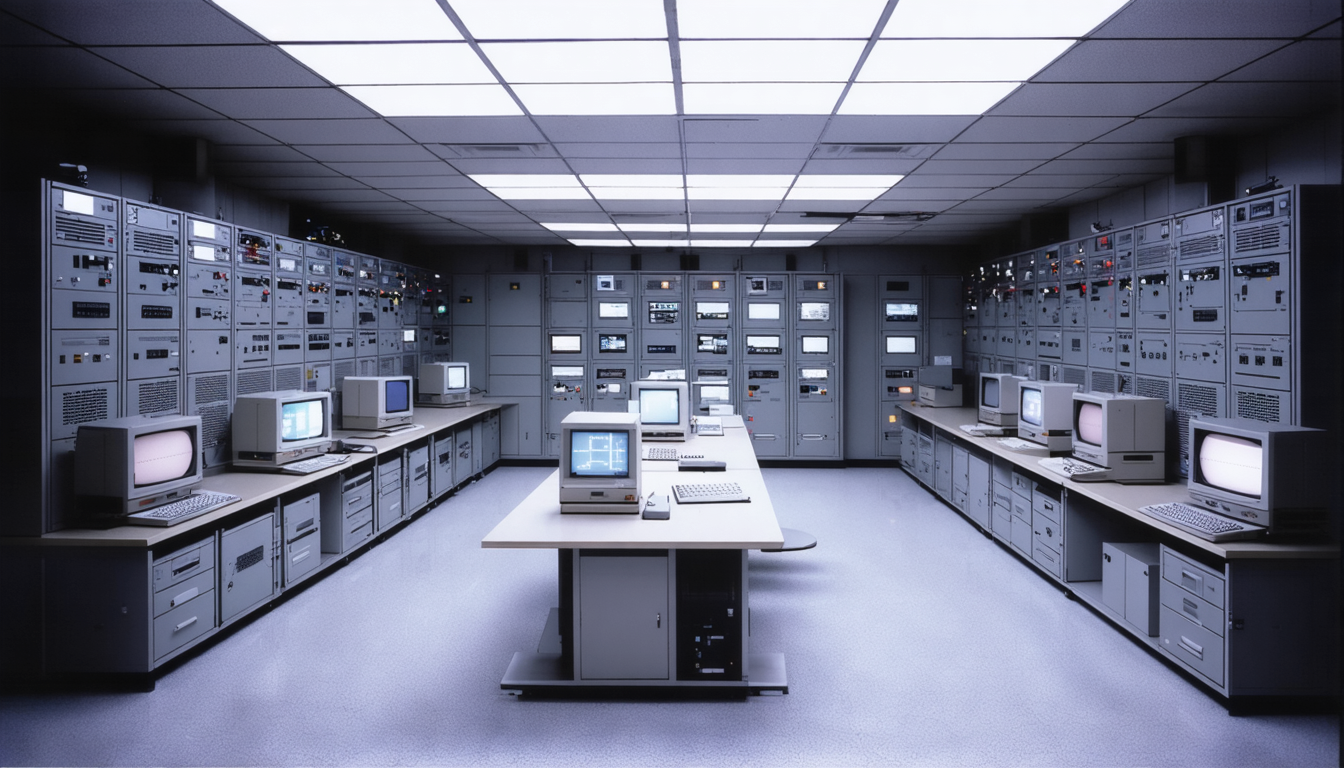
The computer infocenter dates back to the 1970s, a time when companies faced major difficulties in efficiently managing their large and constantly evolving databases. Initially, the model relied on a powerful central computer that communicated with passive terminals such as cathode ray tube screens or printers. This centralized architecture allowed for allocating the necessary computing power to query complex databases without impacting production operations.
Users sent queries via programming languages advanced for the time, particularly BASIC, FORTRAN, or APL. The establishment of the infocenter notably allowed analysts to have a duplicated database, which avoided the risks of overloading production servers and ensured the continuity of critical data entry and updates. This dual approach — one side dedicated to data entry, the other to analysis — was innovative at a time when information systems were generally much more rigid and less efficient than today’s.
In summary, the essential role of an infocenter is to centralize the storage of data from various business applications, while optimizing access for decision-making queries. This centralization facilitated the creation of detailed reports — or reporting — by managers and executives. Typical uses include:
- Consolidating financial information to generate regular accounting statements.
- Tracking key performance indicators by department or service.
- Managing human resources via databases dedicated to personnel and schedules.
- Analyzing sales and customer trends to refine marketing strategies.
| Element | Description | Associated Technology |
|---|---|---|
| Central computer | Main machine with high computing power | UNIX, VMS, MVS/TSO |
| Passive terminals | Input/output devices (connected screens, printers) | Cathode ray tube screens, typewriters |
| Query languages | Means to query and manipulate databases | BASIC, FORTRAN, APL |
This organization also contributed to the development of personal computer architectures by allowing data processing to be located on the user workstation while ensuring the reliability of centralized databases. Thus, from the 1980s, specialized infocenters, notably for human resources management, emerged to meet specific business needs with better accessibility.

Limitations of the infocenter and the emergence of the Data Warehouse
While the infocenter was a major step forward in terms of data management and the decision-making information system, this model was not without flaws, particularly noticeable when companies began multiplying their business applications. Among the main constraints most often encountered are:
- High consumption of IT resources: The centralization model heavily mobilized mainframe machines, limiting scalability and performance during peak activity.
- Limited data integration: Generally, an infocenter connected to a single information source, creating silos and preventing cross-analysis.
- Lack of historization: Data was not always historized, restricting temporal analyses and long-term trends.
- High costs: Duplicating databases and the need for expensive hardware involved significant, sometimes prohibitive, expenses.
Faced with these limits, the concept of the Data Warehouse appeared in the 1990s in response to complex challenges related to multiple sources and growing data volume. The Data Warehouse offers:
- Historical storage of data, allowing going back in time and analyzing trends.
- A data architecture organized into silos thanks to Datamarts, to meet the specific needs of different business units.
- Better performance with background processing and optimized access 24/7.
- The ability to integrate data from several business applications, breaking traditional silos.
| Aspect | Infocenter | Data Warehouse |
|---|---|---|
| Number of integrated sources | 1 or very few | Several |
| Historization | Often absent | Yes |
| Performance | Less optimized | Accessible 24/7 |
| Costs | High | Moderate to high depending on the case |
More than a simple evolution, the transition from the infocenter model to that of the Data Warehouse marked a crucial turning point towards what is now called decision-making IT or business intelligence. This transition allowed companies to significantly improve the efficiency and relevance of their reports, helping decision-makers to make strategic decisions based on more reliable and integrated data.
Contemporary applications of the infocenter in companies and institutions
Despite the significant technological advances brought by the Data Warehouse and modern business intelligence systems, the infocenter remains a relevant tool in some contexts, notably for organizations with more modest or specific needs. In 2025, several institutions and SMEs continue to use infocenters, often in software form or through adapted Cloud services. Here are some application areas:
- Healthcare sector: Several hospitals still use infocenters to manage and analyze their internal data, notably in managing medical resources and patient tracking.
- Public administration: Public organizations such as ministries or research institutes (like CNRS) maintain infocenters to consolidate their decision-making databases.
- Small and medium-sized enterprises: Some SMEs prefer simplified solutions for centralizing and analyzing their data without resorting to complex or costly infrastructures.
Several IT solution providers today offer adapted infocenter software, accessible in SaaS mode or integrated into the Cloud, allowing rapid deployment and controlled costs. Among these players are, for example, CTI Santé, Esus group, and id Logiciel, specialized in sector-specific infocenters.
| Type of organization | Main use | Advantages of the infocenter model |
|---|---|---|
| Hospitals | Management of patient data and administration | Simplicity, security, and local availability |
| Public institutions | Gathering research and administrative data | Consolidation and reliability |
| SMEs | Internal analysis and financial reporting | Reduced cost and speed of implementation |
However, in a period where agility and speed of real-time information access become crucial criteria, these infocenters must often coexist with more modern architectures. They thus benefit from regular backups and optimizations to continue providing strategic value alongside newer tools.
Evolution towards decentralized architectures: from Data Warehouse to Data Mesh
While the computer infocenter and the Data Warehouse were based on centralized or semi-centralized data management models, the advent of Data Mesh embodies a radical change in how IT architecture and data governance are approached in 2025.
Data Mesh proposes decentralizing data ownership by empowering each business domain to manage its own data as a product, with federated governance. This approach addresses weaknesses observed in infocenters, notably the bottleneck created by centralization and difficulties integrating multiple sources.
- Each business team becomes the owner and responsible for the data it produces.
- An architecture distributes loads and promotes agility in information access.
- The system provides near-immediate data availability, eliminating delays observed in centralized infocenters.
- It encourages the use of real-time Artificial Intelligence tools thanks to fresh and reliable data.
The most innovative companies, notably in the banking sector, adopt this model in 2025 to replace old central warehouses, allowing their compliance teams and analytics departments to access critical data directly. In fact, Data Mesh deploys a truly dynamic ecosystem that improves responsiveness and the quality of strategic decisions, thus overcoming the historical limitations of the infocenter.
| Characteristic | Infocenter | Data Warehouse | Data Mesh |
|---|---|---|---|
| Centralization | High | Medium | Low (decentralized) |
| Access management | Via centralized IT | Via specialized IT | Federated governance |
| Data availability | Delay (often D+1) | Real-time or near real-time | Real-time |
| Scale | Limited | High | Very high |
This evolution symbolizes the shift from static IT to dynamic IT, capable of supporting the growing complexity of business needs and massive data processing in the era of artificial intelligence and Big Data.

Practical uses, benefits and advice for implementing an infocenter
Although the trend is towards data decentralization, the infocenter remains a valuable solution for certain contexts where simplicity, security, and controlled access speed are priorities. Here are some concrete benefits and recommendations for successful implementation:
- Securing sensitive data: Centralizing critical data in an infocenter facilitates strict access controls and backup procedures.
- Facilitating operational reporting: The infocenter provides quick access to consolidated data to produce regular and standardized reports without impacting current operations.
- Reducing technical risks: By separating analysis systems from production systems, it minimizes the risks of data failure or corruption.
- Supporting decision-making: By offering a single access point to key data, it strengthens decision-making teams’ ability to rely on reliable information.
To succeed in your infocenter project, it is advised to:
- Precisely assess business needs to adapt the infrastructure.
- Choose tools compatible with existing systems and scalable.
- Ensure clear governance and well-defined access rules.
- Plan for regular maintenance and technical supervision.
- Encourage user training to ensure good adoption.
| Best practices | Description | Benefits |
|---|---|---|
| Controlled centralization | Gather essential data while limiting unnecessary duplications | Performance and simplicity |
| Advanced security | Control access and regularly back up data | Increased confidence and compliance |
| User training | Train teams to optimize tool usage | Smooth adoption and productivity gains |
Ultimately, the computer infocenter remains a strategic component of an organization’s IT ecosystem whose choice will depend on ambitions, company size, and sector. Its successful integration can offer significant advantages, notably in terms of efficiency, security, and management.
{“@context”:”https://schema.org”,”@type”:”FAQPage”,”mainEntity”:[{“@type”:”Question”,”name”:”What is a computer infocenter?”,”acceptedAnswer”:{“@type”:”Answer”,”text”:”An infocenter is a system that centralizes and duplicates a company’s data in a single space to enable analysis without disrupting production applications.”}},{“@type”:”Question”,”name”:”Why were infocenters created?”,”acceptedAnswer”:{“@type”:”Answer”,”text”:”They were created to prevent analytical queries from blocking data entry systems, allowing analysts to work on a copy of the data safely.”}},{“@type”:”Question”,”name”:”How did an infocenter originally work?”,”acceptedAnswer”:{“@type”:”Answer”,”text”:”It relied on a powerful central computer connected to passive terminals, using languages like BASIC or FORTRAN to query databases.”}},{“@type”:”Question”,”name”:”How does an infocenter differ from a Data Warehouse?”,”acceptedAnswer”:{“@type”:”Answer”,”text”:”The infocenter is limited to one or a few data sources, consumes a lot of resources, and does not always historize information. The Data Warehouse integrates multiple applications, organizes data, and keeps it over time.”}}]}What is a computer infocenter?
An infocenter is a system that centralizes and duplicates a company’s data in a single space to enable analysis without disrupting production applications.
Why were infocenters created?
They were created to prevent analytical queries from blocking data entry systems, allowing analysts to work on a copy of the data safely.
How did an infocenter originally work?
It relied on a powerful central computer connected to passive terminals, using languages like BASIC or FORTRAN to query databases.
How does an infocenter differ from a Data Warehouse?
The infocenter is limited to one or a few data sources, consumes a lot of resources, and does not always historize information. The Data Warehouse integrates multiple applications, organizes data, and keeps it over time.




