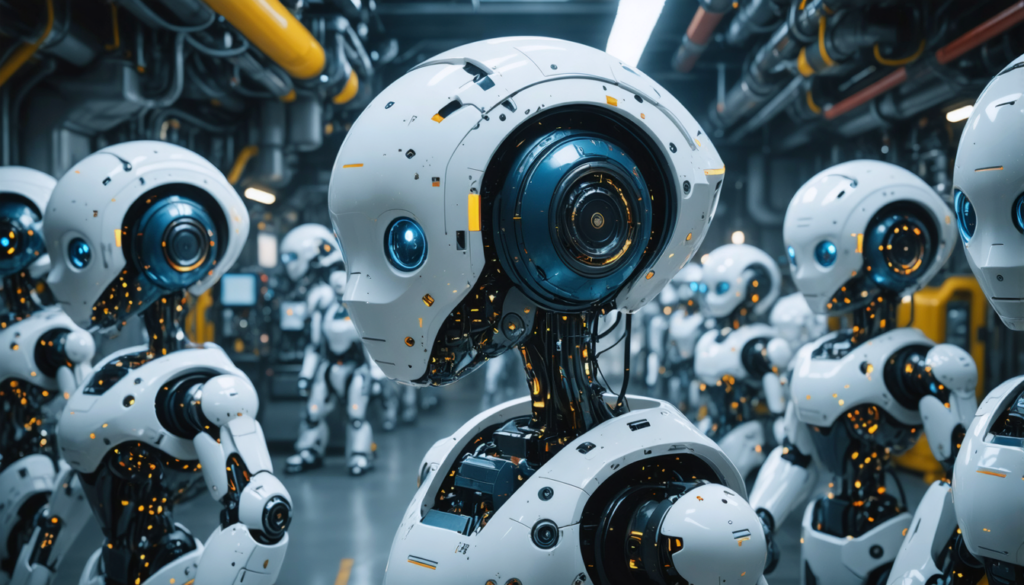
At the dawn of 2026, industrial and service robotics is undergoing a major transformation, not through the creation of new iconic robots, but through a remarkable advancement in artificial intelligence that coordinates a true mechanical army. Humanoid, a pioneering company, unveils KinetIQ, an innovative AI brain capable of simultaneously managing an entire fleet of heterogeneous robots. This convergence between robotics and collective intelligence marks a new stage in how autonomous systems interact with their environment and adapt in real time.
At the heart of this revolution, KinetIQ goes beyond simple automation. It unifies the management of robots with diverse shapes and functions, ranging from mobile robots dedicated to logistics to bipedal humanoids responsible for service interactions. This orchestration not only allows for greater efficiency in the field but also promises to reduce integration costs and open the way to new industrial and commercial applications. The concept of a “shared brain” for an entire fleet, with shared intelligence, disrupts the traditional paradigm where each robot operates in isolation.
The KinetIQ platform, based on a four-layer multitasking architecture, combines strategic decision-making, contextual adaptation, and precise motor control. This intelligent hierarchy grants robots fluid movement, operational autonomy, and unprecedented collaboration between machines. In a world where advanced technology constantly redefines standards, Humanoid establishes itself as a central player in the next industrial revolution through collective robotics.
- 1 A unified artificial intelligence: transforming the robot fleet into an integrated system
- 2 KinetIQ: an advanced four-layer architecture for responsive and strategic robotic orchestration
- 3 Concrete examples of using KinetIQ in logistics and services
- 4 Towards a redesigned industrial automation thanks to collective robotic intelligence
- 5 Security and reliability issues in centralized robotic fleet management
- 6 Humanoid robots and human interaction: a collaboration in full evolution
- 7 Innovation prospects and the future of cooperative robotics
A unified artificial intelligence: transforming the robot fleet into an integrated system
Traditionally, robotics involves the individual programming of each machine, adapted to its specific role. Humanoid changes the game with KinetIQ by offering a unique artificial intelligence platform capable of orchestrating multiple robots simultaneously, regardless of their morphology or specialization. This approach facilitates effective coordination, optimized resource management, and truly shared collective intelligence.
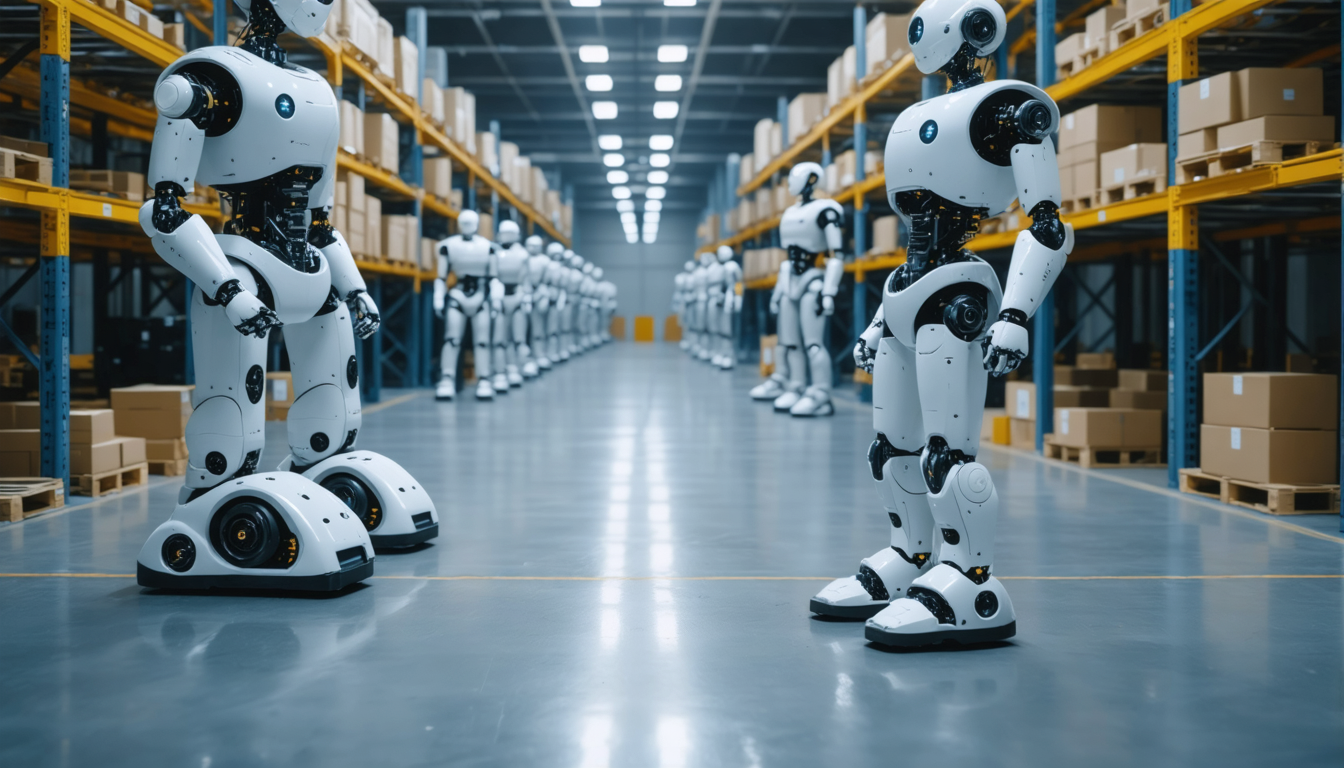
For example, in a modern warehouse equipped with wheeled mobile robots, the latter work on moving containers, order preparation, and packaging goods. At the same time, a bipedal humanoid robot may be assigned to welcoming visitors, handling delicate objects, or performing tasks requiring human interaction, often vocal. Rather than executing distinct instructions, the entire fleet operates with the same decision-making base, which learns, adapts, and improves overall.
A key advancement lies in KinetIQ’s ability to disseminate a robot’s learnings throughout the fleet. If a robot develops a better technique for grasping a fragile object, this skill is automatically applied to others, thereby improving the quality and speed of interventions. Thus, the system resembles a collective intelligence, where each member contributes to global progress, accelerating the pace of evolutions without requiring individual reprogramming. This brings robotics closer to a model very similar to cloud platforms and continuous smartphone updates.
Main benefits of unified AI for robotic fleet management:
- Simplification of software maintenance thanks to a centralized architecture
- Better coordination among machines with diverse physical capabilities
- Rapid and homogeneous evolution of functional capabilities
- Ability to easily integrate new robots into the fleet without heavy readaptation
- Resource optimization through dynamic task allocation according to each unit’s expertise
This shows that collective artificial intelligence, orchestrated by KinetIQ, opens the door to large-scale robotic deployments that are much more flexible and efficient than ever before.
KinetIQ: an advanced four-layer architecture for responsive and strategic robotic orchestration
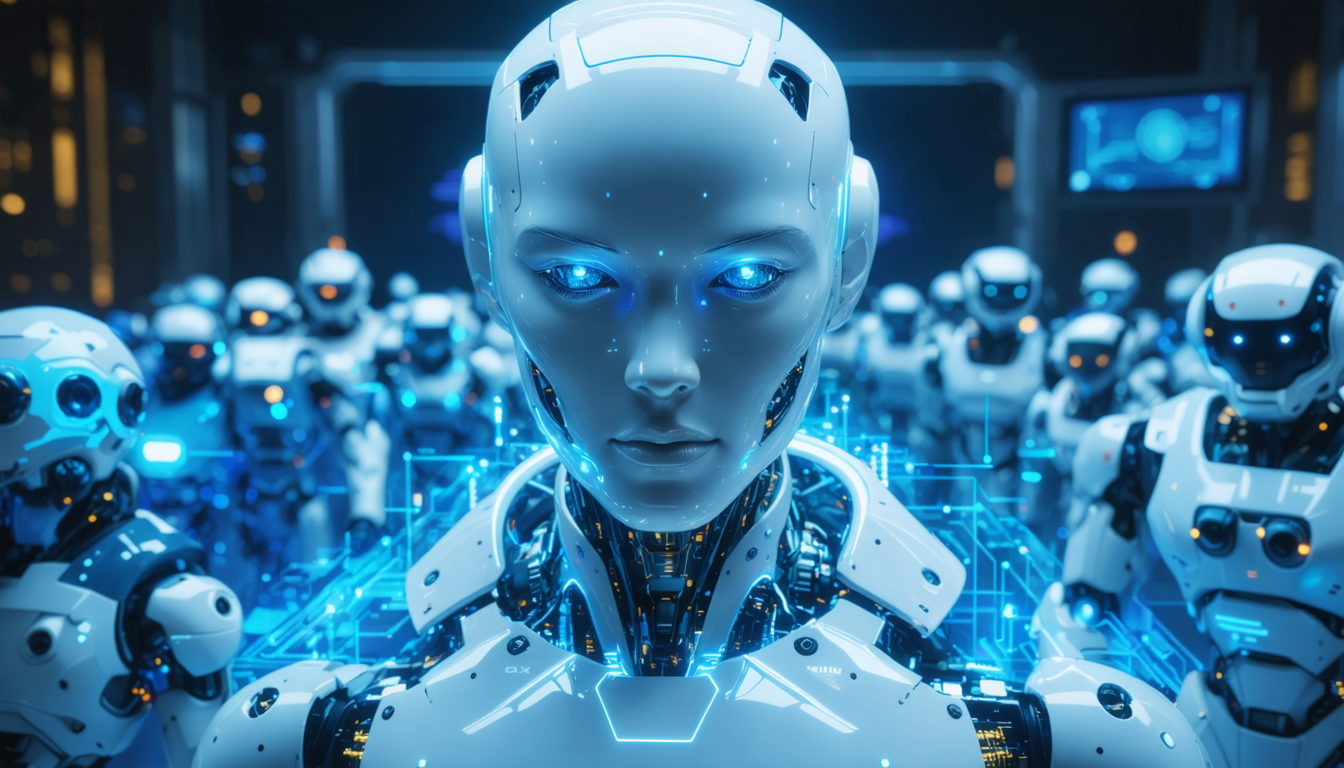
KinetIQ relies on a structure of four distinct but complementary layers, a major innovation in the field of autonomous systems with collective intelligence. This hierarchy allows the system to make long-term decisions while reacting quickly to field constraints.
The top layer corresponds to a fleet management AI. This layer is responsible for mission assignment, priority hierarchy, and overall resource optimization. It can connect directly to existing information systems, such as warehouse management software (WMS) or industrial production systems, thus ensuring smooth integration into operational infrastructures.
The second layer provides situational reasoning. It breaks down each mission into concrete actions adapted to the context, analyzes the environment using sensors, and adjusts robot behaviors in real time. Here, advanced sensory analysis and learning technology enable essential flexibility in varied conditions, whether dynamic warehouses, workshops, or public spaces.
At the third level, KinetIQ uses a vision-language-action model to generate precise movement sequences. This layer determines how to grasp, move, or manipulate objects based on surrounding data and received instructions, calling upon a fine understanding of the connection between visual perception and action.
Finally, the lowest layer directly controls robot joints and motor systems. It ensures stability, balance, and fluidity in movements, giving the fleet an almost natural aspect, especially for bipedal humanoid robots that must operate in often complex human environments.
This multi-layer structure is a considerable asset because it creates a strong link between strategic steering and fine motor control. The whole operates continuously to adapt the level of robot autonomy according to current needs, thus reducing interruptions and improving daily efficiency.
Concrete examples of using KinetIQ in logistics and services
Early field demonstrations quickly highlighted KinetIQ’s versatility in different types of applications. One emblematic use concerns modern logistics, where a fleet of mobile robots is deployed in a warehouse to handle tasks ranging from pallet movement to order preparation.
Thanks to KinetIQ, each robot understands its place in the chain, avoiding conflicts and adapting to unforeseen events. For example, in case of a sudden obstacle or a robot failure, the platform automatically reallocates the workload to available units, ensuring continuity of operations without immediate human intervention.
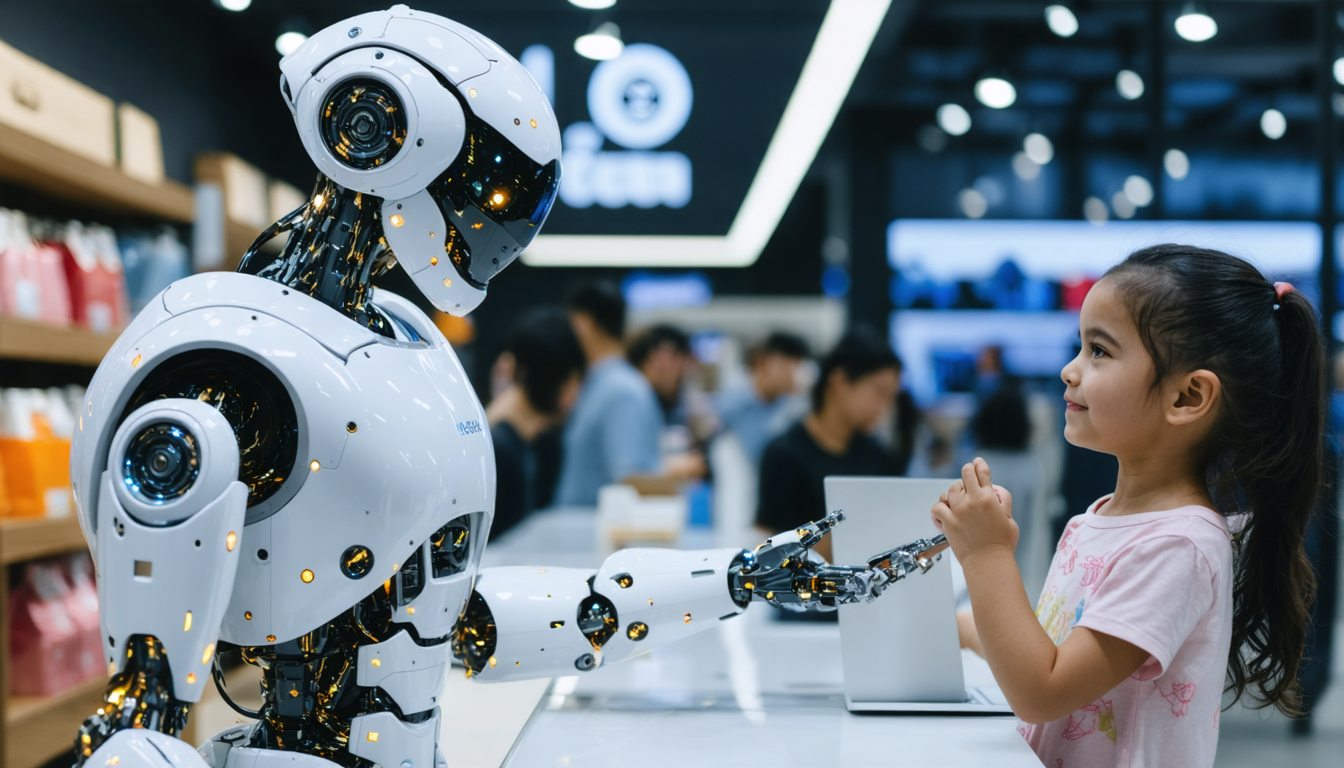
Moreover, in a commercial environment or a service establishment, humanoid robots equipped with this AI can interact with customers, respond to voice requests, and handle various objects precisely, from merchandise to delicate equipment. This integration greatly improves operational flexibility, especially in large retail stores or home services.
Several companies have already begun adopting this system to optimize their automation:
- A logistics center in the Paris region reduced its operating costs by 30% thanks to robotic fleet optimization.
- A retail chain improved customer satisfaction by deploying humanoid robots for reception and assistance.
- An automotive factory uses KinetIQ to coordinate both mobile robots and units specialized in delicate assembly.
These practical cases illustrate how orchestration artificial intelligence allows combining efficiency and versatility, breaking usual barriers between industrial and service robots.
Towards a redesigned industrial automation thanks to collective robotic intelligence
As industrial automation seeks continuous optimization, KinetIQ places robotics on an entirely new trajectory. The main difficulty of massive robot deployments often comes from integration complexity and cost. Each machine usually requires specific programming, and large-scale deployments face costs of customization and software maintenance.
With a common AI brain piloting a complete fleet, the gain is twofold. On the one hand, software maintenance is simplified, since only the central software needs to be updated to propagate improvements to all robots. On the other hand, this distributed intelligence offers unprecedented adaptability to all autonomous systems, making joint operations between very different robots fluid.
Robotics thus moves from a fragmented model to a true automated infrastructure capable of handling complex functions, from logistics management to customer relations. This scale shift is a powerful lever for the industry of the future, where flexibility and operational efficiency are key competitiveness factors.
This table summarizes the major differences between the traditional robotic model and the revolution induced by KinetIQ:
| Aspect | Traditional Model | With KinetIQ |
|---|---|---|
| Software Management | Individualized per robot | Single, centralized platform |
| Adaptability | Limited, rigid scripts | Collective intelligence and shared learning |
| Inter-machine Capabilities | Poor coordination | Fluid collaboration between heterogeneous robots |
| Implementation Costs | High, necessary customizations | Cost reduction thanks to simplified integration |
| Human Intervention | Often essential for adjustments | Facilitated intervention, assisted by AI |
In conclusion, Humanoid shows it is possible to expand robotics’ application fields by fundamentally rethinking its software architecture. This collective intelligence marks a decisive step towards autonomous fleets capable of tackling previously unreachable challenges.
Security and reliability issues in centralized robotic fleet management
With centralization as advanced as that proposed by KinetIQ, system security and reliability become major concerns. Indeed, an error at the AI brain level could propagate quickly, potentially affecting the entire fleet, which requires strict guarantees and sophisticated resilience mechanisms.
Advanced security protocols have been integrated to detect and isolate potential failures. In case of technical difficulty or critical situation, the system can automatically downgrade to a more conservative mode of operation or even allow real-time human takeover. This hybrid role between autonomous machine and human supervision is key to reassuring professional users.
Furthermore, data protection exchanged between the platform and robots is reinforced by the latest cryptographic standards. This ensures communication integrity and protects against malicious intrusions, an essential aspect, especially in connected industrial environments and proximity services.
To illustrate this issue, one can imagine an automated factory where a poorly detected software bug could immobilize an entire production line. With KinetIQ, its multilayer design helps limit risks, as each level is independent yet coordinated, thus avoiding error cascades. This model anticipates the security requirements that autonomous robotics at large scale will have to meet in the coming years.
Humanoid robots and human interaction: a collaboration in full evolution
Among robots piloted by KinetIQ, bipedal humanoids occupy a special place. Their design, close to that of human beings, facilitates interactions in service or assistance contexts. Their fine motor control and natural language understanding enable not only the execution of physical tasks but also the management of complex social situations, often beyond traditional machines’ reach.
This advanced artificial intelligence allows humanoid robots to interpret complex voice requests, respond with nuance, and handle various categories of objects with remarkable finesse. These capabilities greatly expand their scope of action, thus facilitating their integration within human environments, whether at home, in stores, or in public facilities.
An anecdote from a Parisian store in 2026 illustrates the rise of this technology: a humanoid robot, under KinetIQ control, helped a customer find a specific product, explain its features, and even complete payment via voice interaction. This type of automated service enriches the user experience while optimizing on-site human labor.
The convergence between humanoid robotics and collective intelligence poses new challenges, notably in ethical design, social acceptance, and personalization. However, the model proposed by Humanoid paves the way for more humane automation, where AI orchestrates not only mechanics but also the quality of everyday interactions.
Innovation prospects and the future of cooperative robotics
Beyond immediate applications, KinetIQ symbolizes a new era for robotics, focused on software innovation and synergy between different robotic units. This approach lays the foundations for a future where fleets of hundreds of interconnected robots can jointly manage complex, large-scale projects with a high level of autonomy.
The possibilities offered are vast: from autonomous management of entire logistics centers, to predictive maintenance in sensitive industrial environments, to providing personalized services in urban settings. This technological expansion is also accompanied by new professional practices, requiring enhanced dialogue between human operators and intelligent systems.
Finally, collective robotics, made possible by platforms like KinetIQ, should play a key role in the transition to more sustainable and efficient economic models. By combining advanced robotics and artificial intelligence, Humanoid proposes a vision where automation rhymes with adaptability and robustness, thus illustrating the true potential of future autonomous systems.
- Continuous capacity growth through centralized updating
- Easier integration of new robots and complementary equipment
- Reduction of operational costs and acceleration of innovation cycles
- Strengthening human-machine collaboration in work environments
- Possibility of very large-scale deployments, in various contexts