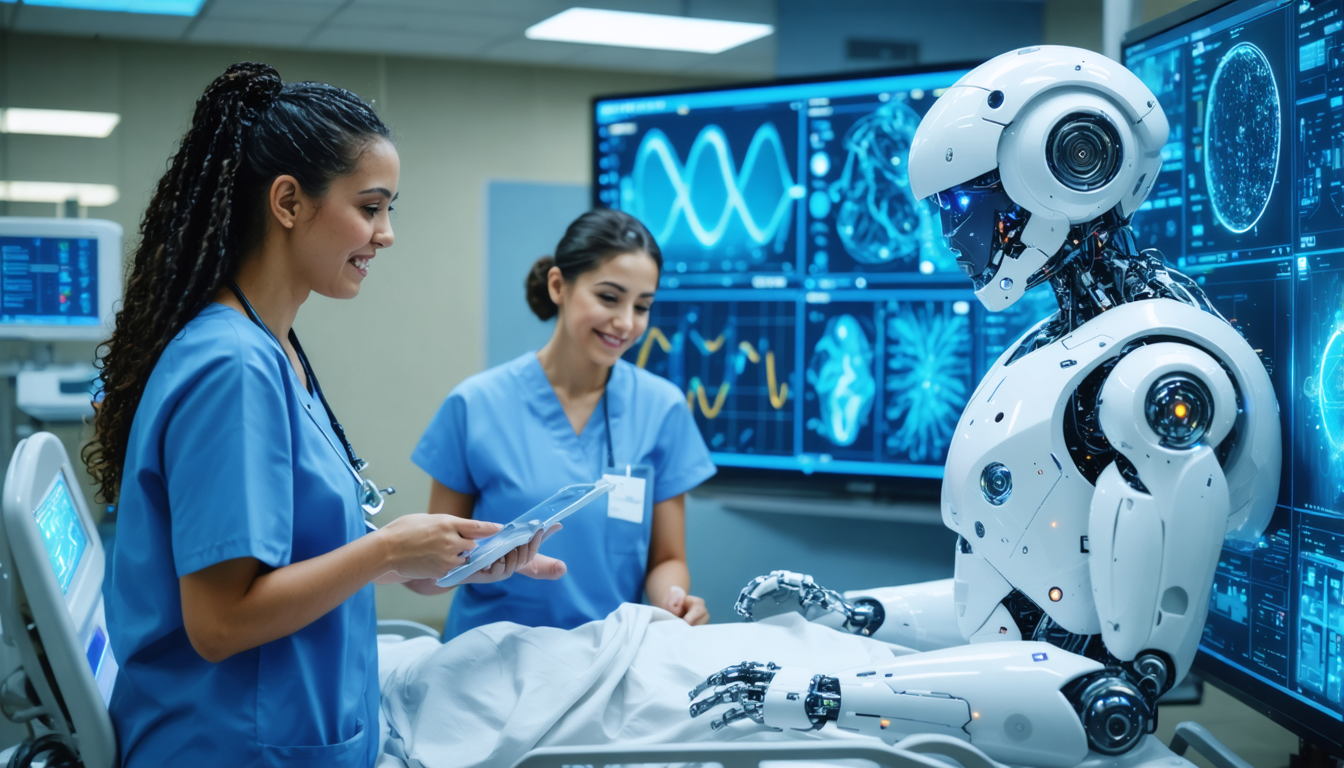
As digital health gains unprecedented importance, artificial intelligence (AI) is establishing itself as a major driver of medical innovation. However, its large-scale deployment in hospitals remains complex, notably due to strict requirements regarding the security and governance of health data. Facing these challenges, two key players in the sector, SAP and Fresenius, have joined forces to usher in a new era for AI integration in hospital institutions. Their collaboration is based on the creation of a sovereign and secure platform designed to transform pilot AI projects into fully operational and reliable solutions. These efforts are part of a strict European approach, complying with current standards while ensuring unprecedented interoperability between health systems. This innovative revolution promises to optimize clinical and administrative processes, while improving the quality of care and patient management.
In a context where trust in AI within the medical sector is questioned, notably because of algorithmic biases revealed by recent investigations, SAP and Fresenius emphasize a robust ethical framework. They are committed to providing simple, scalable tools that above all guarantee the security and sovereignty of sensitive data. This platform relies on advanced technologies such as SAP Business AI and SAP Business Data Cloud, supported by the AnyEMR strategy which ensures smooth communication between various hospital systems through open standards like HL7 FHIR. The expected benefits are considerable: task automation, early detection of complications, and better management of hospital flows. This project thus represents a model of responsible digital transformation, creating conditions for sustainable change in European health.
- 1 A secure and sovereign environment for AI in European hospitals
- 2 An open and integrated platform to break the isolation of hospital AI projects
- 3 Optimizing hospital processes through large-scale artificial intelligence
- 4 The strategic collaboration between SAP and Fresenius for a European medical revolution
- 5 SAP’s AnyEMR strategy: a key to interoperability and integration
- 6 Investment in innovation and support for digital health startups
- 7 A new European standard for AI in the hospital sector
- 8 Direct impact on care teams and patients
A secure and sovereign environment for AI in European hospitals
The implementation of artificial intelligence in hospitals requires the creation of a perfectly secure technical and legal environment. Fresenius and SAP understood that adopting traditional public cloud solutions did not meet the strict obligations related to the confidentiality and management of medical data. The sensitivity of this information imposes rigorous governance both locally and at the European level.
This awareness has led to the establishment of an infrastructure focused on data sovereignty. Patient data remains hosted in an environment compliant with the General Data Protection Regulation (GDPR) and under local control, meaning that only authorized authorities can access it. By reducing the risk associated with data loss or breach, this secure approach also ensures the longevity of AI-based projects.
To fully exploit AI’s potential in this context, SAP Business AI and SAP Business Data Cloud act as technological pillars. SAP Business AI offers advanced analytical tools and easy integration into hospital applications, while SAP Business Data Cloud ensures data management and consolidation in a secure environment. This combination allows hospitals to access intelligent solutions while meeting compliance requirements.
Furthermore, this secure infrastructure prevents algorithmic biases by embedding control and audit mechanisms at the core of the platform. This system directly addresses warnings issued by organizations like the NAACP, which highlight the dangers of biased algorithms in healthcare. Thanks to strong and transparent ethical rules, hospital institutions can deploy reliable AI tools without fearing negative impacts on certain patient groups.
This data sovereignty is not only a technical issue but also a path toward better social and institutional acceptance of AI. Patients and hospital staff benefit from increased visibility over the processing of their personal information. This trust is essential to democratize the use of AI on a larger scale, beyond often marginal pilot initiatives.
- Compliance with strict European standards ensuring the protection of sensitive data.
- Local data control ensuring sovereignty and GDPR compliance.
- Robust technological platform combining SAP Business AI and SAP Business Data Cloud.
- Anti-bias mechanisms embedded for ethical and transparent AI use.
- Strengthening trust among patients and staff in digital solutions.

An open and integrated platform to break the isolation of hospital AI projects
Many AI projects in hospitals have so far remained siloed, often limited to demonstrations or experimental variations without real operational deployment. This fragmentation slows innovation and prevents the generalization of benefits for patients and practitioners.
To counter this phenomenon, SAP and Fresenius have designed an open and interoperable platform capable of breaking the silos that keep various hospital systems separated. This platform supports the large-scale integration of AI models while respecting regulatory constraints.
One of the key elements of this strategy is AnyEMR, a concept developed by SAP to connect hospital information systems already in place. Electronic medical records, hospital information systems (HIS), and other applications now communicate via open standards like HL7 FHIR. This technical choice removes a large share of the usual obstacles to the smooth flow of health data.
Thanks to this interconnection, AI can access a wider and higher-quality range of data, greatly enhancing the relevance of analyses. For example, an early complication detection algorithm can cross clinical observations, lab data, and medical history within a single integrated stream.
Moreover, this platform facilitates cross-functional collaboration between hospital institutions and departments. It authorizes the pooling of AI tools and allows for quick adaptation of solutions to local specifics, whether related to pathologies, practices, or resources.
For illustration, a regional hospital can automatically integrate innovations developed by a leading university center, accelerating the dissemination of best practices at the national and European level.
| Advantages of the SAP-Fresenius open platform | Description | Expected impact |
|---|---|---|
| Interoperability via HL7 FHIR | Standardizing information exchanges between hospital systems | Smoother health data flow |
| AnyEMR connection | Interface compatible with major hospital software | Reduction of silos and better integration of AI tools |
| Modular approach | Library of connected and scalable AI tools | Adaptability to the specific needs of each institution |
| Continuous updates | Ongoing integration of technological innovations | Maintaining performance and energizing usage |
| Multi-institution collaboration | Secure sharing of resources and data | Improvement of care quality at the territorial level |
The outcome is a true revolution in how hospitals leverage artificial intelligence. Rather than remaining isolated pilot projects, AI tools become integral, accessible, and reliable support for care teams’ daily activities.
Optimizing hospital processes through large-scale artificial intelligence
AI deployed in a reliable and connected environment sustainably transforms hospital processes, whether clinical or administrative. This affects both the quality of care and the operational management of institutions.
Thanks to real-time analytical capabilities, AI detects anomalies in patient monitoring more quickly. For example, during hospital stays, AI can provide early alerts on clinical signs indicating complications, enabling swift and potentially life-saving intervention.
On the other hand, teams benefit from significant relief from administrative tasks. Automatic data entry, scheduling management, and file processing are accelerated, freeing up time to focus on the core mission: care.
Moreover, AI optimizes hospital flow management by better planning admissions, operations, and patient discharge. This streamlines the patient journey and reduces waiting times, a crucial issue for user satisfaction and institutions’ capacity.
Here is a list of concrete benefits brought by large-scale AI in hospitals:
- Early detection of complications thanks to integrated analysis of medical data.
- Automation of repetitive tasks, reducing administrative errors.
- Optimization of human and material resources through better planning.
- Improved communication between departments for coordinated care.
- Personalization of care through predictive analyses tailored to each patient.
This transformation helps reconcile innovation and efficiency in hospitals, which can now rely on trustworthy, respectful AI tools directly serving caregivers.

The strategic collaboration between SAP and Fresenius for a European medical revolution
The close cooperation between SAP, a pioneer of enterprise digital technologies, and Fresenius, a major player in global healthcare, gives rise to a large-scale strategic alliance. This synergy combines technological expertise with deep knowledge of hospital needs.
According to Michael Sen, CEO of Fresenius, the goal is clear: to create a European sovereign solution for AI integration in health, ensuring that patient data remains protected and processed locally. This project foreshadows a model capable of being replicated in other countries facing similar challenges.
From now, both groups plan to invest several hundred million euros over the medium term to support this transformation and back innovative startups. This economic support highlights the will to drive a continuous dynamic, with an ecosystem capable of emerging ever more efficient tools.
Christian Klein, CEO of SAP, emphasizes the complementarity between cutting-edge technology and field expertise. Together, they design an interoperable, easy-to-use, and scalable platform intended for global adoption.
This collaboration places data security and sovereignty at the heart of all digital solutions. It establishes a framework where patients and hospital staff can benefit not only from more efficient tools but also from increased control over medical information.
SAP’s AnyEMR strategy: a key to interoperability and integration
The deployment of artificial intelligence tools in hospitals requires smooth communication between different hospital information systems, often heterogeneous. SAP has developed the AnyEMR strategy to precisely address this challenge.
AnyEMR represents a winning approach to connect electronic medical records (EMRs), hospital information systems (HIS), and other specialized applications via open standards such as HL7 FHIR. This protocol is now the European reference for secure exchange of health data.
The implementation of AnyEMR allows gathering disparate information and making it coherently accessible to artificial intelligence. This increases analytical accuracy, promotes better coordination between departments, and paves the way for comprehensive patient monitoring throughout their journey.
In practice, a nurse can for example instantly access all relevant data, even from different institutions. AI tools, for their part, maximize their effectiveness by working on a complete data set, which is particularly decisive for complex medical decisions.
The AnyEMR strategy thus helps drastically reduce the fragmentation that hindered AI adoption in hospitals. This seamless integration creates a solid foundation for the digital revolution in health, where technology acts in perfect harmony with hospital practices.
Investment in innovation and support for digital health startups
To support the digital transformation of hospitals, SAP and Fresenius have planned major investments, including financing innovative startups specialized in artificial intelligence applied to health. This support aims to create a dynamic and responsive ecosystem.
These investments enable the emergence of new solutions, tested in real conditions before integration into the global platform. For example, startups can develop AI tools dedicated to medical image analysis, emergency management, or prediction of medical equipment needs.
Support also includes deployment assistance, including staff training and adaptation of practices. This pragmatic approach facilitates daily AI adoption, preventing new technologies from being perceived as additional constraints by care teams.
This investment and support strategy energizes medical innovation by fostering ongoing exchange between large industrial groups and agile digital sector players. It contributes to creating a virtuous circle where technical performance drives continuous care improvement.
A new European standard for AI in the hospital sector
The SAP-Fresenius platform lays the foundation for an unprecedented standard for integrating artificial intelligence in hospitals on a European scale. This framework incorporates strict security, sovereignty, and interoperability requirements, meeting the most rigorous regulatory constraints.
This standardization fosters faster and smoother AI adoption by providing institutions with a compliant and secure environment. It also facilitates transnational collaboration and the sharing of best practices, essential capabilities in an increasingly global public health context.
The existence of this model paves the way for a true revolution in European digital health. By providing hospitals with reliable, scalable, and safe tools, the platform contributes to more personalized and effective patient care and better management of hospital resources.
This European standard also anticipates increased trust dynamics among sector actors. It encourages governments and regulators to actively support these innovations, convinced that AI can become an essential element of the health system, provided it is controlled and responsible.
Direct impact on care teams and patients
While artificial intelligence is already transforming medical processes, its large-scale adoption through the SAP-Fresenius platform translates into tangible benefits for the main actors in the hospital system: care teams and patients.
Hospital staff see their daily workload lightened, particularly thanks to task automation and data reliability. The time gained can be devoted to human contact and medical analysis, which enhances their expertise and improves working conditions.
For patients, this technological revolution means better care through smoother and safer pathways. Anticipated detection of complications helps limit risks, while faster access to relevant diagnoses increases the quality of care.
Another essential dimension concerns transparency and protection of medical data. Thanks to guaranteed sovereignty on the platform, patients benefit from strengthened control over the use of their personal information, a key factor in reinforcing trust toward digital technologies.
For example, in concrete cases, hospitals having adopted the platform have noticed a notable reduction in administrative delays and an increase in satisfaction among both caregivers and users. This success demonstrates the power of integrated AI, conceived as an ally serving human health.