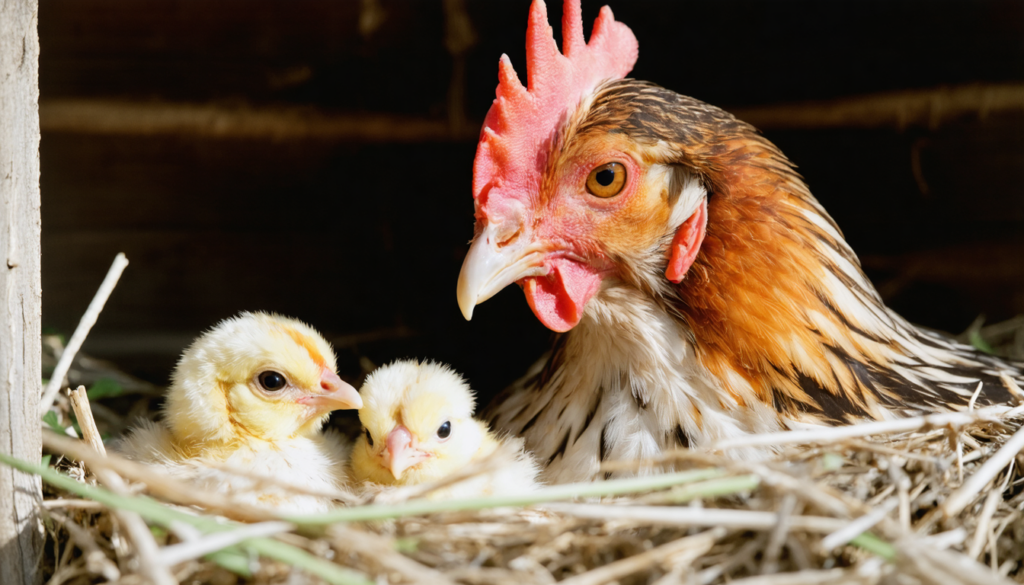
In the fascinating world of the chicken coop, a question often intrigues observers: how can a hen identify her chicks without error among so many others? This phenomenon goes far beyond a simple reflex. It relies on a complex mix of sensory and cognitive processes that allow the mother hen to create a strong bond with her offspring and instinctively reject intruders. This ability to recognize her young is vital to ensure their survival, notably by avoiding the clumsy adoption of foreign chicks, which could compromise the distribution of care and safety. Let’s explore together this fascinating mechanism that mobilizes smell, sight, hearing, and even a silent dialogue between the hen and her chicks.
By scrutinizing maternal behaviors, we discover that the hen begins her communication with her chicks even before their birth. From the 24 hours preceding hatching, a form of vocal imprinting takes place, establishing this auditory bond that will facilitate postnatal recognition. But identification is not limited to the voice: the mother also learns to detect the unique smell of her young, memorizes their face and silhouette at the edge of the nest, and interacts with them through a repertoire of precise vocalizations. This multi-sensory system is a real evolutionary feat, ensuring the protection and cohesion of the family group against threats, whether external or internal.
Thanks to these remarkable faculties, the hen remains attentive, reactive, and selective, ensuring a safe environment for her chicks while controlling natural adoption, which, if it occurs, remains a controlled exception. Let’s discover in detail the unique sensory and behavioral mechanisms that make the hen an exemplary mother in the animal world.
- 1 The olfactory sense in the hen: an overlooked role in chick recognition
- 2 Visual memory: how the hen recognizes her chicks by their unique appearance
- 3 Vocalizations and sound imprinting: a unique dialogue between the hen and her chicks
- 4 Pheromones: essential chemical messengers in the natural recognition of chicks
- 5 When maternal instinct falters: limits and exceptions in chick recognition by the hen
The olfactory sense in the hen: an overlooked role in chick recognition
Contrary to long-held beliefs, the hen does not rely solely on her sight or hearing to identify her chicks. Her smell, often underestimated, actually plays a crucial role in this process. This olfactory ability, well developed in gallinaceous birds, allows the mother to detect and memorize the particular body odor emitted by her chicks as soon as they emerge from the egg.
From birth, chicks develop a chemical signature linked to their metabolism and immediate environment. Staying close to them in the nest, the hen impregnates herself with this unique olfactory mark through repeated contact with their skin and skin secretions, but also through the overall odor of the nest itself. This olfactory imprint turns out to be a powerful filter against the adoption of foreign chicks, since a significant difference in the volatile compounds emitted by an unknown chick can be detected and trigger a rejection reaction.
Studies show that the hen primarily uses this olfactory ability in the days following hatching, a sensitive period during which the mother establishes attachment. This recognition by smell complements and strengthens the security of the maternal bond. For example, if a foreign chick is placed in a nest already impregnated with a specific odor, the hen often shows disinterest or even aggression towards the intruder. This chemical system is therefore essential to avoid confusion in groups of chicks, particularly in environments where several broods coexist.
Through this little-known ability, the hen thus illustrates her maternal selectivity based on a precise sensory cocktail. This faculty is accompanied by other complementary mechanisms, notably visual memory, which adds an extra dimension to identification. Smell acts as a first lock, subtle and effective.
Visual memory: how the hen recognizes her chicks by their unique appearance
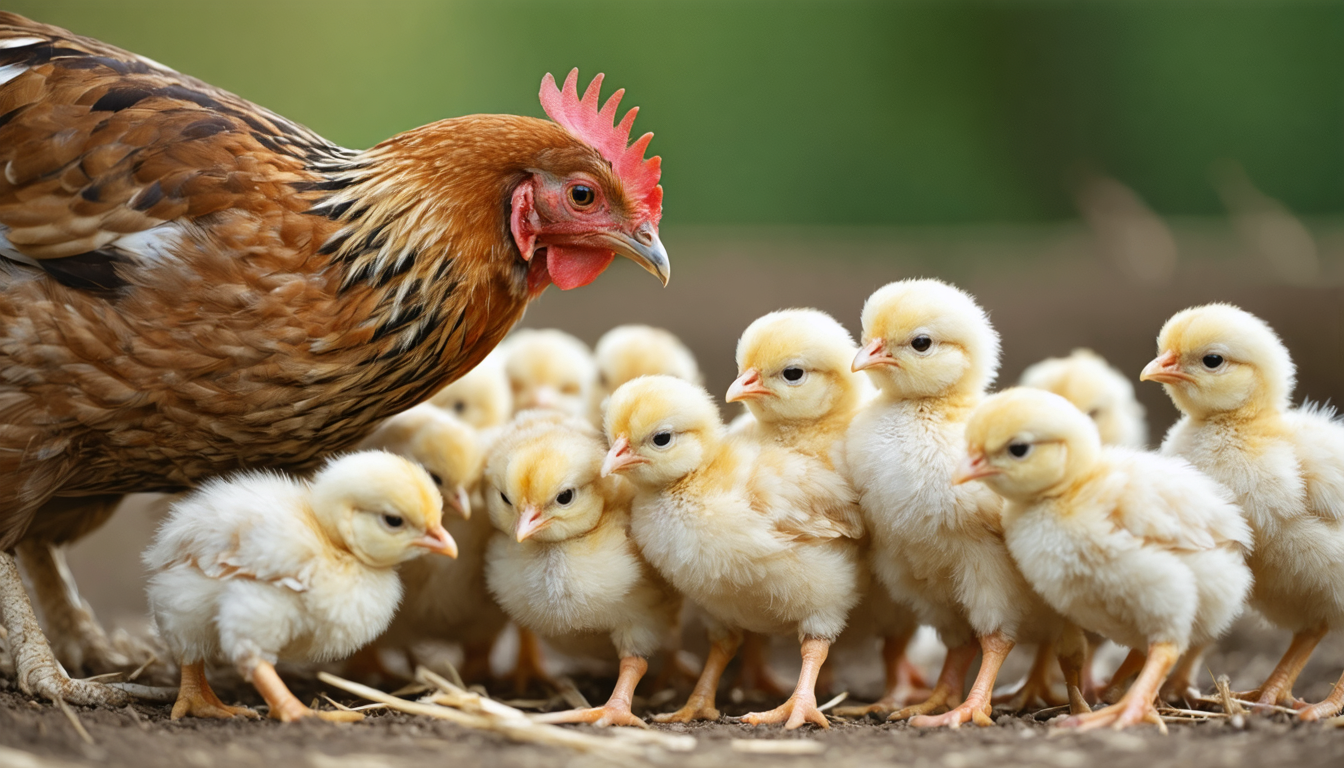
One of the pillars of maternal recognition in the hen relies on visual memory. This functionality is far from trivial, as the mother must accurately distinguish her chicks from others who may share the same space or breed. She meticulously analyzes details: the color of the down, the patterns on the developing feathers, the relative size compared to her other young, as well as the gait or particular attitude of each chick.
This visual recognition is not instantaneous. It is built progressively, especially during the first 48 hours after birth, which constitute a sensitive phase where the mother constructs a fine mental image of each of her chicks. This visual process, combined with other senses, acts as an identity card that will be consulted at every interaction. For example, a hen can recognize a lone or lost chick solely by its appearance and decide to bring it back to the nest or protect it.
However, this method has its limits. When the chicks belong to the same breed and present very similar characteristics, the hen may find it difficult to distinguish them by the naked eye alone. To overcome this problem, she therefore relies on other senses, notably hearing and olfaction, which increase the reliability of recognition. To illustrate this, here is a table summarizing the effectiveness according to different visual criteria:
| Visual criterion | Recognition rate | Reliability |
|---|---|---|
| Down color | 75% | Medium |
| Chick size | 60% | Low |
| Distinctive patterns | 85% | High |
| Multiple criteria combination | 92% | Very high |
We notice that the real strength of visual recognition comes from the combination of several signals, rather than a single isolated criterion. It is this integration capacity that allows the hen to create a reliable representation of her chicks. This visual function is reinforced by sound interactions, often more personal and unique, which establish a specific dialogue between the mother and her young, facilitating almost automatic identification.
Vocalizations and sound imprinting: a unique dialogue between the hen and her chicks
Auditory recognition plays a fundamental role in the maternal behavior of hens. From the final phase of incubation, the chicks begin to emit sounds imperceptible to the human eye but perfectly captured by the mother. This step forms the basis of what is called the vocal imprint, a mutual learning that continues intensely during the first hours after hatching.
Each chick produces a unique repertoire of peeps which vary in intensity, tone, and rhythm. The hen thus learns to identify the particular voice of each one, allowing her to quickly and precisely differentiate her own chicks from foreign ones. This two-way dialogue implies that the mother also emits specific clucks to which her young respond, strengthening this exclusive bond.
This acoustic communication ensures several vital functions:
- Facilitate the gathering of chicks after their explorations or in case of danger
- Guarantee the immediate recognition of scattered or isolated young
- Maintain cohesion and safety of the family group
- Repel foreign chicks through rejection of unknown vocalizations
This auditory identification system is particularly effective because it establishes itself in a critical learning window situated between 24 and 72 hours after birth. During this period, the hen’s brain finely records the acoustic signatures unique to each chick and stores them in areas dedicated to auditory memory. Once this vocal imprint is memorized, confusion is rare, even in the presence of chicks of nearby breeds.
Moreover, the permanence of this auditory learning is such that, even in case of prolonged absence, the mother will recognize her offspring upon return. This faculty plays a major regulatory role in maintaining authentic parentage and effectively protects against any unwanted adoption.
Pheromones: essential chemical messengers in the natural recognition of chicks
Beyond the more visible senses, hens also use a subtle chemical system for recognizing their chicks. Pheromones, these invisible chemical compounds emitted by chicks, are detected by a specialized organ, the vomeronasal organ, located in the hen’s nasal cavity. These molecules play a key role in confirming or denying the filiation link between the mother and her young.
These pheromones contain complex information about several aspects:
- The chick’s genetic identity
- Its health status
- Its integrity and belonging to the family group
When a hen perceives the familiar pheromones of her chicks, her brain triggers the release of hormones such as prolactin, thereby reinforcing her maternal instinct and the care given to their well-being. Conversely, the absence of these familiar chemical signals can induce a rejection reaction, thus protecting the mother from potential impostors seeking to take advantage of her protection.
Among the main sources of these pheromones are found:
- Skin lipids specific to each chick
- Secretions from the uropygial glands, which protect and mark the plumage
- Compounds present in the droppings
- Genetic markers transmitted during skin-to-skin contact
This hormonal and chemical system complements the multi-sensory recognition device, granting the hen remarkable efficiency in chick selection. This fragile balance between olfactory, visual, auditory, and chemical perception is the result of a long adaptation that has maximized the chances of survival of the brood.
When maternal instinct falters: limits and exceptions in chick recognition by the hen
Despite this sophisticated system, the hen’s maternal instinct is not infallible. There are situations where chick identification can fail, resulting either in unplanned adoption or accidental rejection of biological young. Understanding these limits allows us to appreciate the full complexity of maternal behavior in gallinaceous birds.
An artificial or natural adoption can occur notably in these cases:
- When foreign chicks are introduced very early, during the sensitive auditory and olfactory imprinting phase
- When a hen has lost her own brood and displays a strong maternal instinct
- If the age and size of the adopted chicks are close to her own, making identification more difficult
- In certain hen breeds selected for their high tolerance to mixed broods
However, external factors can disrupt recognition and lead to errors:
| Disturbing factor | Impact on recognition | Estimated failure rate |
|---|---|---|
| Early separation between mother and her chicks | Breakdown of sensory imprint | 65% |
| Intense stress in the environment | Alteration of maternal behavior | 45% |
| Excessive handling by humans | Olfactory contamination and signal disruption | 35% |
| Hormonal disorders in the hen | Decrease in maternal instinct | 50% |
These elements show that despite an elaborate system, maternal recognition remains fragile in the face of adverse circumstances. As a result, breeders and observers must take care to limit these disturbances to ensure optimal maternal behavior. Finally, individual variability should be noted: some hens are more prone to adopting foreign chicks, while others show very strict selectivity, illustrating the behavioral diversity of gallinaceous birds and their evolutionary adaptation.