
In a B2B environment marked by increased competition and often reduced margins, precise control of service costs has become an essential strategic lever. The rapid evolution of technologies, notably the booming rise of Artificial Intelligence (AI), is redefining this understanding. Whereas companies once settled for broad, often imprecise estimates of expenses related to customer service and logistics, the digital revolution now offers unprecedented visibility. Thanks to predictive analytics and the use of big data, it is now possible to precisely identify the real costs associated with each customer, delivery, or service.
This transformation directly impacts profitability, but also operational efficiency and service management in the B2B sector. Algorithmic tools no longer just analyze historical data; they also anticipate demand fluctuations to adapt the supply chain on the fly, reduce waste, and optimize every aspect of customer relations. This shift from manual collection to intelligent automation opens a new era where transparency and responsiveness are major assets. For companies, understanding the real cost of each service becomes a key differentiator. This detailed analysis helps avoid traditional biases, correct structural inefficiencies, and improve service quality.
- 1 The digital revolution in understanding B2B service costs thanks to Artificial Intelligence
- 2 Understanding the complexity of B2B service costs: beyond appearances
- 3 Limits of traditional methods in controlling B2B service costs
- 4 Automation and data integration: AI’s winning bet in cost management
- 5 Predictive analysis and cost optimization: anticipating to decide better
- 6 The concrete example of DHL: combining human expertise and artificial intelligence for optimal cost management
- 7 Environmental impact: an additional lever for optimizing service costs via AI
- 8 Future perspectives and challenges: sustaining the AI revolution in B2B service cost analysis
The digital revolution in understanding B2B service costs thanks to Artificial Intelligence
The B2B sector, with its operational complexity, requires precise accounting of service-related costs. For a long time, these costs were calculated based on approximate and fragmented methods, intertwined in various siloed systems. ERP, CRM, and logistics software operated in isolation, making data difficult to cross-reference and thus finely analyze. This siloing hindered not only the speed of analyses but also their reliability.
With the arrival of Artificial Intelligence, this barrier disappears. Machine learning algorithms enable real-time integration and consolidation of information from multiple channels. Thus, the big data generated throughout the production, storage, transport, and customer support chain are now accessible in a unified view. This centralization greatly reduces errors and enlightens decision-making.
Moreover, AI goes beyond simple calculation of direct costs such as production or transport. Indirect costs, often invisible — such as administrative management or order tracking — are now integrated into a comprehensive modeling. A holistic approach makes it possible to identify significant variances, sometimes exceeding 30% between apparently similar customers, without excessive manual effort.
This new analytical capability has immediate impacts:
- Better customer segmentation: by precisely identifying the most costly profiles, the company can adapt its offer and commercial conditions.
- Dynamic management: the company can adjust its delivery or management strategies in real time, with assurance that these adaptations will improve profitability.
- Cost anticipation: thanks to predictive analysis, demand fluctuations and logistical constraints are considered to avoid unexpected surcharges.
These advances illustrate the true disruption brought by Artificial Intelligence in understanding and managing service costs in B2B, imposing a new standard of precision and agility.

Understanding the complexity of B2B service costs: beyond appearances
The concept of service cost is often viewed through the lens of visible expenses: manufacturing, storage, and transport. Yet, in the B2B context, this simplified vision is insufficient. Service operations include a wide range of related activities such as order management, customer support, administrative processing, and return coordination, which also generate significant and sometimes hidden costs.
Each customer, depending on their orders – their frequency, volume, and diversity of products ordered – impacts the cost structure differently. For example, a customer requesting multiple small deliveries across dispersed geographic areas incurs much higher logistics expenses than a customer making less frequent consolidated deliveries.
This complexity is reinforced by B2B specifics, where customized contracts and service agreements create great heterogeneity. The amount of manual interventions and time spent managing customer relations are variable and strongly influence profitability.
Companies thus face situations where two customers have comparable revenues but radically different service costs, sometimes exceeding a 30% difference. Without a detailed and nuanced reading, these gaps remain hidden, and unprofitable segments or products continue to be fed, compromising overall performance.
Here is an overview of factors often underestimated in traditional calculations:
- Order fragmentation: the more fragmented the orders, the more they generate administrative and logistical costs.
- Geographical constraints: deliveries to remote or hard-to-reach areas increase the unit cost.
- Variability of deadlines: urgencies or last-minute adjustments often cause surcharges not integrated.
- Customer support: beyond efficient management, some customers require more interactions, which weighs on resources.
Faced with this complexity, better understanding now relies on tools capable of qualifying, quantifying, and visualizing this data in its entirety, which Artificial Intelligence effectively facilitates.
Limits of traditional methods in controlling B2B service costs
Until now, B2B companies have largely relied on manual methods to calculate their service costs. These techniques are characterized by laborious and heterogeneous data collection, where data comes from several non-integrated systems such as ERP, CRM, or logistics management software. Data processing was often delayed, making the analysis obsolete by the time it was produced.
This mode of operation raises several key difficulties:
- Fragmentation and time lag: with data dispersed across multiple platforms, ensuring coherence and timely updates for rapid decision-making is challenging.
- Limited accuracy: the reliance on constant approximations affects the quality of cost indicators, often underestimated or overestimated.
- Exclusion of indirect costs: administrative fees, costs related to customer follow-up, or return management are insufficiently considered.
- Lack of flexibility: traditional methods struggle to adapt analyses to rapid market or operational condition changes.
A typical example is a company that does not integrate the impacts of high-frequency fragmented deliveries for certain customers. These additional costs are not visible in standard reports but heavily affect profit margins.
This lack of visibility also leads to decisions guided by impressions or old habits rather than strategies based on reliable and accessible data. Consequently, these companies are often limited in their ability to optimize processes and efficiently reduce costs.
In this context, introducing Artificial Intelligence into service cost analysis appears as a decisive response to overcome these obstacles and gain competitiveness.
Automation and data integration: AI’s winning bet in cost management
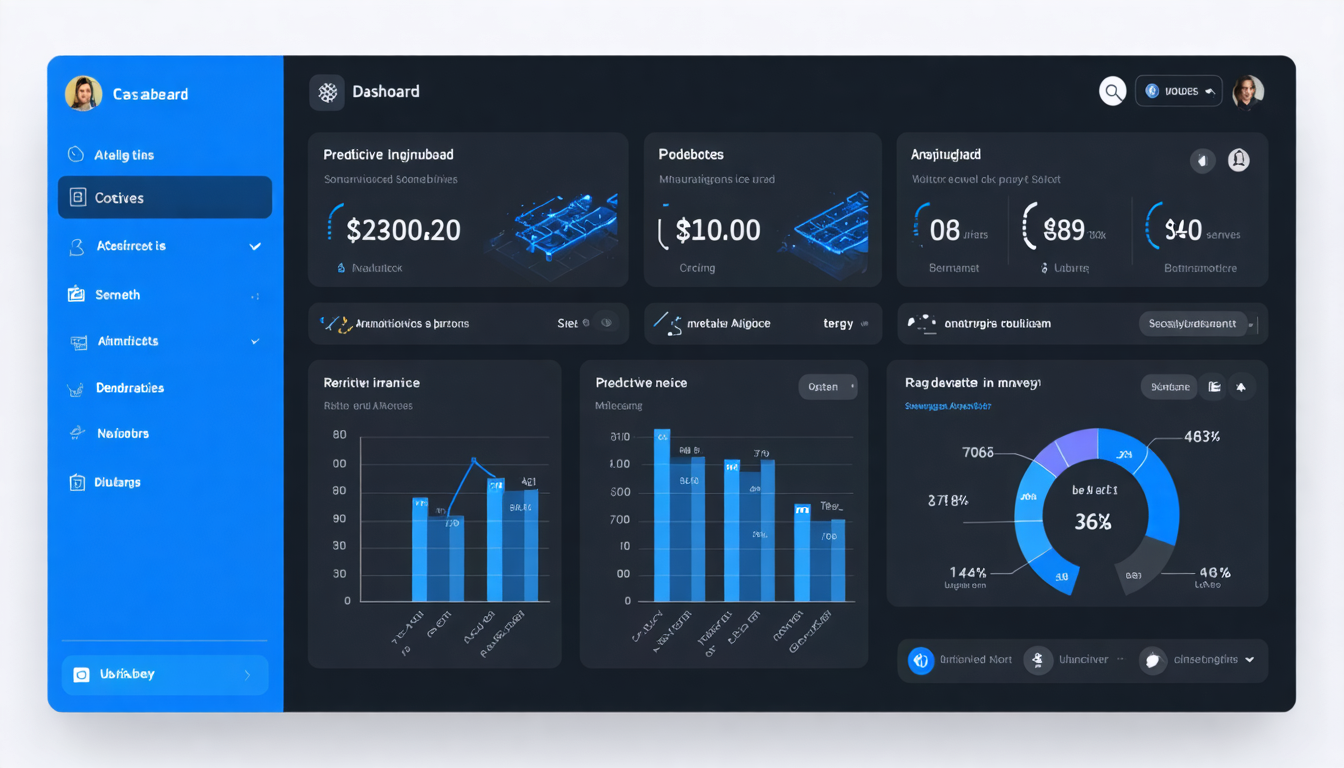
One of the major advances enabled by Artificial Intelligence lies in the advanced automation of data integration and analysis processes. Today, algorithms can continuously connect and integrate data flows from various information systems without human intervention. This automation ensures permanent and reliable data updates, an indispensable factor for effective service cost management.
Specifically, AI collects and harmonizes:
- Financial data: costs of raw materials, logistics expenses, personnel charges.
- Commercial data: volumes, order frequency, customer profiles.
- Logistical data: routes, transport, warehousing.
- Operational indicators: processing times, incident or return management.
This multi-source integration feeds advanced models that precisely distinguish the direct and indirect costs associated with each service. The analysis thus becomes comprehensive and granular.
Another key benefit lies in the dynamic updating of models. Unlike static reporting, AI-driven systems adjust their forecasts and recommendations based on observed variances, demand fluctuations, or new external constraints.
To illustrate this operation, consider a B2B company specializing in spare parts distribution. Thanks to AI, it identifies that certain fragmented deliveries cause logistics costs up to 25% higher. By automating the analysis, it can quickly reorganize its delivery campaigns and consolidate orders according to relevant geographic and temporal criteria. This reorganization generates significant cost reductions within a few months while maintaining customer service quality.
This process illustrates how automation enabled by AI transforms cost management into a lever for operational efficiency and commercial valorization.
Predictive analysis and cost optimization: anticipating to decide better
Artificial Intelligence excels not only in retrospective analysis but also in projecting future trends. Predictive analysis, at the heart of optimization strategies in 2025, enables B2B companies to simulate the impact of different decisions on their service costs and profitability.
Predictive models use historical data and external variables — such as seasonality, economic constraints, or regulatory developments — to anticipate demand, assess logistics costs, and adjust operational planning. This ability to predict avoids passive and reactive management, promoting a proactive stance.
The benefits of this approach include:
- Better resource allocation: adjusting workforce and means according to anticipated peaks and troughs.
- Route optimization: choosing the most cost-effective transport modes and distribution centers.
- Reduction of waste and environmental costs: limiting unnecessary deliveries and returns through refined planning.
In practice, a large logistics company has implemented a simulation system based on artificial intelligence. This system tests different scenarios: reducing delivery frequency, changing order sizes, or modifying routes. Each simulation offers a quantified projection of costs, impacting profitability and customer satisfaction directly.
These simulations also help strengthen collaboration between business teams and financial management. Decisions are no longer based on impressions but on factual and quantified foundations, which facilitates collective buy-in.

The concrete example of DHL: combining human expertise and artificial intelligence for optimal cost management
DHL, a global leader in transport and logistics, perfectly illustrates how the alliance between human skills and Artificial Intelligence technologies revolutionizes service costs in B2B. The company relies on an integrated approach where AI analysis complements business expertise to generate tangible results.
At the heart of this strategy is a precise mapping of costs across the entire value chain. Artificial Intelligence scrutinizes massive volumes of data produced at each stage to identify hidden inefficiencies — cost variations depending on destinations, delivery frequency, order fragmentation — that escaped traditional tools.
This identification is followed by operational recommendations. Teams use the analyses to adjust distribution centers, optimize delivery routes, and rethink administrative load management. These adjustments, based on exhaustive and validated data, generate cost reductions while preserving or even improving customer service quality.
DHL’s approach serves as an inspiring example for many B2B companies looking to leverage the power of artificial intelligence. It demonstrates that technology alone is not enough: combining it with sharp human expertise is essential to turn cost management into a sustainable competitive advantage.
Environmental impact: an additional lever for optimizing service costs via AI
Beyond simple financial control, the advanced understanding of B2B service costs incorporating Artificial Intelligence also involves reducing environmental impact. By rationalizing routes, optimizing transport modes, and decreasing unnecessary deliveries, companies contribute to lowering their carbon footprint while improving profitability.
AI tools today enable quantifying this dual impact — economic and ecological — by providing precise performance indicators. For instance, simulating different logistics scenarios can show both the savings achieved and tons of CO2 avoided. This data is valuable in a context where environmental standards are strengthening and B2B clients expect clear commitments on sustainability.
By adopting these practices, companies enhance their image and increase the trust of business partners. This virtuous approach creates a virtuous circle where the reduction of operational costs and improvement of environmental quality are intimately linked.
This approach is now integrated into best practices in the sector and is among the key success factors in modern service cost management.
- Better management of energy resources thanks to optimized route planning.
- Waste reduction linked to order size optimization and return reduction.
- Compliance with CSR commitments through transparency about actual environmental impact.
- Value enhancement for customers sensitive to ecological criteria in their supplier choices.
Future perspectives and challenges: sustaining the AI revolution in B2B service cost analysis
As the adoption of Artificial Intelligence accelerates in B2B service cost management, several strategic challenges and opportunities are emerging. On one hand, ensuring data quality and security is a crucial issue to avoid costly analysis errors. Data governance must adapt to integrate these new massive flows and guarantee their reliability.
On the other hand, the smooth deployment of technologies with business teams remains a key success factor. It involves training users, encouraging a data-driven analysis culture, and balancing artificial intelligence with human expertise.
Furthermore, generalizing transparency on precise costs paves the way for a more sincere and personalized customer relationship, with better negotiation of contracts and tailored services. This level of sophistication helps strengthen trust and stabilize business partnerships.
Companies that can meet these challenges while capitalizing on predictive analytics, automation, and visualization capabilities will have a major advantage in an ever-changing B2B market. They will thus lay the foundations for cost management that is efficient, sustainable, and innovative.
| Challenge | Opportunity | Expected Impact |
|---|---|---|
| Data quality and security | Implementation of centralized governance | Increased accuracy of analyses and error reduction |
| Adoption by teams | Training and support for change | Better tool appropriation and efficiency gains |
| Management of indirect costs | Predictive models integrating all costs | Overall profitability optimization |
| Transparency and customer relationship | Contract and service personalization | Stronger partnerships and lasting relationships |