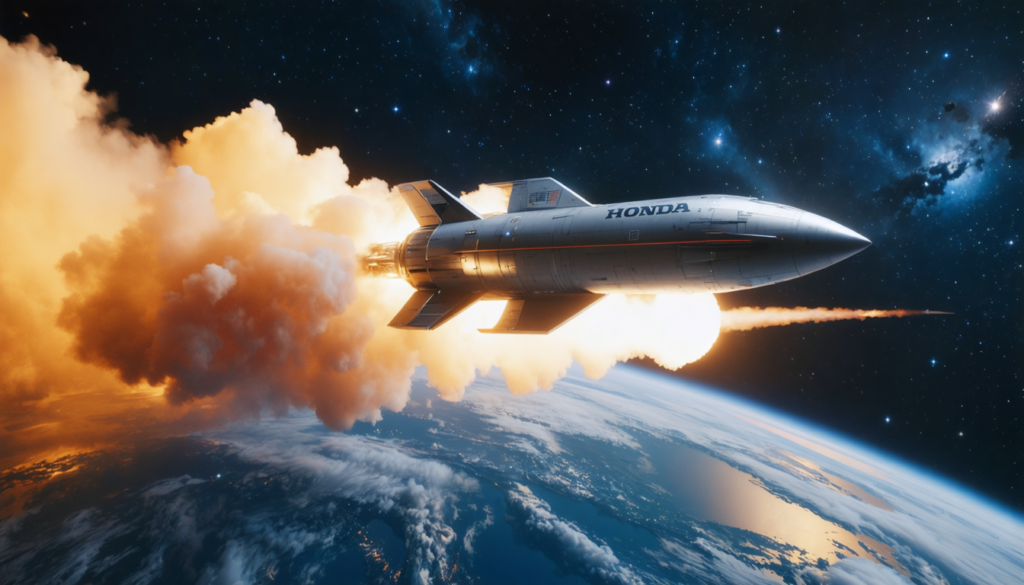
June 17, 2025, marked a turning point in Japan’s industrial history and beyond. Honda, a renowned manufacturer mainly known for its land vehicles, succeeded where it was least expected: in the launch and controlled landing of its first reusable rocket. This feat, far from being a mere one-time achievement, embodies a revolutionary ambition, a determined will by the manufacturer to inscribe its name in the space universe. While the aerospace industry is still largely dominated by players like SpaceX or Blue Origin, Honda is beginning its own technical odyssey with a measured but ambitious approach. This experimental suborbital launch opens the door to many prospects in the field of space technologies, satellite applications, and connectivity, placing the brand in a race where technology, innovation, and cutting-edge engineering are the key words.
This initiative testifies to an innovative strategic vision, transforming Honda from a mere automobile manufacturer into a pioneer in a high-tech sector. By successfully performing the soft landing of its six-meter prototype, lightweight and agile, Honda reveals that it is possible for a traditional manufacturer to embark on an adventure definitively oriented toward space. This success could well reshape not only the Japanese company but also the contours of future space exploration, initiating a new era where the boundaries between terrestrial and space mobility blur, serving global innovation.
- 1 Honda’s Technological Feat: Demonstration of Revolutionary Space Engineering
- 2 An Innovation Strategy Inspired by Aerospace Giants and Adapted to the Automotive Industry
- 3 Japanese Space Ambitions in a Fierce International Competition
- 4 Towards a New Era: How Mastery of the Space Universe Redefines Connected Mobility
- 5 Honda and the Reusable Rocket Revolution: A Model for the Future of the Aerospace Industry
Honda’s Technological Feat: Demonstration of Revolutionary Space Engineering
Originally, vertical propulsion seemed reserved for aerospace specialists, companies like SpaceX. Yet, Honda exceeded expectations with a reusable rocket prototype measuring 6 meters and weighing less than 900 kilograms. Its flight on June 17 consisted of a controlled takeoff, an ascent to 260 meters altitude, followed by a controlled return thanks to the same engineering that enabled a landing just 37 centimeters from the target, thus illustrating remarkable precision.
This feat is not the result of chance. Honda deployed innovative in-house technologies, adapted to a compact but high-performance format. The landing system, with its deployable legs stemming from rigorous engineering, cushioned the descent smoothly. Total flight control relies on advanced mechanics and automated piloting, two essential factors that place this rocket in a new category of reusable space vehicles.
Several key points can thus be identified that demonstrate Honda’s revolutionary engineering:
- Launcher reusability: as popularized by SpaceX, this aspect guarantees reduced costs and sustainable operation.
- High landing precision: the landing at only 37 cm from the planned point illustrates exceptional control.
- Light and compact design: a mass under 900 kg for 6 meters in height, ideal for minimizing launch costs.
- Flight automation: an onboard system that ensures stability and maneuvers without direct human intervention.
- Rapid leg deployment: guaranteeing the protection of the rocket during the final phase.
| Characteristic | Honda Reusable Rocket | SpaceX Grasshopper (2012) |
|---|---|---|
| Height | 6 meters | 32 meters |
| Mass | 900 kg | 420 kg |
| Maximum test altitude | 260 meters | 已超过1000 meters during later tests |
| Landing | Precision at 37 cm | Gradual control but less precise |
| Reusability | Successful prototype | Already proven in operations |
Honda’s rocket flight, although modest in altitude, is a crucial symbolic step proving that technological mastery is within reach for this manufacturer. This pioneering phase is planned as a springboard to a more ambitious goal: suborbital launches by 2029, positioning Honda as a credible player in the aerospace industry.
An Innovation Strategy Inspired by Aerospace Giants and Adapted to the Automotive Industry
Honda’s approach in the space universe relies on an innovative industrial model, learning from the successes of SpaceX and Blue Origin to integrate space technologies into a business model suited to its scale. While SpaceX developed reusability with the Grasshopper and Amazon backs Blue Origin for similar applications, Honda adapts its automotive expertise to aerospace.
This integration involves several axes:
- Development of a space engine: Honda has been working since 2021 on a specific rocket engine, applying mechanical expertise inherited from automobile manufacturing.
- Use of renewable energies: in April, Honda tested onboard the International Space Station an energy system intended for the Moon, underscoring its technological commitment in diverse fields.
- Creation of a space division in the United States: aimed at fostering industrial synergies and developing technological partnerships.
- Planning of suborbital launches: experimental flights are envisaged as early as 2029, demonstrating a medium-term ambition.
- Satellite applications serving connected solutions: space thus becomes an extension to improve mobility and communication, key pillars for Honda.
| Initiative | Description | Expected Impact |
|---|---|---|
| Space engine | Developed since 2021 | Strengthens technological autonomy |
| Lunar energy system | Orbital test in 2025 | Opening towards lunar applications |
| Space division in USA | Recent creation | Industrial partnerships and innovation |
| Suborbital launches | Planned in 2029 | Progressive conquest of the aerospace market |
| Satellite solutions | Developed for mobility and communication | Natural extension of Honda services |
Honda is therefore following a graduated and thoughtful path, where each innovation is calibrated to merge space technology with its automotive roots, thus opening new industrial and commercial perspectives.
Japanese Space Ambitions in a Fierce International Competition
While Honda is an emerging figure in the Japanese aerospace sector, it should not be forgotten that the excitement around space goes well beyond national borders. Indeed, Toyota, another Japanese automotive titan, is not standing on the sidelines. This company is actively investing in the start-up Interstellar Technologies, which specializes in large-scale rockets. This dynamism reflects a collective will among Japanese industrialists to establish themselves on the global space stage.
Honda’s positioning is more cautious but equally strategic. The successful test of its rocket in 2025 highlights a functional prototype, but no major commercial decision has been formalized, which shows a balance between experimentation and prudence. This stance allows Honda to maintain control over its innovations while observing the market and emerging opportunities.
- Collaboration with startups: Honda is developing alliances to accelerate its technological progress.
- Competitive intelligence: monitoring the strategies of SpaceX, Blue Origin, and others to adjust its roadmap.
- Sustainable development: integrating renewable energies to meet future environmental requirements.
- Emphasis on safety: rigorously testing propulsion systems and protocols to ensure reliability.
- Gradual deployment: advancing step by step with rigor before an effective commercial launch.
| Player | Positioning | Key Project | Strategy |
|---|---|---|---|
| Honda | Emerging, pilot of reusable rocket tests | 6-meter rocket, suborbital tests 2029 | Cautious innovation, progressive development |
| Toyota | Investor in space start-up | Interstellar Technologies | External collaboration, industrial support |
| SpaceX | Global leader | Falcon 9, Starship | Advanced reuse, Martian conquest |
| Blue Origin | Amazon’s space arm | New Shepard | Development of commercial suborbital flights |
This table highlights the diversity of approaches in this rapidly evolving market and reveals that even within Japan, the rise of the space industry is developing at several speeds. Honda thus positions itself as a discreet but determined player, ready to revolutionize the link between terrestrial and space industries.
Towards a New Era: How Mastery of the Space Universe Redefines Connected Mobility
Honda’s entry into the space universe is not just a simple industrial diversification. It fits into a broader vision where space technology becomes a powerful lever to transform connected mobility offerings and energy solutions. The successful launch paves the way for concrete applications:
- Satellite deployment: strengthening communication networks for better vehicle connectivity.
- Energy innovations: integrating renewable solutions inspired by systems tested in orbit.
- Augmented services: linking space with IoT services for smart mobility management.
- Logistics optimization: using satellite data to improve fleet and infrastructure management.
- Technological synergies: cross-development between automotive engineering and space technology.
| Space Application | Impact on Mobility | Concrete Example |
|---|---|---|
| Satellite launch | Improved communication networks | Satellite network for autonomous vehicles |
| Innovative energy systems | Renewable energy sources for vehicles | Solar panels inspired by space technologies |
| Connected IoT services | Intelligent management of routes and fleets | Mobile applications integrating satellite data |
Space innovation thus becomes a driving force for profound transformation for Honda, allowing it to broaden its field of expertise and address global challenges related to sustainable and connected mobility. The boundary between driving on Earth and space exploration is narrowing, opening unprecedented perspectives for industry and consumers.
Honda and the Reusable Rocket Revolution: A Model for the Future of the Aerospace Industry
The success of Honda’s first rocket flight is part of a broader dynamic, that of a revolution underway in the aerospace industry: the reusability of launchers. Honda proves that an automobile manufacturer can integrate into this rapidly changing universe thanks to a technology that is both innovative and mastered.
The strengths and challenges related to this revolution can be summarized in the following list:
- Drastic cost reduction: reusable rockets avoid the systematic manufacturing of a new vehicle for each flight.
- Projection of new ambitions: accessibility of suborbital flights for scientific, commercial, or tourist missions.
- Major technical challenges: extreme precision required for landing, structural resistance, optimized propulsion systems.
- Industrial transition: adapting skills from the automotive and space sectors.
- Creation of new markets: introduction of space services to improve terrestrial infrastructures.
| Factor | Advantages | Challenges |
|---|---|---|
| Costs | Reduction of launch expenses | High initial investments |
| Technology | Reusability & precision | Mechanical complexity & reliability |
| Industrial innovation | New technological synergies | Training and team adaptation |
| Market | Expansion of space services | International competition |
Honda, by succeeding in its first test, demonstrates that these challenges are surmountable and that the automobile industry has a rightful place in the aerospace sphere, opening a new chapter in the evolution of technologies related to the space universe. This advance radiates far beyond the simple industrial environment, signaling a momentum towards the revolutionary future of mobility and exploration.