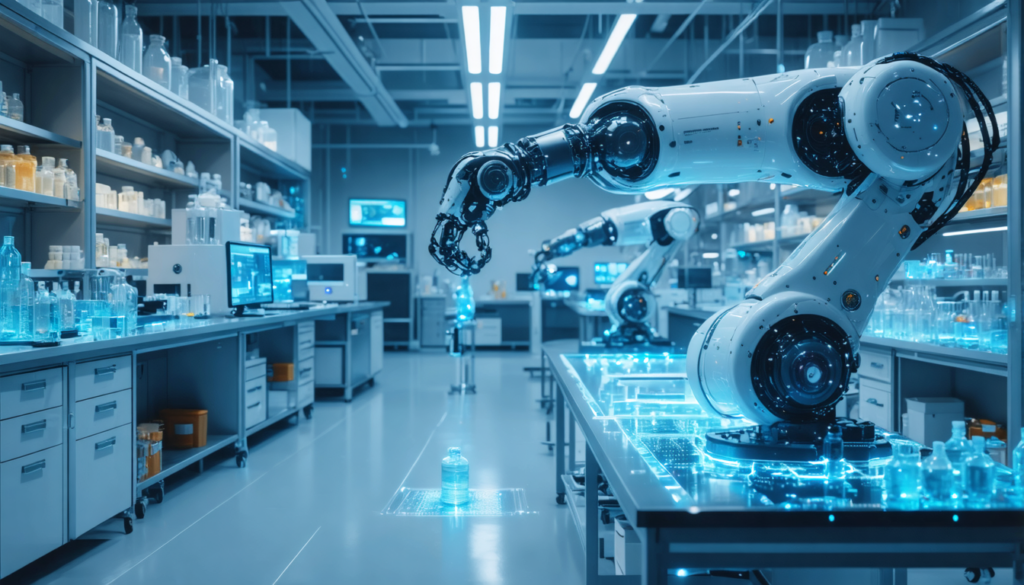
The healthcare sector is experiencing an unprecedented revolution thanks to the massive integration of artificial intelligence (AI). In 2026, the strategic partnership between Nvidia, a technology giant, and Eli Lilly, a leader in pharmaceutical research, embodies this major transition. These two players have decided to invest up to one billion dollars to create a high-tech co-innovation laboratory in the heart of Silicon Valley. This ambitious project aims to accelerate the discovery and development of innovative treatments through exceptional computing capabilities and advanced machine learning models. This collaboration symbolizes the alliance between scientific expertise and computing power, paving the way for more personalized medicine and a profound transformation of research methods in pharmacy.
This initiative relies on an ultra-high-performance supercomputer already being installed in Indianapolis, described as the most powerful ever deployed in the pharmaceutical industry. It will be the technological core of this new ecosystem where researchers and AI engineers will work together to fully harness the power of Nvidia’s new hardware architectures and Eli Lilly’s biological data. Talent training, software adaptation, and the establishment of a continuous experimentation environment are at the center of this exceptional laboratory. The project promises to significantly reduce the traditional timelines for discovering new drugs by automating previously manual and tedious operations.
- 1 A co-innovation laboratory: a catalyst for pharmaceutical research with artificial intelligence
- 2 AI supercomputer: unmatched power serving health and drug discovery
- 3 Artificial intelligence as a driver of innovation in pharmaceutical research
- 4 Nvidia’s expansion strategy in health: between diversification and technological leadership
- 5 Technological collaboration: integration of laboratory equipment and AI-assisted automation
- 6 Impact on drug development timelines and pharmaceutical competitiveness
- 7 Perspectives and ethical challenges related to artificial intelligence in healthcare
A co-innovation laboratory: a catalyst for pharmaceutical research with artificial intelligence
The partnership between Nvidia and Eli Lilly is not limited to a simple financial rapprochement. It is about creating a co-innovation laboratory that combines the complementary strengths of the two companies. Strategically located in the heart of Silicon Valley, this space will become a true crossroads of exchange between artificial intelligence specialists and medical biology researchers.
In this laboratory, AI engineers will have the main mission of mastering advanced scientific equipment and research techniques specific to the pharmaceutical field. This dual specialization will allow effective adaptation of IT infrastructures and software, to take charge of certain classic operations performed by researchers, such as complex data analysis, molecular simulation, or predicting the efficacy of compounds. This automated process could thus surpass human limits related to processing capacity and team availability.
Beyond mere automation, it is primarily about enabling continuous machine learning, where data from physical laboratories is constantly integrated into digital environments to refine and accelerate experimentation. This closed cycle of permanent improvement is fundamental in modern research, as it prevents repeated errors, optimizes clinical trials, and speeds up the validation of drug candidates. Nvidia and Eli Lilly have planned that this synergy will result in a notable acceleration of the discovery of better-targeted and more effective treatments for patients.
This laboratory relies on Nvidia’s cutting-edge hardware infrastructures and Eli Lilly’s long experience in medical research. Thus, the announced five-year investment, which could reach one billion dollars, includes not only financial resources but also a significant human commitment. Teams from both companies will be led to share knowledge and expertise to develop innovative solutions combining biology, chemistry, computing, and artificial intelligence.

AI supercomputer: unmatched power serving health and drug discovery
The nerve center of this collaboration is undoubtedly the supercomputer set up in Indianapolis. From the first quarter of 2026, this technological jewel will be fully operational. Designed to be the most powerful computing engine serving the pharmaceutical industry, it will provide researchers with phenomenal computing capabilities allowing them to process gigantic volumes of biological and chemical data.
The raw power combined with Nvidia’s expertise in GPU architectures and software optimization will open the way to the application of sophisticated machine learning methods on medical and pharmacological data. The ability to quickly simulate complex reactions, explore molecular variations, and model biological interactions with unprecedented precision disrupts traditional processes, which are often very long and costly.
This supercomputer thus becomes an innovation catalyst where artificial intelligence does not merely assist but takes an active part in the research process. The collaboration also allows the integration into this infrastructure of open-source solutions, notably the BioNeMo models and Nvidia’s future Vera Rubin architecture, adapted to computational biology. These tools accelerate genomic modeling, targeted drug design, and therapeutic personalization.
To illustrate the impact of this technology, let’s take the example of neurodegenerative diseases. The supercomputer can simultaneously analyze thousands of molecular leads and identify those with the strongest potential to inhibit or activate pathological mechanisms. This approach prevents laboratories from heading towards useless or unpromising trials, thereby reducing the time necessary to reach a validated drug candidate.
| Nvidia-Eli Lilly supercomputer characteristics | Description |
|---|---|
| Computing power | Over 1 exaFLOP in AI computing capacity, surpassing existing supercomputers in the pharmaceutical sector |
| Architecture | NVIDIA DGX GPUs integrated with the BioNeMo artificial intelligence platform |
| Storage capacity | More than 10 petabytes of biological and clinical data accessible in real time |
| Key functionalities | Continuous learning, advanced molecular simulation, automation of pharmacological analyses |
| Availability | Operational from Q1 2026, base for the co-innovation laboratory |

Artificial intelligence as a driver of innovation in pharmaceutical research
In a sector as complex as pharmacy, the adoption of artificial intelligence is not limited to a mere improvement of tools. It fundamentally transforms the very methodologies of discovery, validation, and drug development. This process is both iterative and cumulative, relying on short cycles of experimentation, analysis, and optimization enabled by AI.
Machine learning models here are capable of simultaneously integrating clinical, genomic, chemical, and pharmacological data, to propose robust and innovative hypotheses. Their reliability increases through iterations, allowing greater precision in identifying therapeutic targets and predicting the efficacy of new compounds.
Eli Lilly, leveraging its medical expertise, and Nvidia, with its AI technologies, demonstrate for example how their synergy allows a considerable reduction in preclinical phases. Sophisticated algorithms simulate biological reactions at the molecular scale, theorize the impact of a drug on the central nervous system, and even anticipate secondary risks, which constitutes a significant saving of time and money.
This approach is also accompanied by better personalization of treatments. AI analyses can target patient subgroups according to specific genetic profiles, making it possible to adapt therapeutic protocols according to individual characteristics. This more precise medicine meets modern requirements and opens promising perspectives for diseases until now difficult to treat.
Nvidia’s expansion strategy in health: between diversification and technological leadership
The collaboration with Eli Lilly fits perfectly into Nvidia’s strategic roadmap, which aims to diversify its application fields beyond traditional digital giants. Despite a strong current dependence on some major clients, the group intends to consolidate its dominant position by also establishing itself as an essential supplier for biomedical and pharmaceutical research.
The healthcare and pharmacy market represents a promising sector with high innovation potential for Nvidia. The demand for computing power and machine learning technologies capable of processing complex biomedical data continues to grow. This strategic orientation also allows the company to play a more central role in major societal issues, such as improving public health and combating chronic or emerging diseases.
Kimberly Powell, director of the health division at Nvidia, states that the use of their AI chips in pharmaceutical laboratories aims to overcome the main bottleneck: human availability. Research is by nature long and complex, slowed down by the necessities of experimentation, analysis, and validation. Intelligent automation thus allows increasing the pace by freeing researchers from repetitive tasks and giving them access to faster and more accurate results.
Nvidia has also committed to an open-source approach with the development of medical AI models accessible to the scientific community. This democratization of tools gives other institutions and companies the possibility to adopt, adapt, and improve these models according to their needs, generating a snowball effect in favor of faster and collaborative innovation.
Technological collaboration: integration of laboratory equipment and AI-assisted automation
Beyond the supercomputer, the partnership between Nvidia and Eli Lilly includes targeted projects aiming to connect laboratory equipment to real-time computing power. For example, the collaboration with Thermo Fisher Scientific enables linking measurement, analysis, and synthesis instruments with a centralized IT platform.
This means that part of the experiments can be controlled and optimized continuously by AI algorithms, with a perspective of experimentation 24/7. This intelligent automation not only improves process precision but also reduces human errors and greatly increases repeatability.
Other initiatives, like the partnership with Multiply Labs, are dedicated to training robots capable of performing complex procedures in medical research. These robots benefit from programming driven by machine learning, making them adaptable to various types of experimental tasks and changing protocols.
- Automation of laboratory testing protocols
- Real-time control of experimental parameters via connected sensors
- Use of intelligent robots for handling chemical compounds
- Instant data collection and analysis to adjust experiments
- Cross-training between human researchers and AI engineers for better technical coupling

Impact on drug development timelines and pharmaceutical competitiveness
The use of this state-of-the-art infrastructure combined with machine learning devices promises a radical change in the time required to bring new treatments to market. Traditionally, pharmaceutical research and development can take about ten years, with a high failure rate, especially during clinical phases.
Thanks to predictive models and accelerated experiments enabled by AI, some preclinical stages can be reduced by half or more. Intelligent automation optimizes the selection of compounds to develop, avoids unnecessary tests, and anticipates potential side effects even before engaging trials on patients. This time gain is also crucial in case of a health threat, where speed in development is vital.
For Eli Lilly, this partnership is a strategic lever allowing it to maintain its position among the world leaders in pharmacy. For Nvidia, it is an opportunity to strengthen its role as a key player in the digital transformation of the medical sector. This co-innovation thus benefits the entire pharmaceutical value chain, from design to production, including quality control and therapeutic personalization.
While the major investment and technological innovation generate legitimate enthusiasm, the integration of AI in the medical field also raises crucial ethical, regulatory, and social questions. The handling of sensitive data, algorithm transparency, and accountability in case of medical errors are among the most debated issues.
In this context, Nvidia and Eli Lilly commit to respecting strict standards regarding patient data protection and to working within collaborative frameworks with health authorities. The objective is to ensure that technological innovation does not sacrifice people’s safety nor public trust.
Another challenge lies in training researchers and technicians to master these complex tools. While AI automates certain tasks, it also requires new skills in computing, machine learning, and result interpretation, which implies continuous skill development within teams. The co-innovation laboratory will therefore play a key role in this knowledge transmission.
Finally, constant vigilance is necessary to avoid biases in AI models, which could skew research results or lead to inappropriate treatments for certain patient groups. The dialogue between medical experts, data scientists, and regulators is essential to guide the development of responsible and equitable tools.