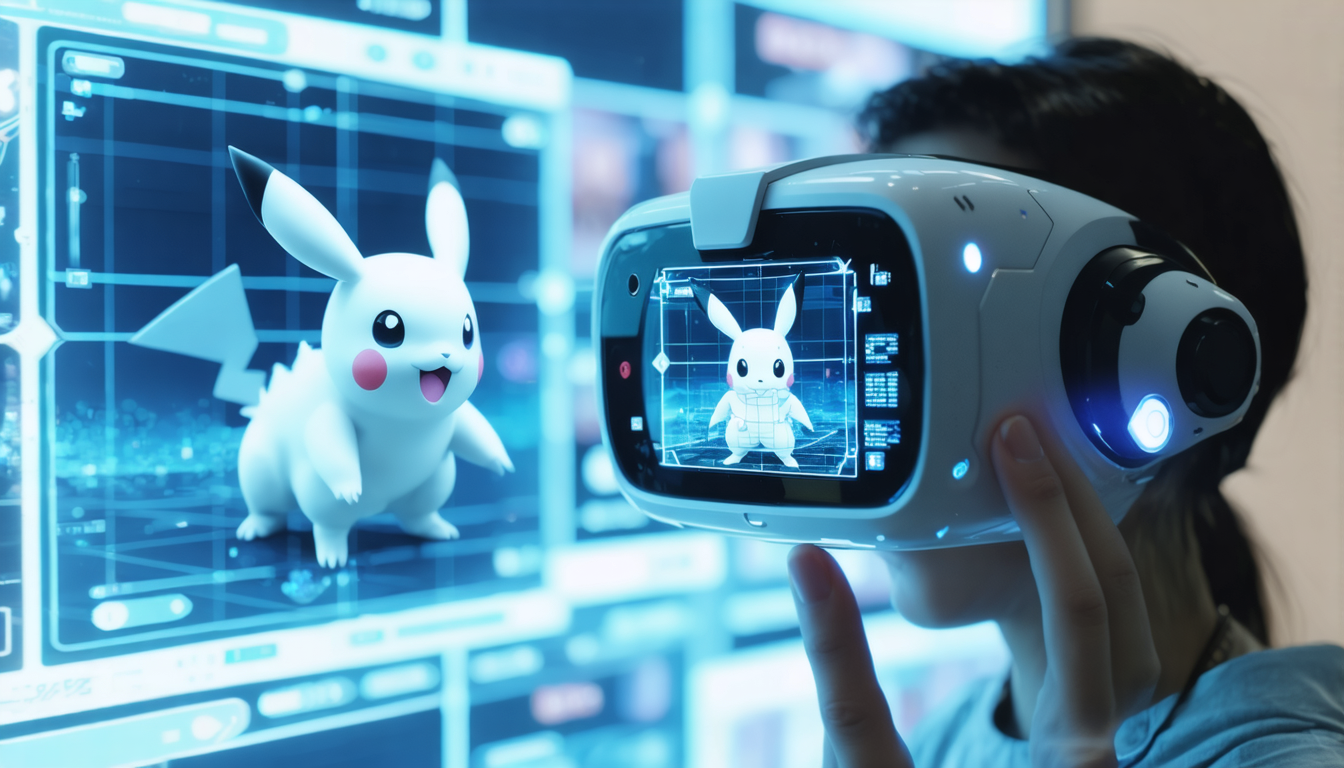
For more than two decades, the Pokémon franchise has fascinated millions of fans worldwide. One of the iconic items of this saga is undoubtedly the Pokédex, that imaginary device that Ash and his companions used to identify and gather information about the pocket monsters they encountered. In 2025, the line between fiction and reality blurs thanks to a remarkable initiative: an enthusiast designed a real operational Pokédex relying on the power of artificial intelligence, and more specifically ChatGPT. This unprecedented project, integrating both visual recognition and speech synthesis, materializes the dream of an entire generation. It offers an immersive and interactive experience faithful to the original series, blending creativity and advanced technology.
The challenge was significant: to reproduce a device capable not only of identifying a Pokémon from an image but also of conveying all the essential information with the same memorable electronic voice. Innovative solutions were deployed to combine various AI technologies, specialized API usage, and 3D printing for the casing. This artisanal feat highlights the growing potential of ChatGPT, which now goes beyond a simple chatbot to establish itself as a truly intelligent interface capable of processing and understanding visual data in a geek and video game universe.
- 1 The genesis of the project: how a fan brought the real Pokédex to life with ChatGPT
- 2 How ChatGPT propels the Pokédex into a new dimension of artificial intelligence
- 3 A faithful design and modern features for a unique immersive experience
- 4 Technical and creative challenges encountered in building the functional Pokédex
- 5 An accessible technology bridging passion and reality
- 6 What this Pokédex means for the Pokémon community and AI enthusiasts
- 7 Evolution prospects: towards an ever smarter and connected Pokédex
- 8 Comparative table: The different generations of Pokédex between fiction and reality
- 9 The Pokédex and the magic of ChatGPT: a revolution for fans and technology
The genesis of the project: how a fan brought the real Pokédex to life with ChatGPT
It all started with a simple idea rooted in childhood nostalgia. Abe Haskins, engineer and Pokémon enthusiast, wanted to create a Pokédex that was not just a simple replica but a functional device integrated with modern technology. Previous commercial versions, although fun, remained limited to a simple toy without real identification capabilities. Abe’s ambition was then to implement an artificial intelligence capable of automatically identifying a Pokémon from an image taken by an onboard camera.
To achieve this, Abe relies on ChatGPT, OpenAI’s language model renowned for its text comprehension and generation capabilities, but also for its extended applications in image recognition coupled with other specialized APIs. Thus, the Pokédex is not only a physical object but a condensate of advanced technologies. Once the image is captured, the artificial intelligence analyzes the visual traits, shapes, and characteristics to propose a precise real-time identification.
But the project does not stop there. Visual recognition is linked to PokeAPI, an exhaustive database created by passionate fans gathering all official information available on each Pokémon: powers, statistics, evolutions, and even anecdotes. Thus, it becomes possible to obtain a detailed sheet directly on the screen with a synthesized voice reproducing the iconic robotic tone. This marriage between artisanal hardware and cloud computing via Google Firebase makes the solution innovative and adaptable.
The casing, for its part, is an aesthetic homage to the first generation of Pokémon: a compact device 3D printed, equipped with a color screen and a set of functional buttons that make the tactile experience faithful to the series. Abe also integrated a speaker to reproduce the metallic voice that announces the names and characteristics, thus enhancing realism and immersion. This type of Pokédex transforms the simple playful touch to offer an exceptional product between video game and connected collector’s item.
How ChatGPT propels the Pokédex into a new dimension of artificial intelligence
The major strength of this creation lies in the subtle integration of ChatGPT, which is not limited to generating texts but becomes a true intelligent brain capable of understanding visuals and instantly associating a multitude of data. Unlike previous attempts where identification was based on simple databases or basic image recognition algorithms, here the AI also includes contextual and textual analysis.
Specifically, when an image of a Pokémon is submitted, the technology interprets every visual element to eliminate errors caused by viewing angles or lighting variations. For example, the machine will be able to differentiate a Pikachu from a Raichu based on specific characteristics such as ear shape or tail. ChatGPT then communicates with PokeAPI to enrich the response, offering not only a name but also detailed data: height, weight, elemental type, possible attacks, and much more.
This interaction between artificial intelligence and extensive databases is orchestrated in the cloud, ensuring response speed without burdening the device’s resources. Google Firebase plays a major role in this architecture by managing exchanges and the stability of communication between the different software components. This infrastructure also facilitates automatic updates, allowing the device to evolve with new Pokémon generations and technological improvements.
It is interesting to note that to optimize recognition, supervised machine learning algorithms were adjusted to guide ChatGPT. Thousands of Pokémon images were used to train the system to identify standard shapes rather than plush toys or abstract representations, which explains the observed accuracy and speed. This mixed technique of textual and visual AI disrupts the very notion of a virtual assistant and opens unprecedented perspectives for the video game universe and connected objects.
A faithful design and modern features for a unique immersive experience
Beyond the technological feat, the Pokédex designed by Abe stands as a true collector’s item thanks to its carefully crafted design. Directly inspired by the famous red devices seen in cartoons, it retains this compact and manageable look that allows easy carrying. The shell was made via 3D printing with robust materials, offering a customizable finish according to user preferences.
The buttons, which appear minimalist, actually integrate advanced functionalities. They allow quick access to different data categories, such as consulting Pokémon already identified, a manual search function, or recognition and speech synthesis settings. The color screen displays dynamic illustrations and information with clear rendering, and the speaker reproduces a synthetic voice faithful to the original games.
Here are the main technical features:
- High-resolution onboard camera: precise capture of figurines and Pokémon images.
- Advanced visual recognition: ChatGPT artificial intelligence coupled with an image processing algorithm.
- Wi-Fi connection: communication with the cloud and PokeAPI for updates and database access.
- Speech synthesis: specific robotic voice for authentic immersion.
- 3D-printed casing: personalized and functional design with physical buttons.
This blend of old and new transforms a simple gadget into an indispensable companion that will delight both video game fans and collectors seeking authenticity. Moreover, the device is designed to evolve with Pokémon novelties, ensuring lasting compatibility and continuous enrichment of accessible data.

Technical and creative challenges encountered in building the functional Pokédex
Creating a device combining artisanal hardware and advanced artificial intelligence is no small feat. Abe had to overcome several obstacles, both technical and design-wise, to deliver a solid and reliable product despite its prototype aspect. One of the first challenges was calibrating the integrated camera to properly capture details necessary for identification.
On the software side, synchronization between ChatGPT and third-party databases faced some complications, including bugs where the Pokédex displayed incoherent characters on screen or unexpected errors during simultaneous API calls. These incidents required data flow optimization and redundancy systems to ensure stability in real conditions.
The visual recognition system, although performant, remains sensitive to certain environmental factors. For instance, insufficient lighting or atypical angles could disrupt the analysis, forcing multiple shots before a certain identification. Abe therefore integrated a function allowing automatic capture of several burst photos to maximize success chances.
Finally, from the user’s point of view, it was about making the interface intuitive despite a complex architecture. User tests made it possible to simplify tactile interactions as much as possible, with fast feedback on commands, while preserving the richness of functions. This care given to user experience makes the Pokédex more than just a technical success, but a true accessible and friendly geek object.
An accessible technology bridging passion and reality
This project clearly shows that with modern AI technologies and accessible tools like 3D printing, it is possible to realize dreams long confined to fiction. Abe’s functional Pokédex is a genuine feat that inspires other creatives to combine their passions with technological advances.
Beyond the playful aspect, this creation illustrates the power of intelligent interfaces to offer personalized and enriching experiences. Using ChatGPT in processing visual data also paves the way for similar applications in other fields, such as animal species recognition, interactive education, or even digital museography.
By realizing a childhood dream for millions of fans, this Pokédex also highlights the importance of a multidisciplinary approach combining engineering, programming, design, and cultural passion. Every element, from the casing to the cloud, was thought out to maximize both technical efficiency and emotion.
What this Pokédex means for the Pokémon community and AI enthusiasts
The appearance of a physical and functional Pokédex, relying on ChatGPT, redefines how fans interact with their favorite universe. It is no longer just a video game or a collection of figurines but an augmented experience where technology makes a part of the imaginary tangible. This device strengthens the link between geek culture and technological innovations.
For AI enthusiasts, this project is a concrete example of an application combining visual recognition, natural language processing, and user interaction. The scientific community and content creators see it as proof of the reliability of current technologies to develop intelligent tools serving creativity and enjoyment.
Moreover, the success of this initiative encourages companies in the video game sector to integrate more AI into their products and platforms. In 2025, the use of ChatGPT and similar technologies is seen as a major driver of innovation, bringing new life to legendary franchises like Pokémon.
Evolution prospects: towards an ever smarter and connected Pokédex
Abe’s Pokédex is only the beginning of a revolution in connecting physical objects and immersive artificial intelligence. Several improvement paths are already being considered to enrich the experience:
- Augmented reality (AR) integration to make consultations more interactive and visual.
- Development of a learning function allowing the Pokédex to better recognize abstract shapes or Pokémon plush toys, thus expanding its scope.
- Multi-device connection to share data between players and create a collaborative network of trainers.
- Optimization of energy autonomy to guarantee prolonged use on the go.
- Complete voice integration in multiple languages to open access to international fans.
These improvements will be possible thanks to the flexibility offered by cloud solutions and the evolving potential of AI models. It is certain that in the coming years, this type of project will inspire many innovations at the crossroads of video games, technology, and pop culture.

Comparative table: The different generations of Pokédex between fiction and reality
| Generation | Fictional Characteristics | Real / Prototype Evolution | Main Technology Used | User Experience |
|---|---|---|---|---|
| First generation (1990s) | Portable device, Pokémon recognition by manual input | Simple electronic toys, without AI | Basic technology, simple electronics | Limited, no interaction |
| Second generation (2000s) | Audio recognition, extended databases | Devices with more complete databases, without visual recognition | Improved storage systems | More informative but still static |
| Third generation (2020s) | Touch interface, integrated AI, image recognition | Functional Pokédex powered by ChatGPT and PokeAPI | Artificial intelligence, cloud, speech synthesis | Full and interactive immersion |
The Pokédex and the magic of ChatGPT: a revolution for fans and technology
Abe Haskins’ project perfectly symbolizes the rise of artificial intelligence technologies serving pleasure and creativity. More than just a gadget, the new generation Pokédex perfectly combines the imagination of a legendary saga and the technical advances shaping the digital world in 2025. Thanks to its intuitive interface and its capacity to understand, analyze, and reproduce complex data, ChatGPT establishes itself as an indispensable pillar for the future of video games and connected objects.
For fans, this device is much more than a childhood dream realized; it is a bridge between nostalgia and the future, between passion and innovation. It embodies the promise that technology can enhance cultural universes by making experiences possible that were until then confined to fiction. With this functional Pokédex, reality surpasses fiction, opening the way to a new era where the dreams of thousands of fans become tangible, palpable, and shared.
What makes this functional Pokédex unique?
This Pokédex is the first to combine advanced visual recognition, ChatGPT artificial intelligence, and speech synthesis to offer instant and detailed identification of Pokémon with an interface faithful to the series.
How does ChatGPT improve the user experience?
ChatGPT analyzes not only the image but also contextual data, allowing for a complete and precise description of each Pokémon, making the interaction natural and immersive.
Is this Pokédex accessible to the general public?
For now, it is a handcrafted prototype. However, the technology used could inspire future commercial versions, subject to legal agreements with The Pokémon Company.
What technical challenges were encountered?
Camera calibration, API bug management, and recognition under varied lighting conditions were the main obstacles, to which the creator responded with software and hardware optimizations.
What evolutions are planned for this Pokédex?
The integration of augmented reality, extended learning to better recognize stylized shapes, and multi-device connectivity are planned to enrich the experience in the future.