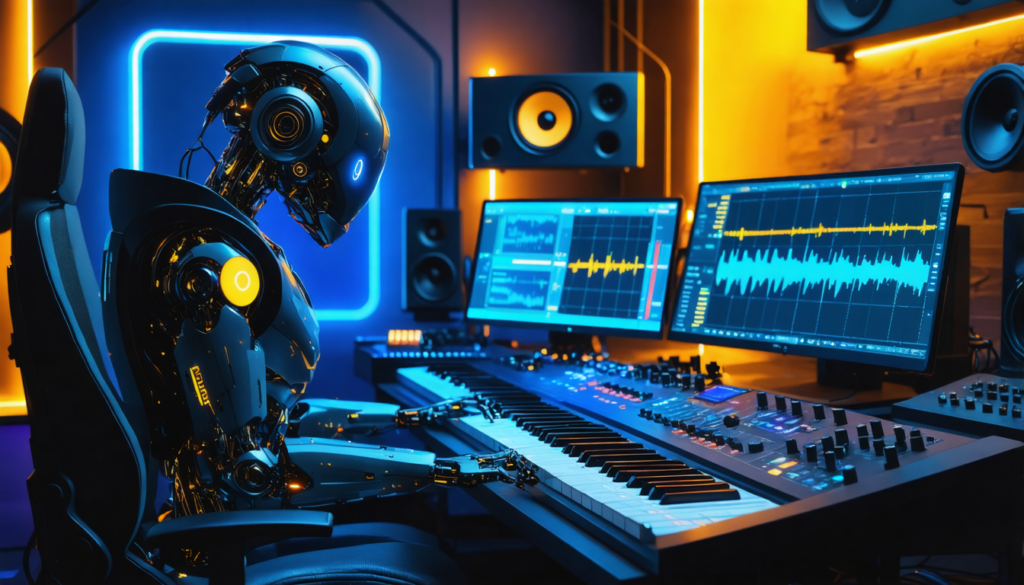
The marriage between technology and music enters a new era with the spectacular announcement of Google’s acquisition of ProducerAI, an artificial intelligence whose revolution in the music world is starting to make a lot of noise. This acquisition, officially announced in February 2026, harnesses the power of the advanced AI Lyria 3 developed by Google DeepMind to transform sound creation. Musicians, producers, and enthusiasts are now faced with an innovation that promises to redefine the way tracks are composed, produced, and imagined, while raising major questions about copyright and human creativity.
With this integration, Google asserts itself more than ever in the field of artificial intelligence applied to music, expanding its ambitions far beyond simple automation to offer close collaboration between artists and technologies. ProducerAI symbolizes this dynamic: capable of transforming very simple textual instructions into coherent, modular, and original compositions, it establishes itself as a full-fledged creative partner in studios. While some famous musicians are already experimenting with this technology, the debate around its impact on the music industry continues to intensify.
At the heart of this upheaval lie delicate questions related to the use of protected music catalogs for training these artificial intelligences, ethics, but also a potential redefinition of the role of music creators in the years to come. By taking hold of this AI, Google opens a new chapter yet to be written in the history of music and technology, where innovation and controversy closely coexist.
- 1 A major breakthrough: how Google integrates ProducerAI into its technological ecosystem
- 2 Musicians and AI: initial feedback with Lyria 3 in music creation
- 3 Legal and ethical issues: musicians’ resistance to AI in music
- 4 Impact of ProducerAI on the music industry: between hopes and concerns
- 5 Concrete examples of AI use in music in 2026
- 6 Comparative table of major AI technologies in music
- 7 Future perspectives for music and AI technology according to Google
- 8 Essential FAQ on the impact of Google’s revolutionary AI in music
A major breakthrough: how Google integrates ProducerAI into its technological ecosystem
Google has officially announced the integration of ProducerAI into Google Labs, a clear sign of its ambition to push the boundaries of artificial intelligence in the musical field. This revolutionary AI relies on Lyria 3, a sound engine developed by Google DeepMind that excels in converting texts and images into high-quality audio compositions. This partnership allows Google to offer a platform capable of generating not only sound loops but also structured tracks with advanced musical coherence.
A user can thus submit a request as simple as “melancholic lofi beat” and instantly receive a usable base for quick creation or in-depth studio work. This ability to produce modular tracks in real time opens new creative horizons that radically transform the role of AI, which becomes more of a partner than a passive tool.
Elias Roman, product manager at Google Labs, emphasizes that ProducerAI contributes to a new dynamic where AI supports the artist in their creative process rather than replacing them. This collaboration allows real-time exchange, smoother experimentation, and the discovery of original soundtracks, at a pace previously inconceivable in classic production.
Google is also working to gradually integrate Lyria 3 directly into its flagship application Gemini, aiming to unify its audio tools and enhance the user experience through a single engine. This strategy demonstrates Google’s desire to unify its innovations around a centralized technology, thus optimizing synergy among its various products to put artificial intelligence at the heart of musical creation.
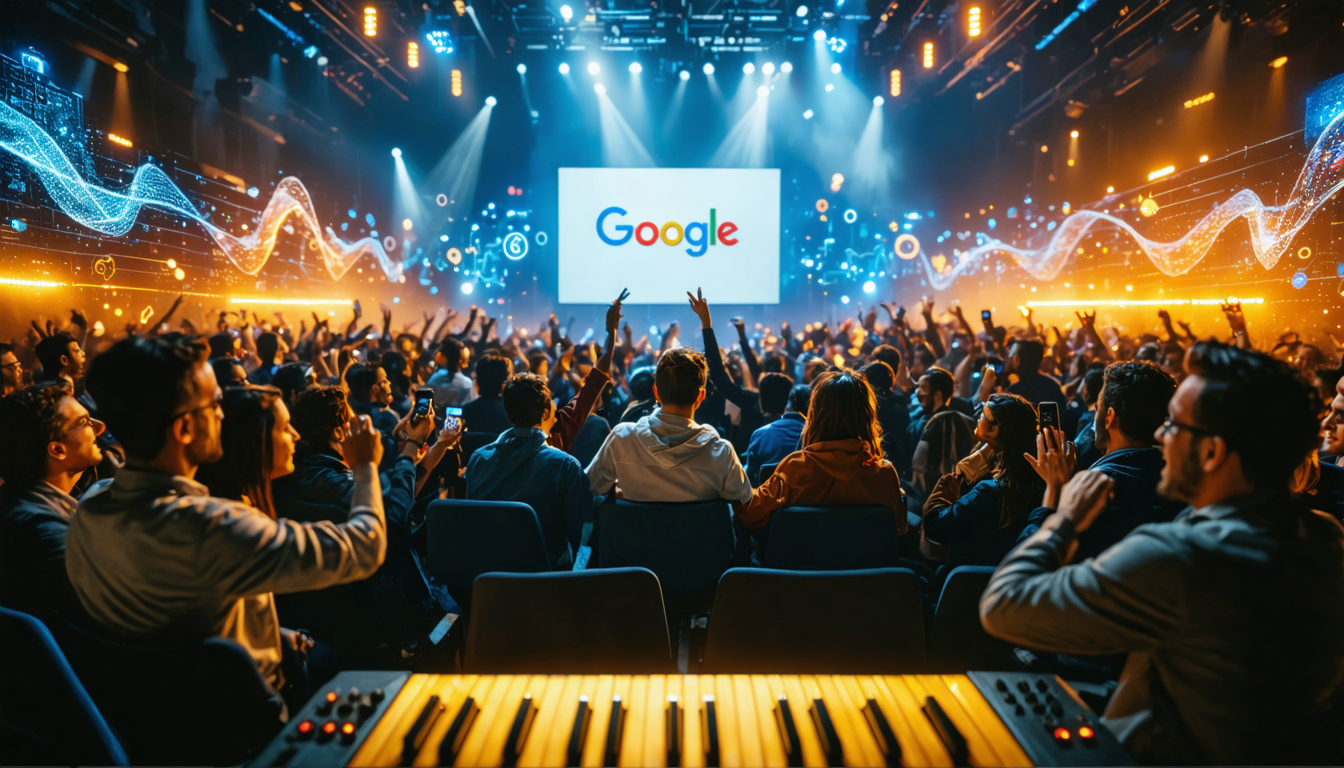
Musicians and AI: initial feedback with Lyria 3 in music creation
Even before its acquisition by Google, Lyria 3 had proven itself with certain musicians who enthusiastically experimented with its capabilities. A flagship example is Wyclef Jean, a renowned artist and three-time Grammy Award winner, who used Lyria 3 to enrich his musical production “Back From Abu Dhabi.” According to him, adding a flute thanks to the AI proved extremely fast, demonstrating a technology capable of complementing and embellishing a recorded track in an instant.
This experience shows that Lyria 3 is not limited to a simple automated interface: it requires precise selection and guidance work to create sounds that correspond to the artistic vision. Jeff Chang, product manager at DeepMind, insists on this collaborative process which favors the exchange between the user and the AI to achieve a satisfying musical result.
This type of tool also gives musicians the ability to deeply explore fusions of genres or novel sound variations that would be difficult to produce without technological assistance. With ProducerAI’s arrival at Google Labs, this exploration is now facilitated, the machine anticipating some proposals and offering alternatives in real time, thus creating a true creative dialogue.
For artists, this means not only a considerable time saving but also renewed inspiration, thanks to which new sounds and arrangements can quickly emerge, thereby facilitating the musical experimentation phase. This phenomenon, currently reshaping studios, highlights the growing importance of artificial intelligences in defining musical trends.
Legal and ethical issues: musicians’ resistance to AI in music
The emergence of AI in musical creation is not a revolution without resistance. Several famous artists have expressed their concerns about how artificial intelligences train on music catalogs often protected by copyright. In 2024, figures such as Billie Eilish, Katy Perry, and Jon Bon Jovi signed an open letter denouncing the risks of devaluing human work and threatening creativity because of these technologies.
The core of the controversy revolves around the transparency and legality of the data used to train these models. Musicians fear that their works, of which they hold the rights, could be incorporated without their consent into the databases exploited by AI, which could lead to a dilution of their style and a homogenization of musical creations.
The rise of tracks entirely generated by AI, now capable of rivaling human productions in realism and even ranking on popular platforms like Spotify or Billboard, intensifies fears of unfair competition and excessive automation of the sector. This dynamic disrupts existing balances and raises deep questions about established practices.
On the judicial side, the situation is also complex and tense. Some publishing houses have sued Anthropic demanding several billion dollars, accusing the company of having downloaded thousands of protected titles without consent, illustrating the legal grey area still dominating this field. Judge William Alsup has already clarified that while piracy is illegal, training on protected data falls into a grey zone, thereby generating crucial debates for the future of the music industry.
Impact of ProducerAI on the music industry: between hopes and concerns
The arrival of ProducerAI under Google’s aegis constitutes both a real threat and an opportunity for the music world. On one hand, its potential to automate and accelerate music production can revolutionize processes, making creation more accessible and breaking down certain technical barriers.
However, the adoption of this technology also raises questions about the future of jobs in the sector. Musicians and producers fear a possible disappearance of traditional roles or a devaluation of human creativity, confronted with competition that is sometimes faster and less costly.
It is certain that ProducerAI is not limited to a simple sound generator but functions like a virtual studio capable of offering evolving tracks, creative suggestions, and live modularity. For some, this fundamentally changes the profession by placing AI in the role of a collaborator with whom one must learn to co-create, thus moving away from a unilateral replacement logic.
In the long term, the successful integration of these tools into artistic workflows will also depend on the ability to resolve issues of copyright, fair remuneration, and recognition of human artists’ contributions. The relationship between technological innovation and respect for creators remains a major point of tension in this turning point of the music industry.
List of main challenges posed by AI integration in music:
- Copyright and protection of works
- Impact on employment and creative professions
- Transparency of training data
- Ethics and recognition of human creativity
- Broadened accessibility to music production
Concrete examples of AI use in music in 2026
Beyond the major announcements, several artists vividly illustrate how AI technology is truly transforming the musical landscape. Paul McCartney, for example, took advantage of advances in artificial intelligence to rework old archival recordings of the legendary John Lennon. Using advanced noise reduction and sound restoration systems, The Beatles were able to release in 2025 an unreleased track titled “Now and Then,” which was awarded a Grammy.
In a different vein, a young artist from Mississippi used an AI named Suno to transform her poems into a viral hit. This success led to a multi-million dollar contract with a major, Hallwood Media, demonstrating the commercial effectiveness of generative tools when intelligently integrated into an artistic strategy.
These examples underline that AI, far from being just a threat, can also become a precious ally for innovation, preservation of musical heritage, and democratization of creation. The interaction between artists and technologies thus opens new paths where performance and authenticity must harmoniously coexist.
Comparative table of major AI technologies in music
| AI Technology | Main Features | Target Users | Limitations |
|---|---|---|---|
| ProducerAI (Google Labs) | Advanced music composition, generation of modular tracks, real-time interaction | Professional musicians, producers, studios | Issues around copyright, risk of excessive dependence on AI |
| Lyria 3 (DeepMind) | Conversion of texts and images into audio, experimentation with varied genres | Creators wanting to explore new sounds | Interface requiring precise calibration work, technical complexity |
| Suno | Transformation of texts into viral hits, assistance with commercial production | Emerging artists, influencers, independent labels | Less suited for complex or experimental productions |
Future perspectives for music and AI technology according to Google
The acquisition of ProducerAI fits into Google’s ambitious vision for the future of music and artificial intelligence. The goal is to create tools that are increasingly intuitive, powerful, and accessible, capable not only of generating content but also accompanying artists in all phases of creation, from design to finalization.
Google plans to expand the capabilities of Gemini, its flagship tool, by more deeply integrating the functions of Lyria 3 and ProducerAI, thus creating a powerful ecosystem of musical assistance. This approach aims to multiply creative experiments, stimulate innovation within studios, and democratize access to music production, also allowing newcomers to explore previously inaccessible sound universes.
At the same time, Google is actively working with industry players to establish ethical and regulatory frameworks to protect creators’ rights while encouraging innovation. The balance between respecting authors and technological progress is a crucial issue on which the company relies to establish itself as a responsible leader in this rapidly changing field.
Essential FAQ on the impact of Google’s revolutionary AI in music
What is the exact role of ProducerAI in music creation?
ProducerAI acts as a creative partner capable of generating structured tracks from simple instructions, thus facilitating real-time composition and offering varied musical suggestions.
Why does this AI raise reservations among musicians?
The main concerns involve unauthorized use of protected catalogs to train AIs, as well as the risk of diluting human creativity and altering copyright.
How does Google plan to integrate this technology?
Google aims to integrate ProducerAI and Lyria 3 within its Gemini app to unify the user experience and make assisted composition accessible to a broad audience.
Is AI a threat to the musician’s profession?
AI does not aim to replace musicians but to assist them by multiplying creative possibilities, allowing artists to push their limits in sound exploration.
What are concrete examples of successful AI use in music?
Besides Wyclef Jean and Paul McCartney, young artists use AI as a tool for creating and distributing their works, demonstrating its commercial and artistic impact.