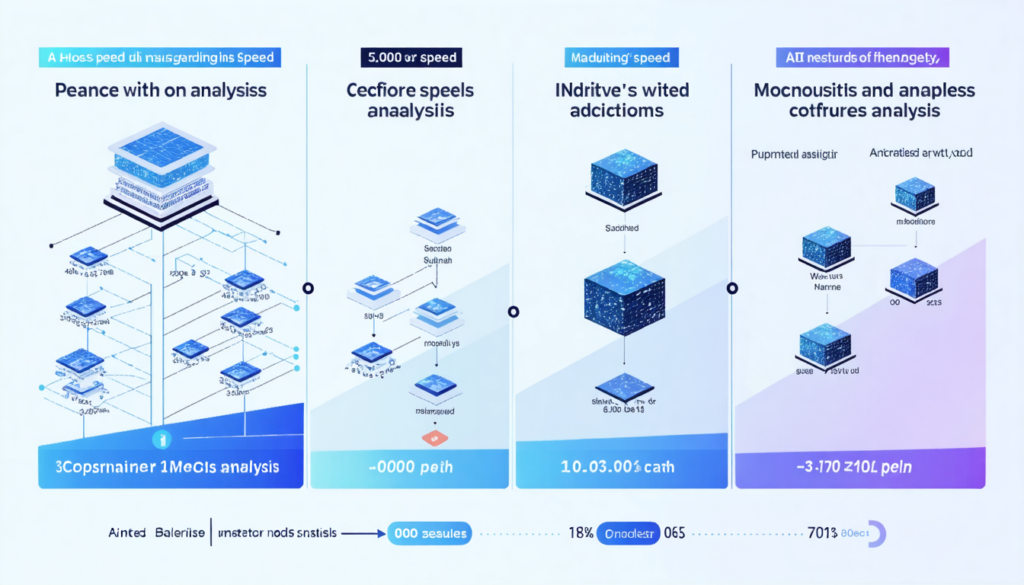
In the ever-evolving world of artificial intelligence, Google sharpens its tools with two flagship products: Google Gemini 3 and Gemini 3 Flash. While the first embodies depth and advanced analysis, the second positions itself as the champion of speed and accessibility. These two models represent a significant advancement in AI technology in 2025, offering users a varied range tailored to diverse needs. The comparison between Gemini 3 and Gemini 3 Flash highlights important strategic choices by Google, aiming to democratize artificial intelligence while keeping a foot in cutting-edge innovation.
More than a simple technical evolution, this variant shows how Google seeks to address different uses, from quick searches to complex analysis in science or industry. This article explores the key differences between these two versions, their distinctive features, performances, as well as their impact on current and future uses of AI assistants. A dive into a universe where speed meets precision, and where technology adapts to every request with mastery.
- 1 Google Gemini 3 Flash: a speed revolution in artificial intelligence
- 2 Gemini 3: the depth of analysis at the service of complex tasks
- 3 Key differences between Google Gemini 3 and Gemini 3 Flash
- 4 The technological innovations behind Gemini 3 and Gemini 3 Flash
- 5 Performance and benchmarks: Gemini 3 Flash versus the competition in 2025
- 6 What usages for each model? Adaptability and practical cases
- 7 Interface and accessibility: user experience with Google Gemini 3 and Gemini 3 Flash
- 8 The future outlook for Google Gemini 3 and Gemini 3 Flash
- 8.1 What are the main differences between Google Gemini 3 and Gemini 3 Flash?
- 8.2 Is Gemini 3 Flash accessible for free?
- 8.3 In which fields is the classic Gemini 3 most used?
- 8.4 Which to choose between Gemini 3 and Gemini 3 Flash for daily use?
- 8.5 What are the advantages of the Pro versions based on Gemini 3?
Google Gemini 3 Flash: a speed revolution in artificial intelligence
Gemini 3 Flash, as its name suggests, is designed to be the fastest and most agile version of the Gemini family. It is an AI model optimized to quickly execute simple and intermediate tasks, making this tool a major asset for queries where speed takes precedence over complexity. For example, when a user performs a quick search or requests a rephrasing, Gemini 3 Flash can provide a response in a fraction of the time a classic version would take.
The increase in speed does not come at the expense of quality, as Google announces a tripling of speed compared to Gemini 2.5 Pro, while maintaining coherent and relevant responses. This performance is notably visible in daily uses, where expectations for fluency are high to ensure a natural interaction with the user. It is precisely this speed that allows Gemini 3 Flash to be accessible for free to a wide audience, without subscription, everywhere in the world, thus facilitating the massive adoption of AI.
In practice, Gemini 3 Flash offers remarkable versatility. It excels in coding, writing short texts, and step-by-step reasoning, providing considerable support to both professionals and individuals. Its ability to maintain coherence across a wide variety of topics without noticeable slowdown is proof of an intelligent optimization of the underlying algorithms.
This “Flash” version represents a considerable innovation, as it changes the perception of free artificial intelligence models. Where such models previously seemed limited, Gemini 3 Flash now positions itself close to the performance of paid AIs such as OpenAI’s GPT-5.2 or Claude Sonnet 4.5, without systematically surpassing them. This positioning alters habits and opens the door to a broader democratization of access to cutting-edge technologies.
Gemini 3: the depth of analysis at the service of complex tasks
Unlike Gemini 3 Flash, the classic Google Gemini 3 model adopts a more thoughtful and analytical approach. It does not sacrifice speed but favors a longer and more in-depth processing of information to provide detailed and precise results, especially when interpreting complex or technical questions.
This mode of artificial intelligence is particularly useful in fields such as scientific research, medicine, or industrial applications, where the slightest approximation can have significant consequences. For example, a healthcare professional using Gemini 3 will obtain answers supported by more rigorous reasoning, taking into account different parameters and contextual data, which can far exceed a simple basic summary.
Gemini 3 is also the basis on which the pro versions of the range are built, aimed at corporate and specialized users. These advanced versions offer even more powerful capabilities, notably in processing complex data, validated by a premium subscription. Thus, the classic model retains all its relevance in environments where quality and precision are strategic.
The compromise between speed and depth proposed by Gemini 3 is a deliberate choice that responds to different needs. For many companies or researchers, quality and relevance are well worth the additional waiting time, allowing better understanding of a problem and development of finer, adapted solutions. Google thus exploits the full richness of AI technology by adapting its tools to a plurality of uses.
Application domain and adaptation according to needs
The spectrum of applications covered by Gemini 3 is broader and more refined. Its use ranges from the development of medical protocols to financial data analysis or the drafting of technical reports. This increased processing capability allows it to span sectors by providing a deep level of understanding and a multifaceted reasoning essential to advanced use cases.
This version can also be seen as an essential resource for innovation, where data processing must take into account very detailed information and high stakes. It thus becomes a key partner for projects requiring rigorous validation, attesting to the growing role of artificial intelligence in complex processes.
Key differences between Google Gemini 3 and Gemini 3 Flash
The main distinction between Google Gemini 3 and Gemini 3 Flash lies in their balance between speed and precision. To better understand these differences, let’s analyze the fundamental points that separate them.
- Execution speed: Gemini 3 Flash is about three times faster than Gemini 2.5 Pro, which naturally places it ahead of the classic version in terms of responsiveness.
- Response quality: Gemini 3 favors in-depth reflection, which gives it a better ability to handle complex queries with more precision.
- Target audience: Flash targets general public use, accessible for free and ideal for everyday needs. Classic Gemini 3 and its Pro version mainly target professionals who require in-depth analysis.
- Cost and access: Gemini 3 Flash is offered without subscription worldwide, while Gemini 3 Pro requires a paid subscription with advanced features.
- Technical performance: Flash combines performance and speed, while offering surprising versatility for a free model, competing with the best AIs on the market.
These aspects are essential to understand why Google now offers two complementary platforms. The flexibility offered corresponds to the evolving expectations of users, who often seek a compromise between speed and depth depending on the context.
| Features | Google Gemini 3 | Gemini 3 Flash |
|---|---|---|
| Response speed | Moderate, geared towards deep analysis | Very fast, designed for instant efficiency |
| Response quality | Excellent for complex cases | Good, suited to general needs |
| Accessibility | Subscription for Pro, limited free standard version | Fully free and accessible to all |
| Preferred usage domains | Research, medicine, industry | Daily use, coding, quick writing |
| Underlying technology | Advanced analytical approach | Optimized for speed and versatility |

The technological innovations behind Gemini 3 and Gemini 3 Flash
Google has integrated several major advances into its Gemini AI models, notably exploiting cutting-edge architectures that allow benefiting from both speed and analytical depth. Gemini 3 relies on a set of multi-step reasoning techniques, capable of producing detailed answers based on large data sets.
The Flash version, meanwhile, benefits from an engine optimized to shorten processing times without compromising relevance. This optimization involves simplified learning algorithms when possible, a lighter compressed model, and better management of computational resources. This makes access smoother and drastically reduces waiting times.
At the core of these products, system modularity allows Google to adapt AI to different scenarios according to user needs: the models can evolve towards higher complexity or faster execution, while maintaining an impressive level of reliability. This flexibility reflects a clear desire to meet the ever-changing challenges in the field of intelligent digital assistants.
Another important innovation is the advanced integration of multimodal capabilities, notably the cross-understanding of images and text, which is gaining ground in Gemini 3. This multiplies interaction possibilities and paves the way for hybrid applications capable of processing several data formats simultaneously, a key factor for the future evolution of AI assistants.
Performance and benchmarks: Gemini 3 Flash versus the competition in 2025
Independent tests carried out in 2025 place Gemini 3 Flash very close to the performance of other major industry names such as GPT-5.2 and Claude Sonnet 4.5, without systematically surpassing them. This performance is all the more remarkable as Flash is offered free of charge, which changes the market dynamics in terms of accessibility and value for money.
During benchmarks focused on coding, text generation, or multi-step reasoning, Gemini 3 Flash shows remarkable stability, with results often within 5% difference compared to paid leaders. This consistency allows Google to consolidate its position as a key player in the race for artificial intelligence.
The speed-performance compromise of Gemini 3 Flash appeals to many users, as it allows adopting efficient AI without budget constraints or significant latency. In comparison, the classic Gemini 3 and its pro versions remain preferred for cases where the finesse of answers is paramount, particularly in specialized professions or research.
These tests also confirm the strategic importance of Google’s choice to offer a diversified range. The public can now combine speed and precision according to their needs, benefiting from a personalized and more satisfying experience.
What usages for each model? Adaptability and practical cases
Let’s try to understand how these two AI assistants materialize in everyday and professional life by examining typical use cases.
For a student or a user simply seeking a quick answer to a factual question, Gemini 3 Flash is undoubtedly the most suitable tool. Its agility makes it possible to find information, rephrase a passage or write a short text in a few seconds, without apparent compromise on quality.
On the other hand, for a researcher or professional faced with more elaborate problems, the standard Google Gemini 3 offers the assurance of in-depth processing and fine contextualization. For example, in the medical field, drafting a research report often relies on this version to guarantee precision and compliance with scientific standards.
In companies, Gemini 3 Pro enriches this ecosystem by integrating modules dedicated to data security and sector specialization. Thus, an engineering firm or a biotechnology laboratory can fully exploit the analytical power and adaptability of these cutting-edge technologies.
- Quick consultation and daily decision-making: Gemini 3 Flash
- Advanced scientific exploration: Gemini 3 standard or Pro
- Complex content production: Gemini 3 standard
- Software development and rapid coding: Gemini 3 Flash
- Specialized professional uses, critical analysis: Gemini 3 Pro
This segmentation clearly responds to a logic of adaptation to the diversity of practices and user expectations, thus consolidating the relevance of each version according to the context.

Interface and accessibility: user experience with Google Gemini 3 and Gemini 3 Flash
Another crucial point of this comparison is the user interface and how each of these models integrates into current systems. Google has chosen to offer Gemini 3 Flash as the default engine in its chatbot, thus providing a smooth and fast experience to a wide audience.
The interface remains intuitive, with usual features, without any special learning required to switch between versions. This simplicity favors adoption by novices or hurried users. Moreover, Flash’s free availability in many regions without restriction strengthens its appeal.
For professional users, access to classic Gemini 3 or Pro often involves registration and subscription, opening a range of advanced functions and dedicated support. This dual offering addresses the specific needs for quality, security, and customization demanded by companies and researchers.
By integrating these models into its services, Google thus facilitates the coexistence of speed and depth, giving users choice depending on their momentary usage, while maintaining a homogeneous and accessible interface.
The future outlook for Google Gemini 3 and Gemini 3 Flash
Looking to the future involves anticipating the evolution of AI technologies and how Google intends to continue innovating with Gemini 3 and Gemini 3 Flash. The modularity and flexibility of these models hint at continuous adaptation to emerging needs, notably thanks to the growing integration of multimodal data.
Expected advances include better contextual understanding, more natural interaction, and increased autonomous capabilities. Google bets on AI capable not only of responding quickly but also of grasping nuance in complex requests, thus merging the speed of Flash with the analytical depth of classic Gemini 3.
The likely arrival of hybrid versions could eventually offer an assistant endowed with combined qualities and unparalleled efficiency. Furthermore, the development of personalized sector solutions will undoubtedly strengthen Google’s position as a leader in the conversational artificial intelligence market.
Finally, increased accessibility and democratization of these technologies suggest a future where every user, whether professional or curious, will be able to benefit from a powerful artificial intelligence adapted to their specific needs, thus shaping a new era in human-machine interaction.
What are the main differences between Google Gemini 3 and Gemini 3 Flash?
The major difference lies in speed and depth: Gemini 3 Flash favors speed and accessibility, while Gemini 3 focuses on in-depth reasoning and precision in complex tasks.
Is Gemini 3 Flash accessible for free?
Yes, Gemini 3 Flash is offered worldwide without a paid subscription, facilitating wide and rapid access to artificial intelligence.
In which fields is the classic Gemini 3 most used?
The classic version is particularly suited to sectors requiring complex analyses, such as medicine, scientific research, or industry.
Which to choose between Gemini 3 and Gemini 3 Flash for daily use?
For daily uses, quick searches, and simple needs, Gemini 3 Flash is recommended due to its speed and ease of use.
What are the advantages of the Pro versions based on Gemini 3?
The Pro versions offer advanced features, specialized data processing, and dedicated support, intended for professionals requiring maximum quality and security.