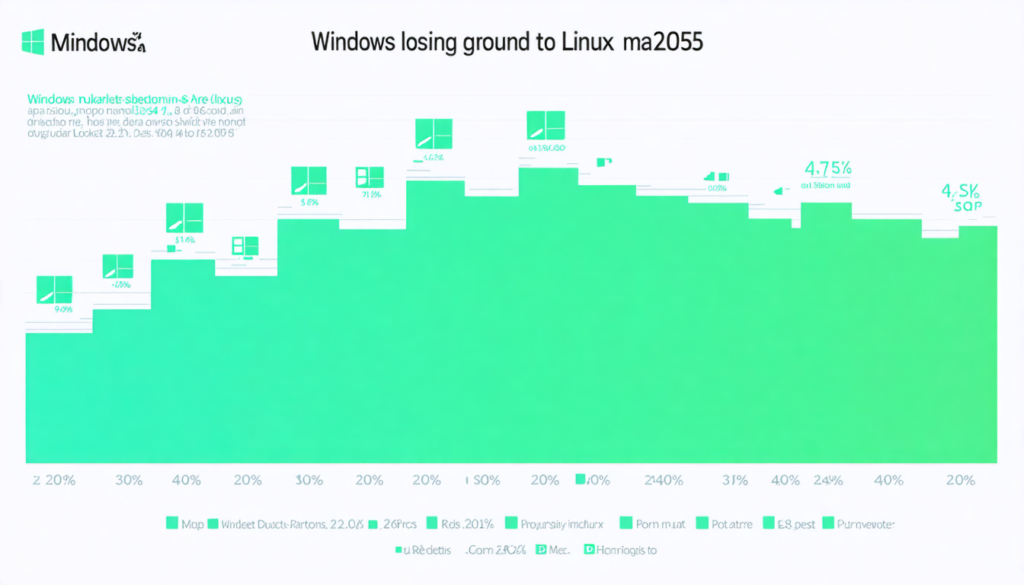
The computer industry is experiencing a major shake-up as the backbone of mainstream operating systems, Windows, seems to falter under harsh criticism. GOG, the well-known video game platform famous for its rejection of DRM and its close ties with the Linux community, no longer hesitates to openly denounce Microsoft’s recurring flaws. Tensions are escalating, fueled by a Windows perceived as increasingly rigid, intrusive, and disconnected from the deep expectations of users. What some are already calling a deep operating system crisis could herald the end of an era dominated by Windows, signaling an uncertain future for the American publisher. Michał Kiciński, co-founder of CD Projekt and owner of GOG, casts an uncompromising eye on the gradual fall of this giant, foreshadowing a pivotal turning point towards 2026.
A complex evolution is underway throughout this decade, where technological, economic, and social challenges intersect. As Windows 10 approaches its definitive obsolescence, with the end of support posing a colossal challenge to hundreds of millions of users, the debate rages on the sustainability of this system against all odds. Meanwhile, the rise of alternative solutions like Linux, strengthened by the remarkable breakthrough of Valve’s Steam Deck, is shaking Microsoft’s historic hegemony. GOG’s firm stance on this topic reflects a growing divide at the very heart of the industry, sending shockwaves through both professional and general audiences.
The increased control exercised by Microsoft through updates seen as intrusive, drastic hardware requirements, and the multiplication of telemetry and integrated advertisements fuels growing rejection. This progressive delegitimization directly affects the image and trust around the system but also, indirectly, the PC market. We are witnessing a true paradigm shift where the competition between systems becomes more direct and where users question their freedom and digital experience. GOG, once a simple niche player, now positions itself as a warning voice, even a prophet of a new era, where Windows could lose its dominant place by 2026.
- 1 A harsh critique of Windows by GOG: a turning point in the operating systems landscape
- 2 Windows 11: the crystallization of growing frustrations with Microsoft’s operating system
- 3 GOG and the rise of Linux: an increasingly credible alternative for 2026
- 4 The economic and social weight of the end of Windows 10: challenges and opportunities
- 5 Impact on the PC market: how the end of Windows is shaking up the computer industry
- 6 The rise of the open source community and pressure on Microsoft
- 7 From the impact on developers to the reinvention of digital consumption modes
- 8 2026 outlook: toward a major recomposition in the world of operating systems
A harsh critique of Windows by GOG: a turning point in the operating systems landscape
Michał Kiciński, a major figure in the video game world, does not mince words when he talks about Windows. For him, the Microsoft environment has become an “incredibly bad software.” Such a brutal statement reflects a build-up of frustration over several years regarding the direction taken by this OS. The main reasons do not lie solely in isolated mistakes but in an increasingly closed design philosophy, ever more focused on maximal control of users and their machines.
The critique is based on several observations: first, the overload of Windows 11, which by adding layers and features like Copilot, degrades the user experience. Then, the rapid rise of telemetry, a true silent spy, followed by the growing intrusion of advertisements even in spaces as sensitive as the Start menu. Finally, and most importantly, the obligation to accept coercive updates that regularly modify the system’s functioning without taking users’ preferences into account.
This strategy poses a fundamental problem for GOG, which defends freedom of use, a core pillar of its raison d’être. Michał Kiciński highlights how every setting, every parameter to modify under Windows has become a real obstacle course. Disabling a function is like searching for a needle in a haystack, and circumventing hardware requirements like TPM 2.0 sometimes seems out of reach, even for advanced users.
An anecdote drawn from GOG’s internal experience illustrates this degradation. The technical teams have found that simply maintaining a stable environment for their applications requires increasing effort, bypassing more and more barriers imposed by the system. This is not a minor detail because it involves additional costs, slows down innovation, and distances developers from fine integration.
By comparison, the experience on macOS, although less open, remains smooth and coherent, reinforcing the feeling that Microsoft has lost simplicity and stability. This degradation is all the more striking since Windows had for decades been synonymous with inclusiveness and accessibility, two values now under threat.
Windows 11: the crystallization of growing frustrations with Microsoft’s operating system
The release of Windows 11 did not meet the expected enthusiasm. From the start, this version sparked controversies around technical constraints. The obligation to have TPM 2.0, for example, ignited debates among both average users and IT experts. This hardware component, intended to enhance security, is also seen as a way to lock down the ecosystem further.
This aspect illustrates the widening gap between user needs and Microsoft’s strategic directions. Rather than simplifying, Windows 11 complicates things on multiple levels. Updates occur more frequently, often disruptive, and increased monitoring via telemetry generates a feeling of intrusion that harms trust.
The new features never really excited the IT community. For example, the introduction of the Copilot assistant, presented as an intelligent help tool, is felt by many more as an imposed gadget than a real breakthrough. This functional overload degrades fluidity and increases the mental load on users.
A notable case study is the impact of automatic updates that leave no real alternative to users. Several reports from large companies and administrations highlight that this forced update policy caused major interruptions in their operations. This aspect intensifies the debate around the upcoming end of support for Windows 10, pushing them to migrate to costly and sometimes risky solutions.
Windows 11 has thus crystallized many frustrations, contributing to the perception that this operating system is now more an obstacle to productivity than a lever.
GOG and the rise of Linux: an increasingly credible alternative for 2026
Faced with uncertainty around Windows, GOG made a strategic major decision: to turn to Linux as a priority alternative. This choice reflects a clear desire to embrace a freer model that respects users. Maciej Gołębiewski, CEO of GOG, describes 2026 as a pivotal year when Linux will no longer be a mere “background” system but a major player in the video game scene.
This decision occurs within a context of accelerated projects aimed at making Linux more accessible and performant for gamers. Thanks to Proton, developed by Valve, compatibility with titles usually running under Windows has significantly improved. Many users report performance or even greater stability on Linux compared to Windows, notably thanks to more efficient resource management and finer system control.
The growing adoption of Linux is accompanied by challenges, however. GOG has yet to launch a native Galaxy client for Linux, forcing players to use third-party tools like Heroic or Lutris, which work but remain community-built workaround solutions. This situation represents both an opportunity and a challenge for GOG, which by 2026 must consolidate its software infrastructure to ensure a smooth and native experience for its Linux users.
The table below compares the advantages and disadvantages of the three main market systems in 2026, illustrating the strategic choices available to the gaming and developer communities:
| Operating System | Advantages | Disadvantages |
|---|---|---|
| Windows 11 | Large game catalog, universal compatibility, Microsoft integrations (Office, Xbox) | Coercive updates, advertising intrusions, high hardware requirements (TPM), growing complexity |
| Linux (Proton, Steam Deck) | Open source, optimized performance, fewer restrictions, large community, no DRM | Lack of native applications, need for tinkering, less commercial support, fragmentation |
| macOS | Stability, simplicity, hardware-software integration, good performance on some games | Limited catalog, closed system, high prices, less gaming-oriented |
This combination of factors places Linux as a serious challenger. For GOG, distancing itself from Windows is not an isolated act but a strong trend that could profoundly redefine the balances of the computer industry in 2026.
The official end of support for Windows 10, announced for October 2026, raises many major questions. With more than 400 million PCs still running this version worldwide, the stakes are colossal. These machines will become instantly obsolete from a software perspective, triggering very significant economic and social repercussions.
On one side, individuals will have to choose between often costly upgrading to Windows 11, with its share of constraints, or adopting Linux distributions sometimes seen as complex. On the business and administration side, the challenge is even greater as they must ensure service continuity, security, and regulatory compliance.
This support stop also causes a little-known ecological crisis. The massive renewal of hardware to meet the higher requirements of the latest Windows versions generates significant electronic waste. Several voices are calling on Microsoft to reconsider its strategies to extend the lifespan of existing computers.
A petition, gathering nearly 40,000 signatures in France, advocates for free Windows 10 updates until 2030, arguing this complex situation. Microsoft, for its part, tries to ease tensions by offering paid ESU (Extended Security Updates) support extensions, but this only partially satisfies users, especially small organizations.
- Social consequences: potential digital divide for millions of users, increased access fracture.
- Economic impacts: increased operating and maintenance costs, training efforts.
- Ecological issues: mass electronic waste, increased resource consumption.
Faced with these challenges, several alternatives are being explored, and the transition to a Linux environment seems to take a central place in many actors’ strategies.
Impact on the PC market: how the end of Windows is shaking up the computer industry
The transition imposed by Microsoft greatly influences the overall PC market. With the end of Windows 10 support, many users are forced to reinvent themselves, thereby stimulating a wave of hardware and software renewals. However, this dynamic also hides a clear divide in user expectations and means.
On one hand, the market is witnessing a revival of high-end PC sales compatible with Windows 11, integrating new technologies like TPM chips, 5G, or high-resolution screens adapted to Microsoft’s OS. This technical modernization represents a fresh breath that some call a “second youth” for personal computers.
However, the market also records a spectacular rise in the sales of machines optimized for Linux, especially in the portable sector dedicated to development professionals and alternative gamers. The democratization of solutions like the Steam Deck and improved Linux performance bring this system closer to mainstream usage, which had long been exclusively reserved for Windows.
A comparative market share table for 2026 shows a notable evolution:
| Year | Windows Market Share (%) | Linux Market Share (%) | macOS Market Share (%) |
|---|---|---|---|
| 2022 | 76 | 2 | 17 |
| 2026 | 60 | 10 | 25 |
This contextual shift reflects a major upheaval in the hierarchy of operating systems and in the way users perceive their computing tools. The choices made in 2026 will have a lasting impact on the global computer industry.
The rise of the open source community and pressure on Microsoft
The shift taken by GOG also reflects greater pressure on Microsoft by the open source community. Many developers, enthusiasts, and industry players demand a more open, transparent environment that respects privacy. This demand places Microsoft in a delicate position, especially as alternatives gain maturity and popularity.
This dynamic is visible in several areas:
- Software development: exponential growth of Linux contributions in open source projects, notably in the video game sector via Proton.
- Mobility: Linux establishes itself durably as the OS of choice for alternative portable devices, thanks to its flexibility and adaptability.
- User respect: the fight against intrusive telemetry and unsolicited ads evolves usage policies.
Historically very closed, Microsoft tries to adopt a more open posture, notably through support for Windows Subsystem for Linux (WSL). Nevertheless, the ecosystem remains largely dominated by rules and barriers that hinder free innovations and freedom of use.
Against this background, GOG acts as a trailblazer. Michał Kiciński and his team show that users must no longer passively accept the degradation of their experience and that competition is livelier than ever. This fight is now part of a global struggle for the future of technology and digital freedom.
From the impact on developers to the reinvention of digital consumption modes
The 2026 shift not only changes the game for end users but deeply affects the developer community and the way digital content is created and consumed. On Windows, the rise of restrictions, DRM, and forced updates complicates developers’ management, who must continuously adapt their products, sometimes to the detriment of quality.
Conversely, the Linux ecosystem frees many actors from excessive constraints. Open source promotes rapid innovation and horizontal collaboration, which benefits responsiveness. GOG itself reports positive experiences in offering DRM-free games, fostering trust and freedom for players.
Consumers, for their part, are increasingly aware of issues related to respect for their digital lives. This evolution is already pushing some platforms to rethink their model, for example by offering more customizable options and challenging the monopoly of closed systems.
A list of main transformations in consumption and development modes:
- Growth of DRM-free games, reinforcing users’ ownership of content.
- Increased adoption of multiplatform solutions facilitating access regardless of the OS.
- Rise of collaborative open source communities to improve compatibility.
- Development of tools enabling users to more finely control their experience.
- Implementation of eco-responsible practices in infrastructure and hardware management.
2026 outlook: toward a major recomposition in the world of operating systems
As we rapidly approach the Windows 10 support deadline, 2026 promises to be an essential turning point. GOG’s critique, far from being a mere rant, embodies a deep questioning of the sustainability and relevance of a model inherited over decades. The impact of this crisis touches every part of the computer industry: from end users to developers, manufacturers, and economic stakeholders.
The future seems to lead to increased diversification of operating systems, with Linux at the forefront, supported by initiatives like Proton and platforms committed to digital freedom. Microsoft must now contend with this new reality that challenges its choices and economic model.
The competition is toughening, and the battle to win users’ hearts is intensifying. The days of Windows’ undisputed supremacy seem numbered, and 2026 could well mark the beginning of the end of an era. Faced with this mutation, consumers, professionals, and companies will have to rethink their technological choices, opening the door to a complete reinvention of computing uses in a freer and decentralized world.