
In the bustling world of computer components, random access memory (RAM) holds an essential place, ensuring performance and smoothness for both personal and professional computers. However, an insidious plague has been spreading for several years on major online sales platforms, especially Amazon: that of fake RAM. In 2025, this threat, far from being marginal, stands as a real challenge for consumers keen to invest in counterfeit products with a flawless appearance. This phenomenon is no longer limited to dubious third-party sellers; it has even infiltrated official channels, bypassing the usual quality control mechanisms. How does this formidable fraud work? What are the Amazon traps to avoid to secure your purchases? Discover a comprehensive overview of the issues related to RAM counterfeiting and proven methods to guarantee authenticity verification and electronic component quality when acquiring RAM modules.
Beyond mere anecdotes, several recent testimonials and in-depth investigations highlight a particularly sneaky method: the substitution of DDR5 sticks with disguised older DDR4s, accompanied by intact blister repackaging through the Amazon returns system. This scheme exploits the logistical complexity and speed required in stock management, making it difficult for employees to detect the fake. Facing a continuous rise in component prices and increased demand, this scam threatens not only buyers’ trust but also the technical reliability of equipped machines. The following article aims to explore this issue in depth, offering practical advice to recognize the signs of counterfeit RAM and outlining measures to take in case of suspicion. A crucial insight for all those wishing to protect their investment and avoid falling into the traps of RAM fraud on Amazon.
- 1 The mechanisms of fraud on RAM sold on Amazon
- 2 Understanding the technical specificities of DDR5 memory versus DDR4
- 3 Warning signs and methods to identify fake RAM memory
- 4 Amazon’s logistical weaknesses and return fraud: fertile ground for fake products
- 5 Guaranteeing online purchase security: procedures and recourse in case of detected counterfeiting
- 6 Essential tips to avoid buying fake RAM on Amazon in 2025
- 7 The technical and security implications of fake DDR5 sticks on your system’s reliability
- 8 The evolution of the fight against counterfeiting in the electronic components sector
The mechanisms of fraud on RAM sold on Amazon
E-commerce has revolutionized the way consumers purchase electronic components, with Amazon leading the way. Yet, this very progress has opened the door to increasingly sophisticated fraudulent practices. In 2025, the case of fake RAM perfectly illustrates this trend: DDR5 RAM kits, highly demanded and often expensive, are covertly replaced by older DDR4s. The latter lack recent technological advances, notably the integrated PMIC (Power Management Integrated Circuit) specific to DDR5, responsible for power management of the sticks.
Fraudsters often act by manipulating products returned by fake customers. After receiving a DDR5 kit, they carefully remove the original heat spreader to reposition it onto refurbished DDR4 sticks, sometimes with visible glue traces or subtle imperfections. The entire product is then sent back to Amazon through the customer returns system, claiming error or disinterest. This renewed product is then integrated into official stocks under the label sold and shipped by Amazon, thus reassuring the next victims.
It must be understood that behind this process lie major logistical flaws. Amazon’s sorting centers must analyze thousands of returns daily, in record time. A thorough check of each stick is impractical, especially if there is no perceptible alteration of packaging or box. This context offers fertile ground for counterfeiting, aimed at deceiving even the most cautious consumers.
Concrete examples of detected frauds
A misadventure reported on the subreddit r/pcmasterrace attests to the complexity of the phenomenon. A user purchased a Corsair Vengeance DDR5 kit via Amazon. Upon receipt, he noticed a slight play in the heat spreaders and incompatibility with his DDR5 slot, confirming he had been delivered disguised DDR4 memory. The replacement by Amazon was possible but required patience and video evidence to support his case.
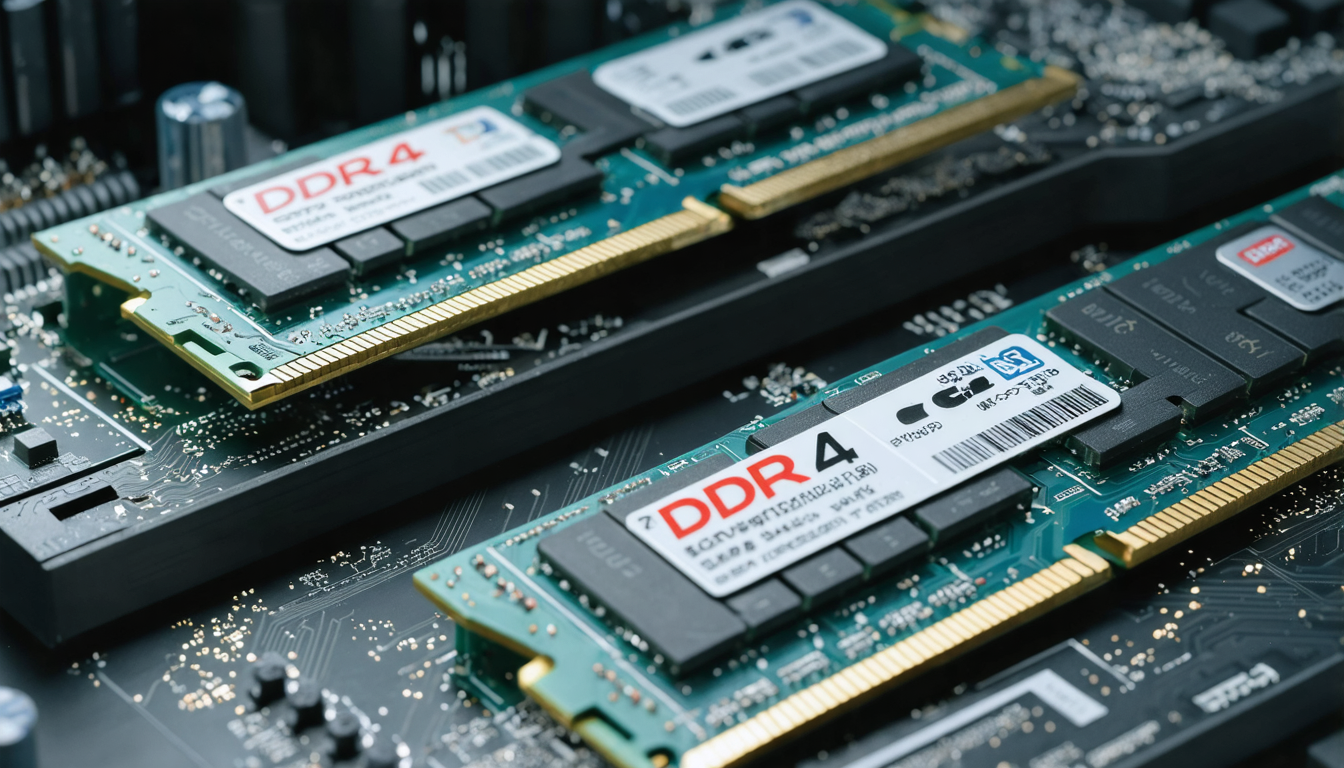
Technical analysis highlights key aspects to differentiate a genuine DDR5 stick from a copy. Beyond the location of the physical notch, DDR5 modules integrate a PMIC circuit absent on DDR4, an element visible especially with specific inspection tools. While DDR5 allows better energy efficiency and a higher transfer rate (beyond 4800 MT/s), DDR4 runs at lower frequencies, around 3200 MT/s. This technical difference directly impacts electronic component quality and the machine’s final performance.

Understanding the technical specificities of DDR5 memory versus DDR4
To protect your computer setup from counterfeit products, it is essential to acquire a good knowledge of the targeted components, here the difference between DDR4 and DDR5. DDR5, massively launched in 2023-2024, represents the new generation of RAM with a redesigned architecture and a set of innovations that improve computational performance and energy consumption.
The first visible difference is the location of the physical notch on the stick, a security marker preventing the insertion of an incompatible component on the motherboard. DDR5 also includes a PMIC module, essential for fine voltage management, a major improvement compared to DDR4, which relied on the memory controller integrated into the processor.
Technically, DDR5 allows frequencies up to 8400 MT/s, whereas DDR4 caps around 3200 MT/s on average. This translates on the ground to a considerable gain in software responsiveness and multitasking efficiency, notably for gaming, graphic creation, and intensive calculations. Practically speaking, using non-compliant memory can generate hardware malfunctions, blue screens, or even damage the motherboard.
To illustrate this, here is a comparative table of fundamental characteristics:
| Characteristic | DDR4 | DDR5 |
|---|---|---|
| Maximum Frequency | 3200 MT/s | 8400 MT/s |
| Voltage | 1.2 V | 1.1 V |
| Number of chips per stick | 16 | 32 |
| PMIC Presence | No | Yes |
| Safety Notch | More central position | Offset position toward the edge |
Understanding these differences allows the informed consumer to better anticipate the risks of RAM fraud and act with discernment before and after purchase.
Warning signs and methods to identify fake RAM memory
Spotting a counterfeit RAM does not only rely on advanced technical experience; physical and behavioral details often suffice to raise suspicion. Vigilance must start as soon as the product is unpacked, a key moment when scams often reveal their flaws.
Among the most telling indicators are:
- Alignment and fixing of heat spreaders: If the spreaders move slightly or show visible glue marks or reassembly traces, it is a warning sign.
- Serial number and labels: Consistency between the number on the stick and that on the box must be perfect. Any discrepancy indicates possible tampering.
- Notch location: It is impossible to physically install a DDR4 stick on a DDR5 slot, but an attempt to force insertion can cause damage.
- Incompatible performance: After installation, unstable behavior, repeated memory errors, or unrecognized modules may signal a problem.
It is strongly recommended never to force the insertion of a stick. In case of doubt, filming the entire unpacking allows you to have concrete evidence in case of dispute. These videos are decisive for exchanges with after-sales service (SAV).
The following list summarizes good practices upon receipt:
- Film the opening of the package to document the initial condition.
- Check the presence and integrity of security seals on the packaging.
- Carefully compare the model printed on the box with that printed on the stick.
- Visually inspect the heat spreaders for any anomalies.
- Test insertion without forcing the stick into its slot.
Amazon’s logistical weaknesses and return fraud: fertile ground for fake products
A crucial element in the circulation of fake RAM is the process known as return fraud. This mechanism relies on exploiting the very permissive guarantees and policies offered by e-commerce giants, including Amazon, which must manage an immense volume of daily returns. The system, originally designed to build trust between seller and buyer, is paradoxically used by seasoned scammers.
Here is how these wrongdoers operate:
- They buy a new product at full price, here a high-performance DDR5 kit.
- Upon receipt, they discreetly dismantle the original parts to replace them with cheaper and often ineffective modules, typically refurbished DDR4s.
- The tampered component is restored to a new appearance, with packaging carefully resealed.
- They send the kit back using the legal return system, invoking error or dissatisfaction.
- The sorting teams, under time pressure, do not detect the falsification and return the item to stock for the next buyer.
This system thus exploits the saturation of logistical flows, which results in superficial and insufficient quality control. While Amazon’s policy provides for quick refunds, this sometimes comes with a risk of defective products being reintroduced into the distribution chain. In the long run, the platform faces erosion of customer trust, especially in the critical electronics components segment.
Guaranteeing online purchase security: procedures and recourse in case of detected counterfeiting
Faced with the rise of counterfeit products and the complexity of fraud on Amazon, it is essential to know best practices to secure transactions and assert one’s rights in case of anomaly. A swift and structured reaction can allow obtaining a refund, even compensation, while protecting equipment.
First of all, it is imperative to keep a complete file: video proof of unpacking, photos of defects, written exchanges with customer service. This documentation is the key to act effectively. In case of initial refusal or difficulties, recourse to third-party organizations, such as a consumer mediation platform or public authorities, facilitates resolution.
It is important to note that victim buyers can sometimes benefit from legal aid, for example assistance from a specialized lawyer or connection to consumer associations. According to documented cases in 2025, several files have resulted in satisfactory compensation.
Here is a recommended process in case of suspected fraud:
- Contact Amazon customer service quickly via their dedicated interface.
- Send videos and photos proving the product’s non-conformity.
- Request a full exchange or refund.
- In case of dispute, turn to a consumer mediator.
- If necessary, initiate legal proceedings with specialized advice.
Essential tips to avoid buying fake RAM on Amazon in 2025
Prevention is always the best weapon against RAM fraud. In 2025, several simple yet effective tips help limit risks linked to online purchases of sensitive components such as RAM. First of all, favor sales made by reputable sellers and not exclusively those marked “sold and shipped by Amazon” which can sometimes offer more guarantees, notably by consulting previous buyer reviews.
It is advised to:
- Choose RAM kits whose origin is verifiable, ideally from recognized brands with an official product tracking website.
- Use component status checking tools, including memory diagnostic software like MemTest86, to verify stability after installation.
- Develop a systematic habit of checking the physical notch and serial numbers during unpacking.
- Make group purchases from local specialized computer stores, as they often guarantee reliable RAM warranty and quality after-sales service.
- Avoid overly attractive offers on multiple platforms, which may hide a massive fraudulent operation.
By keeping these tips in mind, consumers considerably reduce the likelihood of falling into the trap of counterfeit contents and protect the lifespan of their computer equipment.
The technical and security implications of fake DDR5 sticks on your system’s reliability
Beyond the economic aspect, the presence of counterfeit products such as these famous fake DDR5 RAM sticks poses a real technical and security problem. Indeed, a stick not meeting the expected specifications causes the risk of frequent crashes, degraded performance, and even irreversible hardware damage. Electrical incompatibility or lack of PMIC integration can lead to overvoltages or poor energy regulation, fatal for the motherboard or processor.
Industry professionals have warned of a growing number of calls related to these failures, which often challenge users regarding their equipment’s reliability. The confusion is all the greater since the fake component appears perfectly new and sometimes operates partially for a short period.
Here are the main associated risks:
- Intermittent malfunctions: random errors and blue screens (BSOD) may occur, especially under heavy load.
- Hardware damage: risk of premature wear or even total motherboard failure.
- Data loss: instability during critical operations such as backup or transfer.
- Software incompatibility: some operating systems may poorly handle non-standard components.
Thus, beyond mere financial disappointment, RAM fraud directly impacts the reputation and security of users of computer products.
The evolution of the fight against counterfeiting in the electronic components sector
Faced with the rise of counterfeiting, the IT sector began in 2025 to deploy advanced technologies to secure the supply chain. Manufacturers now integrate digital traceability systems, such as official QR codes and security holograms embedded in packaging. These solutions are designed to assist in authenticity verification within seconds via a mobile app or dedicated web portal.
Furthermore, Amazon and other major platforms strengthen their strict supplier selection policies and improve the training of their logistics teams to better detect anomalies during return processing. Collaborations with public security agencies and consumer protection associations are also developing to better inform the public.
In this context, user awareness occupies a central place, and information campaigns on online purchase security are regularly broadcast to educate about risks and available solutions. The goal is to create a virtuous circle where collective vigilance limits the impact of scams and strengthens trust in digital commerce.
Technological and regulatory advances are progressing, but it remains crucial for every buyer to remain cautious and informed so as not to become the next victim of counterfeiting.