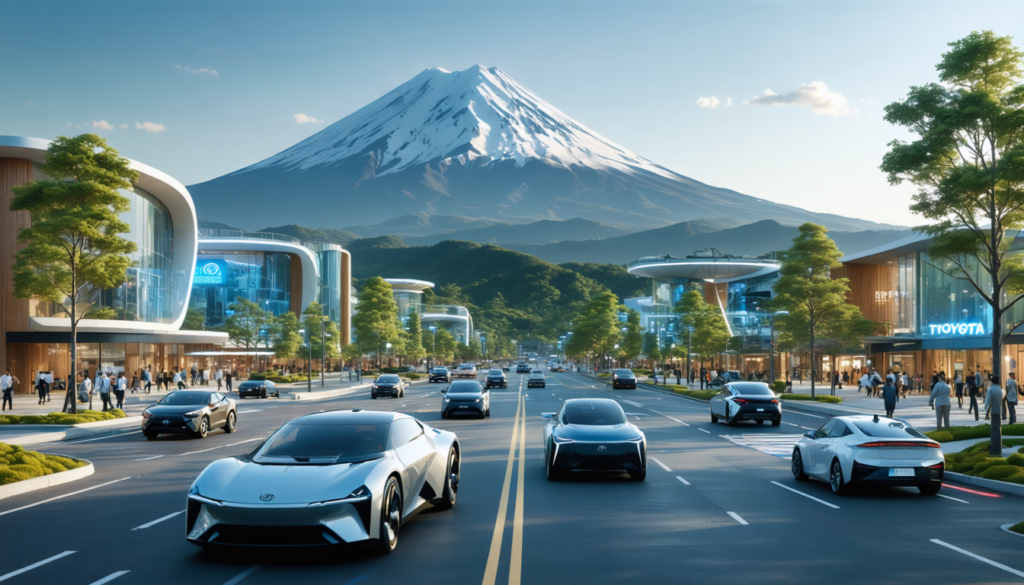
In Japan, a land where tradition and technological advancements coexist, Toyota innovates with the creation of Woven City, the first robotic city at the foot of the majestic Mount Fuji. This futuristic city, designed as a living laboratory, embodies a new era where artificial intelligence, robotics, and human life combine to pave the way for revolutionary urbanization. Announced in 2020, this extraordinary project aims to transform 175 acres of former industrial land into a model of smart urban planning, blending autonomous mobility, ecological infrastructures, and continuous innovation. In a context where technology is at the heart of climate and social challenges, Woven City stands out as an exemplary ecosystem, propelling Toyota’s vision for the city of the future.
Toyota’s robotic city aims to establish a new paradigm where residents, mostly engineers and innovators, live and work in a fully connected and automated environment. Every detail, from autonomous vehicles to smart buildings, is orchestrated by artificial intelligence systems that optimize energy management, health, and urban logistics. Facing global challenges related to rapid urbanization and environmental sustainability, Woven City offers an innovative response by integrating technological innovations never brought together on this scale before. Let us explore the many facets of this unique urban experience that redefines coexistence between humans and machines.
- 1 Woven City: a revolutionary prototype at the foot of Mount Fuji
- 2 Robotic innovations at the heart of daily life in Woven City
- 3 A city powered by clean energies and integrated sustainable management
- 4 Artificial intelligence and automation: the engine of the city of the future
- 5 Autonomous mobility and connected infrastructures: a new model of urban living
Woven City: a revolutionary prototype at the foot of Mount Fuji
The realization of Woven City on the historic site of the former Higashi-Fuji factory marks a major milestone in Toyota’s strategy, which now goes beyond its traditional role as an automobile manufacturer to become a pioneer in mobility and smart cities. The location, about 140 km from Tokyo and nestled at the foot of the famous Mount Fuji, offers an idyllic setting to develop a futuristic city where technology and nature meet harmoniously.
Built over 175 acres, this project aims to welcome 100 residents in its initial phase, mainly engineers and researchers involved in developing the applied technologies used in the city. The number of inhabitants is expected to reach 360 during the first expansion, before reaching a target population of 2,000 individuals. This duality between inventors, who design the innovations, and weavers, who implement them in daily life, ensures a cycle of continuous improvement and adaptation of technologies.
The infrastructures of Woven City rely on several key technological axes:
- Autonomous mobility: notably with the e-Palette, a versatile electric autonomous shuttle for transporting people and goods.
- Renewable energies: integration of hydrogen, solar panels, and water recycling systems.
- Urban automation: intelligent management of infrastructures via connected networks controlled by AI.
- Domestic robotics: in homes, robotic assistants monitor residents’ health and optimize energy consumption.
A distinct road network is designed to separate pedestrians, cyclists, and autonomous vehicles, enhancing safety and smoothing movement. Furthermore, an underground logistics network ensures deliveries without disturbing the surface. This segmentation of the city into an “interwoven fabric” illustrates how Toyota applies automation to essential domains of urban life.
| Aspect | Description | Key Technologies |
|---|---|---|
| Mobility | Autonomous vehicles, electric shuttles, and dedicated paths | e-Palette, sensors, AI |
| Energy | Renewable sources and ecological management | Hydrogen, solar, water recycling |
| Habitat | Smart homes with integrated robots | Domestic robotics, health AI, automation |
| Logistics | Underground infrastructure for delivery | Robotics, autonomous systems |
Robotic innovations at the heart of daily life in Woven City
One of the most fascinating aspects of Woven City lies in the deep integration of robotics in all aspects of everyday life. Residents benefit from an environment where intelligent technologies work together to improve comfort, safety, and health.
Personal robots and domestic assistants, designed by Toyota, do not limit themselves to performing classic household chores. Thanks to artificial intelligence, they adapt their actions according to the behavior and medical needs of inhabitants. For example, a robot can monitor vital signs or remind medication intake, facilitating the at-home care of elderly or vulnerable populations.
In public spaces, maintenance robots ensure street cleanliness, waste management, and infrastructure control. Their ability to move autonomously and cooperate with each other optimizes the efficiency of urban functioning while reducing environmental impact.
- Personal assistant robots: health support, domestic energy management.
- Urban maintenance robots: cleaning, waste collection, repairs.
- Social robots: assistance for persons with reduced mobility, community interactions.
- Security robots: intelligent surveillance of public spaces thanks to facial recognition and abnormal behavior detection.
This omnipresence of robotics fits into a coherent ecosystem, thanks to ultra-fast and secure computer networks linking every device. Automation here does not seek to replace humans, but to support them in their activities by relieving them of repetitive or physically demanding tasks.
| Robotics | Functions | Expected Impact |
|---|---|---|
| Health assistants | Monitoring residents, medication reminders | Better health, increased autonomy |
| Automatic maintenance | Cleaning, waste collection | Clean environment, cost reduction |
| Security | Real-time surveillance, incident detection | Enhanced safety, prevention |
| Mobility support | Assistance for people with reduced mobility | Social inclusion |
A city powered by clean energies and integrated sustainable management
Woven City is a perfect example of integrated implementation of clean energies serving a robotic city. Toyota has integrated various innovative systems to maximize energy efficiency while reducing ecological footprint.
The choice of hydrogen as the main energy source to power vehicles and certain buildings illustrates the will to definitively abandon fossil energies. Additionally, solar panels installed on the roofs of homes and infrastructures contribute to local and renewable electricity production. Water is recycled in a closed loop, improving water resource management and limiting waste.
Moreover, the city adopts a strict ecological waste management policy, combining automated sorting and energy recovery. Intelligent technologies oversee the entire resource lifecycle within the city, enabling continuous optimization of environmental performance.
- Renewable energy production: solar, hydrogen.
- Water recycling: closed-loop systems to limit water consumption.
- Automated waste management: intelligent sorting and energy recovery.
- Smart grids: autonomous and adaptive energy networks.
| Element | Description | Environmental Benefits |
|---|---|---|
| Hydrogen | Main source of clean energy | Near-zero carbon emissions |
| Solar panels | Local electricity production | Energy independence and green energy |
| Water recycling | Advanced resource management | Reduction of drinking water consumption |
| Waste sorting | Automated sorting and recovery systems | Reduced landfill waste and effective recycling |
This global approach reflects the demand for a futuristic city where technology is fully dedicated to a sustainable lifestyle. Toyota thus illustrates that innovation in urban planning can effectively contribute to the fight against climate change, while offering a pleasant and functional environment.
Artificial intelligence and automation: the engine of the city of the future
At the heart of Woven City beats a network of advanced artificial intelligence, capable of orchestrating all urban flows, from energy to mobility, including health and safety. This total automation transforms the way cities can function daily.
Smart buildings communicate with each other, adjust their consumption, and participate in energy production. For example, AI anticipates energy needs based on residents’ habits and modulates indoor temperature to maximize comfort while saving energy.
Intelligent management of traffic flows optimizes autonomous vehicle routes, reducing congestion and noise pollution. Moreover, automated underground logistics ensures discreet and efficient supply without disturbing human activities on the surface.
- Smart homes piloted by AI for energy and health management.
- Network of autonomous transports programmed and monitored in real time.
- Environmental optimization based on massive data collection and analysis.
- Automated and predictive security surveillance.
| Application Areas | Automated Functions | Advantages |
|---|---|---|
| Energy | Predictive consumption management and renewable production | Reduced energy waste |
| Mobility | Optimized routes, autonomous traffic management | Traffic jam reduction, reduced travel times |
| Health | Continuous monitoring, preventive alerts | Preventive maintenance for residents |
| Security | Early detection and intervention | Enhanced resident protection |
This synergy between artificial intelligence and automation projects Woven City as a concrete example of tomorrow’s urban planning, able to continuously adapt to human and environmental needs. The close collaboration between technologies and inhabitants guarantees constant improvement of services and living conditions.
Autonomous mobility and connected infrastructures: a new model of urban living
Autonomous mobility is one of the fundamental pillars of Woven City. Toyota deploys its emblematic concept of the e-Palette here, an automated electric mini-bus that revolutionizes urban travel. More than a simple vehicle, the e-Palette becomes an extension of the mobility network, connected in real time with city infrastructures.
The city roads are divided into three distinct lanes, each adapted to a specific mode of travel: one for pedestrians, one for bikes and scooters, and a third reserved exclusively for autonomous vehicles. This innovative organization ensures maximum safety and fluidity in movement, while reducing conflicting interactions between users.
Underground logistics complements this system, ensuring the discreet and regular distribution of goods. This infrastructure helps reduce surface traffic and associated emissions, actively contributing to the inhabitants’ quality of life.
- e-Palette: versatile autonomous vehicle for passengers and goods.
- Dedicated lanes for different types of users to streamline traffic.
- Underground logistics network for daily delivery management.
- IoT network integration for optimized traffic coordination.
| Mobility Elements | Description | Main Advantages |
|---|---|---|
| e-Palette | Multifunctional autonomous electric mini-bus | Flexible and eco-friendly transport |
| Road justice | Separate lanes for each type of user | Increased comfort and safety |
| Underground logistics | Autonomous transport of goods beneath the surface | Reduced surface traffic and pollution |
| IoT coordination | Integrated real-time traffic management system | Optimized travel |
This mobility model illustrates how Toyota combines technological innovation and quality of life to invent a functional and pleasant robotic city. The harmonious integration of infrastructures and means of transport brings a real change in the way urban space is conceived.