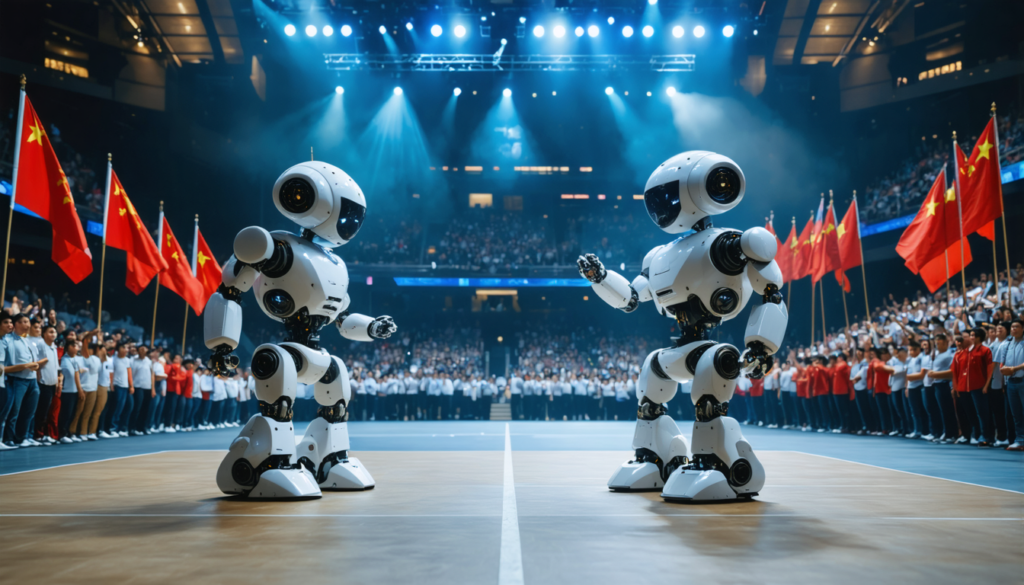
In 2026, Shenzhen becomes the stage for an unprecedented spectacle, that of the very first global league of humanoid robot battles. A technological and sporting innovation where machines face off in a high-tension arena, combining cutting-edge mechanics, artificial intelligence, and strategic confrontation. Beyond the spectacular feats, this league named Ultimate Robot Knockout Legend (URKL) represents a crucial step in the development of robotics in China, a full-scale laboratory to test robots’ agility, robustness, and decision-making speed under extreme conditions. In a country where industrial robotics already reigns supreme, this initiative opens a new chapter, striving to make machines not only tools but also formidable competitors.
The URKL League is not limited to a competition of parasitic robots. Behind the visual spectacle of surprise attacks and millimetric dodges plays a much more fundamental battle: that of perfected motor control, ultra-precise environmental perception, and optimal use of artificial intelligence in direct interaction with a physical opponent. Every received blow, every loss of balance or unexpected slip serves to refine the robots’ coordination, with decision latency measured in just a few milliseconds. These fights thus become a privileged canvas for innovation in mechatronics, intended to feed multiple sectors, from automated logistics to assistance for people.
To grasp the stakes, one must understand that the robots involved are not products of radically new individual creations. They all rely on a standardized hardware platform named T800, developed by EngineAI, combining a lightweight aluminum structure, powerful actuators, and a perception system combining 360° LiDAR and stereo cameras. From rigorous to daring, each team thus focuses on software improvement: motor control, combat strategies, algorithm responsiveness.
This article takes you behind the scenes of this technological and sporting revolution, explores how China shapes an ecosystem around this new industry, examines the role of combat as an innovation catalyst, and questions the prospects of a future robot-sport industry whose championships could well capture the attention of millions of spectators.
- 1 The revolutionary concept of the robot combat league in China
- 2 The T800 robot: an engineering model serving robot combat
- 3 Combat, a revolutionary challenge for humanoid robotics
- 4 How China uses the robot combat league to boost its technology industry
- 5 The robot combat league: a laboratory for innovation in mechatronics and AI
- 6 Prospects for an emerging industry around robot-sport
- 7 The geopolitical stakes behind the creation of a robot combat league
- 8 Public engagement: why the robot combat league captivates attention
The revolutionary concept of the robot combat league in China
The birth of the Ultimate Robot Knockout Legend (URKL) in Shenzhen embodies an innovative approach in the field of humanoid robotics, going beyond the simple framework of a sports competition. At the heart of this league, it is about confronting humanoid robots in a totally unpredictable environment where shocks, imbalances, and real-time reactions are the norm. The idea of making machines of this nature fight may seem purely spectacular at first glance, but its ambition is much deeper.
The fights bring together several teams, all benefiting from the same hardware base: the T800 robot. This technical equality forces participants to excel in software development, especially in artificial intelligence, to optimize decision-making, visual perception, and motor coordination of their robot. Such a competition highlights advanced skills in algorithmic programming and software architecture design, while generating a rich bank of real data usable for industrial research.
Another particularity of the concept is its relevance for concrete industrial applications. In an automated warehouse, for example, a robot is regularly confronted with imbalances, sudden obstacles and must quickly recalculate its trajectory. Robot combat pushes these capabilities much further, under extreme conditions where the machine must withstand blows and react instantly, often in less than 20 milliseconds, to avoid falling.
This temporal and mechanical requirement demands ultra-precise motor control, managed by an intelligent fusion between LiDAR sensors, stereo cameras, and embedded computing. Combat then takes on the appearance of a living laboratory where dynamics, robotics, and mechatronics mingle in an endless dance of adjustments and corrections.
The standardized approach with the T800 platform ensures a homogeneous base so that only advances in artificial intelligence and strategy are put into competition. This energizes collaborative research among universities, startups, and industrial teams, creating an unprecedented ecosystem. By bringing together diverse actors around a single playing field, China is setting a very high bar on the global advanced robotics scene.
Launched with a substantial prize of 10 million yuan for the winning team, this championship promises to attract the best talents in ATH (Algorithms, Technology, and Hardware). It is also a revelation of how a technological superpower can bet on mechatronic competitions to drive the industrial future and economic power.
The T800 robot: an engineering model serving robot combat
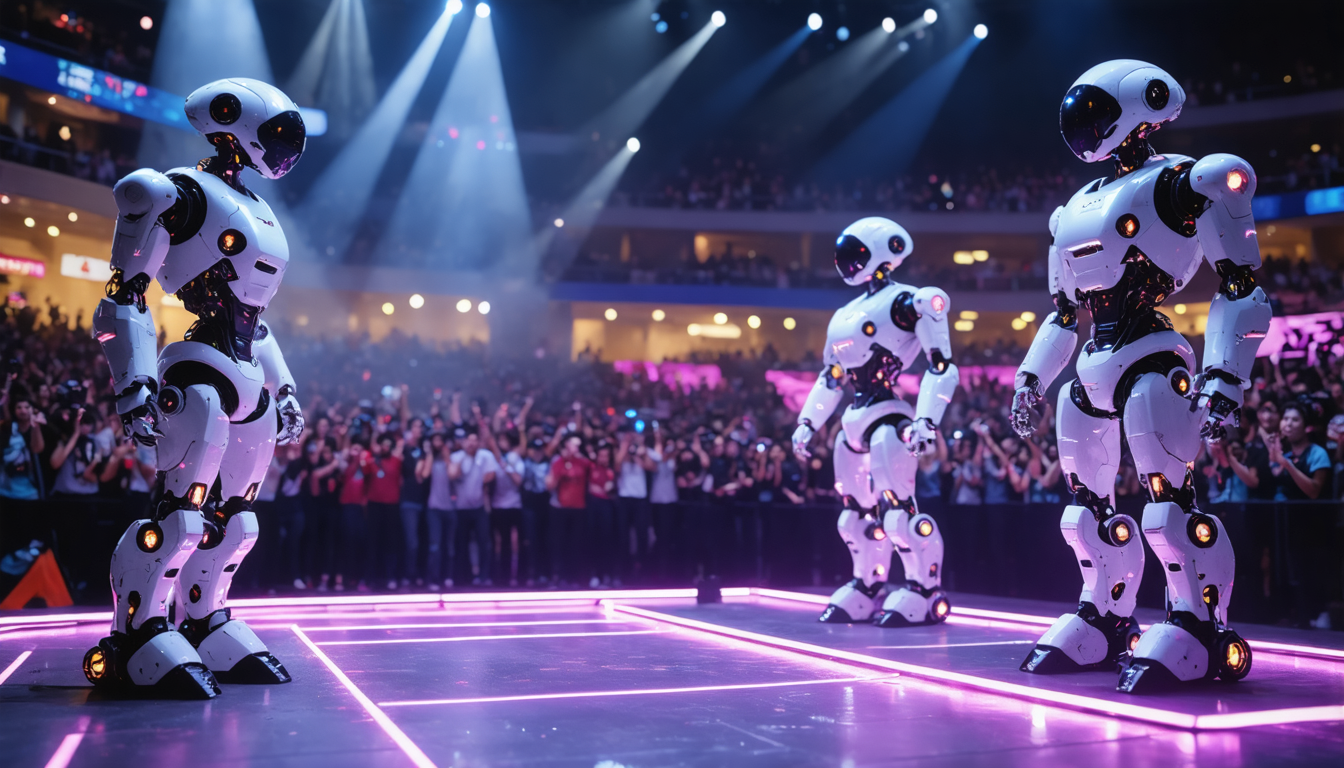
At the base of this new league, the T800 robot developed by EngineAI is a machine specially designed to face the harsh conditions of the ring. The goal is to produce a robust and adaptable platform capable of withstanding the physical constraints of combat and executing complex movements in real time.
Its architecture combines a lightweight aluminum structure, limiting weight without sacrificing solidity, with high-torque actuators, giving the robot the power needed to generate fast strikes or reposition quickly after a shock. The balance between lightness and power is key to allow spectacular confrontations while respecting the league’s safety rules.
But what truly distinguishes the T800 is its sophisticated perception system. It carries a 360-degree rotating LiDAR that maps the environment with great precision, far beyond simple classic stereo cameras. This sensor fusion offers a complete three-dimensional vision that is essential to anticipate the opponent’s movements and make the right decisions in real time.
Indeed, the real difficulty of combat does not lie in physical power alone, but in the ability to reduce decision latency. After an impact, the robot must recalculate its posture and engage counter-movements in less than a few tens of milliseconds. This action speed is made possible by a complex orchestration between perception hardware, embedded intelligence, and multi-joint control programs.
This process is an engineering feat that relies on several innovations:
- Fast data processing from sensors, where images and LiDAR scans are analyzed almost in real time.
- Motor control algorithms enabling fluid and coordinated reaction of multiple joints despite unforeseen situations.
- Dynamic adaptation strategies that adjust motion graphs live based on rebounds and collisions.
Each confrontation thus becomes an opportunity to test this expertise, from which innovations applicable beyond combat may emerge. For example, robotic assistance in industrial environments will greatly benefit from better stability management and adaptability to obstacles.
| Characteristic | Description | Advantage for combat |
|---|---|---|
| Aluminum structure | Lightweight and robust | Fast mobility and impact resistance |
| High-torque actuators | Powerful motors | Fast movements and effective strikes |
| 360° LiDAR | Detailed mapping | Complete environmental perception |
| Stereo cameras | Three-dimensional vision | Anticipation of opponent movements |
| Optimized embedded computing | Fast data processing | Ultra-low latency responsiveness |
Combat, a revolutionary challenge for humanoid robotics
Choosing combat as a testing ground for humanoid robotics may seem paradoxical, even provocative to some. Yet this approach carries key ambitions for modern technology and its industrial application. Humanoid robotics has always faced major challenges related to balance, management of lateral shocks, slips or sudden imbalances, as well as the low margin of error allowed in complex real-world environments.
The URKL ring simulates these extreme conditions, forcing robots not only to physical endurance but also to rapid adaptation to unforeseen situations, produced by an opponent who is also active and aggressive.
Each fight highlights:
- Dynamic stability management, as robots must stay standing against violent impacts and sudden movements.
- Multi-joint coordination to execute fast, precise, and optimized movements according to context.
- Mechanical robustness ensuring machines are not damaged by the slightest shock but can continue performing.
Lessons drawn from these confrontations directly influence the design of robots used in logistics, handling, or even personal assistance. Understanding how to better manage an inevitable fall or sudden imbalance is crucial to ensure the safety and efficiency of robots in daily tasks.
At the same time, this combat shapes a sustained innovation dynamic, encouraging researchers and engineers to push the limits of embedded systems, artificial intelligence algorithms, and materials used. It is a remarkable acceleration of applied research:
- Each analyzed impact paves the way for a better sensory feedback system.
- Each balance correction becomes a step toward more sophisticated adaptation protocols.
- Management of unexpected events becomes a key factor in the development of robotic control.
This active approach stands out clearly from static demonstrations or laboratory tests that do not faithfully reproduce real-world constraints.
How China uses the robot combat league to boost its technology industry
The launch of the URKL league comes at a time when the Chinese government is making a massive strategic bet on integrated robotics and advanced artificial intelligences, decisive vectors of future economic and industrial power. With a global humanoid robots market estimated to reach between 15 and 30 billion dollars by 2030, China seeks to consolidate its dominant position on several technological fronts.
Beyond the sports competition, this league acts as a catalyst allowing to:
- Structure a robust ecosystem bringing together engineers, scientists, startups, and large companies.
- Set normative standards around a unique hardware platform, facilitating collaborative research.
- Attract massive international investments and strengthen Chinese presence on the global stage.
- Produce data under extreme conditions, otherwise inaccessible, which accelerate innovation.
This approach also fits within a soft power strategy, with China sending a clear message to the international community: humanoid robotics is no longer fiction or a mere academic subject, it is a structured industry, a driver of growth, and ready to impose itself.
Moreover, the organization of a spectacle on par with Formula 1 and UFC standards guarantees optimal visibility, playing on popular appeal for high-level competitions while promoting technology transfer and applied research through a multidisciplinary event.
The robot combat league: a laboratory for innovation in mechatronics and AI
Within the framework of the Ultimate Robot Knockout Legend, engineers have a unique experimental ground to refine their technologies. Indeed, a fight pits extreme and varied factors that few laboratories can reproduce:
- Sudden impacts from moving obstacles.
- Disturbances caused by falls or slips.
- Rapid reactions to the opponent’s unexpected movements.
- Simultaneous management of dozens of motors and sensors in real time.
These exacerbated constraints provoke an acceleration of innovation cycles, where each confrontation is a new source of learning and optimization. This synergy between mechatronics and artificial intelligence favors:
- The development of predictive algorithms capable of anticipating opponent movements.
- Improvement of closed-loop control systems for better stability.
- Enhancement of hardware architectures for advanced integration and better responsiveness.
Thus, the competition is not limited to a sporting victory but actively contributes to advancing robotic and AI technologies, creating an innovative virtuous circle beneficial for the entire industrial chain.
Prospects for an emerging industry around robot-sport
Over the seasons of the Ultimate Robot Knockout Legend, a true industry with discovered contours begins to take shape. The successful combination of a standardized hardware platform with a race focused on software excellence opens the way for increased specialization of teams in different areas: motor control, artificial vision, attack strategy, and even spectator experience.
It is easy to imagine that this sector structures itself and grows, generating employment and investment opportunities around:
- Development and commercialization of optimized software for combat robotics.
- Creation of materials and components aimed at robustness and performance.
- Production of media content, live broadcasting, and sports marketing.
- A new training sector for engineers specialized in mechatronics and AI applied to combat.
This birth of a techno-sport vertical combining innovation, AI, and entertainment could ultimately attract a global audience, similar to motorsports or e-sports competitions. The main sponsor is no longer a car brand or video game developer, but cutting-edge electronics and artificial intelligence companies.
The geopolitical stakes behind the creation of a robot combat league
Beyond mere entertainment, the Chinese robot combat league displays strategic geopolitical ambitions. In the current context where advanced technologies dictate world power and influence, mastering humanoid robotics represents a major competitive advantage. The visibility offered by the Ultimate Robot Knockout Legend acts as an international showcase that highlights Chinese technological expertise.
The competition channels the attention of media, investors, and governments, affirming China’s position as a leader in a sector crucial for the decades to come. This dynamic is reminiscent of previous initiatives by the Asian superpower, such as the first race between humans and robots or the Robot Olympics.
Moreover, the creation of this league contributes to:
- Strengthening international cooperation through exchanges and technological partnerships around robotics.
- Increasing technological sovereignty by reducing dependence on foreign technologies.
- Consolidating investments in advanced research targeting humanoid robotics.
This ambitious strategy positions China not only as an industrial player but also as an innovation engine and a reference in the robotics sector, with growing influence in international standardization and regulation policies.
Public engagement: why the robot combat league captivates attention
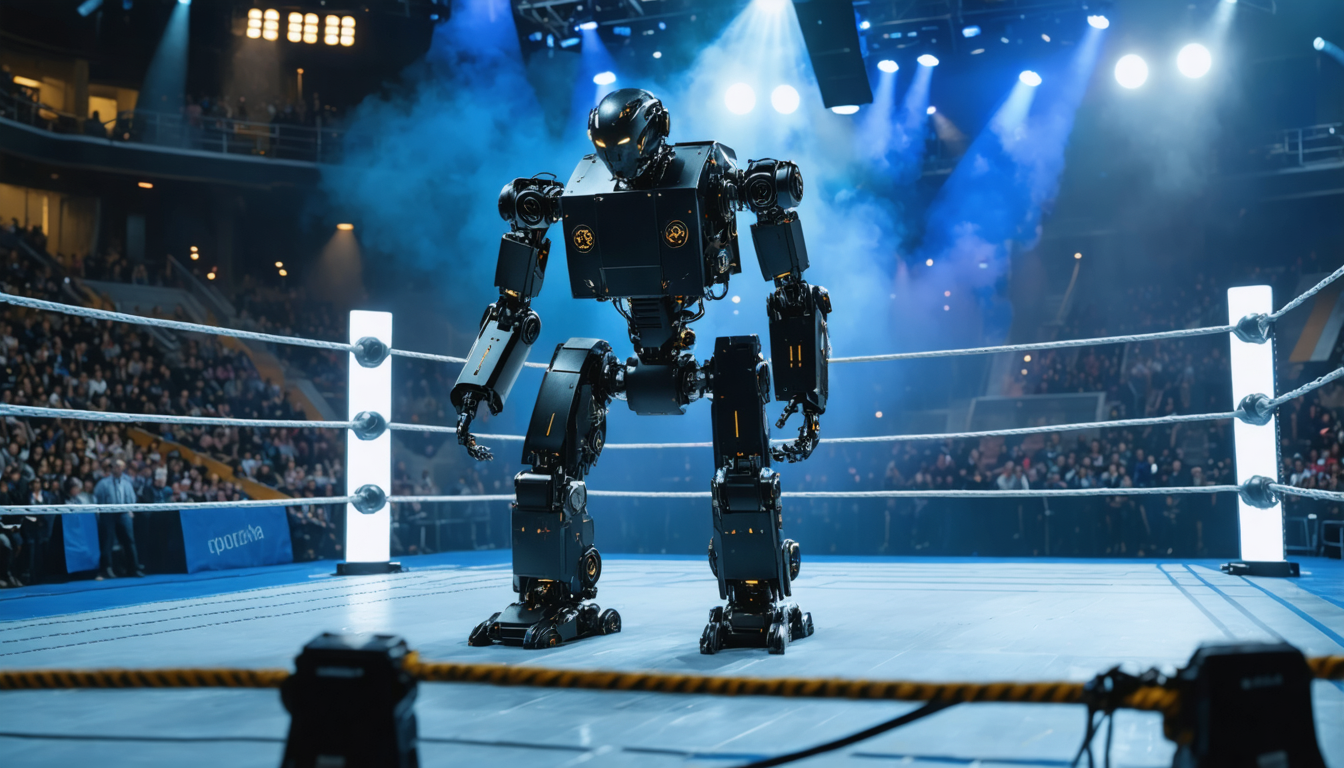
Another non-negligible aspect in the success of this league is its immense potential to attract crowds. Robot combat combines fascination for advanced machines, adrenaline from clashes, and a technological dimension that appeals to a wide audience, from robotics enthusiasts to simple curious onlookers.
Live broadcasts, already massively streamed in 2026, offer an immersive experience on digital platforms. With international rankings and teams embodied by charismatic engineers and developers, the league approaches a true electronic sport, but with physical machines in a ring.
This fascination rests on several pillars:
- Fierce competition where each fight brings suspense and twists.
- The innovative aspect where each movement demonstrates the latest advancements in robotics and AI.
- Community emulation among fans, teams, and developers around a common passion.
Many express the wish to see this league develop internationally, perhaps with world competitions hosting robots from several countries, making this event a key reference in the global technological and sporting landscape.