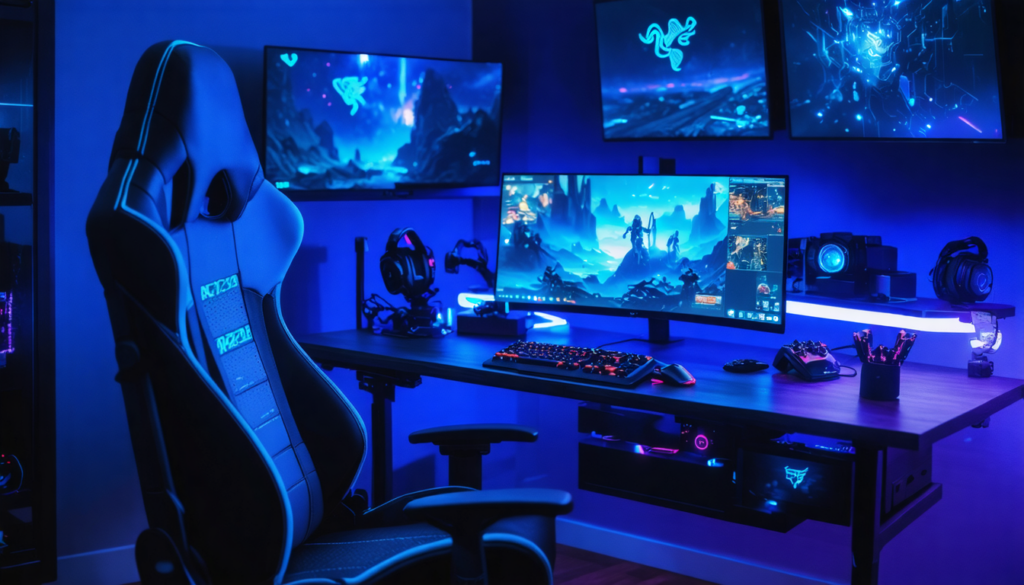
The CES 2026 in Las Vegas once again highlighted the spectacular evolution of the technology sector, but it is Razer that particularly captured attention with its bold announcement: a colossal investment of 600 million dollars in artificial intelligence. This strategic decision aims to profoundly redefine the world of video gaming by integrating AI not only as an additional tool but as the pillar around which the company intends to build its future ecosystem.
At a time when most tech players present AI-focused products without always demonstrating their concrete added value, Razer stands out as an exception by addressing its millions of users directly to revolutionize their gaming experience. With over 150 million players on its platform, the company intends to capitalize on this solid base to propel a real technological revolution in the gaming world by providing smart tools and devices designed to adapt to the needs of modern players.
This rise of AI at the heart of peripherals, computers, and services offered by Razer illustrates an ambitious vision of a future where technology fits perfectly into gamers’ daily lives while delivering unprecedented performance. From AI-based esports coaching to the creation of computers capable of handling intensive computing loads related to artificial intelligence, the brand takes a lead in a market still little explored but very promising.
Beyond a simple modernization, this shift marks a major mutation that could well disrupt usages and expectations in the video game universe, while demonstrating how innovation, coupled with massive investment, can generate a coherent and efficient ecosystem centered on data, computation, and intelligent interaction.
- 1 A strategic investment of 600 million: artificial intelligence at the heart of Razer’s new direction
- 2 Key Razer innovations to watch at CES 2026: connected earbuds, AI-powered PCs, and more
- 3 The impact of AI on the player experience: towards a deep revolution in video gaming
- 4 How Razer wants to unite developers and companies with an open-source AI kit
- 5 The competitive context: where does Razer stand compared to other giants at CES 2026?
- 6 The stakes of an AI revolution in video gaming: What benefits for players and professionals?
- 7 The future of gaming according to Razer: between technological innovation and enhanced user experience
A strategic investment of 600 million: artificial intelligence at the heart of Razer’s new direction
The CES 2026 was the stage for a major announcement signed by Razer: committing 600 million dollars to the development of AI-based solutions. This financial investment, as significant as it is thoughtful, reflects a clear desire from the company to establish itself as a leader in technological innovation in the video game field.
Since its inception, Razer has established itself as an indispensable reference for gamers, notably thanks to the quality of its peripherals. But the evolution towards a multitude of finely integrated devices and services with artificial intelligence opens a much more ambitious new chapter. This colossal amount will mainly be used to finance research, development, and recruitment of AI specialists – about 150 researchers and engineers according to announcements made by Min-Liang Tan, CEO and co-founder of Razer.
The massive recruitment of experts in this field testifies to Razer’s will to fully master the underlying technologies rather than integrate simple external components. This also guarantees tailor-made innovation, coherent with the vision and specific needs of the gaming community.
Specifically, this budget will be deployed across several axes:
- Creation of physical devices integrating AI to improve immersion and interactions
- Development of platforms and software to exploit these new tools
- Implementation of open-source models facilitating collaboration with other players and developers
- Consolidation of a complete ecosystem linking hardware and services around intelligent data
In short, beyond a simple investment, Razer is drawing the roadmap for a hybrid future that combines technical exploration and optimized user experience, in a territory still largely unexplored that is AI in video gaming.

Key Razer innovations to watch at CES 2026: connected earbuds, AI-powered PCs, and more
Razer’s announcement in Las Vegas does not stop at budget promises; it is materialized by the presentation of very promising technological innovations that illustrate the advanced scope of the project. Among these novelties, six major advances particularly attract attention:
- AI connected earbuds: Designed as direct competitors to smart glasses, these earbuds incorporate smart features capable of adapting sound in real time, analyzing the environment, and offering an enhanced virtual assistant for gamers. Their design combines comfort, performance, and intuitive interaction, changing how users perceive in-game audio.
- Powerful computer for AI: Razer is working on a computer able to efficiently handle massive loads related to artificial intelligence. This product is aimed both at demanding gamers and professionals seeking robust support for training and deploying complex algorithms.
- Open-source development kit: Razer relies on openness to accelerate the creation of AI-centered applications and accessories. This collaborative approach aims to unite developer communities and foster rapid, needs-driven innovation.
- Holographic assistant Project AVA: Already presented last year, this concept evolves with increased capabilities in visual recognition and natural interaction. The AVA assistant, which “sees” and understands the environment, is a major advancement for integrating AI into everyday interactions with gaming devices.
- Smart functions for gamers: Analysis tools, personalized coaching, and performance optimization based on machine learning are integrated into traditional devices, enriching the user experience without requiring new hardware.
- Complete ecosystem around data: These innovations converge into a coherent system where hardware, software, and artificial intelligence work together to create a unified and efficient universe.
This diversity of innovations clearly shows that Razer bets not only on a single product but on a true interoperable set oriented towards artificial intelligence and performance, capable of meeting the demands of both passionate gamers and industry professionals.
The impact of AI on the player experience: towards a deep revolution in video gaming
The rise of artificial intelligence radically changes the way players interact with their digital universes. At Razer, this trend is seen as a unique opportunity to redefine the user experience by offering personalized aids, real-time analyses, and intuitive interaction with the hardware.
For example, the integration of an esport coaching assistant capable of analyzing live performances, strategy, and even the player’s emotional reactions opens fascinating perspectives. This type of technology optimizes learning and progression while personalizing recommendations, even transforming casual players into more competitive and informed participants.
This revolution doesn’t stop there. AI also allows dynamic adaptation of gaming environments according to the player’s profile, style, and preferences. No more fixed experience; each session becomes unique, more immersive, and engaging thanks to continuous machine-driven adjustments.
Moreover, the usual mechanisms of peripherals are optimized by intelligent systems: mouse sensitivity, keyboard responsiveness, sound quality, and haptic feedback devices evolve to adapt in real time to needs. This synergy between hardware and artificial intelligence concretely enriches gameplay.
Beyond gaming, Razer plans to extend these applications to content creation, communication between players, and streaming platform management, thereby increasing quality and interactivity in all aspects of gaming.
This approach perfectly illustrates how innovative technology, properly integrated, can genuinely enrich digital entertainment and boost competitiveness in a rapidly expanding sector.

How Razer wants to unite developers and companies with an open-source AI kit
The emergence of artificial intelligence in video gaming entails a strong collaborative dynamic among manufacturers, developers, and companies. Razer has already announced the availability of an open-source development kit, designed to facilitate AI integration into various tools and applications, aimed both at players and professionals.
This initiative, far from being trivial, expresses a will to open its ecosystem and create a community around this new technology. By facilitating access to APIs, libraries, and pre-trained models, Razer aims to accelerate innovation and multiply relevant use cases, ensuring a certain flexibility of adaptation to the rapid evolutions of the sector.
The kit includes several key components:
- Interfaces for integrating intelligent assistant functions into existing peripherals
- Tools for developing coaching and real-time analysis modules
- Preconfigured templates to accelerate the creation of AI-compatible applications
- Systems for managing anonymized and secure data to enhance model performance
Thanks to this openness, independent developers and studios will be able to create personalized experiences, while companies will benefit from a robust platform to train or deploy their own models.
In the long run, this strategy should help enrich the entire ecosystem, allowing Razer to stay close to real expectations and uses, while avoiding the pitfall of a technology that is too closed or locked.
The competitive context: where does Razer stand compared to other giants at CES 2026?
At the CES 2026, many other brands also showcased their AI-based solutions, but Razer’s approach clearly stands out by its sharpness and the depth of its commitment.
For example, Meta unveiled advances in its connected glasses, introducing smarter features for augmented reality. Walmart, on its side, bet on an AI-based advertising assistant to optimize its marketing campaigns. Furthermore, domestic robotics also drew visitors’ attention with proposals for specialized assistants in targeted tasks, even if their adoption remains moderate and gradual.
For manufacturers like LG or Samsung, the value of domestic robots lies as much in their strategic positioning within technological ecosystems as in their immediate usefulness. These solutions embody the growing convergence between physical and digital spaces, illustrating a strong trend aiming to facilitate daily life as best as possible through technology.
In this landscape, Razer has chosen to focus its efforts on the world of video gaming, a fertile ground for experimenting with artificial intelligence. The company thus offers a model where technological innovations are directly embedded in the user experience, while establishing a complete and coherent ecosystem that leverages multiple facets of AI.
This orientation allows it to avoid dispersion and concentrate its resources on a promising, high-growth segment, thus consolidating its position as a leader in a rapidly evolving sector.
The stakes of an AI revolution in video gaming: What benefits for players and professionals?
The massive integration of AI in the video game field, as envisioned by Razer, raises many questions about the concrete benefits for the various stakeholders. First and foremost, players are the main beneficiaries of this revolution.
Thanks to AI, they benefit from personalized aids that go far beyond simple tutorials or traditional automatic settings. Intelligent assistants embedded in peripherals can analyze in real time the playing style, stress level, and even detect weaknesses to correct. These instant feedbacks transform gaming sessions into true intensive and adapted learning experiences.
For professionals, especially developers and studios, AI opens the door to unprecedented possibilities in content creation and optimization. Analysis tools allow refining game mechanics based on collected data, while intelligent algorithms can generate adaptive scenarios, environments, or characters, enriching the diversity and richness of virtual universes.
In summary, the benefits are multiple:
- Improvement of player performance and engagement
- Development of a personalized and evolving offer
- Facilitation of innovative and adaptive content creation
- Optimization of game development and testing processes
This virtuous circle, driven by a high-performing and well-integrated artificial intelligence, promises to inject new momentum into the market, with richer experiences and renewed economic models.

The future of gaming according to Razer: between technological innovation and enhanced user experience
The shift taken by Razer under the impetus of its CEO Min-Liang Tan marks a decisive turning point in the future of gaming. The company no longer limits itself to meeting player expectations with high-performance hardware but now aims to integrate artificial intelligence as a fundamental element of every product and service.
To achieve this goal, Razer acts on several levers:
- Continuous improvement of its products so they become true intelligent interfaces
- Launching collaborations with specialized research centers and universities
- Promoting an inclusive community around open-source innovation
- Developing accessible tools so every player can benefit from the latest AI advances
These orientations illustrate Razer’s recipe for success: combining technical performance, breakthrough innovation, and personalized immersive experience. Relying on these pillars, the company hopes to strengthen its leadership position while offering players increasingly engaging, efficient, and adaptive experiences.
It becomes clear that the era of gaming no longer resides solely in the raw power of machines but in their capacity to learn, anticipate, and optimize each experience thanks to artificial intelligence. Razer is therefore fully part of this movement, preparing players and professionals for a new generation of games and technological interactions.