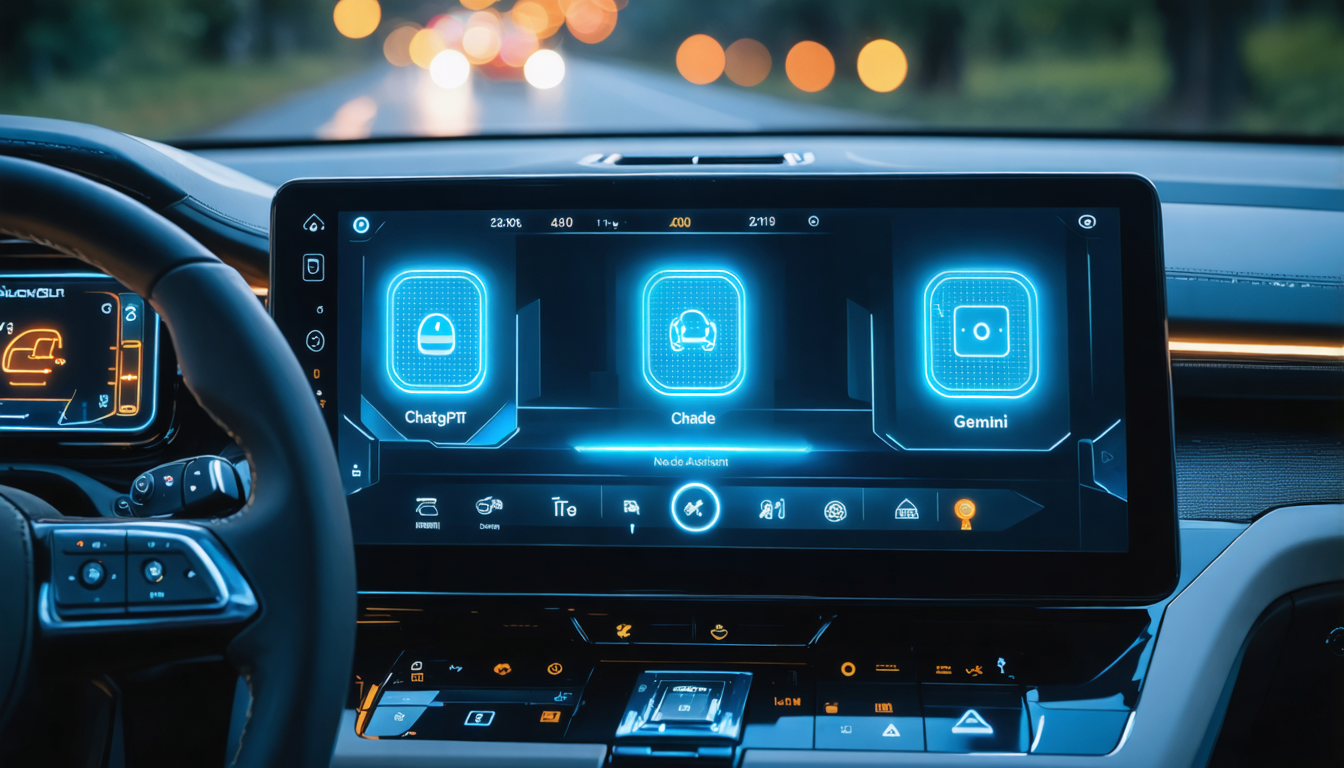
As artificial intelligence increasingly seeps into our daily lives, a new step is emerging in the automotive world with the announced integration of ChatGPT, Claude, and Gemini within Apple CarPlay. This advancement, embodied by the upcoming release of iOS 26.4, will allow drivers to interact with these next-generation voice assistants directly from their car’s screen. An enticing promise that nevertheless raises questions: is this a true revolution in how we use our connected cars, or simply a superfluous gadget likely to add complexity and distractions while driving?
Apple CarPlay, until now very conservative and protective of the driving experience, is finally opening its doors to these third-party artificial intelligences, ending the relative hegemony of Siri in the cabin. This openness is part of a clear desire to improve embedded technology by enriching the possibilities of dialogue and services offered to the driver. ChatGPT, Claude, and Gemini, each with their specificities, promise to transform the car into a true space for conversation and productivity. However, this experiment will have to comply with road safety imperatives and the driver’s attention, with Apple imposing strict constraints to frame these interactions.
By analyzing this new situation, it is possible to understand the technical, ergonomic, and psychological stakes of this integration, but also to spot potential limits and risks of these chatbots turning into distractions. Beyond the simple functional aspect, this change reflects a cultural evolution: the car is no longer just a means of transport; it becomes a connected environment where artificial intelligence plays the role of a vocal co-pilot.
From the user’s point of view, this novelty can appear as a technological boost, offering the possibility to access more powerful and versatile voice assistants capable of helping with information management, communication, or planning, directly while driving. This transformation could well announce an automotive revolution where the boundary between mobility and digital life gradually fades.
- 1 Apple CarPlay and iOS 26.4: a measured opening to conversational artificial intelligence applications in the car
- 2 How ChatGPT, Claude, and Gemini revolutionize the concept of voice assistant in the connected car
- 3 Technical limits and safety constraints regarding the use of AIs inside the automotive cabin
- 4 Practical uses and possible interaction scenarios with ChatGPT, Claude, and Gemini on Apple CarPlay
- 5 Apple CarPlay facing the challenges of distraction while driving: integration or superfluous gadget?
- 6 Future perspectives: towards broader integration and an increasingly intelligent car
Apple CarPlay and iOS 26.4: a measured opening to conversational artificial intelligence applications in the car
With the release of iOS 26.4, Apple is finally opening a new era for its Apple CarPlay system by allowing access to third-party applications based on conversational artificial intelligences such as ChatGPT, Claude, and Gemini. This change, initially revealed in the official CarPlay developer guide, introduces a category of applications called “conversational voice applications,” designed for hands-free and secure use via a dedicated screen.
Until now, the CarPlay ecosystem was highly compartmentalized, limiting the user experience to built-in or Apple-validated music, navigation, or messaging apps. Siri remained the only available voice assistant, with relatively basic functionalities compared to the powers offered by contemporary generative AIs. The integration of ChatGPT, Claude, and Gemini represents a strategic turning point: Apple implicitly acknowledges that its own assistant is insufficient given users’ growing expectations.
This opening remains cautious, however. The new feature will not allow AIs to intervene on the vehicle’s critical controls, nor to directly operate the iPhone device or system features by voice without manually launching the application. This rigorous framework aims to protect the driver’s concentration and avoid any accidental manipulation that could create a risk while driving.
Technically, developers must integrate a specific graphical voice interface, offering a clear and readable visual feedback optimized for the automotive context. This standardization ensures that the use of these assistants complies with Apple CarPlay’s safety and ergonomic standards. Compatible applications will be granted a dedicated authorization, excluding any automatic launch via a wake word, which further limits the risk of interference.
The opportunities offered by this new architecture fit within an evolving framework: as soon as the stable version of iOS 26.4 becomes available in spring, opening the door to these integrations, it will be up to the main players like OpenAI, Anthropic, or Google to adapt their existing applications. The success of this collaboration will largely determine the acceptance and real usefulness of these AI assistants in the modern automotive sector.
How ChatGPT, Claude, and Gemini revolutionize the concept of voice assistant in the connected car
Traditionally, voice assistants embedded in cars, such as Siri, Alexa Auto, or Google Assistant, have been designed for simple and direct commands: making a call, changing a GPS destination, sending a message. This approach was designed to minimize distractions and provide intuitive but limited assistance.
The arrival of ChatGPT, Claude, and Gemini within Apple CarPlay goes far beyond these classic functionalities. These artificial intelligences are characterized by the ability to understand complex requests, maintain long conversations, generate creative content, synthesize information, or even learn the user’s preferences to offer a personalized experience. They thus fundamentally transform the relationship with the voice assistant, turning it from a simple tool into a true digital co-pilot.
For example, a driver en route to a business meeting can ask ChatGPT to summarize confidential documents received by email, or Claude to draft an email to be sent upon arrival. Gemini can intervene to handle multitasking requests, such as complex planning with integrated reminders while consulting real-time traffic information. This richness of use imposes a new way of interacting with the vehicle, where conversation becomes as natural as with a human passenger.
This evolution promises to disrupt the notion of connected car. Conversational applications no longer are limited to a functional role but become tools for productivity and entertainment, sometimes even education, accessible in a secure environment. The car transforms into a space for communication and mobile collaboration, where embedded technology plays a central role in the digital daily life of its occupants.
However, this transformation raises a major challenge related to attention management. The driver must never lose sight of road safety, and Apple has understood this well by integrating these assistants within a strict framework, notably through a specific voice command screen, likely simplified and streamlined, designed to limit cognitive and visual impact. For now, these assistants will neither be able to control vehicle functions nor replace Siri, thus avoiding confusion of uses and complicating the interface.
Key benefits of integrating these AIs into Apple CarPlay:
- Access to complex and personalized interactions adapted to the automotive context.
- Possibility to use more powerful and specialized third-party assistants.
- A dedicated interface designed to reduce distractions and secure usage.
- An enriched experience that makes driving time more productive or creative.
- Compatibility with a wider range of audio/video applications and services.
This new generation of voice assistants represents a major qualitative leap in embedded technology, at a time when the connected car truly becomes a mobile digital hub.
Technical limits and safety constraints regarding the use of AIs inside the automotive cabin
The integration of conversational intelligences within Apple CarPlay does not come without strict restrictions. The absolute priority remains the driver’s safety, as evidenced by the framework defined in the CarPlay developer guide and the specifications of iOS 26.4. Despite the obvious attraction of ChatGPT, Claude, and Gemini’s capabilities, Apple imposes several barriers to avoid any potential drift.
The first major constraint concerns the control of vehicle-related commands. These AIs are not allowed to directly interact with the car’s settings, such as air conditioning, navigation system, or audio settings. This limitation aims to prevent any conflicting or dangerous uses where a misinterpreted command could jeopardize road safety.
Next, the system does not allow activation via a common wake word across all these applications. Users must manually launch the AI application to begin interaction, which slows access but enhances control. Apple thus wants to prevent accidental or untimely triggers that could distract the driver.
Beyond these functional restrictions, the ergonomics of the proposed interface must also be considered. The limitation to a single, streamlined voice command screen specifically designed for the car is an initiative aimed at minimizing cognitive and visual load. The visual feedback of applications must be clear, concise, and non-intrusive so as not to divert the driver’s attention.
On the technical side, this new category of applications requires specific updates from the publishers of these AIs, who must integrate the authorization system required by iOS 26.4. Without this adaptation, they will not function within CarPlay, temporarily locking some advanced features.
To summarize, the main security constraints are:
| Constraints | Description | Objective |
|---|---|---|
| Prohibition of control over vehicle functions | The AIs cannot adjust air conditioning nor change navigation. | Avoid distractions and potentially dangerous errors. |
| No activation by wake word | The application must be launched manually before interaction. | Limit accidental and untimely activations. |
| Simplified dedicated interface | A specific voice screen with minimal visual feedback. | Optimize readability and reduce cognitive load. |
| Specific authorization | Apps must obtain special permission via iOS 26.4. | Control usage and ensure secure compatibility. |
Ultimately, Apple is betting on a subtle balance between embedded technological innovation and the necessary caution for road safety. This thoughtful approach shows a clear intention to not sacrifice the driver’s focus for the benefit of a superfluous or distracting gadget.
Practical uses and possible interaction scenarios with ChatGPT, Claude, and Gemini on Apple CarPlay
The integration of ChatGPT, Claude, and Gemini within Apple CarPlay opens a range of varied uses that can accompany daily driving while maximizing safety. These intelligent voice assistants offer more than simple control by voice command; they provide a palette of advanced conversational tools.
Among the most convincing usage scenarios are intelligent preparation on the go: for example, a driver regularly commuting between home and work can ask the AI to summarize the news, explain a technical concept, or help remember a shopping list. During a business trip, the assistant might draft, for example, a letter aloud, provide a summary of documents, or perform instant translation.
In another register, these AIs can serve as co-pilots for managing contingencies: a question about an alternative route in case of traffic jams or immediate information about a place encountered by chance can be formulated. The advanced interactivity also allows monitoring ongoing projects, taking voice notes, or organizing the agenda without taking eyes off the road.
The playful dimension is not forgotten; certain situations like long trips or dense traffic can be eased by smooth conversation, a question-answer game, or even generating personalized music. This organizational and relational adaptability shows that the connected car is reinventing itself into a multifunctional space where embedded technology becomes an ally at all times.
List of possible practical uses:
- Real-time summary and synthesis of vocal or written documents.
- Writing and dictation of emails and messages via an efficient voice interface.
- Instant translations in multiple languages.
- Intelligent agenda planning and contextual reminders.
- Playful or conversational interaction to reduce stress while driving.
- Management of lists (shopping, tasks) accessible via voice command.
- Help with note-taking and creative brainstorming during stops.
Thanks to these functionalities, our cars, equipped with ChatGPT, Claude, or Gemini, become dynamic environments capable of adapting to various driving contexts while integrating safety imperatives.
Apple CarPlay facing the challenges of distraction while driving: integration or superfluous gadget?
One of the central debates surrounding the arrival of ChatGPT, Claude, and Gemini in Apple CarPlay concerns the sensitive issue of distraction while driving. This problem, well known to road safety services and car manufacturers, intensifies as the car transforms into a multi-access digital point.
The temptation is great to consider these assistants as mere superfluous gadgets, entertainment liable to impair concentration. Indeed, the risk of a complex or prolonged conversation with a productive AI while driving could divert the driver’s gaze or attention, thus increasing the risk of an accident.
However, the design put in place by Apple and the imposed constraints show a clear desire to minimize these dangers. The absence of direct vehicle control, the need to manually launch applications, and the use of a simplified interface are all safeguards designed to ensure the experience remains safe.
It is also necessary to analyze how these assistants can positively contribute to driving. For example, during waiting phases, at traffic lights, or in traffic jams, a driver can benefit from the dialogue to turn potentially frustrating dead time into useful moments. This could reduce stress and improve overall wellbeing behind the wheel.
The future of this integration will therefore depend on how it is used by drivers, but also on Apple’s and developers’ ability to continuously monitor and adapt the operational framework. Misused, this technology could prove a superfluous gadget, distracting more than it helps. Well framed, it could mark a real automotive revolution.
Future perspectives: towards broader integration and an increasingly intelligent car
The evolution initiated with iOS 26.4 and Apple CarPlay constitutes a first step but also opens many doors for embedded technology in the coming years. The integration of ChatGPT, Claude, and Gemini into our connected cars is only the beginning of a deeper transformation.
We can imagine that, in the near future, AI evolution will allow even more natural and fluid dialogue, potentially coupled with recognition of contexts and emotions to adapt responses and interactions. The car will thus become a pleasant and intelligent assistant, capable of managing complex tasks while anticipating the driver’s needs.
On the manufacturers’ side, this advance could come with better integration of home automation and mobile systems, with cross interactions between the car, home, and office. For example, an AI assistant could prepare your home for your arrival according to preferences detected during driving.
Moreover, this approach will probably lead to a rise in embedded safety tools. Embedded AI could intervene more to detect fatigue, adapt speed, or warn in case of imminent danger, thus increasing safety. Embedded intelligence would no longer be just a gadget but an active safeguard.
Table: Expected evolution of AI functions in the connected car
| 2026 functionalities | Evolution potential | Impact on user experience |
|---|---|---|
| Conversational voice assistants (ChatGPT, Claude, Gemini) | More natural dialogues, multimodal integration (voice, gestures) | Smoother interactions, increased productivity, more pleasant driving |
| Restrictive functions on vehicle command | Controlled authorization with adaptive learning | More AI autonomy without compromising safety |
| Simplified dedicated visual interface | Adaptation to lighting environments and distractions | Improved readability and reduced visual fatigue |
The automotive revolution emerging through this integration signals the rise of a deeply embedded voice assistant capable of shaping the contours of mobility that is ever more connected, intelligent, and safe. Success will depend on the ability to find a fair balance between technological innovation and respect for human imperatives.