In a world where digital transformation is accelerating exponentially, the partnership between Anthropic and Accenture stands out as a major alliance to propel artificial intelligence (AI) to the heart of businesses. This strategic collaboration aims to go beyond the experimental stage of AI to deliver tangible and measurable results, especially in regulated sectors where the requirement for compliance and efficiency is the strongest. Relying on the Claude model, developed by Anthropic, and Accenture’s expertise in consulting and technological deployment, this initiative intends to make AI not only accessible but above all profitable for thousands of companies around the globe.
While investments in AI are often hindered by doubts related to return on investment, this alliance hopes to change perception and open the way to widespread and pragmatic adoption of the technology. The challenge? To make artificial intelligence a strategic lever capable of optimizing processes, automating complex tasks, and offering a new dimension to data analysis. Following the evolution of this partnership over several years, a promising dynamic is already visible that could redefine the rules of the game in the digital transformation of companies by 2025.
- 1 The Anthropic-Accenture partnership: a new era for artificial intelligence in business
- 2 Claude, the Anthropic model revolutionizing AI strategy in business
- 3 Training 30,000 employees: Accenture’s operational strength to integrate Claude AI
- 4 The first targeted sectors: finance, healthcare, life sciences, and public sector
- 5 Strategic support towards concrete financial and operational results
- 6 Anthropic and Accenture facing competition in the professional AI market
- 7 The expected impact of this partnership on the digital transformation of businesses
The Anthropic-Accenture partnership: a new era for artificial intelligence in business
The recent three-year agreement between Anthropic and Accenture represents a significant turning point in the integration of artificial intelligence into the industrial and commercial fabric. Taking into account the specific needs of modern companies, this partnership aims to combine Anthropic’s technological power with Accenture’s recognized expertise in digital transformation. With 30,000 Accenture employees trained in the use of the Claude model, the firm is preparing a large-scale deployment capable of covering a very broad spectrum of industries.
The heart of this collaboration centers around Claude, an advanced artificial intelligence model developed by Anthropic, which stands out for its performance in legal, financial, and programming fields. The shared goal of the two companies is clear: to turn these advances into concrete and measurable benefits for client companies. This project also addresses a crucial issue, the distrust of IT departments, often reluctant to engage high budgets for technologies perceived as experimental. The objective is therefore to bring a pragmatic and results-oriented approach.
Beyond the numbers, this partnership fits into a dynamic where innovation becomes a direct lever for growth and competitiveness. The fact that Anthropic now holds about 40% of the AI market in business, even surpassing OpenAI according to Menlo Ventures, highlights the rise of this technology in the professional sector. This dominant position gives enhanced credibility to the Claude model, which is notably integrated into the Microsoft Copilot suite, demonstrating confirmed technological adoption.
Claude, the Anthropic model revolutionizing AI strategy in business
Claude, Anthropic’s AI, is much more than a simple digital tool. This model is designed to excel in high value-added tasks, such as legal or financial analysis, fields where rigor and precision are essential. Its ability to perform complex programs and interpret regulatory texts gives it a considerable advantage in highly regulated environments.
For example, in the banking sector, Claude can quickly analyze hundreds of contracts or financial reports, detect risks or anomalies, and assist compliance teams. This not only allows faster results but above all greater reliability, thus reducing human errors and financial risks. This degree of precision and automation helps make artificial intelligence an indispensable tool for companies wishing to remain competitive while respecting strict frameworks.
Healthcare companies, a sector also under strict regulatory oversight, also benefit from Claude’s capabilities. The AI facilitates the analysis of medical data, the synthesis of clinical reports, as well as compliance with complex standards, helping to accelerate diagnoses and optimize administrative processes. By integrating these solutions, establishments can reallocate their human resources to tasks with higher human value, strengthening their digital transformation strategy.
Beyond specific applications, Claude also enables better data exploitation through sophisticated analysis that transforms raw data into strategic information. This intelligent “data analysis” thus offers a better market vision, optimization of internal processes, and anticipation of trends, essential elements in the current era of rapid technological and economic evolution.

Training 30,000 employees: Accenture’s operational strength to integrate Claude AI
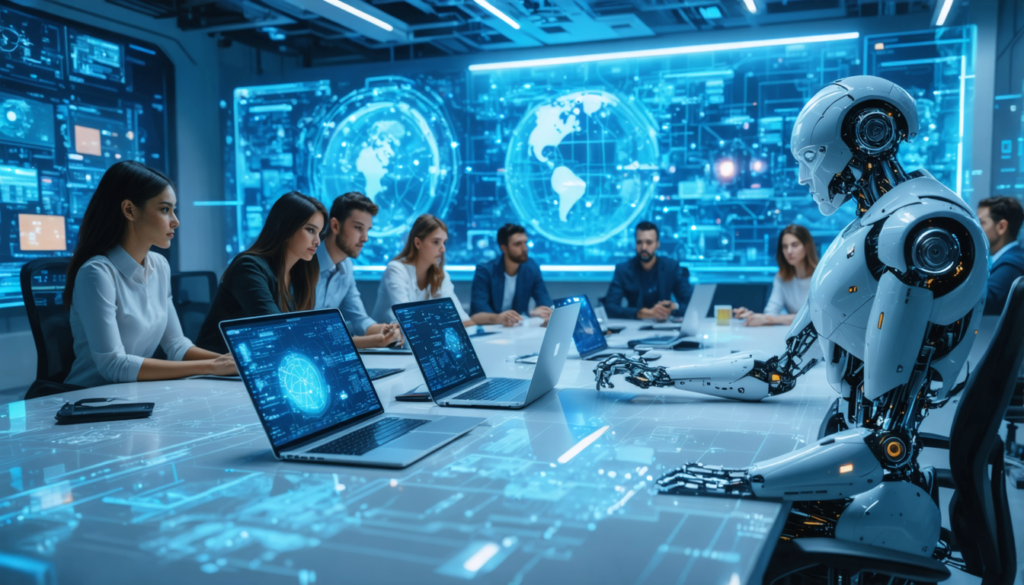
The training of 30,000 Accenture employees on the Claude model illustrates a colossal commitment to making AI strategy an operational success. This massively ambitious approach goes far beyond simple knowledge acquisition. It is about arming teams capable of intervening directly in the field, at the very heart of client companies, to facilitate the implementation and concrete use of Claude-based solutions.
This approach relies on a strong physical and operational presence, with “engineers deployed in reinvention” integrated directly within clients. These engineers work in tandem with Anthropic AI specialists. Their shared role is to ensure that artificial intelligence does not remain a theoretical concept but really becomes a driver of efficiency and innovation for each organization.
Individual and personalized follow-up also guarantees constant adaptation of solutions to the specific challenges of each sector and company. For example, a client in the public sector will benefit from an approach adapted to regulatory and administrative requirements, while a company in financial services will have a deployment optimized to maximize compliance and risk management.
The training instills immediate operational competence that helps eliminate one of the major pitfalls of AI projects: the mismatch between technology and real business needs. With this deployed operational force, Accenture ensures that companies do not get stuck in experimental phases but quickly move towards large-scale deployments generating tangible value.
List: Key skills developed during Claude training at Accenture
- In-depth understanding of artificial intelligence principles and the Claude model
- Ability to integrate Claude into complex business processes
- Skills in AI project management and digital transformation
- Mastery of regulatory requirements specific to each sector
- Advanced use of data analysis and automation tools
- Development of personalized approaches to maximize return on investment
- Cross-cultural collaboration and work in multidisciplinary teams
The first targeted sectors: finance, healthcare, life sciences, and public sector
Within the framework of this partnership, the initial efforts of Accenture and Anthropic focus on the most regulated sectors, where artificial intelligence can play a critical strategic role. These fields require absolute rigor and transparency, often associated with complex standards and high risks.
Finance is typically marked by massive volumes of operations and data, with constant pressure to optimize risk management and regulatory compliance. Thanks to Claude, financial institutions can automate tasks that previously required large teams, while increasing the precision and speed of analyses.
In the healthcare sector, digital transformation passes through better exploitation of patient data and regulatory advances for the protection of sensitive information. AI helps to perform complex syntheses and ensures compliance with normative standards, allowing professionals to refocus their efforts on direct care.
Life sciences also benefit from this automation to accelerate research and development, notably in managing clinical trials, monitoring outcomes, and regulatory compliance. Finally, the public sector benefits from enhanced digitalization that improves the quality of services and transparency while reducing operational costs.
This sectoral strategy is deliberately targeted to maximize impact and added value from the first deployments. The rigor required in these environments indeed makes AI indispensable to improve efficiency and competitiveness in the face of current challenges.
Strategic support towards concrete financial and operational results
The partnership places particular emphasis on creating real value, systematically linking artificial intelligence projects to clear performance indicators. This positioning is unique in the AI technology market, which often experiences a gap between spectacular promises and measurable results.
A dedicated organization, the Accenture Anthropic Business Group, has been set up to supervise this mission. This group offers comprehensive support, from assessing existing infrastructures to integrating AI tools, up to monitoring obtained financial and operational gains. Therefore, each step is documented to secure investments and convince executive management.
The impact of the Claude solutions is measured through parameters such as cost reduction, productivity increase, enhanced compliance, and faster task execution. This model also adapts to the changing business context, offering an agile and evolving framework fully aligned with the needs of the ongoing digital transformation.
This pragmatic approach attracts companies that until now were cautious about AI adoption, particularly in markets where the smallest error can have major consequences. The strategic value of artificial intelligence thus goes beyond a mere trendy effect to become a lever for competitiveness and sustainable growth.
| Key step | Strategic objective | Expected impact |
|---|---|---|
| Employee training | Develop solid and operational AI expertise | Rapid and efficient deployment of AI solutions |
| Deployment in regulated sectors | Ensure compliance and efficiency | Risk reduction and better regulatory management |
| Monitoring financial results | Measure return on investment | Justification of AI investments |
| Personalized support | Meet clients’ specific needs | Flexible adaptation of solutions and increased satisfaction |
Anthropic and Accenture facing competition in the professional AI market
Although this partnership marks an important step, the artificial intelligence market dedicated to businesses remains very competitive. Players such as Deloitte, Cognizant, OpenAI, or Cohere are also developing solutions and strategies to capture this booming segment.
However, the complementarity between Anthropic and Accenture offers them a significant advantage. While Anthropic focuses its efforts on cutting-edge technology and AI modeling expertise, Accenture brings its know-how in consulting, integration, and large-scale support. This tandem is thus capable of proposing a unique offering combining innovation and rapid deployment in complex contexts.
Their ability to provide intensive training and personalized follow-up facilitates an industrial-scale transition, crucial to meeting the demands of demanding clients. This pragmatic positioning, focused on digital transformation and effective AI strategy, creates a barrier to entry against competitors who sometimes prioritize technological innovation at the expense of practical support.
In summary, the Anthropic-Accenture partnership illustrates how a well-thought-out collaboration can transform artificial intelligence from a mere technological topic into an unmatched commercial and strategic differentiator. Their success will depend on their ability to continue innovating while meeting growing business expectations for practical and profitable AI usage.
The expected impact of this partnership on the digital transformation of businesses
The collaboration between Anthropic and Accenture is ready to leave a deep mark on the technological evolution of companies. By providing turnkey expertise, this partnership facilitates AI adoption in diverse contexts, ranging from the public sector to private companies and life sciences.
The promise is clear: to transform AI tools into performance levers, to generate growth, optimize processes, and enhance competitiveness. With a value-centered approach, intelligent automation, and advanced data analysis, companies can now seriously consider AI as a strategic partner on which to build their future.
By combining technological innovation with operational proximity, this partnership paves the way for inclusive and sustainable digital transformation. It encourages decision-makers to rethink their strategies, invest in trained talents, and integrate artificial intelligence at the very core of their future successes. Thus, artificial intelligence stops being an abstract concept to become one of the cornerstones of competitiveness in 2025 and beyond.