
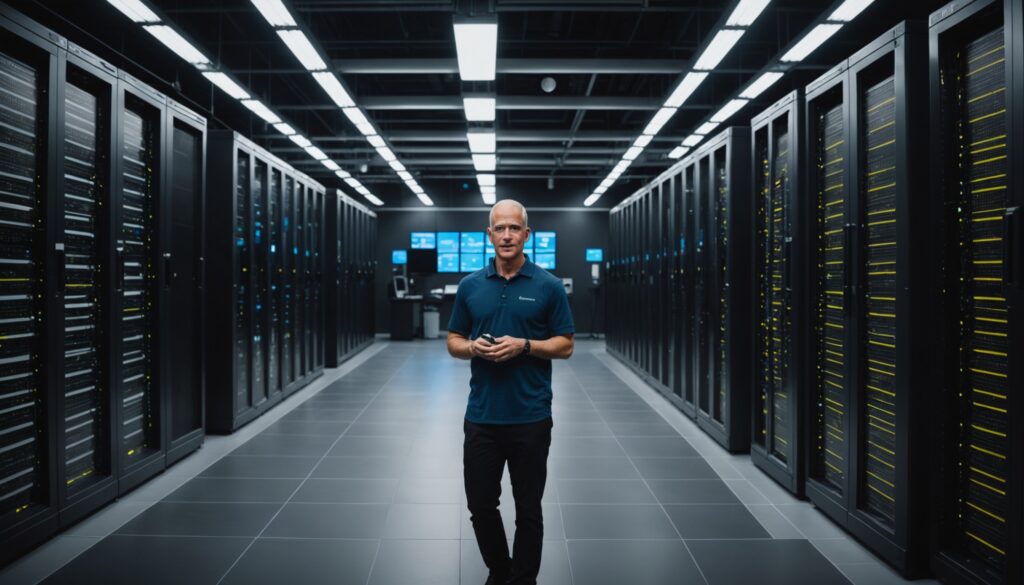
Amazon, global giant of online commerce and technological leader, decisively marks the digital landscape by announcing a colossal investment of 12 billion dollars in the construction of data centers dedicated to artificial intelligence (AI) in Louisiana. This initiative aims to strengthen the necessary infrastructure to support its rapid expansion in cloud computing and the development of AI-related services. However, this ambitious choice sparks a series of local controversies and economic questions, mixing technological hopes and social concerns. While these facilities promise the creation of thousands of jobs and an unprecedented boost in technology in the region, opposition is growing, fueled by environmental and energy concerns. Beyond public debates, investors remain skeptical about the profitability of such projects, weighing the enormous costs against the questionable benefits of artificial intelligence in the long term. This story thus highlights the major challenges faced by Amazon, torn between innovation, social responsibilities, and financial demands in a rapidly changing market.
- 1 Amazon and its massive investment in AI data centers in Louisiana: a strategic bet
- 2 Environmental issues and local resistance to Amazon’s data centers
- 3 Amazon faces investor criticism regarding artificial intelligence spending
- 4 The economic benefits of creating data centers in Louisiana: towards local recovery?
- 5 Technological impacts of these data centers on the artificial intelligence sector
- 6 Comparison of Amazon’s investments with those of other technology giants
- 7 Future challenges: between societal integration, environmental requirements, and technological competitiveness
Amazon and its massive investment in AI data centers in Louisiana: a strategic bet
Amazon’s choice to commit 12 billion dollars to the construction of data centers in Louisiana reflects a determined strategy to dominate the artificial intelligence and cloud computing sector. These infrastructures, mainly located in the parishes of Caddo and Bossier, will play a key role in processing the exponential volumes of data generated by modern AI applications. Indeed, these centers will serve as a foundation for advanced technologies, particularly those driving evolution in machine learning, natural language processing, and service automation.
The planned creation of 540 direct salaried jobs in the centers constitutes an important local economic lever. In addition, about 1,700 indirect jobs linked to essential services such as electricity, air conditioning, and security will be created, demonstrating the socio-economic impact extending beyond the simple technological sphere.
In the context of a market where demand for AI capabilities continues to grow, this type of investment underlines the desire to position Amazon as a key pillar, capable of offering robust, reliable, and innovative infrastructure.
An infrastructure designed to meet the demands of artificial intelligence
Recent data centers bear no resemblance to the first generations of facilities serving the web and storage. Those dedicated to artificial intelligence must manage enormous data flows and guarantee massive computing capacities while maintaining optimized energy consumption. In this respect, Amazon is considering state-of-the-art cooling technologies and hybrid energy systems integrating renewable sources to limit the ecological footprint.
Moreover, the location in Louisiana is not incidental. This choice offers advantages in terms of network infrastructure, operational costs, as well as qualified labor, but it also involves environmental challenges that require rigorous management.
Environmental issues and local resistance to Amazon’s data centers
Despite the obvious economic and technological benefits, Amazon’s projects face significant resistance from local communities and environmental activists. This opposition takes place in a broader context where the construction of data centers raises concerns due to their high energy consumption and their often significant use of water resources, particularly necessary for cooling equipment.
In regions like Louisiana, struck by recurring drought episodes, the impact on local water reserves is a major sticking point. Several groups are mobilizing especially to prevent the situation from deteriorating further, stressing that these projects could exacerbate tensions over already limited resources.
Additionally, the noise generated by cooling devices and generators contributes to the concern of local residents, who fear a decline in quality of life and a degradation of rural and agricultural landscapes.
Comparison with other regions facing similar opposition
The situation in Louisiana is not isolated. In the United States, several states have seen their data center projects slowed down or even canceled following opposition from local populations. For example, in Pennsylvania, a united front bringing together farmers, environmentalists, and citizens rose against the excessive multiplication of data centers, fearing a “data center alley” that would have fragmented farmland and deteriorated ecological stability.
In Arizona, Amazon even had to abandon a 3.6 billion dollar project in Tucson, faced with pressure from residents and real estate developers, thus illustrating the complexity of these challenges at the crossroads of economic needs and environmental imperatives.
Amazon faces investor criticism regarding artificial intelligence spending
On the economic and stock market side, the announcement of a colossal 200 billion dollar investment by Amazon for the current year, largely aimed at strengthening its AI-related infrastructures, has generated some skepticism among investors. Amazon’s valuation temporarily suffered, illustrating the perception of a high financial risk associated with the still uncertain profitability of these projects.
This reaction originates from the fact that, despite spectacular advances in AI, the actual impact on global GDP growth remains difficult to quantify to this day. The massive costs related to new infrastructures, research, and development thus raise a fundamental question: to what extent will these investments translate, in the medium or long term, into tangible benefits for the company and its shareholders?
Despite this turbulent environment, Amazon does not seem to be abandoning its strategy. On the contrary, it is engaged in an intense competition with other giants such as Google, Microsoft, or Meta, which together plan expenditures amounting to 650 billion dollars for their own AI and cloud computing development.
Analysis of financial perspectives and associated risks
Investors are closely scrutinizing Amazon’s ability to generate a sufficient return on investment in the long term. The heaviness of investments in specific and energy-intensive infrastructures could appear as a burden, especially if the growth in demand for AI services slows or if other revolutionary technical innovations profoundly change the market.
Current financial analyses highlight risks related to the volatility of technology markets, fierce competition, as well as growing pressure to make services more ecological and less energy-consuming.
The economic benefits of creating data centers in Louisiana: towards local recovery?
Beyond technological and financial aspects, the local impact of such a project is considerable. Amazon’s announcement of creating 540 direct jobs in the region, related to the operation and maintenance of the centers, represents an important economic opportunity. In addition, nearly 1,700 additional jobs in related sectors such as electricity, security, heating, and air conditioning could boost the local economy.
This model creates a virtuous circle where the establishment of advanced technology is accompanied by a favorable employment dynamic, helping to support communities sometimes facing economic difficulties.
Louisiana thus benefits from enhanced attractiveness, with public and private investments likely to stimulate innovation, promote technical training, and prepare a workforce adapted to these high-tech sectors.
Social and economic considerations in the medium term
While these economic benefits are appreciable, they must nevertheless be balanced with environmental requirements and the needs for responsible resource management. This project could thus serve as an example of a sustainable development strategy to be integrated into the operational and technical phase.
Collaboration between Amazon, local authorities, and civil society will be a key factor to ensure compatibility between economic growth and ecological preservation, indispensable for the envisioned success’s sustainability.
Technological impacts of these data centers on the artificial intelligence sector
Amazon’s data centers in Louisiana are intended to catalyze advances in artificial intelligence by providing the computing power necessary for complex algorithms. The significant increase in capacity will allow processing and analyzing ever-larger volumes of data, a prerequisite to improving machine learning models and accelerating the development of innovative solutions.
Thanks to this infrastructure, Amazon aims to strengthen its existing cloud services, notably AWS (Amazon Web Services), and to offer high value-added solutions for businesses, from automated decision support to intelligent applications including robotics and predictive analytics.
Increased use of AI-specialized infrastructures will also enable better cost management, performance optimization, and reduced latency times, major assets in a sector where speed and reliability are decisive.
Concrete and advanced applications in offered services
- Optimization of logistical operations through predictive analytics
- Deployment of smarter and more responsive chatbots and virtual assistants
- Improvement of personalized recommendation systems on e-commerce platforms
- Advanced support to researchers via data analysis platforms
- Acceleration of augmented and virtual reality development
Comparison of Amazon’s investments with those of other technology giants
The artificial intelligence market attracts colossal sums. Amazon is not alone in this frantic race. Google, Microsoft, and Meta are also positioning themselves through combined investments amounting to several hundred billion dollars to develop their AI and cloud computing infrastructure.
For example, Meta has allocated 27 billion dollars for a data center in Louisiana, a facility that complements the network and increases overall capacity to support projects similar to Amazon’s. This situation illustrates how the region is becoming a strategic hub for the technology industry.
| Company | Amount invested (billion $) | Main location | Objective |
|---|---|---|---|
| Amazon | 12 | Louisiana, USA | AI and cloud data centers |
| Meta | 27 | Louisiana, USA | Massive data center for AI |
| 260 | Global | Cloud & AI infrastructure | |
| Microsoft | 150 | Global | AI and data center development |
This table puts Amazon’s investment weight in perspective compared to its main competitors, highlighting the market size and the complexity of the challenges to be met. Each player develops its infrastructures to capture a share of the rapidly growing artificial intelligence market.
Future challenges: between societal integration, environmental requirements, and technological competitiveness
As data centers multiply, attention shifts to their harmonious integration within territories. Reconciliation between economic development, environmental preservation, and social acceptability becomes a major challenge.
For Amazon, succeeding in sustaining its investments requires active listening to local populations, developing public-private partnerships, and strong commitment towards sustainable practices.
Finally, competitive pressure demands continuous innovation, both technologically and strategically, to reduce costs, improve energy efficiency, and guarantee data security, a crucial issue in the digital age.
These multiple parameters will condition the future of Amazon’s investment in data centers, at a time when the company intends to impose its mastery of artificial intelligence as an indispensable lever for the future.




