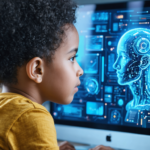
Since the early 2020s, rapid advances in artificial intelligence (AI) are profoundly changing the way we work and questioning the very future of many professions. Between promises of increased efficiency and fears over the disappearance of certain jobs, the impact of these technologies on the world of work is far from anecdotal. At a time when a machine can now not only assist but fully perform complex tasks, it becomes crucial to alert your loved ones about the major ongoing transformations. The recent innovations of 2026, marked by models capable of handling entire projects with disconcerting autonomy, reveal a startling reality: AI is no longer just a simple tool, it is becoming a real player in the job market.
While this transition does not affect all sectors uniformly, some industries and professional profiles are particularly exposed, especially in administrative and technical jobs with procedural profiles. To understand this silent revolution, it is necessary to examine in detail how AI is transforming work practices, its current impact, as well as the social and economic challenges it raises. This article therefore looks at the multiple facets of this profound change in the job market and explains why it is imperative to alert your network today.
- 1 Radical transformation of office work thanks to artificial intelligence in 2026
- 2 The shock of administrative jobs: a slow but relentless erosion
- 3 Technological advances that disrupt the game in 2026
- 4 A major threat to entry-level white-collar employment: the “white-collar bloodbath”
- 5 Social and economic disparities: AI exacerbates inequalities in employment
- 6 How to warn your loved ones about the impact of AI on employment and help them adapt?
- 7 Companies’ responses to the impact of AI on employment
- 8 Societal and political impact: what role for regulation in the face of AI’s rise?
- 8.1 Will AI replace all office jobs?
- 8.2 How to prepare your career facing the impact of artificial intelligence?
- 8.3 Which sectors are most threatened by AI-related automation?
- 8.4 How can companies help their employees adapt?
- 8.5 What is the responsibility of public authorities regarding this transformation?
Radical transformation of office work thanks to artificial intelligence in 2026
The boundary between humans and machines at work continues to fade, especially in office tasks. In early February 2026, two AI giants, OpenAI and Anthropic, unveiled revolutionary models capable of executing a multitude of complex tasks over long periods. These artificial intelligences can now read, analyze, sort, correct, write, and even program with unmatched finesse and endurance. It is no longer just occasional assistance, but massive automation at the scale of entire business processes.
Concretely, this means that intelligent “agents” now take on missions that previously required several hours or even days from junior employees or assistants. For example, a large administrative document can be automatically sorted, summarized, and archived while the employee is on a lunch break, which disrupts traditional notions of productivity and availability. This phenomenon, less spectacular than a physical robot occupying an office, is nevertheless much more impactful and threatening: it operates in the background, invisible, but deeply effective.
This technology no longer only handles conversations or simple assistance. It now involves actual execution, multiplying speed and accuracy, forcing organizations to rethink not only their processes but also the strategic position of employees within teams.
- Automation of repetitive tasks: writing, proofreading, document classification, email management.
- Assisted or fully handled programming: code correction, testing, and debugging.
- Management of complex projects: sequencing and coordinating processes across multiple levels.
This reality calls for reconsidering the share of human work in so-called “white-collar” jobs and offers an unprecedented upheaval, oriented towards historically unmatched increased efficiency.
The shock of administrative jobs: a slow but relentless erosion
The AI revolution will not strike suddenly but through a gradual erosion of opportunities, making it all the more difficult to perceive and combat. One of the most alarming aspects concerns administrative jobs and “entry-level” positions where young talents learn their profession on the ground by performing many repetitive tasks.
These roles often serve as career stepping stones, allowing the acquisition of skills and experience. Yet, a large part of these activities are now automated, slowly closing the door on these crucial first steps. For example, in the banking sector, standard data entry and control operations, once entrusted to an army of assistants, are now handled by AI systems capable of managing tens of thousands of files in parallel.
The World Economic Forum already warned in 2025 about this phenomenon, reporting that nearly 40% of employers anticipate workforce reductions related to automated tasks. This trend leads to:
- the gradual disappearance of junior positions,
- a flattening of opportunities for beginners,
- significant imbalances in the skill development of new generations.
This erosion is further aggravated by IMF analysis, which estimates that in advanced economies up to 60% of jobs could be directly impacted by AI technologies. Faced with this wave, organizations must urgently rethink their recruitment and training to avoid major social and economic disengagement.
Technological advances that disrupt the game in 2026
February 2026, a landmark date, marks a turning point: the release of OpenAI’s GPT-5.3-Codex and Anthropic’s Claude Opus 4.6. These models no longer limit themselves to simple tasks but execute “almost everything professionals can do on a computer.” The shock is all the greater as the technology has passed a new milestone: it self-improves by integrating AI into the software development process itself.
The model learns to correct its own code, manage tests, and diagnose anomalies without constant human intervention. This virtuous cycle accelerates innovation at a breakneck pace. This means AI no longer simply enhances human productivity but directly increases its own production capacity. Here are the concrete impacts on work:
- Reduction of project cycle times thanks to very rapid iteration capacity.
- Autonomous continuous improvement of digital systems rarely replaced by strict human supervision.
- End-to-end automation: from design to delivery, including debugging and updates.
This transformation deeply redefines the role of employees, as jobs related to IT development, once in high demand, are likely to radically evolve towards more strategic and creative profiles, while technical low-complexity gaps are absorbed.
A major threat to entry-level white-collar employment: the “white-collar bloodbath”
The term is strong and comes from a recognized expert: Dario Amodei, CEO of Anthropic, talks about a possible “bloodbath” among entry-level office jobs. According to him, up to 50% of these first professional levels could disappear within the next five years, with potential unemployment reaching 20% if no adaptation is implemented.
This difficult-to-accept observation, aligned with an acceleration of AI technologies, reflects real concern about young people’s ability to enter the labor market. Administrative assistant, junior analyst, or data entry operator jobs are the first victims. This phenomenon is worsened by:
- the replacement of the simplest and most repetitive tasks by intelligent agents,
- increased competition with tireless machines,
- saturation of the hiring system at these entry levels.
The result is a fractured labor market where the classic entry path is blocked, forcing candidates to reposition themselves towards more specialized jobs or accelerate their digital skills.
| Job Type | Expected Impact | Estimated Timeframe |
|---|---|---|
| Administrative Assistant | Partial disappearance of repetitive tasks | 1-3 years |
| Junior Developer | Automation of basic tasks and tests | 2-4 years |
| Data Entry Clerk | Complete replacement by AI | Immediate |
| Support Technician | Enhanced assistance by AI, repositioning required | 3-5 years |
Only proactive anticipation and skills adaptation will allow young people not to be excluded from the new work economy.
Social and economic disparities: AI exacerbates inequalities in employment
One particularly disruptive aspect of this mutation is that AI does not affect everyone equally. According to a recent study by Brookings and the OECD, jobs with high exposure to automation often coincide with those of the least educated and socially vulnerable populations.
In particular, administrative and clerical professions are predominantly occupied by women without advanced university education. These exposed professions represent a very high social risk, as the ability to retrain or evolve remains often limited for these groups.
The factors deepening these inequalities are:
- less adaptability to new digital skills,
- restricted access to suitable training,
- socio-economic barriers to professional mobility,
- an increased risk of long-term unemployment,
- severe psychological and social consequences, such as loss of confidence or stress.
For a balanced society, it becomes crucial to implement robust and inclusive public policies to support these transitions, notably through continuous training, retraining support, and open social dialogue.
How to warn your loved ones about the impact of AI on employment and help them adapt?
The technological wave arrives silently, but its consequences are already being felt today. Warning your loved ones is above all avoiding the trap of comfortable denial that consists of thinking “this won’t concern me.” This denial delays personal decisions about skill upgrading or career change, exposing those who do not prepare to major risk.
Becoming aware of the most exposed jobs and tasks is the first step to preparing. Highly procedural sectors, with a strong presence of repetitive digital tasks, are the most threatened. Warning is also about making it clear that anticipation does not necessarily mean a complete career change but often a gradual adaptation of skills, notably:
- strengthening analytical and complex problem-solving abilities,
- mastering digital tools and collaborating with AI,
- deepening relational and creative skills,
- continuous training and regular technological monitoring.
It is also essential to encourage young people to pursue educational paths integrating the specificities of this new professional era, with special attention paid to versatility and flexibility.
Companies’ responses to the impact of AI on employment
As technological pressure intensifies, companies find themselves at the heart of the transformation. Several large organizations have put strategies in place to support their employees amid these upheavals. These initiatives include:
- internal training and reskilling programs,
- personalized support for professional mobility,
- integration of AI tools as work support, without immediate job cuts,
- creation of hybrid positions mixing human and digital skills.
Concrete examples show that well-managed transformation can create new opportunities rather than massively destroy jobs. For example, SNCF launched a reskilling plan aimed at 20,000 employees to prepare for the gradual integration of AIs into business processes without harsh exclusion.
These corporate adaptation models provide a path forward, emphasizing social dialogue and skills development as essential levers of change.
Societal and political impact: what role for regulation in the face of AI’s rise?
The disruptive impact of artificial intelligence on the future of employment cannot be understood without including societal and political dimensions. Faced with risks of mass unemployment, growing inequalities, and social destabilization, states and international institutions have begun to mobilize to frame this transformation.
Structural measures are thus being discussed or implemented:
- laws regulating the use of AI at work,
- stimulus for mandatory professional training,
- support for the most exposed sectors,
- creation of adapted social safety nets,
- incentives for responsible and ethical innovation,
- promotion of hybrid economic models, combining AI and human jobs.
These policies aim to turn an economic shock into a sustainable opportunity, reconcile technological progress and social progress, and prevent the “white-collar bloodbath” from becoming a major social crisis.
Will AI replace all office jobs?
No, AI mainly automates repetitive and procedural tasks. However, it strongly disrupts entry-level jobs and requires continuous adaptation of human skills.
How to prepare your career facing the impact of artificial intelligence?
It is essential to develop technical and interpersonal skills, regularly train in using digital tools, and adapt to evolving professions.
Administrative, finance sectors, and jobs related to basic programming are among the most exposed, especially entry-level positions.
How can companies help their employees adapt?
By implementing tailored training, tutoring, and fostering a culture of adaptation and collaboration with AI technologies.
They must regulate AI use, support training, protect exposed workers, and promote ethical and socially responsible innovation.