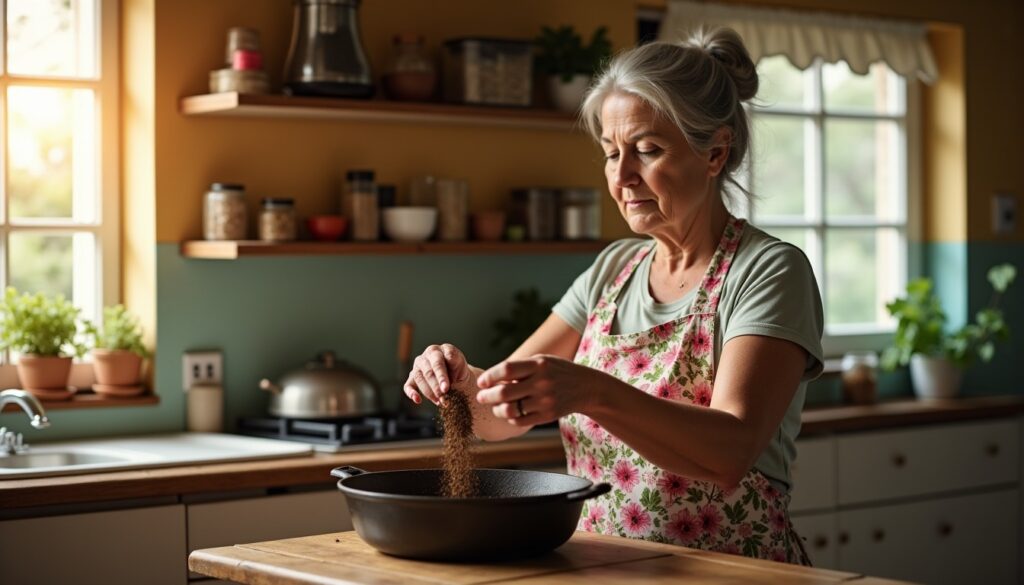
In our contemporary kitchens, under the endless flow of industrial cleaning products, a often overlooked treasure lies dormant: coffee grounds. This dark and fine residue, once considered a simple waste, is actually an element with unsuspected virtues, especially for the ecological maintenance of our pans and pots. A precious heritage from our grandmothers, this grandmother’s secret breathes new life into our cookware with a natural, economical, and environmentally friendly effectiveness. By rediscovering this natural tip, we reconnect with a reasoned consumption and a sustainable know-how that turns cleaning into a responsible and flavorful gesture of domestic ingenuity.
At a time when domestic economy aims to be more and more aware of ecological issues, reusing coffee grounds is proving to be an effective remedy against waste and pollution. It degreases, deodorizes, and polishes without resorting to chemical products, thus allowing our pans—whether made of cast iron, stainless steel, or non-stick—to regain their former shine. By adopting this solution, one embraces the philosophy of a clean, healthy, and economical home, where every resource is given a second useful life.
The little-known virtues of coffee grounds for ecological and effective cleaning
Coffee grounds are not simple residue to be carelessly thrown away. On the contrary, they have a beneficial composition that makes them a powerful natural cleaner for maintaining pans. Its granular, slightly abrasive texture acts as a gentle exfoliant on surfaces, capable of lifting stubborn dirt without scratching the metal or non-stick coating. This physical property is complemented by its slight acidity, which facilitates the dissolution of ingrained fats and oils.
Beyond its mechanical action, coffee grounds also act as an exceptional odor neutralizer. It captures molecules responsible for bad smells, notably persistent ones like fish or garlic, traditionally difficult to eliminate after cooking. This capacity is essential for thorough maintenance of utensils, ensuring cleanliness that goes beyond mere appearance.
Properties of coffee grounds for pan maintenance
- Gentle abrasive action: allows to dislodge burnt residues without damaging delicate surfaces.
- Degreasing effect: absorbs and dissolves greasy films more effectively than many chemical products.
- Odor neutralization: traps volatile components and prevents the persistence of unwanted odors.
- Preservation of seasoning: particularly beneficial maintenance for cast iron pans whose protective patina is respected.
This multitude of effects makes coffee grounds a natural product that is both simple to use and remarkably effective. This grandmother’s secret, passed down from generation to generation, is now worth rediscovering for its positive environmental impact combined with its technical efficiency. Integrating coffee grounds into maintenance routines becomes a step toward a healthier home and more ecological consumption.
How to use coffee grounds for optimal ecological pan maintenance
Mastering the use of coffee grounds is essential to fully enjoy its benefits. This natural tip is suitable for regular use as well as for deep cleaning. The application method varies depending on the type and degree of soiling of your utensils. Respecting these practices ensures the longevity and intact beauty of your pans, while avoiding unnecessary scratches or damage.
Routine pan maintenance with coffee grounds
After each use, as soon as the pan starts to be stained by grease or food residues, a simple cleaning using coffee grounds may suffice:
- Wait until the pan is warm to avoid thermal shocks.
- Remove excess grease with an absorbent paper.
- Slightly moisten a sponge or cloth, then sprinkle a tablespoon of damp coffee grounds on it.
- Gently rub the inside of the pan making circular motions, focusing on the dirtiest areas.
- Rinse thoroughly with hot water and immediately dry with a clean cloth to prevent rust, especially on cast iron pans.
Deep cleaning of a burnt pan
For pans with carbonized or ingrained residues, the method requires more thorough care:
- Generously sprinkle the bottom with dry coffee grounds.
- Add a bit of ecological dishwashing liquid.
- Pour very hot water, just enough to cover the bottom surface.
- Let act for at least one hour, or even overnight for the most stubborn cases.
- Then scrub with a soft sponge before rinsing thoroughly.
These gestures, although simple, allow combining the mechanical cleaning power of coffee grounds with the gentle chemical effectiveness of soap, thus removing even the most stubborn cooking stains without compromising the integrity of the coating.
| Type of pan | Compatibility with coffee grounds | Specific advice |
|---|---|---|
| Cast iron | Excellent | Ideal cleaning, respects seasoning, immediate drying recommended |
| Stainless steel | Excellent | Makes shine without scratching, use without excessive pressure |
| Non-stick (Teflon) | Good (with caution) | Rub very gently with a soft sponge to preserve the coating |
| Ceramic | Good (to test) | Test on a small area, rub without forcing |
| Copper | Excellent | Restores shine, removes oxidation stains |
Practical grandma tips to prolong the life of your pans
The wisdom passed down by our ancestors offers us a range of effective remedies to keep our pans in excellent condition for the long term. Coffee grounds form the heart of this, but it is part of a complete maintenance routine where every detail counts.
The seasoning secret: preserving the protective patina
Seasoning is absolutely essential for cast iron or sturdy steel pans. It consists of creating, by regular application of heated oil, a natural non-stick layer that protects the surface from damage and facilitates cooking.
Our grandmothers avoided harsh detergents that damage this protective layer. On the contrary, they favored gentle cleaners like coffee grounds, which remove dirt without attacking the patina. After cleaning, wiping with an oil-soaked cloth nourishes the surface and reinforces this essential film.
Additional tips for durable maintenance
- Avoid thermal shocks: never rinse a hot pan with cold water, risking deformation or cracking.
- Use appropriate utensils: prefer wood, silicone, or non-abrasive materials to preserve coatings.
- Dry immediately: careful drying prevents rust formation, especially for steel and cast iron.
- Store smartly: place a fine cloth, absorbent paper, or a felt pan protector between pans to avoid scratches from rubbing.
This domestic know-how, including the famous grandmother’s secret of coffee grounds, contributes as much to the longevity of the equipment as to the quality of your culinary preparations. It revitalizes worn pans and turns cleaning into a gratifying experience.
Domestic economy and ecological gesture: a winning duo with coffee grounds
Using coffee grounds to maintain pans is not only a practical choice, it is also an intelligent decision that fully fits into a responsible and sustainable dynamic. By reducing expenses related to industrial cleaners and decreasing ecological impact, the consumer wins on several fronts.
Concrete economic impact
Degreasing products and scouring creams often represent significant recurring expenses. Coffee grounds, for their part, are a natural product obtained at no additional cost since they come from regular coffee consumption. This constitutes a direct saving while limiting the use of expensive and sometimes polluting plastic bottles.
| Cleaning product | Estimated annual cost | Environmental impact |
|---|---|---|
| Degreasing products and scouring creams | €20 – €50 | Plastic packaging, chemical substances, carbon impact from transport |
| Coffee grounds | €0 | Biodegradable, valorization of organic waste, no packaging |
Contribution to waste and pollution reduction
By using coffee grounds for ecological cleaning, the quantity of household waste incinerated is significantly reduced. Moreover, it decreases the introduction into wastewater systems of chemicals from industrial detergents. These agents, sometimes poorly degradable, can harm aquatic fauna and degrade drinking water quality.
In a context where responsible consumption is paramount, this grandmother’s revealed secret perfectly illustrates the intelligent reuse of domestic resources. It is a simple gesture, accessible to all, that places the home on the path to a healthier and more sustainable future.