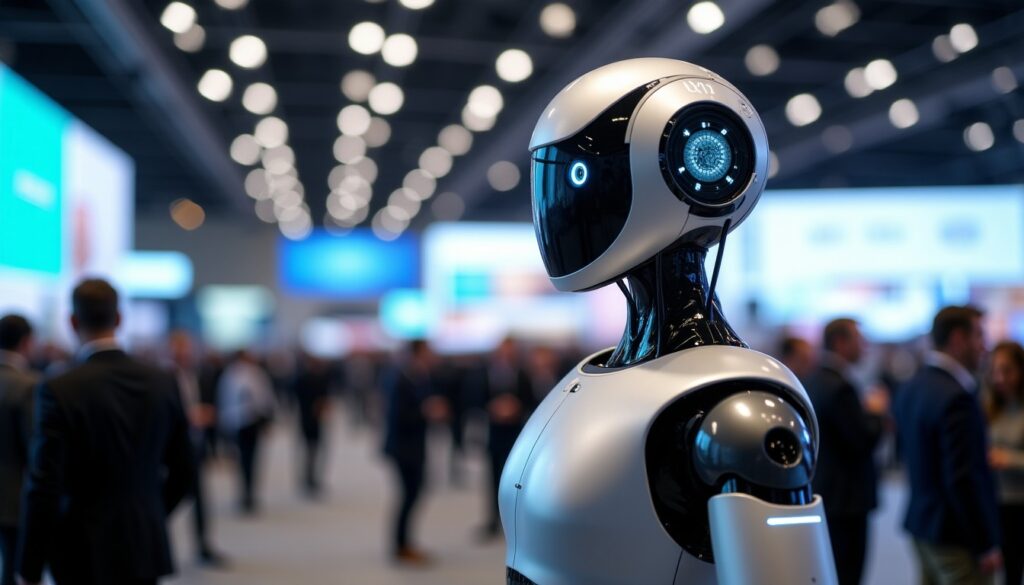
CES 2026 was marked by a spectacular breakthrough in the field of industrial robotics with the presentation of the HMND 01 Alpha, a revolutionary humanoid robot designed in just seven months. This feat of rapid design demonstrates how essential technological innovation related to artificial intelligence and advanced technologies has become to transform modern industrial environments. This robot, unveiled by the British start-up Humanoid, combines mobility, efficiency, and adaptability in an unprecedented format, paving the way for a new era where robotics is no longer limited to laboratories but concretely invests production lines.
The HMND 01 Alpha, standing 2.20 meters tall and equipped with a wheeled base, was presented under real conditions at the automotive group Schaeffler’s booth. Its ability to move on flat ground at a speed of 7.2 km/h while handling loads up to 15 kg with remarkable precision shows the scope of the technological innovation it embodies. This intelligent robot, equipped with an advanced artificial intelligence system, offers unprecedented prospects for productivity gains, safety, and flexibility in heavy industry and logistics.
Beyond its performance, the HMND 01 Alpha reflects an agile development model, where rapid design has optimized processes by relying on an expert team from major technology companies such as Apple, Tesla, and Boston Dynamics. With an investment of 50 million dollars, Humanoid intends to revolutionize industrial robotics and offer a modular technological platform adapted to the many contemporary challenges related to labor shortages and increased automation requirements.
- 1 Rapid design of the HMND 01 Alpha: an unprecedented industrial feat
- 2 Wheeled mobility of the HMND 01 Alpha: balance between performance and practicality
- 3 Load handling: advanced mechanical and electronic expertise
- 4 Artificial intelligence and advanced perception: the brain of the HMND 01 Alpha
- 5 Strategic collaboration between Humanoid and Schaeffler: a winning duo
- 6 Industrial and economic prospects of the HMND 01 Alpha for 2026 and beyond
- 7 A team of experts from technology leaders to drive Humanoid’s innovation
- 8 Integration and impact on the labor market: towards a new human-robot era
Rapid design of the HMND 01 Alpha: an unprecedented industrial feat
The development time of the HMND 01 Alpha is an immediately striking aspect. Moving from concept to an operational prototype in less than seven months defies the standards of industrial robotics, a field often associated with endless design cycles. This achievement highlights not only technological mastery but also a methodical and collaborative organization.
Traditionally, humanoid robots require several years of research, iterations, as well as close synchronization between hardware and software. For Humanoid, this challenge was met thanks to an agile methodology combining technical expertise, artificial intelligence, and hardware modularity. From the early stages, engineers accelerated the development of locomotion systems, manipulator arms, and the electronic brain based on AI capable of real-time decisions.
This performance is also linked to the choice of a wheeled base rather than bipedal. On perfectly flat industrial floors, this choice simplified mechanical challenges but also those related to balance and energy consumption, contributing to considerable time savings in the engineering of the HMND 01 Alpha. Indeed, a wheeled platform offers greater stability and lower risk of falls, also facilitating the integration of advanced technologies in perception and motor control.
To illustrate this achievement, Humanoid exploited technologies from tech giants, whether in motor control, computer vision, or software architecture. This synergy allowed reaching the goal in record time, notably thanks to close collaboration with industrial partners like Schaeffler.
- Adoption of a stabilized wheeled base adapted to flat environments.
- Design combining modularity and rapid prototyping.
- Integration of artificial intelligence from the early phases.
- Interdisciplinary collaboration with robotics and AI experts.
- Continuous optimization via real condition testing on industrial sites.
This approach demonstrates that industrial robotics can move beyond purely experimental frameworks to offer rapidly deployable solutions, responding to market urgencies and the accelerated needs of modern factories.
Wheeled mobility of the HMND 01 Alpha: balance between performance and practicality
The decision to equip the HMND 01 Alpha with a wheeled base rather than articulated legs drew particular attention at CES 2026. This technical option, often seen as less “humanoid” in its locomotion, ultimately proves to be a pragmatic innovation that perfectly matches current industrial realities.
In factory environments, floors are generally flat, uniform, and designed for intensive machine traffic. Choosing wheeled robotics simplifies motor control, improves robot stability, and reduces risks of interruptions due to accidents linked to falls or imbalances. Thus, the HMND 01 Alpha can move at up to 7.2 km/h, an optimal speed to maintain a sustained work pace without compromising safety.
The challenge of this mobility also lies in the combination with performant manipulator arms, capable of reaching both the floor and heights of two meters. The robot can thus handle tasks usually reserved for human operators, such as manipulating metal bearing rings in unsorted bins or those up to 60 centimeters deep, with a maximum load of 15 kg.
This wheeled mobility also facilitates integration into existing assembly lines without requiring heavy modifications to industrial infrastructures. According to Andreas Zeug, Schaeffler representative, it is enough to press a button to start a fully automated process, highlighting ease of use despite a very high technological level.
Advances in sensor technologies and embedded intelligence allow the HMND 01 Alpha to move autonomously while avoiding any obstacles, which is essential for operating in cluttered and complex areas. This mobile autonomy fits into a long-term vision where robots and humans coexist and collaborate safely.
Load handling: advanced mechanical and electronic expertise
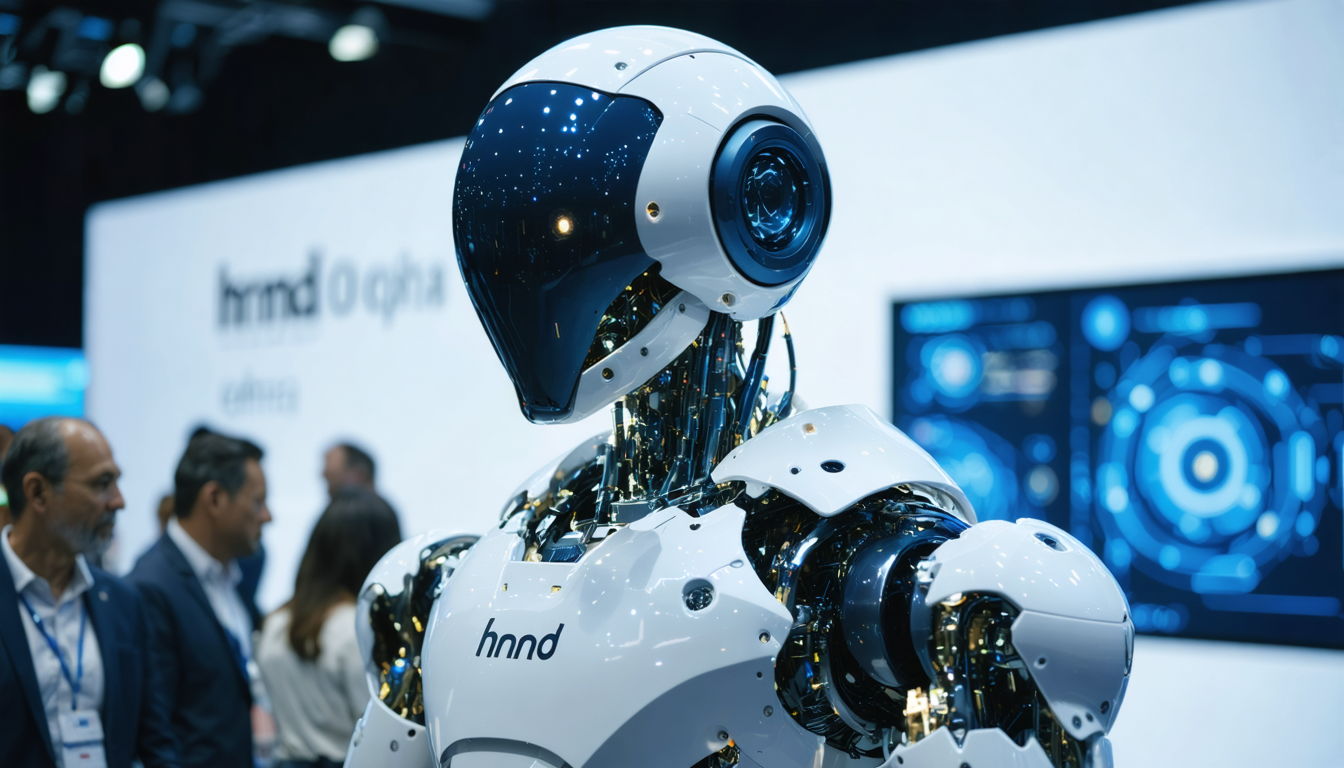
At the core of the HMND 01 Alpha’s capabilities lies its handling system which combines power and finesse. Capable of lifting parts up to 15 kg, this robot exhibits great adaptability in varied industrial scenarios, notably in agri-food, automotive, and logistics sectors.
Equipped with two double arms designed for high precision, the robot can reach complex spaces, from the floor up to two meters high, as well as access deep bins. The choice between a highly articulated five-fingered hand and a more robust gripper allows adjusting the configuration according to the nature of the task.
This flexibility makes the HMND 01 Alpha a versatile platform, capable of performing functions such as:
- Picking parts from unsorted bins, requiring fine visual recognition.
- Precise movement and placement on buffer tables connected to assembly lines.
- Handling different types of objects, whether fragile or heavy.
- Adaptation to changing environments thanks to many and varied sensors.
| Characteristic | Description | Industrial advantage |
|---|---|---|
| Maximum load | 15 kg manipulable simultaneously | Allows the handling of heavy components in production |
| Vertical reach | From 0 to 2 meters height | Flexible access to varied work zones |
| Type of grippers | Five-finger articulated hand or robust gripper | Adaptability to diverse tasks, from precision to robustness |
| Access to bin | Up to 60 cm depth | Optimization of sorting and picking in standard containers |
Thanks to its robust hardware and precise programming, the robot significantly reduces error risks and increases operational fluidity, a key factor in modernized industrial productivity.
Artificial intelligence and advanced perception: the brain of the HMND 01 Alpha
What mainly distinguishes the HMND 01 Alpha from other industrial robots is its embedded artificial intelligence system, designed for full autonomous management. With 29 active degrees of freedom in its joints and a head equipped with multiple sensors, this robot perceives its environment in real time and continuously adapts its movements.
360-degree cameras combined with depth sensors provide a comprehensive panorama enabling obstacle avoidance and uninterrupted work in often crowded spaces. This also ensures the robot can operate safely alongside humans, an essential criterion in modern factories where cobotics is booming.
The AI of the HMND 01 Alpha is not limited to simple navigation or manipulation. It analyzes objects, recognizes shapes, sizes, and contexts to decide the best way to execute a task without external intervention. This autonomy is supported by a modular, flexible software platform allowing regular updates and adaptation to different industrial sectors.
Humanoid relies on this integrated intelligence to offer an industrial solution capable of absorbing and analyzing large volumes of data in real time, thereby increasing precision and safety while reducing the need for constant supervision. Moreover, this opens the way to future integration of machine learning functions to continuously improve the robot’s performance.
Strategic collaboration between Humanoid and Schaeffler: a winning duo
The partnership between Humanoid, a start-up specialized in robotics and artificial intelligence, and Schaeffler, a major automotive production player, forms a solid foundation for the success of the HMND 01 Alpha. This strategic collaboration not only validates the robot’s performances but also quickly adapts its functionalities to real industrial requirements.
During CES 2026, Schaeffler demonstrated how the HMND 01 Alpha can be integrated into a production line, performing crucial actions usually attributed to human operators. This field feedback is vital to adjust the ergonomics and robustness of the solution.
Furthermore, Schaeffler plays a dual role, both user and supplier, as it also provides strategic components such as ball bearings handled by the robot. This virtuous synergy optimizes the supply chain and maintenance of robotic systems, guaranteeing performance and durability.
With tests depending on concrete industrial variables, such as sorting metal rings, Schaeffler provides valuable judgment for Humanoid’s future roadmap, notably for a more compact beta version or intensive serial production.
- Functional validation in real conditions thanks to Schaeffler.
- Co-development of robotic solutions adapted to client needs.
- Continuous optimization ensured by rigorous field feedback.
- Sharing of technologies and expertise between start-up and industrial player.
- Coordinated preparation for mass industrialization.
Industrial and economic prospects of the HMND 01 Alpha for 2026 and beyond
The repercussions of the HMND 01 Alpha in the industrial landscape are multiple, especially at a time when the shortage of skilled labor strongly hinders production lines growth. This intelligent humanoid robot constitutes an innovative response, able to reduce bottlenecks while increasing safety and process quality.
Thanks to its rapid development, Humanoid is ideally positioned to meet rising demands for automation and robotization. With a significant investment of 50 million dollars and an experienced multidisciplinary team, the start-up shows great ambitions, where other historic players may struggle to renew their platforms.
The robot is designed for gradual scaling, with industrialization phases and sectorial adaptations planned in the near future. By improving operational flexibility, the HMND 01 Alpha can also reduce costs related to downtime, workplace accidents, and increase overall factory productivity.
Beyond the automotive sector, industrial robotics now finds in mobile humanoids a transversal solution to logistical, pharmaceutical, or agri-food challenges, proving that this technological innovation opens up hitherto unexplored application fields.
A team of experts from technology leaders to drive Humanoid’s innovation
The success of the rapid design of the HMND 01 Alpha owes much to the concentrated expertise that Humanoid managed to gather. With nearly 200 specialists from prestigious companies such as Apple, Tesla, or Boston Dynamics, the start-up benefits from a rare and extremely qualified human capital in the development of intelligent robots.
These teams combine software engineering, artificial intelligence, mechanics, and industrial design, working synergistically to refine every component of the HMND 01 Alpha. The experience gained in tech giants allows integrating best practices in motor control, 3D perception, and autonomous decision-making.
This talent jungle also ensures agile evolution of robotic platforms, enabling Humanoid to quickly integrate innovations and guarantee high competitiveness in the market. This dynamic relies on an industrial investment of 50 million dollars, highlighting investors’ confidence in the revolutionary potential of this technology.
Integration and impact on the labor market: towards a new human-robot era
The HMND 01 Alpha is announced as a catalyst for change in industrial sectors, prompting as much enthusiasm as reflection on the future of work. Its appearance is not intended to completely replace human jobs but to complement operators’ capabilities by automating strenuous, repetitive, or risky tasks.
Humanoid emphasizes that this robot will gradually take its place in production lines, leading to an organizational change where humans will focus more on supervision, maintenance, and high value-added functions. The deployment of intelligent robotics also contributes to improving working conditions and addressing demographic challenges related to an aging workforce.
In this context, several scenarios are possible for companies, which will need to support their employees in the digital and robotic transition, with targeted training programs on human-machine collaboration. The HMND 01 Alpha is therefore not a simple robot but the pivot of a hybrid industry, combining the power of AI with human flexibility and creativity.