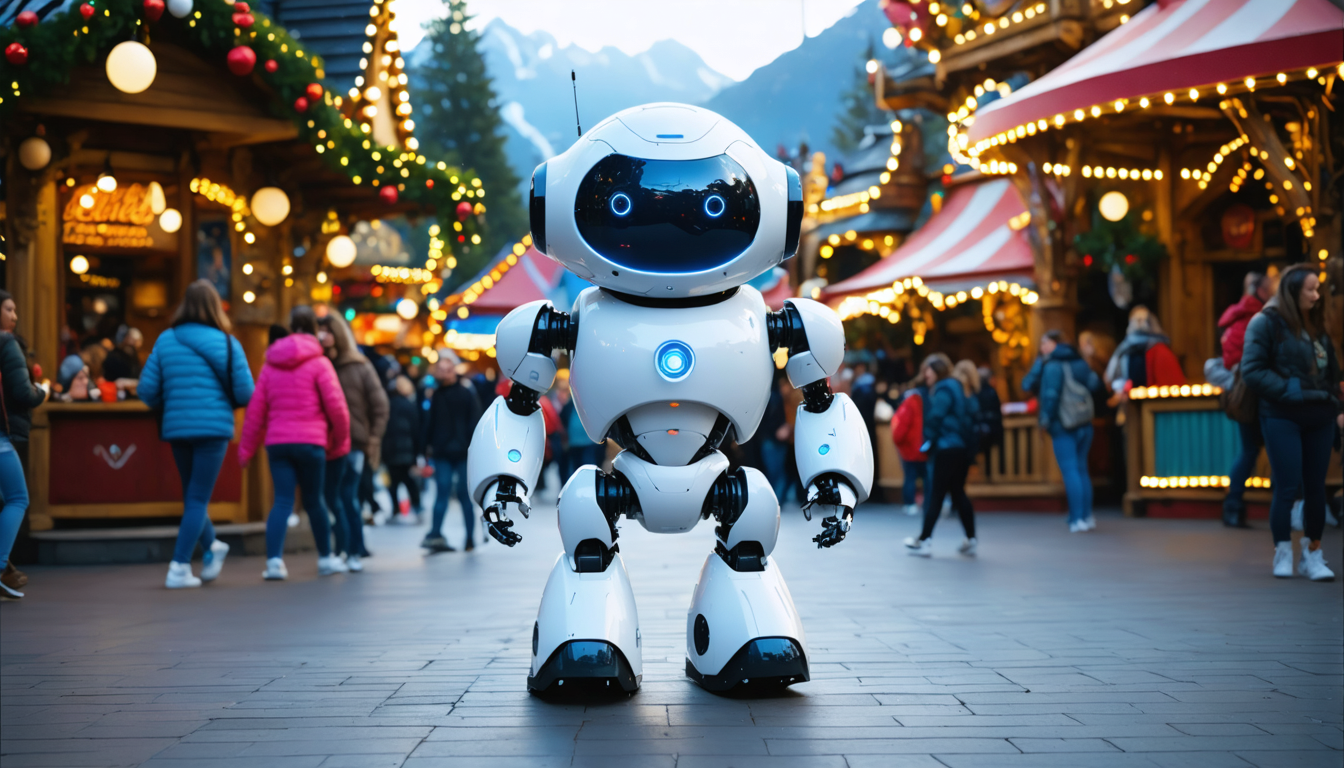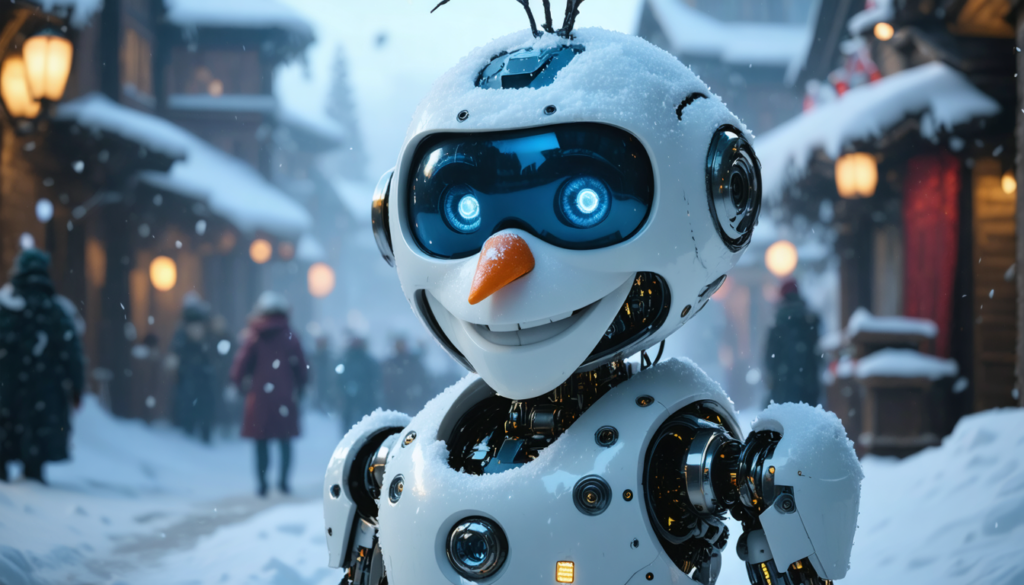
Disney magic took a new step forward in 2025 with the creation of Olaf, the famous snowman from “Frozen,” now embodied by a high-tech animated robot. This ambitious project not only pays tribute to the adorable character who has won millions of fans worldwide. It also disrupts the way technology, transformation, and emotion intertwine, immersing visitors in a universe where science fiction blends with reality. While fascination for this snowy cyborg comes with a certain admiration for the craftsmanship employed, some shivers of strangeness also run through minds, symbolizing the uncanny effect born from this transformation between fiction and tangible.
This new robotic incarnation of Olaf is part of Disney’s strategy to transform the fantastic into tangible experiences while exploring the increasingly fine boundaries between traditional animation, science fiction, and artificial intelligence. Through this unprecedented marriage of narrative charm and technical prowess, visitors in the parks can now interact with an animated Olaf who walks, talks, smiles, and above all, evokes a poignant mix of wonder and unease.
- 1 The secrets behind Olaf’s transformation into a robot: a fascinating technological feat
- 2 Olaf, this science-fiction cyborg: between wonder and apprehension
- 3 Robotized Olaf: total immersion in Disneyland Paris’s World of Frozen
- 4 The impact of Olaf’s robotization on visitor experience and pop culture
- 5 Technical and ethical challenges surrounding the Olaf robot: between innovation and apprehension
- 6 Future perspectives for Olaf and robotic animation in theme parks
The secrets behind Olaf’s transformation into a robot: a fascinating technological feat
The transformation of Olaf into a robot is much more than a simple mechanical assembly operation. To transpose this iconic snowman into a tangible entity, Disney engineers combined various technologies, from social robotics to advanced artificial intelligence. The main challenge was to reproduce Olaf’s instantly recognizable silhouette, with his oversized head awkwardly resting on a thin neck, while his original legs are hidden, giving the impression that his feet float above the ground.
This choice was not only aesthetic but also responded to major technical constraints. Indeed, the team designed a system where most of the mechanical organs and actuators are hidden inside his spherical body, which resembles a snowball. This innovative approach guarantees the visual impression of an Olaf faithful to animation, while ensuring stability and fluidity of movements. Thanks to reinforcement learning, the robot was able to train virtually to walk with natural gaits, integrating multiple parameters such as silent footsteps, thermal management, and sensory response to the environment.
The result? A robot Olaf who can move with almost imperceptible steps, his movements generating an impact noise reduced from 82 to 64 decibels, a feat that strengthens the illusion of an almost living being. It is this technological metamorphosis that fascinates, turning a typically animated character into a robotic, embodied, and tangible presence, inspiring as much admiration as subtle tensions in the face of this realistic cyborg.
Olaf, this science-fiction cyborg: between wonder and apprehension
Technology is at the heart of Olaf’s rebirth, but what visitors truly feel in front of this metamorphosis goes beyond technical innovation. Exposure to this living robot triggers an astonishing cocktail of emotions: fascination with technology, nostalgic pleasure in finding a beloved character, but also a shiver of worry, almost an uncomfortable unease. This psychological phenomenon, called the “uncanny effect,” arises from this confrontation between a fictional figure and its almost perfect yet nonetheless artificial reproduction.
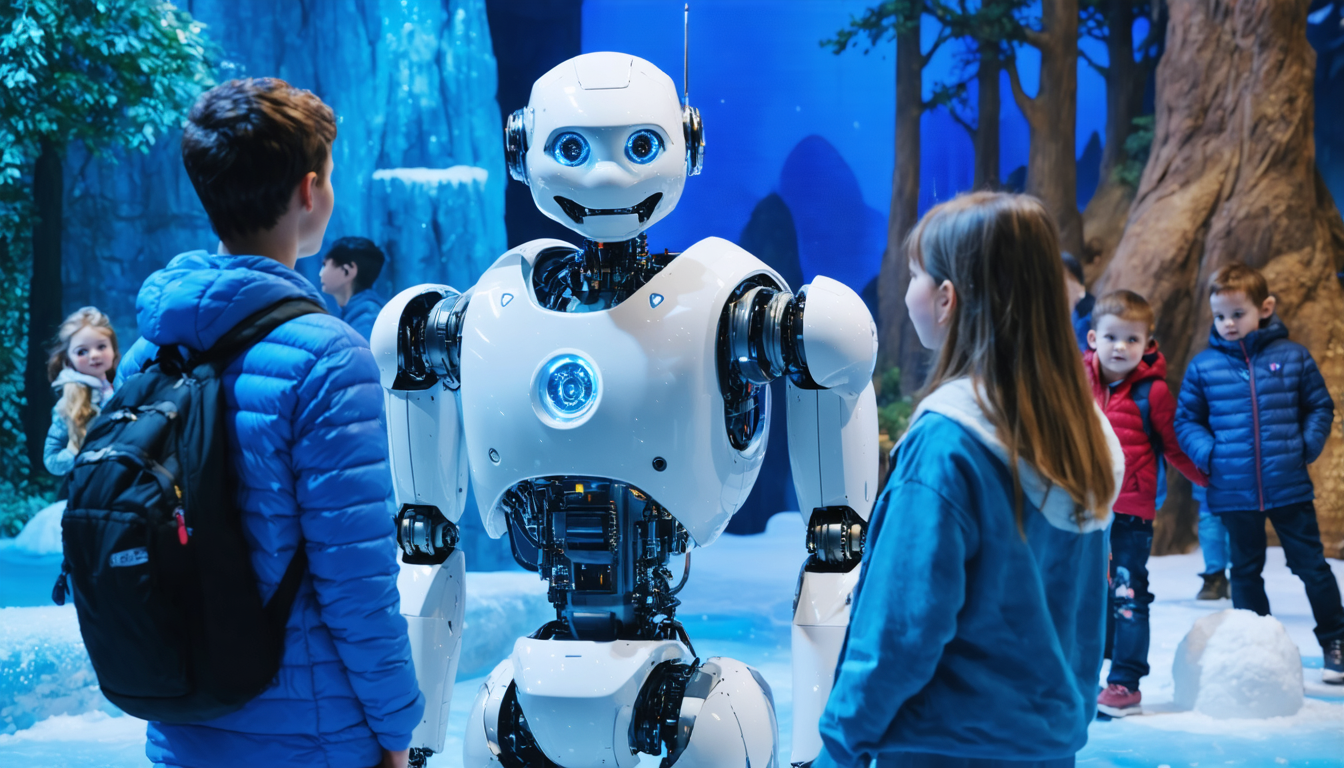
The presentation of the Olaf robot in Disney spaces – notably in the immersive “World of Frozen” area – plunges visitors into a universe where the boundary between animated dream and tangible reality fades. One is amazed by his animated facial expression, awkward gestures, and contagious laugh, but it is hard not to feel that strange sensation that a science fiction creature has entered our everyday world.
This robot is not just an animated toy: it represents a turning point in social robotics. Engineers deliberately imbued Olaf with behaviors mimicking the natural curiosity and naivety that characterize him in the film, in order to create an immediate emotional connection. Yet, this resemblance also pushes toward strangeness, between charm and slight anxiety.
Visitors often speak of a mix of chills and wonder, stressing that this animated cyborg disrupts our usual perception of what is natural or artificial. Olaf thus becomes a mirror of our contemporary fascination with robots, where science fiction meets human emotion in a spectacle as captivating as it is unexpected.
Robotic innovations serving emotion
The Olaf robot is designed not only to reproduce physical actions but also to interpret emotions through facial micro-expressions, a rare technological feat in 2025. Every smile, every surprised or saddened look is driven by a sophisticated artificial intelligence system capable of adapting the robot’s responses based on interactions with its audience. Voice recognition technology combined with controlled facial animations allows Olaf to react in real time, offering enhanced sensory immersion.
Robotized Olaf: total immersion in Disneyland Paris’s World of Frozen
Olaf’s spectacular metamorphosis is not limited to an isolated feat. This new-generation robot is part of a global Disneyland Paris project called “World of Frozen,” aimed at offering unprecedented immersion in the universe of “Frozen.” In this new park area, visitors can now encounter this emblematic character in cyborg form, interacting realistically, walking alongside them with fluid and natural movements.
The integrated technology not only reproduces the gait but also Olaf’s personality. This radically transforms the customer experience, inviting an instant and authentic dialogue between a robot and a human. This technological revolution underlines Disney’s desire to blur the lines between the fictional world and the real world, a strategic choice to strengthen the park’s appeal and diversify the experiences offered in the face of global competition.
Beyond technical performances, Disney also worked extensively on the psychological aspect of this robotized Olaf to avoid the pitfall of a mere gadget. Priority was given to creating a genuine emotional connection, so that Olaf’s transformation into a robot is not perceived only as a mechanical feat but also as a warm and authentic encounter for visitors.
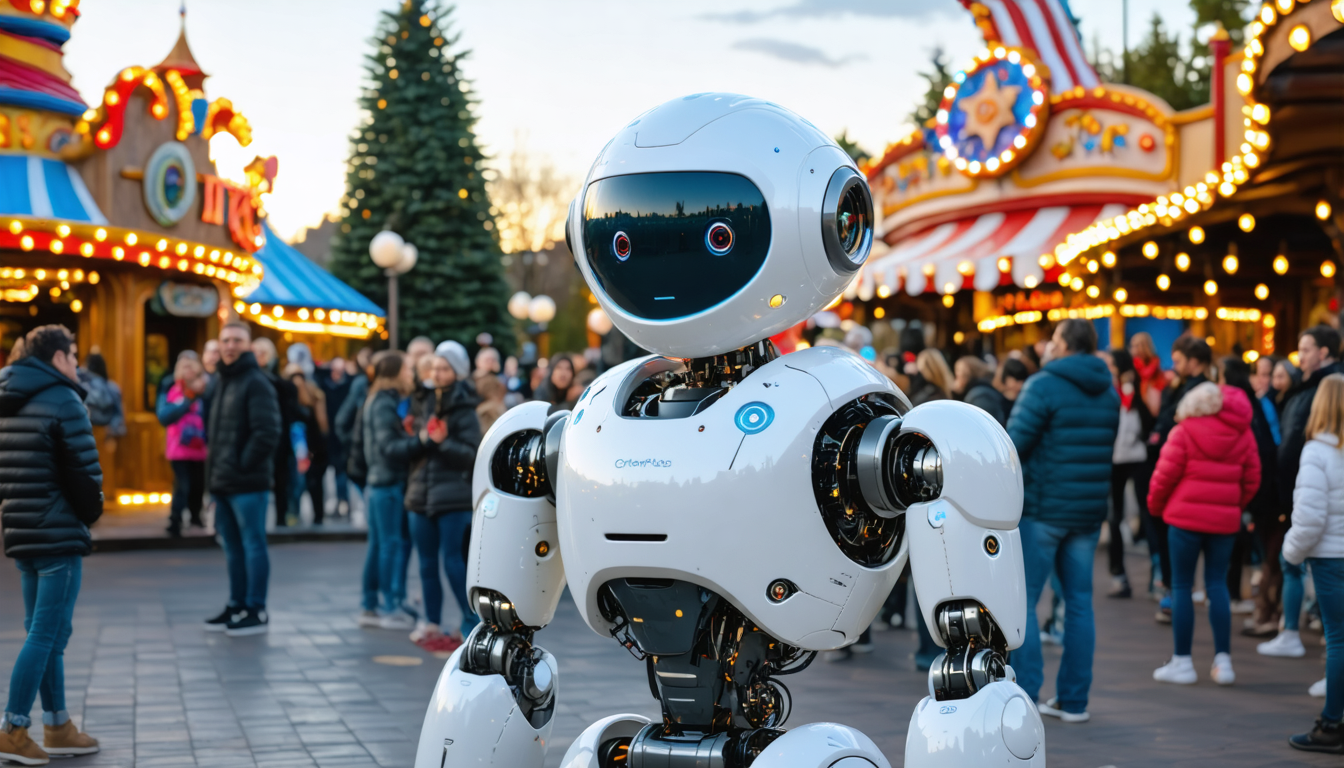
Comparison table of the robotic Olaf’s features versus a classic animated Olaf
| Criteria | Animated Olaf (film) | Robot Olaf (Disney park) |
|---|---|---|
| Movements | Fluid 2D/3D animation, unlimited | Real steps, mastered physical mechanisms |
| Interaction | Scripted in the film | Real-time reactions, integrated AI |
| Emotional expression | Rendered by digital animation | Physiological micro-expressions controlled by AI |
| Mobility | Without physical limits | Limited by mechanics, but fluid |
| Realism | Pure visual fiction | Tangible presence, physical interaction |
The impact of Olaf’s robotization on visitor experience and pop culture
Olaf’s robotization is not just a technical innovation; it profoundly changes the relationship between the public and Disney characters. Offering a robotic version of a beloved hero is a way to renew the emotional bond by bringing a multisensory dimension previously unknown. This metamorphosis redefines pop culture by introducing fictional creatures as almost living companions.
Visitors recount memorable experiences, reporting an unprecedented immersion where the boundary between dream and reality blurs. Some even lament a kind of slight apprehension, a shiver mixed with wonder that heightens the intensity of the encounter. This duality perfectly illustrates the new technological era where social robotics and emotional design unite to create unique experiences.
The fascination aroused by this robot is also an example of the capacity of modern technologies to bring science fiction to life. Olaf, beyond his playful role, becomes an archetype illustrating all the transformations to come in the leisure domain and human-machine interaction.
Elements enhancing the immersive experience with robotized Olaf
- Dynamic facial expressions, adapted in real time
- Fluid body movements and discreet generated noise
- Natural verbal interactivity thanks to voice recognition
- Ability to trigger emotions in the audience
- Seamless integration into the “World of Frozen” environment
- Contextual responses based on artificial intelligence
Technical and ethical challenges surrounding the Olaf robot: between innovation and apprehension
Despite the generated enthusiasm, Olaf’s robotization also raises profound questions, notably on technical and ethical levels. From a purely mechanical standpoint, maintaining a balance between realism, limited mobility, and authentic emotional expression remains an ongoing challenge. The complexity of hiding mechanisms in an unconventional body while ensuring safety and stability pushed the limits of classical robotic design.
Ethically, the existence of a robot embodying a childlike and endearing character questions the relationship between humans and emotional machines. Visitors can develop almost human attachments to the robotized Olaf, which raises concerns about the manipulation of emotions via artificial entities. This phenomenon, although regulated for playful experiences, opens the door to reflections on the place of cyborgs in our future society.
Moreover, the striking realism of the robot intensifies the debate about the boundary between natural and artificial. As technology continuously pushes its limits, it is appropriate to question the place of robots in public spaces and the public’s ability to distinguish authentic animation from mechanical simulation.
Future perspectives for Olaf and robotic animation in theme parks
In 2025, while robotized Olaf is already an impressive success, it is only a first step toward a future where fictional characters will take increasingly autonomous and immersive forms. Developments in artificial intelligence and social robotics hint at even richer experiences, where dialogue, memory of interactions, and behavior personalization will be the norm.
Theme parks are already considering integrating robots capable of adaptive evolutions over the long term, able to remember visitors and interact with them uniquely. This evolution would profoundly transform how stories are experienced, creating truly interactive digital companions. Olaf could thus become the first robotic ambassador of a broader series of animated characters.
Furthermore, advances in miniaturization and integration could also allow these cyborgs to deploy in smaller spaces, offering spontaneous interactions and multiplying sensations of presence. The alliance between emotion, technology, and storytelling will then take on the full dimension of a futuristic and sensory experience.
List of key advances to watch in animation robotics
- Improvement of facial micro-expressions thanks to generative AI
- Increased autonomy for freer movement paths
- Development of complex and emotional contextual dialogues
- Enhanced integration of environmental and biological sensors
- Tactile interaction to strengthen physical connection
- Algorithmic adaptation to emotions felt by the audience