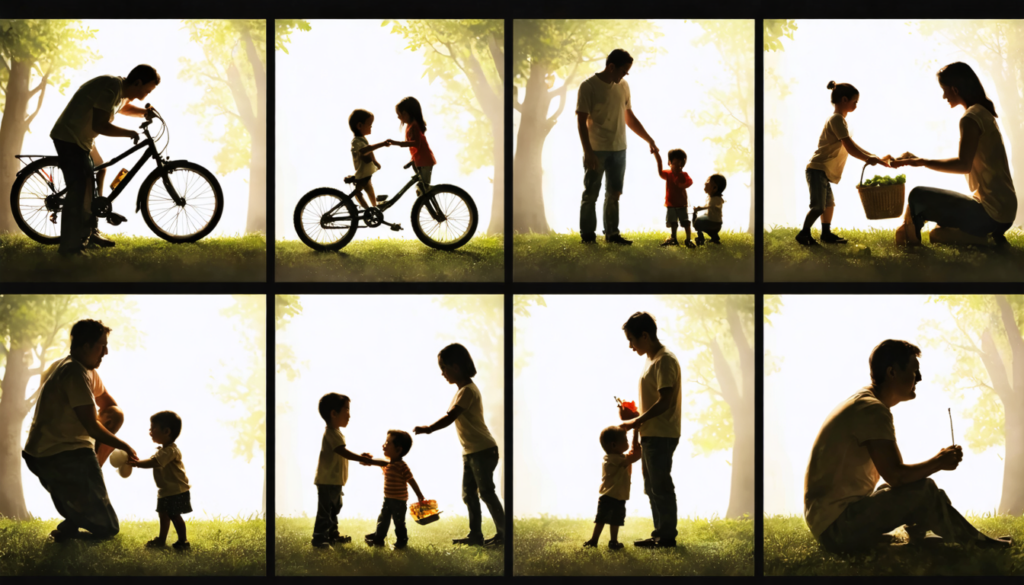
In a world in constant flux, where challenges intensify at the breakneck pace of technological and societal evolutions, the legacy that parents pass on to their children far exceeds the material realm. At the heart of this transmission lie life lessons, teachings bearing precious wisdom that shape character, nurture values, and guide choices throughout life. Understanding the true scope of these early childhood counsels is to recognize the importance of an education focused not only on knowledge but above all on experience, empathy, and resilience.
This intangible wealth, the fruit of long years of observation, shared experiences, and constant attention, shows that the true strength of a family is measured by the quality of this transmission. Recent studies also confirm that adults who have received such a heritage develop increased independence of mind, a keen sense of human relationships, and remarkable adaptability. These are the values your parents, through their example and advice, were able to instill in you, offering an exceptional inner guide to navigate existence.
- 1 The value of active listening and empathy: foundations of precious parental wisdom
- 2 Turning failure into a learning opportunity: an essential life lesson passed on by parents
- 3 Intellectual autonomy: a fundamental parental legacy to think for oneself
- 4 Emotional intelligence: learning to express emotions with sensitivity and respect
- 5 Choosing self-respect beyond the pursuit of popularity: a parental lesson full of wisdom
The value of active listening and empathy: foundations of precious parental wisdom
In our society saturated with information and sometimes superficial discourse, the ability to truly listen becomes a rare treasure. Parents who teach their children the art of active listening impart a lesson of inestimable value because it goes far beyond merely perceiving words. It is a deep commitment aimed at understanding others in their entirety, paying attention both to verbal content and non-verbal nuances, such as implicit emotions or hidden intentions.
Practically, learning to perceive facial expressions, tone of voice, and posture of an interlocutor allows a better grasp of their feelings and real needs. For example, a child encouraged to ask questions to clarify a message or to rephrase a sentence before responding develops a form of attention that authenticates communication and encourages respectful dialogue. This process also fosters patience, as listening to understand requires mastering the natural impatience to respond quickly.
But this attentive listening is above all the gateway to empathy, that key skill which consists in feeling and sharing another’s emotions. It belongs to the emotional and social sphere, allowing children to build themselves with an open view on the diversity of human experiences. For instance, a young person who develops empathy will be better able to skillfully manage conflicts by choosing peaceful solutions, collaborate harmoniously in a school or professional group, and provide sincere support to those in difficulty.
Far from being a weakness, empathy constitutes a pillar of relational intelligence, contributing to forging solid and lasting bonds with others. Wise parents therefore know the importance of teaching their children not only to express themselves but also to open up to others, thus shaping an education where respect, understanding, and kindness prevail. This mastery paves the way for better self-knowledge, both in successes and trials, because understanding others is also learning to understand oneself.
Turning failure into a learning opportunity: an essential life lesson passed on by parents
The natural instinct of many parents is to protect their children from failure, often considering it as a source of pain or devaluation. However, intelligent parenting rather involves reversing this perception by viewing failure as an essential step toward success and an exceptional lever of experience. Teaching a child to see their mistakes as learning opportunities equips them to face the complex challenges they will encounter in adult life.
Reflecting on mistakes with curiosity, rather than judgment, encourages the child to develop what psychologists call a growth mindset. Instead of self-criticizing with negative thoughts like “I am incapable,” they learn to ask themselves “what can I take away from this situation?” which stimulates their adaptability and progress. For example, a defeat in a school exam no longer symbolizes an end but a starting point to identify weaknesses and strengthen skills.
This process also strengthens resilience, that precious ability to get back up after a fall. Children who have experienced and overcome difficulties learn that failure is not a signal to give up but a natural step in the pursuit of their goals. They thus cultivate perseverance, a valuable quality in the face of life’s uncertainties, which will allow them to reach great heights even in adverse contexts.
| Approach to failure | Impact on development |
|---|---|
| Fear and avoidance of failure | Stagnation, performance anxiety, low risk-taking |
| Acceptance of failure as learning | Innovation, creativity, accelerated learning |
| Ability to recover (resilience) | Achievement of ambitious goals, better mental health |
In sum, transmitting this positive and constructive vision of failure is a truly precious lesson from parents, as it prepares the child for independence of thought and action, a sine qua non condition for lasting fulfillment.
Intellectual autonomy: a fundamental parental legacy to think for oneself
In a universe where sources of information abound and social networks encourage the reproduction of unfiltered opinions, learning to exercise one’s own judgment has become a vital imperative. Wise parents understand that they must not transmit merely ready-made ideas but rather equip their children with the skills necessary to build their own reasoning autonomously.
This ability to think for oneself involves developing critical thinking, questioning one’s assumptions, and not accepting things at face value. Thus, asking questions like “Why do you think that?” or “What are the other possibilities?” helps the child become an actor of their thought rather than a mere receiver. Learning debate, curiosity, and reasoned doubt is an integral part of this process. For example, faced with a current event, a child trained in critical thinking will seek to verify the reliability of sources, compare contradictory points of view, and understand the underlying arguments.
In the digital age, these skills are even more crucial since information is abundant but uneven in quality. Parents thus show their children the importance of consulting multiple sources, identifying cognitive biases, and refraining from hasty judgments. This know-how prepares them to become informed citizens, capable of making enlightened and responsible decisions.
In addition to this intellectual autonomy, emotional maturity is indispensable for critical thinking to be fully effective. It is not about rejecting any differing idea but cultivating open-mindedness and respect for diverse opinions without succumbing to intolerance.
Emotional intelligence: learning to express emotions with sensitivity and respect
Many families still consider talking about emotions a taboo subject, relegated behind academic or professional success. However, mastering one’s emotions and the ability to express them constructively are key elements of a balanced education and a harmonious life. Enlightened parents initiate their children into this learning from a very young age, laying the foundations of true emotional wisdom.
This approach begins with recognizing and naming emotions – sometimes called emotional literacy. By learning to identify feelings such as anger, sadness, joy, or fear, the child gains critical distance essential to better understand and manage their reactions. For example, instead of expressing frustration through a scream or aggression, they will be invited to verbalize “I am angry because…,” which facilitates dialogue with loved ones and avoids misunderstandings.
Another fundamental aspect is validating emotions, even when the resulting behaviors are not acceptable. Saying to a child, “I understand you are sad, but that’s not a reason to break your toys,” allows them not to feel rejected in their feelings while setting a clear framework. This essential distinction ensures a climate of trust where emotions are respected, and discipline is seen as guidance toward better self-control.
This emotional intelligence thus establishes better self-esteem because it gives the child the ability to manage their feelings without denying or letting them take over. In the long term, this will encourage more authentic and solid relationships as well as lasting personal balance in the face of stress and daily difficulties.
Choosing self-respect beyond the pursuit of popularity: a parental lesson full of wisdom
The desire for belonging and social pressure are unavoidable realities in every child’s life, especially during adolescence. However, some parental teachings aim to guide children toward something far more precious than mere popularity: self-respect. This lesson, often difficult to integrate in a context where conformity sometimes seems the easiest path, teaches the value of authenticity that protects against costly compromises.
Parents concerned with their children’s deep development cultivate their self-esteem not only through achievements but also through recognition of their uniqueness and passions. Thus, a child encouraged to express what makes them unique, rather than blindly following group trends, develops a strong inner compass. This grounding is crucial to resist the temptations of denying their values in the short term in favor of illusory social acceptance.
This inner strength has concrete impacts on quality of life: choices marked by integrity, healthier relationships, and lasting well-being. In contrast, the exclusive pursuit of popularity is often accompanied by anxiety, identity loss, and superficial relationships.
| Decision based on… | Long-term consequences |
|---|---|
| The pursuit of popularity | Anxiety, loss of identity, superficial relationships, vulnerability |
| Self-respect | Integrity, confidence, healthy relationships, lasting well-being |
This precious parental teaching, well-rooted, allows the child to face social turbulence with a clear perspective and a solid stance, founded on the experience and guidance of a family committed to transmitting lasting values.