
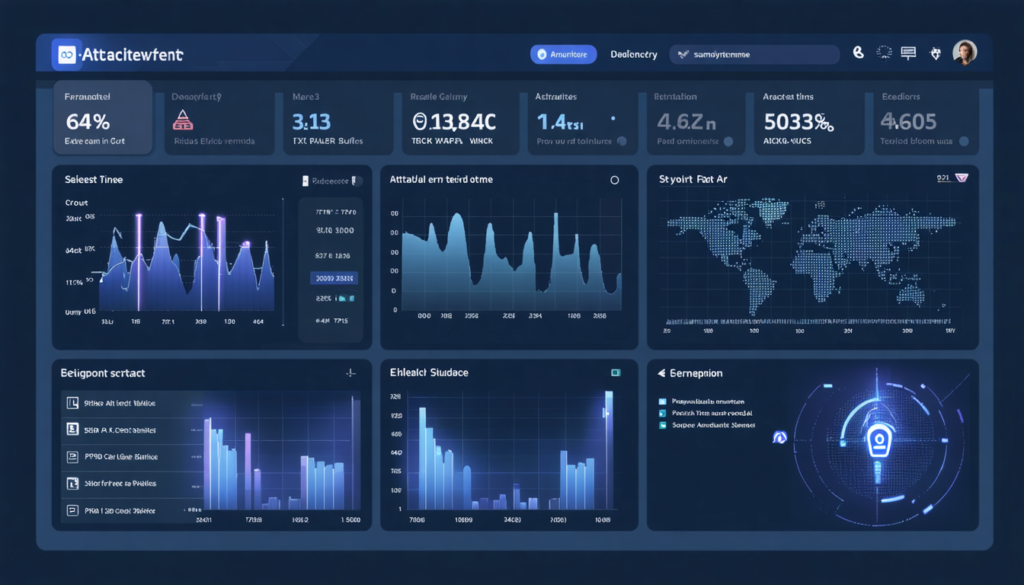
As cybersecurity becomes a central issue for all organizations, the increasing complexity and sophistication of threats force industry players to innovate relentlessly. In this context, Palo Alto Networks stands out in 2025 with Cortex XSIAM, a groundbreaking security platform now valued at over 100 billion dollars on the NASDAQ. This innovative solution promises to radically transform the way companies deploy their IT protection by intelligently combining the power of artificial intelligence, advanced automation, and centralized risk management. The challenge is all the more urgent as the average time to detect an intrusion now exceeds 277 days, an alarming statistic that highlights the limitations of traditional architectures against modern cyberattacks.
The increasing volume of data collected by contemporary digital infrastructures makes the security teams’ task increasingly difficult. Alerts multiply at a frantic pace, overwhelming analysts and generating unproductive informational noise. Palo Alto Cortex XSIAM positions itself as a strategic response by offering a new generation of autonomous and proactive SOC (security operations center). By integrating self-learning artificial intelligence technologies, the platform continuously analyzes all raw telemetry, without premature filtering, thus ensuring rapid and precise detection of even the most subtle malicious behaviors. Automation, the core of this innovation, frees experts from repetitive tasks so they can focus on high-value interventions, while ensuring uninterrupted monitoring of critical systems at all times.
- 1 Palo Alto Cortex XSIAM: a major technological breakthrough in cybersecurity monitoring
- 2 Towards autonomous and proactive security thanks to advanced automation
- 3 The Cortex ecosystem: an integrated whole for coherent and complete protection
- 4 An innovative business model and its impact on the financial market
Palo Alto Cortex XSIAM: a major technological breakthrough in cybersecurity monitoring
For nearly twenty years, companies have relied on traditional Security Information and Event Management (SIEM) systems largely based on static rules and segmented analyses. These tools, although useful, often remain ineffective against the growing volume of data and evolving tactics of cybercriminals. Cortex XSIAM marks a decisive turning point by reversing this logic. Rather than prematurely filtering information from the network, the platform ingests all the raw data collected by sensors deployed throughout the infrastructure.
This method preserves exhaustive context for each alert, crucial during investigation phases. Thanks to sophisticated artificial intelligence, the solution detects anomalies invisible to the human eye and previously escaped the vigilance of analysts fatigued by the multitude of often false-positive alerts. The system continually refines its learning based on the specifics of each client environment, making detection increasingly relevant and personalized.
Such a capability radically transforms the role of security centers, which become intelligent platforms capable of anticipating rather than merely reacting. This holistic approach fosters a significant reduction in the time to identify attacks and enables a faster and more resilient defense posture.

How Cortex XSIAM optimizes detection with artificial intelligence
The Cortex XSIAM analysis engine relies on a unified and intelligent data lake, capable of normalizing and merging gigantic volumes of logs, events, and telemetry in real time. This massively enriched base allows the system to establish a unique behavioral profile for each user, device, and process within the company. Any deviation from this profile immediately triggers an alert qualified by artificial intelligence.
Beyond simple detection, the platform automatically consolidates multiple weak signals associated with a given incident, grouping them into a single case clearly presented on a timeline. This way, analysts benefit from a synthetic view, simplifying and accelerating investigation. Furthermore, a conversational assistant based on generative AI now allows querying the database in natural language, making data access much more intuitive and rapid.
Towards autonomous and proactive security thanks to advanced automation
In a context where security teams are overwhelmed by the noise of incessant alerts, Cortex XSIAM imposes itself as an indispensable response by massively automating sorting and response processes. This innovative paradigm frees analysts from tedious repetitive tasks, allowing them to focus on complex investigations that the machine cannot yet fully manage.
The platform integrates predefined remediation scenarios, reacting instantly when a threat is validated by the system. For example, it can isolate an infected endpoint within seconds to prevent lateral spread of the attack, or block connections to malicious command servers to protect sensitive data and limit exfiltration risks.
This advanced automation, combined with a coherent and unified interface, ensures centralized management of all defenses. The native cloud architecture provides almost unlimited scalable computing power, essential for processing the ever-growing real-time data flows. This centralization efficiently eliminates blind spots that persisted in fragmented and often complex corporate networks.

Concrete benefits for security teams and organizations
The advantages for SOC teams are multiple:
- Reduction in average incident detection time thanks to exhaustive and continuous network data analysis.
- Drastic reduction of false positives through the application of contextualized and dynamic learning to observed signals.
- Automation of immediate responses to quickly contain threats without human intervention.
- Consolidation and simplification of operations in a centralized interface promoting better decision making.
- Scalable adaptability of the platform to hybrid architectures and the specific needs of each company.
The Cortex ecosystem: an integrated whole for coherent and complete protection
Cortex XSIAM does not operate in isolation. It represents the backbone of a global security ecosystem designed by Palo Alto Networks, where each component contributes an essential piece to defense consolidation. Cortex XDR sensors deployed on various endpoints – computers, servers, cloud environments – continuously collect telemetry data without noticeable impact on the end user.
A complementary key element is Cortex Xpanse, an advanced external attack surface management solution. By automatically identifying assets visible on the internet, especially those forgotten or misconfigured, it ensures unprecedented visibility over publicly exposed potential risks. This information feeds back into the XSIAM platform for a finer and proactive risk level assessment.
This integrated approach guarantees a unified defense where discovery, monitoring, and incident response converge in a comprehensive dashboard, accessible in real time by technical teams as well as management. By strengthening coherence and intervention speed, the Cortex ecosystem sets a new benchmark for modern security operations.

| Cortex Component | Main Function | Added Value for Security |
|---|---|---|
| Cortex XSIAM | Unified data analysis and automation of SOC operations | Reduction in detection time and autonomous incident response |
| Cortex XDR | Telemetry collection on endpoints and servers | Continuous monitoring with no user impact |
| Cortex Xpanse | Discovery and management of the external attack surface | Identification of exposed assets and proactive risk assessment |
| Cortex XSOAR | Automation and orchestration of incident responses | Reduced intervention times and limited impacts |
An innovative business model and its impact on the financial market
Unlike traditional approaches charging licenses based on the number of users, Palo Alto favors flexible pricing based on actual data consumption and computing power used in the cloud. This cloud credit model offers scalability adapted to the fluctuating needs of customers, especially in hybrid or multi-cloud architectures. Thus, although the initial investment may seem substantial, the total cost of ownership savings prove very advantageous in the medium and long term.
By eliminating dependence on physical servers and consolidating multiple tools into a single platform, companies realize savings on their energy bills and reduce fees related to third-party contracts. Productivity gains are notable thanks to simplified management and improved incident response times. Palo Alto supports this momentum with specific financial incentives to accelerate the adoption of Cortex XSIAM by large organizations with complex architectures.
This strategy has attracted Wall Street, where Palo Alto Networks stock shows a record valuation exceeding 100 billion dollars, placing it at the forefront of the cybersecurity sector. The company enjoys support from major institutional investors such as The Vanguard Group and BlackRock, convinced by the relevance of platformization and AI automation in securing tomorrow’s enterprises.
The competition facing an integrated and innovative offering
The SecOps platform market today is highly competitive, with established players and new challengers. Splunk Enterprise, for example, remains recognized for its data ingestion capacity, although its complex deployment remains a barrier for some companies. Microsoft Sentinel, with tight integration of its Office 365 offerings, attracts IT departments seeking simplicity and efficiency in AI.
IBM QRadar continues to convince regulated sectors, notably banking, thanks to its compliance expertise. On their side, CrowdStrike Falcon LogScale relies on fast analysis without indexing, suited to agile structures. Yet none of these offerings provide native centralization and automation as advanced as Palo Alto Cortex XSIAM, a position reflected in growing commercial success in 2025 and accelerated adoption across various industry sectors.




