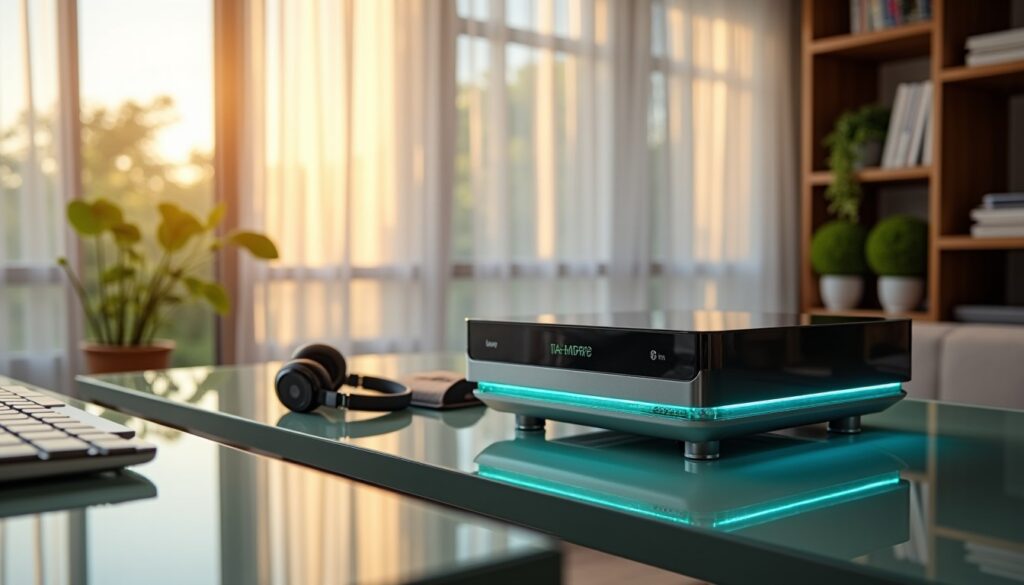
AMD marks a major breakthrough in the field of artificial intelligence with the introduction of a revolutionary mini PC. This compact device, equipped with the powerful Ryzen AI Max+ 395 chip, is designed to run massive AI models locally, thus eliminating the need to rely on the cloud or costly subscriptions. This paradigm shift opens new possibilities for businesses and computer enthusiasts seeking power, privacy, and freedom of use. By enabling intensive computing directly on a small standalone computer, AMD shines a spotlight on the future of embedded technology in the AI sector.
Traditionally, the most powerful artificial intelligence models require large and expensive infrastructures, often accessible via cloud services. This operation involves ongoing fees that are difficult to amortize for some users and also raises questions about data management and security. AMD therefore innovates by offering a solid alternative, which promises smooth use of massive AI without subscription, guaranteeing complete control over information on the local machine. This mini PC thus sets a new standard for local performance, with power sometimes rivaling the most expensive solutions on the market.
- 1 The Ryzen AI Max+ 395: the beating heart of AMD’s mini PC for artificial intelligence
- 2 Massive AI execution without cloud: a revolution for privacy and autonomy
- 3 Comparison with other AI solutions on the market in 2026
- 4 Technical challenges and limits of the Ryzen AI Halo mini PC for artificial intelligence
- 5 Market evolution prospects for autonomous computers for local AI
- 6 How AMD democratizes access to massive AI thanks to its subscription-free accessible mini PC
- 7 The impact of AMD’s mini PC on professional and AI enthusiast uses
The Ryzen AI Max+ 395: the beating heart of AMD’s mini PC for artificial intelligence
At the core of this new mini PC is the Ryzen AI Max+ 395 processor, also called Strix Halo. This integrated chip combines CPU and GPU with unified memory that can reach 128 GB, of which up to 96 GB can be allocated to graphics memory. This technical feature allowed AMD to push beyond traditional limits on loading and executing large AI models.
This innovative architecture enables powerful intensive computing, while maintaining a compact form factor (150 × 150 × 43 mm), a remarkable feat. In practice, this translates to the ability to process models with up to 235 billion parameters directly locally, a figure that rivals some hybrid data centers. For example, in a famous demonstration, Lisa Su, AMD’s CEO, ran a model of this scale live without using the cloud or renting remote GPUs.
AMD’s ambition is clearly stated: to provide an accessible solution for developers, researchers, and professionals who demand both the power needed for heavy computations and absolute control over their sensitive data. The Ryzen AI Max+ 395 thus represents a true catalyst for innovation in the 2026 computing landscape.
Massive AI execution without cloud: a revolution for privacy and autonomy
The massive use of cloud to run artificial intelligence models still presents notable limits today, especially in terms of privacy, costs, and dependence on a stable internet connection. By removing these constraints through a standalone mini PC capable of massively handling AI, AMD paves the way for enhanced data protection and strong technological independence.
Let us detail this advance. Most cloud solutions require constant transfer of user data to remote servers. This architecture can prove problematic in relation to regulations on sensitive data, especially for sectors like healthcare, finance, or defense. With AMD’s mini PC, all data remains stored and processed locally, thereby eliminating the risks of leaks or unauthorized access.
Moreover, considering the financial aspect, subscriptions to online AI services can quickly become a recurring expense that is difficult to manage long-term. By having a machine capable of running gigantic AI models without a subscription, users avoid these ongoing costs and can better control their budgets.
This autonomy also comes with a reduction in latencies induced by cloud exchanges, which improves real-time performance in applications requiring fast responsiveness. A valuable advantage in sectors like robotics, augmented reality, or embedded systems in industrial environments.
Examples of use cases where local AI makes a difference
- Data science consultants: an expert who replaced expensive GPU rentals with this mini PC saw profitability improve significantly.
- Healthcare companies: optimal confidentiality for processing sensitive data, while benefiting from powerful AI processing.
- Mobile app developers: accelerated prototyping thanks to local computations without network dependency.
- Technology enthusiasts: easy access to intelligent personal assistants without going through an online platform.
- Scientific research: possibility to use complex models even in remote environments where internet access is limited.
Comparison with other AI solutions on the market in 2026
With its Ryzen AI Halo Mini PC, AMD directly challenges established references like Nvidia’s DGX Spark or machines featuring Apple M3 Ultra processors dedicated to artificial intelligence. This technological confrontation is based on several essential criteria: raw power, software flexibility, compact form factor, and control of operating costs.
In particular, the Ryzen AI Max+ 395 features the unique ability to optimize graphics memory on an unprecedented scale, offering up to 96 GB VRAM, where many consumer cards plateau at significantly lower values. This configuration propels the machine into a rare category of computers capable of supporting extremely complex models, locally and at a reduced size.
| Criteria | AMD Ryzen AI Halo | Nvidia DGX Spark | Apple M3 Ultra AI |
|---|---|---|---|
| Integrated CPU-GPU Power | Ryzen AI Max+ 395, 128 GB unified memory | Multi-GPU Nvidia, very high power | M3 Ultra with unified architecture |
| VRAM Capacity | Up to 96 GB VRAM | Variable, high capacity | Less than Ryzen AI Halo |
| Local AI execution | Yes, without cloud or subscription | Yes, but often depends on cloud for certain tasks | Yes, but in a format less focused on massive AI |
| Form factor | Compact mini PC (150 × 150 × 43 mm) | Bulkier | Compact but less oriented toward heavy AI |
| Indicative price | $3,999 | About $4,700 | Variable |
This analysis shows that AMD’s mini PC stands as an attractive alternative, notably thanks to its reduced size, lower price, and ability to operate without cloud or subscriptions. These points make it a technological vehicle particularly suited to growing adoption in various fields of activity.
Technical challenges and limits of the Ryzen AI Halo mini PC for artificial intelligence
Despite its impressive performance, the Ryzen AI Halo mini PC cannot hide certain inherent constraints in executing massive AI locally. Performance notably depends on the software used and the context of use.
For example, in some benchmarks, the Ryzen AI Halo outperforms the GTX 5080 on specific AI inferences, but sometimes falls behind very high-end models like the RTX 5090. This gap highlights that AMD still needs to refine its ROCm software ecosystem, which seeks to compete with Nvidia’s widely dominant CUDA platform.
This stage of software development is crucial to ensure optimal compatibility with common AI frameworks and to guarantee stable performance in varied scenarios. While the experience of a consultant who managed to reduce GPU expenses is encouraging, it should be noted that this type of success can vary depending on business needs and the specifics of the AI models used.
Also, the thermal capacity and power consumption of the mini PC are parameters to keep under watch. Its compact design requires a rigorous balance between power and heat dissipation, a constant challenge in the high-performance standalone computer industry.
The challenges of software optimization for maximum local performance
The ROCm system, AMD’s platform dedicated to AI and intensive computing, is progressing regularly but still needs to catch up with CUDA, Nvidia’s historic reference. This guarantees that, despite solid hardware, the Ryzen AI Halo mini PC does not always deliver its full potential across all AI applications.
Efforts are thus underway to make the platform more universal, with expanded support for frameworks like TensorFlow, PyTorch, and ONNX. This software expansion is essential to convince as many users as possible to migrate to this solution.
Market evolution prospects for autonomous computers for local AI
The trend toward high-performance local AI solutions is gaining momentum in 2026. The issues of security, cost, and efficiency lead more and more organizations to prefer standalone computers capable of running complex models without cloud calls. This movement is driven by technological advances, combining raw power and miniaturization, visible in AMD’s Ryzen AI Halo.
While AMD’s example illustrates the rise of mini PCs adapted to massive AI, there remain areas to explore, particularly in connectivity, energy management, and integration into specific business environments. Each industry could benefit from customized configurations optimized for its local artificial intelligence needs, whether in automotive, industrial production, or audiovisual sectors.
The democratization of such standalone computers thus promises to disrupt the historic models of accessing computational power for AI, a challenge that both worries and excites industry professionals alike.
How AMD democratizes access to massive AI thanks to its subscription-free accessible mini PC
One of the strong ambitions behind the launch of the Ryzen AI Halo is to make the execution of advanced artificial intelligence accessible to the greatest number, without recurring financial constraints. AMD’s mini PC, sold at an affordable price for its category, offers unprecedented access to massive AI without subscription or cloud.
This not only revolutionizes companies’ economies but also opens new possibilities for independent developers, researchers, students, and enthusiasts. By helping to remove the barrier to intensive computing, AMD fuels creativity and innovation throughout the AI ecosystem.
Furthermore, the freedom to install tools of one’s choice, such as Ollama or other open source solutions, allows maximum flexibility in managing models and data. This software autonomy constitutes a significant advantage in a sector still often dominated by proprietary platforms and their constraints.
Good reasons to choose an AMD Ryzen AI Halo mini PC
- Unmatched local power for giant AI models
- Complete independence from cloud and subscriptions
- Full data retention on the device, a guarantee of security
- Compact form factor, easy to integrate anywhere
- Progressive compatibility with major AI frameworks
- Sustainable savings on costs related to intensive computing
The impact of AMD’s mini PC on professional and AI enthusiast uses
The availability of a mini PC capable of running massive artificial intelligences without the cloud is shaking up practices both in businesses and among individuals. At the professional level, this technology facilitates the management of complex projects, drastically reduces operating costs, and simplifies the maintenance of AI systems.
For researchers, the Ryzen AI Max+ 395 processor promotes a new agility in prototyping and testing large models, without barriers linked to network access or subscription policies. As a result, the mini PC becomes a valuable tool, offering both power and mobility.
For enthusiasts, the possibility of having a local, high-performance AI without subscription opens up unprecedented applications, such as creating personalized assistants, voice synthesis, or advanced multimedia modeling. This convergence of high technology and ease of use further helps to democratize artificial intelligence.
Sectors benefiting from AMD’s mini PC for local artificial intelligence
- Education: access to powerful AI resources for training
- Tech companies: development and deployment of secure AI applications
- Research laboratories: acceleration of simulations and modeling
- Creative industries: rapid processing of multimedia data via local AI
- Sensitive sectors: finance, defense, healthcare, with increased confidentiality constraints