The WWDC 2026 conference revealed an unexpected decision from Apple concerning its operating system for smartwatches, watchOS 27. Unlike what is observed on the iPhone side with iOS 27, offering wide compatibility, watchOS 27 proves to be particularly restrictive this year. Only five recent Apple Watch models will be able to benefit from this new update, which integrates advanced features related to artificial intelligence. This announcement already provokes a strong reaction among users, the majority of whom find themselves excluded from the update program, raising questions about the longevity and lifespan of smartwatches within the Apple ecosystem.
While innovations such as Siri AI promise to enrich the user experience, the limited compatibility creates a significant divide. Older watches, still widely used, will not be able to access the essential new features required to remain efficient and competitive against the competition. This situation highlights a strategic shift on Apple’s part, perhaps dictated by the technical needs imposed by the new features, but also questioning the brand’s commitment to its older customers. In this article, we will explore in detail the compatible models, the technical and strategic reasons for this restriction, as well as the repercussions for users.
- 1 Detailed list of Apple Watch models compatible with watchOS 27
- 2 Excluded models: which Apple Watches are left out and why?
- 3 The technical reasons behind watchOS 27’s limited compatibility
- 4 Key features of watchOS 27 and their impact on the user experience
- 5 Consequences of the restriction on users and the Apple Watch ecosystem
- 6 Artificial intelligence at the heart of watchOS 27’s strategy
- 7 Looking ahead: what prospects for older generation Apple Watches?
Detailed list of Apple Watch models compatible with watchOS 27
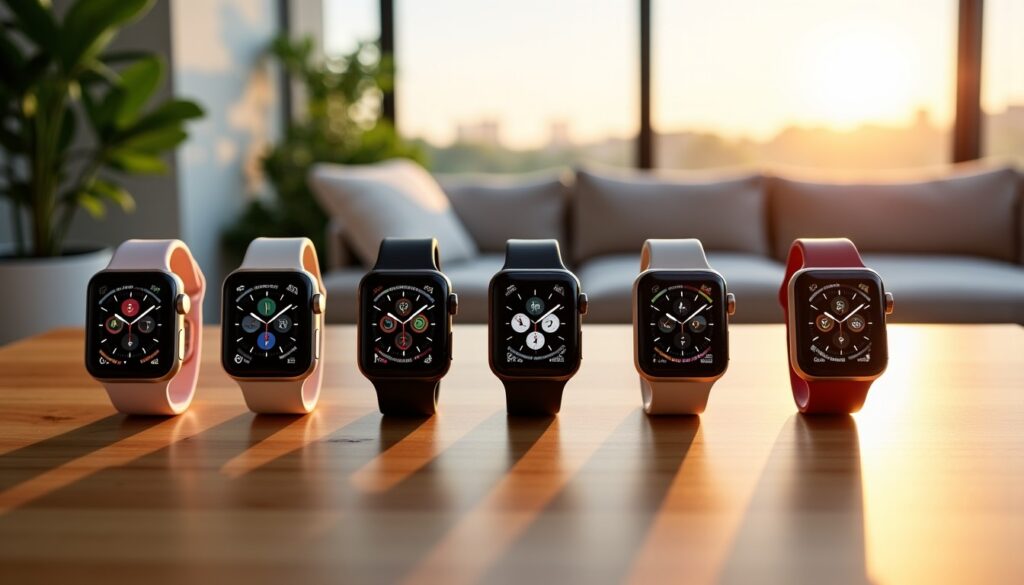
The compatibility of watchOS 27 is one of the most surprising announcements of WWDC 2026. Apple has lowered the technical requirements by focusing only on recently marketed models. Only five Apple Watch models can install this update:
- Apple Watch SE 3
- Apple Watch Series 10
- Apple Watch Series 11
- Apple Watch Ultra 2
- Apple Watch Ultra 3
These models therefore represent the new generation of Apple Watch launched between 2024 and 2025. To better understand this selection, it should be noted that watchOS 27 relies notably on enhanced performance linked to the integration of advanced artificial intelligence functions, especially through Siri AI.
By comparison, last year with watchOS 26, Apple had expanded compatibility to older models such as the Apple Watch Series 6. This time, the break is clear: the old models are no longer supported.
This choice has direct impacts not only on users’ ability to enjoy the latest features but also on the usage lifespan of their smartwatch. At a time when technology evolves rapidly, this restricted selection may have a decisive influence on the device replacement cycle and brand loyalty.
| Apple Watch Model | Release Year | watchOS 27 Compatibility |
|---|---|---|
| Apple Watch SE 3 | 2024 | Yes |
| Apple Watch Series 10 | 2024 | Yes |
| Apple Watch Series 11 | 2025 | Yes |
| Apple Watch Ultra 2 | 2024 | Yes |
| Apple Watch Ultra 3 | 2025 | Yes |
| Apple Watch Series 9 | 2023 | No |
| Apple Watch Series 8 | 2022 | No |
| Apple Watch Series 7 | 2021 | No |
| Apple Watch Series 6 | 2020 | No |
| Apple Watch Ultra 1 | 2022 | No |
Excluded models: which Apple Watches are left out and why?
Apple’s decision to limit watchOS 27 compatibility to five recent models leaves many users stranded. Here is the list of Apple Watches that will not be able to benefit from this update, despite still being frequently worn by many customers:
- Apple Watch Series 6
- Apple Watch Series 7
- Apple Watch Series 8
- Apple Watch Series 9
- Apple Watch SE 1 and 2
- First-generation Apple Watch Ultra
This exclusion risks being seen as an unprecedented tightening of Apple’s policy. The Series 9, launched in 2023, is deprived of watchOS 27 support, which represents a real shock for a watch still considered recent. This measure contrasts sharply with Apple’s policy in recent years, where devices often benefited from at least five to six years of major updates.
This break explains the growing dissatisfaction among part of the Apple community towards a strict limitation imposed without any possibility of extension. Significant consequences then appear, both in terms of resale value and customer satisfaction.
Indeed, several technical factors justify this decision. The processing power required to activate the new AI features, the integration of a new dynamic user interface, and optimized notification management require more powerful components. This level of requirement leaves little room for earlier models, often unable to support new algorithms or advanced Siri AI updates.
The technical reasons behind watchOS 27’s limited compatibility
The technological context plays a major role in Apple’s decision. In 2026, watchOS 27 introduces functions deeply rooted in artificial intelligence, with hardware requirements that exceed those of previous years. Notably, Siri AI promises a more intuitive and personalized use, based on local and cloud processing, offering enhanced contextual responses, better voice understanding, and more natural interactions.
To make this experience smooth, Apple has integrated into compatible models more powerful chips, optimized for machine learning. For example, the chips in Apple Watch Ultra 2 and 3 are capable of performing complex calculations locally without relying exclusively on an internet connection. In comparison, older processors face notable limitations and cannot guarantee the required responsiveness.
Moreover, the software architecture of watchOS 27 has been revised to manage a more dynamic interface. The latter includes a modifiable app grid in real time, adapted to new gesture interactions. These innovations require better memory management, graphic power, and multitasking processing, which further widens the gap with previous generations.
Finally, Apple must ensure the security and stability of its system. The new cryptographic protections as well as continuous firmware updates require additional resources. The old hardware has simply become insufficient to guarantee an experience up to the current standards of the brand.
This technical complexity imposes drastic but understandable choices on Apple’s part. It illustrates the tension between innovation and compatibility that now characterizes the smartwatch industry.
Key features of watchOS 27 and their impact on the user experience
Although compatibility is limited, watchOS 27 introduces many new features that could well redefine the use of the smartwatch. Among the most notable are:
- Improved Siri AI: A voice assistant capable of more natural, personalized interactions, better exploiting the usage context and offering more precise answers.
- Dynamic app grid: An interface that automatically adapts according to use, wrist position, and user preferences.
- New gestures: Manual recognition allows interaction with quick commands without touching the screen.
- Health tracking optimization: Sensors leveraged by new algorithms for more reliable monitoring of heart rate, sleep, and even stress.
- Enhanced notifications: More interactive, with better automatic management and prioritization according to the situation.
These innovations are not limited to an increase in technicality but have a direct impact on users’ daily lives. For example, the new gestures offer a discreet and quick way to interact with the watch during meetings or sports sessions, without interrupting the activity.
Some users already report that the new app grid simplifies access to their favorite tools, reducing navigation time and making the watch smarter and more proactive. Finally, the improvement in health tracking meets strong consumer demand for a device that is both fun and accurate for their well-being.
– This combination of features aims to strengthen the role of the smartwatch as an indispensable daily tool.
Consequences of the restriction on users and the Apple Watch ecosystem
The limitation of watchOS 27 to only five models has a direct impact on a large part of Apple Watch users. Several consequences deserve to be highlighted:
- Accelerated obsolescence: Many watches, still in good condition, see their software capability reduced, which naturally leads to faster replacement.
- Frustration and feeling of injustice: Some customers, notably those owning recent models like the Series 9, feel they invested in a product that does not benefit from the full promised lifespan.
- Impact on resale value: A watch incompatible with the latest operating system version quickly loses attractiveness on the second-hand market.
- Economic consequences: For Apple, this strategy could encourage consumers to renew their devices more frequently, boosting sales but also potentially tarnishing the image of durability.
This situation raises a broader debate about the software support policy for connected objects and the responsibility of manufacturers in managing product lifespans. In a world where ecological awareness is intensifying, imposing such rapid software obsolescence contradicts expectations of sustainability.
To illustrate, several forums and online communities have seen passionate discussions emerge, where users confronted with this exclusion express their dissatisfaction, sometimes even considering switching to other brands offering better software support.
Artificial intelligence at the heart of watchOS 27’s strategy
One of the pillars of watchOS 27 lies in its new advanced integration of artificial intelligence. Siri AI represents one of the major axes of software refresh, bringing a smoother and smarter interaction between the user and their watch.
This embedded intelligence allows the watch to better anticipate needs, offer personalized suggestions, and perform complex tasks with minimal human intervention. The rise of AI in smartwatches thus transforms the classic notification function into a more contextual and proactive experience.
However, for this AI management to be efficient, it relies on recent processors capable of supporting fast and heavy calculations. This requirement partly explains why Apple limited watchOS 27 compatibility to more recent models.
This trend fits within a broader evolution of connected objects towards more autonomy and local intelligence. In this scenario, the watch becomes a natural extension of the smartphone, capable of understanding and interacting with the environment and user habits in real time.
Looking ahead: what prospects for older generation Apple Watches?
Faced with the exclusion of still recent models, what future awaits older Apple Watches? The limited update marks a turning point in Apple’s lifecycle management and invites reflection on the place of older watches in an ecosystem in full mutation.
Even though these models will not benefit from the latest watchOS 27 features, they will continue to function with their current versions. However, the lack of access to the newest functions may create a significant gap for their owners, notably regarding performance and innovative interactions.
It is also possible that Apple will favor less ambitious but more broadly compatible updates in the future. However, this reminds us of the inherent constraints in the increasing power of embedded technologies. The question remains: how far can software lifespan be extended without hindering innovation?
Finally, the community and developers could become major players in extending the user experience. Alternative solutions, such as third-party apps optimized for older models, could allow some users to keep their Apple Watch relevant without necessarily going through the official update.