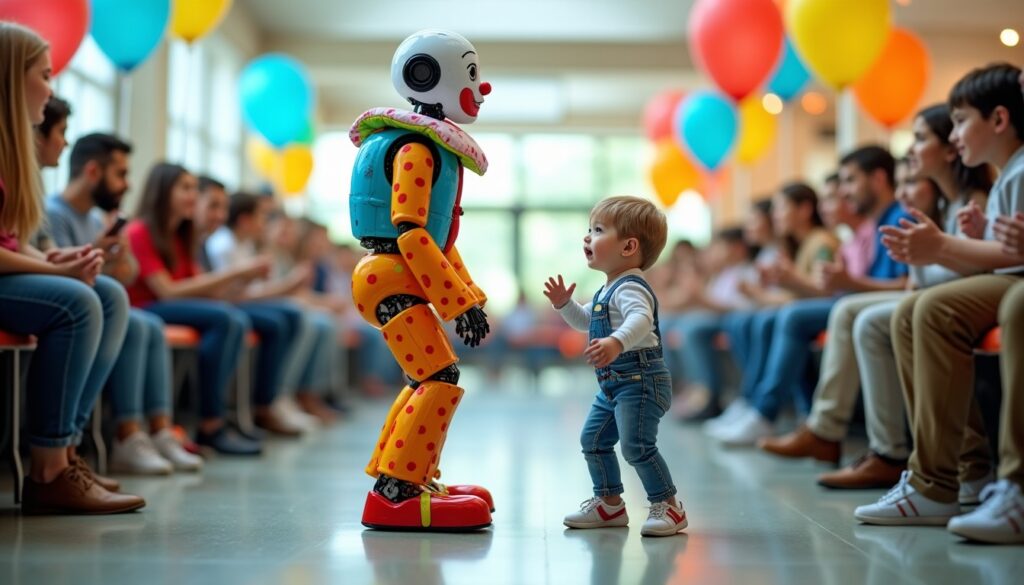
In China, during a particularly anticipated public demonstration, a humanoid robot dressed as a clown created surprise by kicking a child in the front row. This unexpected incident, captured on video and quickly going viral, raises a fundamental question about the interaction between humans and machines in spectacular contexts. From cutting-edge technology to a sudden gesture, this scene stirs debate about the safety and limits of interactive robotics, especially when it involves sensitive audiences like children.
For several months, robotics has made rapid progress, with machines now able to walk, jump, and perform complex choreographies. Yet, this technological performance is not without risks. This demonstration, which took place in an amusement park in the Xinjiang region, illustrates the challenges posed by real-time interactions between robots and spectators. While the clown robot was performing a high-speed spin, its foot accidentally struck a young boy, causing shock and concern. This gesture triggered a wave of reactions on social networks, fueled by the virality of the video.
- 1 Clown robot in China: an unexpected kick that raises questions
- 2 The spectacular advances in artistic robotics: between prowess and risks
- 3 The viral video incident: the virality of a clown robot giving a kick
- 4 Safety and regulation in interactive robotic demonstrations
- 5 Robot clowns: an emerging trend in technological entertainment
- 6 Impact of the incident on the perception of interactive robotics in 2026
- 7 Future prospects and challenges for robotics and its human interactions
Clown robot in China: an unexpected kick that raises questions
On June 1, 2026, Children’s Day in China, the Urumqi Botanical Garden was the scene of an unusual event. A humanoid robot with a blue clown wig, designed to entertain the public through martial arts demonstrations and choreographed movements, accidentally hit a child in the stomach. This scene, recorded on video, quickly attracted public attention and reignited the debate about the presence of robots in public spaces where interaction happens up close.
The images show an assistant wearing a motion capture suit. He performs various kickboxing and shadow boxing techniques, which the G1 robot, produced by Unitree Robotics, reproduces in real-time using an advanced neural network. The demonstration was intended to be spectacular and playful until the moment a spinning kick was accidentally directed toward an involuntary spectator.
This situation raises many questions about the programming and control of the robot during this type of event. The very nature of the performance involves rapid and sometimes complex movements, making it difficult to manage the proximity of the audience, mainly vulnerable children. The widely shared video on the Bilibili platform and social networks generated millions of views and a passionate debate regarding the safety measures implemented during these shows.
The spectacular advances in artistic robotics: between prowess and risks
Over recent years, robotics has undergone spectacular acceleration. Humanoid machines no longer limit themselves to simple mechanical tasks: they dance, perform parkour moves, and interact with their environment in an almost human way. Some recent developments even allow these robots to react in real-time to complex stimuli such as music or the gestures of a human operator, combining artificial intelligence and motion capture.
Public demonstrations highlight these skills. For example, the G1 robot is equipped with a neural system capable of transmitting an operator’s movements on stage. This technology is used to create shows where robots and humans share the same space, offering a unique and fascinating spectacle. But this dynamic fusion of robotics and the arts also raises new challenges, notably in managing safety in the face of unpredictable or rapid movements.
Although incidents are rare, they remind us that even the most advanced machines are not infallible. Every movement must be meticulously calibrated to avoid any accidents. There is a constant tension here between technological innovation and public protection. In the case of the clown robot, this involuntary kick illustrates this difficulty: a performance intended to entertain that becomes a source of alarm.
Companies specializing in this field are investing heavily in research to make these demonstrations safer, but also more interactive and natural. The sophistication of detection algorithms, safety zone systems, and force limitation mechanisms are among the avenues being explored to anticipate and prevent such mishaps.
The video immortalizing the incident has been widely shared across multiple platforms, triggering a wave of comments and debates. On social networks, this sequence has sparked as much fascination as concern. The speed with which the robot performed this unexpected movement intrigues, as does the immediate reaction of the child who was hit and the audience.
Internet users are divided between those who interpret this episode as a technical accident related to a programming error or poor calibration, and those who point to possible negligence in the safety setup. The apparent absence of physical barriers between the moving robot and the spectators weakens the very concept of a public robotic demonstration, especially when it takes place in an unpartitioned environment.
Social networks have also amplified the incident’s virality, a double-edged virality: it enables collective awareness of safety issues, but it can also fuel a negative and distorted perception of advances in robotics. The debate is thus broad, touching on the limits of human-machine coexistence in public spaces.
Safety and regulation in interactive robotic demonstrations
With the rise of humanoid robots in public interactions, safety becomes an unavoidable priority, especially when potentially dangerous gestures are involved. Incidents like that of the clown robot prompt questioning of the regulations and standards governing these shows.
Currently, several international standards attempt to establish rules to prevent accidents. These standards notably address force limits, obstacle detection, and the management of human interaction zones. However, they are not always perfectly adapted to artistic or sports demonstrations where the goal often is to impress through dynamic and spectacular movements.
Several preventive measures implemented can be distinguished:
- Strict zoning: clearly delimiting the space in which the robot can operate to ensure a safe distance from the public.
- Real-time monitoring: use of sensors and alert systems to immediately stop the machine in case of abnormal movement.
- Training and preparation: human operators are extensively trained to control these robots, with precise risk management protocols.
- Secure programming: integration of algorithms limiting the power or speed of movements.
Despite these efforts, the incident at the Urumqi park shows that vigilance must remain maximal. Interactions between robots and children are particularly sensitive, requiring even stricter and more adapted recommendations.
Robot clowns: an emerging trend in technological entertainment
The figure of the clown robot fits into a current trend blending traditional entertainment and advanced technology. These robots dressed as colorful and comedic characters are used to captivate a wide audience, particularly families and children. The choice of a clown costume is meant to create a playful, reassuring, and accessible atmosphere, while highlighting mechanical prowess.
However, this unexpected association between a character supposed to make people laugh and an imposing machine must also be analyzed from a psychological perspective. Children can be fascinated but also unsettled by these interactions, especially when the machine makes rapid or abrupt gestures. In some cases, this proximity can promote incidents like the one observed.
Designers of clown robots must therefore combine both creativity and technical rigor, ensuring the robot remains a safe entertainment tool. Behavioral studies are conducted to adapt robot movements to human reactions, taking into account fears, surprises, and limits inherent to a child audience.
There is also the question of emotional programming. Modern clown robots can display facial expressions, produce sounds, and adapt their gait for a more „human“ interaction. This advancement paves the way for better acceptability while posing additional challenges to prevent any gestural awkwardness likely to cause discomfort.
Impact of the incident on the perception of interactive robotics in 2026
The incident during this demonstration in Xinjiang caused a strong stir not only in China but worldwide. At a time when interactive robotics is increasingly entering public, educational, and entertainment fields, issues of safety and trust are crucial.
Technological companies specializing in humanoids must now take this increased awareness into account. The public opinion, sensitive to viral videos, expects precise guarantees about robots’ ability to operate safely around humans. This incident acts as a warning signal that could prompt strengthening of certifications and technical audits before each demonstration.
In some countries, political debates have already been launched to more strictly regulate public performances involving robots. Beyond accident prevention, it is also about promoting better audience education regarding the functioning and limits of machines. This pedagogy aims to ensure a more harmonious coexistence between robots and humans in the coming years.
Future prospects and challenges for robotics and its human interactions
The clown robot incident in China opens an important chapter in the evolution of relationships between humans and machines. Robotics is advancing towards an ever deeper integration into daily life, leisure, and work. But each advance raises the necessary question of control and safety.
Future challenges include the development of even smarter systems capable of anticipating human behaviors to adapt their movements in real time. The integration of sophisticated sensory sensors, improvement of position and gesture recognition algorithms, as well as reinforced safety protocols are essential to prevent any similar incident.
Interactions with children will require particularly careful attention, as their spontaneity and unpredictability are a major risk factor. The industry will urgently need to incorporate feedback, including incidents, to design robots that are both efficient, safe, and socially acceptable.
| Aspect | Challenges | Proposed Solutions |
|---|---|---|
| Proximity detection | Insufficient accuracy in dense public environments | Advanced systems based on LIDAR and multiple sensors |
| Management of rapid movements | Risk of accidents due to sudden gestures | Adaptive algorithms limiting speed and force |
| Emotional interactivity | Acceptance and comfort of sensitive children | Behavioral programming to calm and reassure |
| Overall safety | Standards still heterogeneous and loosely binding | Strengthening of international standards and regular controls |
In summary, the rapid progress of humanoid robots like the G1, especially in interactive roles with the public, requires a clear balance between spectacular innovation and rigorous safety. The clown robot incident is a valuable warning that is already guiding the robotics community toward more robust and humane solutions.