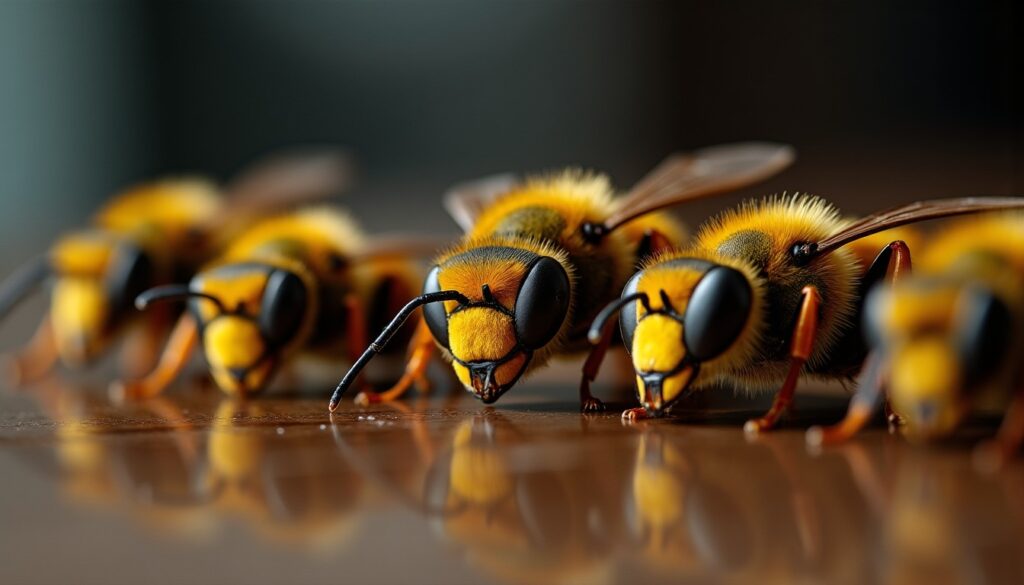
In the animal world, alcohol consumption is generally accompanied by severe toxic effects, ranging from loss of coordination to paralysis, even death. Yet, certain hornets defy these fundamental biological rules. These insects, feared for their aggressiveness and painful sting, possess an exceptional ability: they can ingest large quantities of alcohol, especially ethanol, without ever showing signs of intoxication or behavioral failure. This unique aptitude has fascinated scientists for several years and challenges the classical knowledge of animal toxicology.
Observations show that these hornets continue to fly, hunt, and interact in their environment as if nothing were wrong, even with alcohol concentrations that would be lethal for most other species. Their extraordinary tolerance to the liquid poison is explained by biological mechanisms at the crossroads of biochemistry and genetics, reinforcing their position as both formidable predators and influential ecological actors. Rooted in specific evolutionary adaptations, their resistance to ethanol illustrates a fascinating natural strategy that could open the way to new medical and biotechnological avenues.
- 1 The spectacular phenomenon of hornets facing alcohol: a biological enigma
- 2 The biochemical mechanisms explaining the unique tolerance of hornets to alcohol
- 3 Behavior and ecology: how this tolerance influences hornet life in their environment
- 4 What recent scientific studies teach us about hornets and their ethanol tolerance
- 5 Future perspectives: how research on hornets could revolutionize medicine and biotechnology
The spectacular phenomenon of hornets facing alcohol: a biological enigma
Hornets, and more particularly the species Vespa orientalis, have revealed a troubling aptitude during laboratory experiments: they can ingest food containing up to 80% ethanol without showing the symptoms of intoxication to which most organisms are subject. This capacity far exceeds the tolerable threshold for mammals, including humans and most rodents. For example, a blood alcohol level of 0.5 to 1 g/L causes a notable impairment of coordination in humans, while mice experience sedative effects from 2 to 3 g/L, potentially leading to coma. In comparison, the oriental hornet not only survives but remains fully functional while ingesting an alcohol concentration by volume that could be explosive for many other species.
This incredible phenomenon invites understanding of the physiological and biochemical particularities of these insects. Their organisms seem capable of metabolizing and eliminating ethanol with a speed and efficiency unmatched anywhere else in the animal kingdom. This is not a mere evolutionary “stroke of luck” but the result of a complex adaptation, the fruit of millions of years of constant exposure to fermented food sources. Hornets, wasps, and other social hymenopterans have always exploited these ecological niches where their alcohol resistance translates into a major selective advantage.
To better illustrate this striking contrast, here is a comparative table of ethanol concentrations tolerated by different species and their effects:
| Species | Ethanol concentration tolerated | Observed effects |
|---|---|---|
| Human | 0.5 to 1 g/L in blood | Euphoria, loss of coordination |
| Mouse | 2 to 3 g/L | Sedation, possible coma |
| Oriental hornet (Vespa orientalis) | Up to 80% v/v in diet | No visible signs of intoxication |
This biological singularity raises major questions about the internal functioning and adaptive capacity of these insects facing substances usually lethal.
The biochemical mechanisms explaining the unique tolerance of hornets to alcohol
The ability of hornets to ingest large quantities of alcohol without damage relies on a series of refined biological processes. At the heart of this resistance is an essential enzyme: alcohol dehydrogenase (ADH). This enzyme plays a crucial role in the rapid breakdown of ethanol into less toxic compounds.
In hornets, multiple copies of the gene coding for this enzyme have been identified, resulting in increased production and enzymatic efficiency far superior to that of other insects or vertebrates. These specialized versions of ADH allow the transformation of alcohol into acetaldehyde, then acetate, without dangerous accumulation of ethanol in their bodies. This accelerated metabolic chain avoids acute poisoning and preserves the proper neurological functioning of these insects.
Beyond this enzymatic aspect, hornets also exhibit other specificities:
- Nervous system less sensitive to the depressant properties of ethanol, preventing the usual disorientation and motor disorders.
- Metabolic use of ethanol as an energy source, thus exploiting an abundant alcoholic resource in their habitat.
- Differences at the level of neuronal receptors, which reduce the disruptive effects of alcohol on their biological circuits.
These are not isolated mechanisms, but a synergistic combination that gives hornets extraordinary robustness against a universally dangerous toxin for most organisms.
Researchers believe this adaptation results from intense evolutionary pressure linked to the diet of these insects, which often includes decomposing or fermented fruits. This resistance probably allowed hornets to occupy ecological niches inaccessible to other species and establish themselves as feared predators and competitors.
Behavior and ecology: how this tolerance influences hornet life in their environment
The ability to tolerate high alcohol concentrations profoundly affects the feeding behavior and ecological relationships of hornets. Indeed, they can consume highly fermented fruits that other insects and even some vertebrates avoid or cannot digest. This aptitude opens them a broader access to food resources, especially at the end of summer when the natural fermentation of fruits makes them toxic to most other consumers.
This expansion of dietary ranges has several consequences:
- Increased competition with other pollinating or frugivorous insects, which can alter local biological balances.
- Increased pressure on bee colonies, as fermented nectar or ethanol-enriched honey offers an access point to a valuable resource, but also a potential source of alcohol that hornets can exploit.
- Impact on the dispersion of yeasts and fermenting microorganisms, playing an indirect role in the microbiological ecosystem.
Hornets thus position themselves as key actors in their environment, capable of colonizing difficult food niches and influencing the dynamics of insect populations and fermenting microorganisms.
Their behavior exemplifies the interconnection between individual biology and ecology: alcohol tolerance is not limited to a scientific curiosity but is part of major evolutionary and environmental processes. Understanding their role can also help better anticipate their impacts in areas where they have become invasive, such as certain European and African regions.
What recent scientific studies teach us about hornets and their ethanol tolerance
Many specialized laboratories have deepened the toxicology and genetics of these particular insects. Controlled experiments have subjected colonies to increasing alcohol concentrations in their food sources, rigorously documenting their behavior and physiological reactions. These studies have highlighted several significant aspects:
- Hornets show no aversion to ethanol, even consuming high-concentration solutions without decreased appetite.
- Alcohol concentrations in the hemolymph remain low, indicating extremely efficient enzymatic degradation.
- No notable detrimental effects on colony survival or productivity, even with prolonged ethanol exposure.
- Marked overexpression of genes coding for detoxification enzymes, confirmed by genomic and transcriptomic analyses.
This resistance thus relies on a set of clearly physiological and genetic factors, not merely behavioral or related to some form of avoidance. These results argue for a profound biological adaptation, far more advanced than had been supposed in past decades.
Below is a simplified table of the main observations from recent studies on hornet alcohol tolerance:
| Aspect studied | Key observation | Implication |
|---|---|---|
| Feeding behavior | No reduction in ethanol consumption | High behavioral tolerance |
| Concentration in hemolymph | Very low alcohol level despite ingestion | Strong enzymatic efficiency |
| Survival and health | No significant mortality | Solid physiological resistance |
Future perspectives: how research on hornets could revolutionize medicine and biotechnology
Insights from the mechanisms of alcohol absorption and degradation in hornets open unprecedented avenues for contemporary science. For example, in-depth study of the enzymes involved could enable development of new therapeutic strategies against acute alcohol intoxication or liver diseases linked to alcohol abuse.
By understanding how hornets break down ethanol rapidly and without damage, researchers hope to design enzymatic treatments capable of efficiently neutralizing alcohol in the human body. These innovations could reduce the risks of severe intoxication, coma, or liver sequelae, offering immense potential in emergency services and medical prevention.
Moreover, several scientific questions remain open and fuel debates in the evolutionary biology field:
- Which genes are precisely involved in this tolerance and how are they regulated?
- Are there variations in this capacity depending on hornet species or geographic populations?
- What effects does repeated ethanol consumption produce on the collective health of colonies?
- How did this adaptation develop within the evolutionary framework of feeding behaviors?
The study of hornets illustrates that alcohol tolerance, far from being a mere chance, is a complex adaptation with multiple facets. It also shows that insects often accused of being nuisances can become model subjects for better understanding revolutionary biological phenomena.