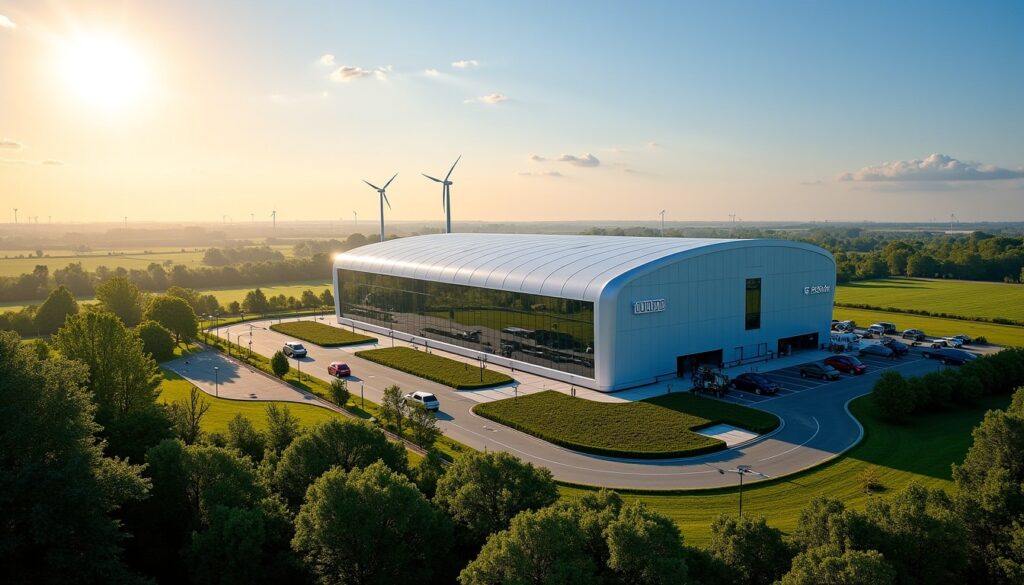
In a global context where artificial intelligence (AI) is deeply transforming economies, France stands out with a major project that brings together some of its largest industrial and technological players. The AION consortium brings together heavyweights such as Free via Iliad, Orange, EDF, but also Capgemini, Bull, Artefact, Ardian, and Scaleway. Together, they aim to build an Artificial Intelligence Gigafactory on French soil, a powerful, sovereign computing infrastructure that is also environmentally energy-friendly. This initiative reflects a clear desire to reduce dependence on American and Chinese platforms in AI matters, while leveraging European strengths. The challenge is not limited to the technological aspect: it is also a strategic response to energy challenges, digital sovereignty, and industrial competitiveness in a world where data control becomes crucial for businesses and public administrations.
The Gigafactory aims to offer an infrastructure capable of training and deploying AI models on a very large scale, with low-carbon energy consumption ensured notably by EDF’s contribution, leveraging its nuclear fleet. Orange and Scaleway will carry the European cloud layer while Bull will be responsible for computing power thanks to its supercomputers. This unprecedented alliance, enriched by the presence of actors in finance and digital sectors such as Ardian and Artefact, demonstrates the ambition to make France a key hub for the European artificial intelligence ecosystem. Through this project, France intends not only to accelerate the adoption of AI in private and public sectors but also to guarantee strict data control in sensitive areas, thereby strengthening digital sovereignty over a strategic territory.
- 1 Free, Orange, and EDF: a strategic partnership for a sovereign artificial intelligence gigafactory in France
- 2 The technological and energy architecture of the French AI gigafactory
- 3 European digital sovereignty at the heart of the Gigafactory project
- 4 Expected economic and industrial benefits of the AION project in France
- 5 How the Gigafactory fits into the European technological and industrial strategy
- 6 Energy and environmental challenges of the Gigafactory in the 2026 context
- 7 Opportunities and next milestones for the AI ecosystem in France
Free, Orange, and EDF: a strategic partnership for a sovereign artificial intelligence gigafactory in France
The collaboration between Free, Orange, and EDF fits into a dynamic driven by the need to build a national infrastructure capable of hosting and operating cutting-edge artificial intelligence models. The AION consortium, created in May 2026, aims to counter the dominance of foreign cloud giants – Microsoft, Google, Amazon – who currently control most of the computing capacity necessary to train efficient AI models. These French companies intend to develop a gigafactory that bets on technological sovereignty.
Each brings a key skill: EDF ensures energy supply, exploiting its electricity mix mainly nuclear and hydraulic, thus guaranteeing low-carbon and stable electricity – an essential criterion for the continuous and intensive operation of data centers. Orange and Scaleway bring their cloud expertise, as well as data hosting on European infrastructures that respect privacy and security standards. Free, with its Iliad branch, enriches this setup through its digital infrastructures and telecommunications know-how.
Beyond industrial strength, this alliance aims to be an innovation catalyst: the consortium not only brings together energy and telecom players but also companies specialized in AI integration and application such as Capgemini and Artefact. This guarantees that the gigafactory is not simply a data center but a true engine of industrialization and concrete implementation of artificial intelligence projects, particularly in sensitive industries such as health, finance, or energy.
The project also illustrates a resolutely forward-looking and sustainable approach. EDF, for example, relies on low-carbon energy, which represents a decisive advantage compared to other regions of the world where energy is often more polluting and subject to fluctuations. In a context where AI infrastructure energy consumption can easily reach colossal volumes, this energy strategy proves to be a major lever for the competitiveness and ecological acceptability of the gigafactory.
The technological and energy architecture of the French AI gigafactory
The success of the gigafactory relies on the combination of an ultra-high-performance IT infrastructure and solid, sustainable energy supply. Bull is designated to provide the computing power needed, thanks to its supercomputers adapted to the massive training of next-generation AI models. These machines must allow processing huge amounts of data with optimal efficiency while controlling energy consumption and heat dissipation.
EDF plays a fundamental upstream role: ensuring a constant supply of low-carbon energy. By combining nuclear energy, stable and low in CO2 emissions, and hydraulic energy, flexible and renewable, EDF meets critical stability needs, an essential point to avoid any risk of outage during very heavy IT processing. This energy configuration differentiates the French gigafactory from competing data centers and offers it a globally competitive ecological edge.
Orange and Scaleway provide an innovative and secure cloud infrastructure, notably choosing to prioritize open-source solutions to maximize technological independence from dominant proprietary suppliers. Digital sovereignty requires complete mastery of the entire value chain, from data processing to storage in France, with strong respect for European regulations such as GDPR.
The complementary role of AION consortium members
- Bull: Provision of high-performance supercomputers for AI training.
- EDF: Low-carbon energy production, stable and sustainable electricity supply.
- Orange & Scaleway: Cloud infrastructure and data hosting on European soil.
- Capgemini & Artefact: Integration and concrete application of AI in companies.
- Iliad (Free) & Ardian: Provision of financial resources and long-term digital expertise.
This assembly of skills forms a solid and complete chain, ensuring that the gigafactory is not merely a technical project, but a dynamic ecosystem where innovation and infrastructure intertwine to create a lasting strategic advantage.
European digital sovereignty at the heart of the Gigafactory project
In a computing landscape dominated by a few American and Chinese companies, European digital sovereignty becomes a crucial issue. France, through this project, aims to offer a robust and competitive alternative, ensuring that sensitive data remains under local control, according to European regulatory requirements.
Sectors such as health, public administration, industry, or finance have strong constraints regarding data localization and confidentiality. The AION gigafactory aims to meet these needs while offering technical capabilities up to current and future AI requirements.
In this context, promoting open-source technologies becomes a key strategy. This not only limits technological dependency risks but also stimulates an open and collaborative European innovation ecosystem. The involvement of partners such as Hugging Face or INRIA illustrates this willingness to integrate research and development actors to continuously enrich this AI infrastructure.
Concrete advantages of a sovereign infrastructure
- Enhanced control of sensitive data to comply with confidentiality standards.
- Technical independence from foreign cloud giants.
- Stimulating local innovation through an open and collaborative ecosystem.
- Reduction of geopolitical risks linked to external dependency.
- Job creation and industrial development on national territory.
| Advantages | Description |
|---|---|
| Enhanced confidentiality | Guarantee of strict control over the storage and use of personal data |
| Technological autonomy | Use of open-source technologies avoiding dependence on foreign suppliers |
| Collaborative innovation | Close partnerships with European laboratories and startups for an evolving infrastructure |
| Energy sustainability | Use of stable, renewable, and low-carbon energy to reduce ecological footprint |
| Economic creation | Generation of jobs and strengthening of the French industrial fabric |
Expected economic and industrial benefits of the AION project in France
The launch of this gigafactory promises a considerable leverage effect on the French economy. By creating an AI infrastructure that is both powerful and sovereign, the country aims to attract massive investments, encourage the creation of startups, boost industrial competitiveness, and strengthen the position of large French groups on the global stage.
The field of artificial intelligence generates a growing need for computing power and digital infrastructures. By having a local cutting-edge solution, French companies, but also European ones, will be able to develop and deploy innovative applications more quickly. The use of low-carbon energy also helps reduce operational costs related to energy consumption, an important competitive advantage in a market where the carbon footprint becomes a strategic criterion.
Beyond direct benefits, the gigafactory’s ripple effect on the industrial fabric could be very significant. Increased demand for IT equipment, digital services, and specialized engineering will foster a virtuous circle of employment and research and development within the territory. The French industry will thus position itself as a key player in the global AI production chain.
Some concrete impacts for businesses
- Easier accessibility to advanced AI infrastructures without external dependence.
- Reduced development times for AI projects deployment.
- Stronger support for local innovation and SMEs.
- Optimization of energy costs thanks to an efficient low-carbon mix.
- Improved IT security and regulatory compliance.
How the Gigafactory fits into the European technological and industrial strategy
The French project fits into the broader framework of European ambitions to develop cutting-edge infrastructures dedicated to artificial intelligence. The European Union, aware that AI will become a major strategic lever, actively supports the construction of several AI Gigafactories in the Eurozone, helping reduce dependency on foreign actors and strengthen the local ecosystem.
The candidacy led by the AION consortium highlights France as a preferred location to host one or several of these infrastructures. Through this initiative, the country hopes to become a nerve center for AI research, development, and industrial application in Europe. This approach relies on the complementarity of French technological and industrial expertise, as well as on available energy resources.
Coordination among different European countries in this field remains essential but France seeks to position itself as a leader through an initiative that brings together telecommunications, energy, finance, and industrial expertise. This leadership will enable the federation of a network of European partners, thereby promoting collaborative innovation on a continental scale.
Topics of European collaboration around AI Gigafactories
- Pooling of large-scale computing resources.
- Creation of a European standard for AI infrastructures.
- Strategic distribution of geographic zones to avoid duplication.
- Joint development of open-source and security solutions.
- Support for AI adoption in public and private sectors.
Energy and environmental challenges of the Gigafactory in the 2026 context
In a context where the environmental footprint of digital technologies is closely scrutinized, the energy issue is a critical parameter for the sustainability and acceptability of AI infrastructures. Energy consumption of data centers dedicated to artificial intelligence is climbing exponentially with the complexity of models and the intensity of computations.
EDF’s strategic choice to rely on its nuclear and hydraulic fleet helps meet this demand while controlling the carbon impact. The stability of this energy is also an essential asset, reducing the risk of outages or fluctuations that could compromise the quality of AI processing. Comparatively, some countries mainly dependent on fossil or intermittent renewable energies face difficulties ensuring constant availability of their digital infrastructures.
This energy responsibility aligns with broader concerns regarding sustainability and ethics in AI development. The AION consortium intends to lay solid foundations here for sustainable artificial intelligence, which combines power, efficiency, and environmental respect, thus helping position France and Europe as pioneers in this field.
List of specific energy challenges for the French AI Gigafactory
- Consumption management: optimize resources to limit energy waste.
- Use of low-carbon energy: prioritize clean sources, particularly nuclear and hydraulic.
- Reduce fluctuations: ensure stable and constant supply.
- Carbon footprint reduction: limit the overall ecological impact of data centers.
- Innovation in thermal management: develop eco-efficient cooling systems.
Opportunities and next milestones for the AI ecosystem in France
The creation of the French AI Gigafactory, led by AION, opens significant perspectives for the French and European ecosystem. It will enable the consolidation of expertise, stimulate research and innovation, and strengthen the competitiveness of companies internationally. This flagship project already catalyzes local initiatives and encourages the emergence of new players in the field of artificial intelligence.
The next key steps include the final selection by European bodies, securing funding, constructing physical infrastructures, and developing the first industrial use cases. The consortium is also working to broaden partnerships with laboratories, universities, and innovative startups to enrich the ecosystem and foster harmonious development.
An important issue will also be training the necessary talent to support this transformation. Indeed, the ramp-up of AI capacities requires a skilled workforce in digital fields, high-performance computing, and energy management. Education and training programs are thus crucial to ensure the sustainability and competitiveness of this project in the long term.
Key upcoming actions for the development of the Gigafactory
- Validation of the project by European authorities.
- Construction of infrastructures and installation of supercomputers.
- Development of a collaborative ecosystem with startups and researchers.
- Support for training and recruitment of AI and energy specialists.
- Implementation of first industrial and public use pilots.