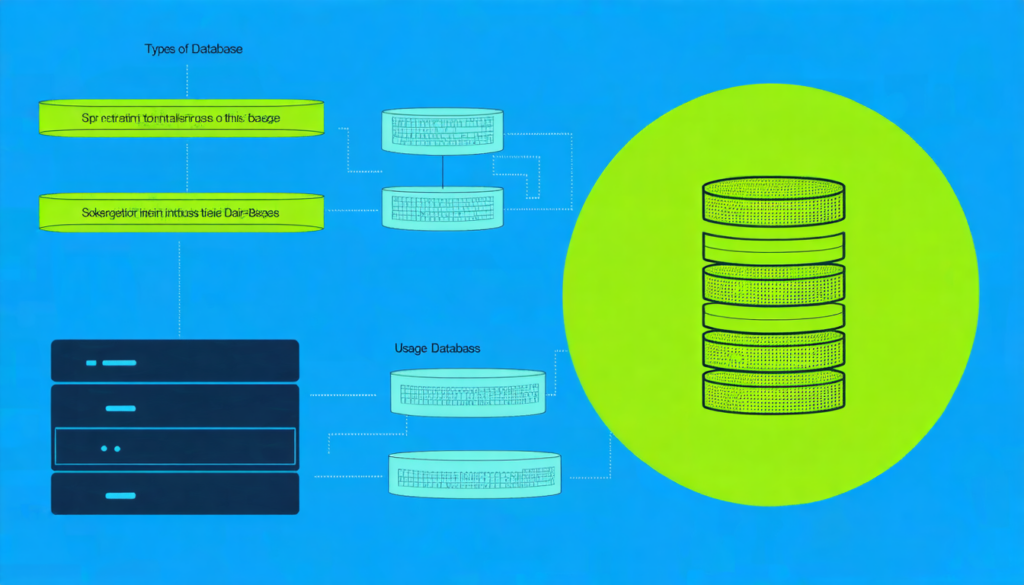
In a constantly exploding digital universe, the role of databases has become fundamental. These organized structures orchestrate the management of information flows that shape the global economy, media, health, and research. In 2025, as Big Data becomes omnipresent, understanding the basic definition of a database and its architectures is essential to optimizing data management across all sectors. These systems are no longer just simple archives but strategic levers allowing data to be exploited in real time with efficiency and security. Technological advances push the discipline towards smarter and more flexible models, notably integrating artificial intelligence to surpass traditional limits.
Database concepts have evolved significantly since their beginnings in the 1960s and 70s, up to the advent of rapidly expanding cloud-native databases today. These evolutions offer powerful tools to businesses but also require a deep mastery of data management systems, especially Database Management Systems (DBMS) and SQL language. This database guide thus details the types, architectures, functions, and uses of these systems, drawing a comprehensive panorama indispensable for any digital professional or data science enthusiast.
- 1 Clear definition of a database: fundamental concepts and operation in 2025
- 2 Different types of databases: detailed classifications and adapted uses
- 3 Database Management Systems (DBMS) and SQL language: pillars of automated data management
- 4 Cloud databases and their revolutionary impact on enterprise data management
- 5 Ethical, security, and technological challenges of databases in the era of artificial intelligence
Clear definition of a database: fundamental concepts and operation in 2025
A database represents an organized set of information enabling efficient storage, management, and access. The typical organization relies on structures in rows, columns, and tables, where each data item is encoded and indexed to facilitate searches. The concept has evolved over decades, but the essence remains the same: to provide a framework to manipulate diverse data, whether numerical, textual, or multimedia.
At the heart of this organization, the Database Management System (DBMS) ensures control of access, integrity, and database security. The DBMS acts as an interface between the end user and physical storage, ensuring that data remains coherent, fast enough to query, and protected against errors or attacks. In 2025, this system often integrates automatic backup mechanisms and cloud-native functionalities, strengthening both availability and scalability.
For example, in the medical sector, a hospital uses a database to store patient records, including histories, test results, and treatments. Daily updating, reproducibility, and confidentiality are critical to ensuring effective and compliant service. Databases also facilitate links between multiple departments: pharmacy, medical imaging, and administration, illustrating the power of centralized and structured data management.
List of key functions of a database:
- Structured storage: organization and classification of information according to a logical model.
- Fast querying: targeted and optimized retrieval via queries.
- Dynamic manipulation: addition, deletion, modification of data in real time.
- Security and confidentiality: access controls, encryption, and audit to protect sensitive data.
- Transaction management: ensuring that multiple operations are atomic and consistent.
| Component | Function | Example |
|---|---|---|
| Table | Groups rows and columns representing entities | Patients Table, Products Table |
| Index | Speeds up data searching and sorting | Index on field ‘Name’ for quick access |
| Query | Query instruction to extract specific data | SELECT * FROM Patients WHERE City = ‘Paris’ |
| DBMS | Management interface controlling interactions with the database | Oracle, MySQL, Microsoft SQL Server |

Different types of databases: detailed classifications and adapted uses
Over time, database architecture has diversified to meet the varied needs of companies and organizations. Each type has its specificities, advantages, and limits, allowing adoption of a model based on analysis needs, volume, and speed.
Here is a list of the main types of databases today:
- Relational database (SQL): classic table-based structure with relationships. Relational model invented by E.F. Codd in the 1970s, still dominant thanks to its flexibility and power.
- NoSQL database: alternative designed to handle unstructured or semi-structured data, oriented towards documents, columns, graphs, or key-value pairs. Ideal for Big Data and scalability.
- Hierarchical database: tree organization, useful for heavily linked data in a parent/child structure.
- Network database: multiple and complex relationships between entities, suited for environments requiring high relational versatility.
- Object-oriented database: for storing complex objects from object-oriented programming, facilitating correspondence with modern languages.
- Cloud-native database: designed for the cloud, they offer scalability and enhanced resilience thanks to remote hosting and management via platforms such as AWS, Google Cloud, or Azure.
For example, a social networking platform can use a graph-oriented database to analyze relationships between users and optimize personalized recommendations. Meanwhile, a large industrial company will prefer a robust relational database for its financial operations and human resources.
| Database type | Main characteristics | Common applications |
|---|---|---|
| Relational (SQL) | Tables, normalized relations, standard SQL language | ERP systems, CRM, banks, e-commerce |
| NoSQL | Flexible, multi-model: documents, key-value, graphs | Big Data, social networks, real-time analysis |
| Hierarchical | Parent-child tree organization | Legacy systems, file management |
| Network | Multiple relations, pointers between records | Complex management, industrial databases |
| Object-oriented | Storage of complex objects, inheritance and encapsulation | CAD applications, multimedia, simulation |
| Cloud-native | Cloud hosting, scalability and high availability | Modern applications, SaaS, ELT/ETL infrastructures |
It is important to note that hybrid solutions combining relational and NoSQL databases are increasingly common in practice. These combinations take advantage of the best of both worlds according to workload requirements.

Database Management Systems (DBMS) and SQL language: pillars of automated data management
To master access and manipulation of a database, DBMS are essential. In 2025, these software have reached an advanced level of automation, facilitating data management while enhancing database security. SQL remains the major reference for relational databases, offering a powerful and universal standard.
A DBMS plays several essential roles:
- Structure management: creating and modifying tables, indexes, and constraints.
- Data manipulation: inserting, modifying, deleting, and querying via requests.
- Access control: user authentication and privilege assignment.
- Integrity maintenance: rules of uniqueness, data relationships, secured transactions.
- Performance optimization: cache management, query planning, and indexing.
SQL, created in the 1970s and standardized by ANSI then ISO, continues evolving. The SQL:2023 standard now includes extensions to handle JSON data, graphs, and better integration in distributed architectures. SQL commands are divided into several categories:
- DQL (Data Query Language): SELECT to extract data.
- DML (Data Manipulation Language): INSERT, UPDATE, DELETE to manage data.
- DDL (Data Definition Language): CREATE, ALTER, DROP to modify structure.
- DCL (Data Control Language): GRANT, REVOKE to manage permissions.
- TCL (Transaction Control Language): COMMIT, ROLLBACK to ensure transactional consistency.
For example, a bank can use a SQL query combining multiple tables to extract a financial report with complex join rules. The robustness of the relational model and the precision of queries guarantee a reliable and secure result for decision-making.
| SQL Category | Main commands | Description |
|---|---|---|
| DQL | SELECT | Data extraction according to criteria |
| DML | INSERT, UPDATE, DELETE | Addition, update, deletion of records |
| DDL | CREATE, ALTER, DROP | Creation/modification/deletion of database objects |
| DCL | GRANT, REVOKE | User access rights management |
| TCL | COMMIT, ROLLBACK | Validation or cancellation of transactions |
Thanks to recent improvements, DBMS also integrate artificial intelligence modules to automatically optimize queries and strengthen database security monitoring, anticipating anomalies and external attacks.
Cloud databases and their revolutionary impact on enterprise data management
The emergence of cloud computing has radically transformed traditional database models. Cloud-native databases offer unprecedented flexibility that changes hosting, scalability, and database security paradigms.
The main forms of cloud databases are:
- Traditionally hosted cloud databases: deployment on virtual machines managed by the company itself, requiring a dedicated IT team.
- Database as a Service (DBaaS): fully managed service by an external provider, with automatic maintenance, backup, updates, and scaling.
This distinction is key. A DBaaS offers a “pay-as-you-go” model where the company only spends for resources consumed in storage, CPU, and traffic, optimizing operating costs and avoiding heavy investments in physical infrastructure.
The major benefits of these cloud solutions include:
- No internal infrastructure: less need for hardware and space.
- Automatic scaling: instant adaptability according to usage.
- High availability and redundancy: fault tolerance through mirror servers and multiple datacenters.
- Updates and security managed by experts: access to the latest technologies without client intervention.
- Reduction of overall costs: financial optimization through flexible models.
| Criterion | Traditional database | Cloud Database (DBaaS) |
|---|---|---|
| Hosting | Internal servers | Remote cloud servers |
| Management | Internal IT team | Cloud provider |
| Scaling | Manual, slow | Automatic, fast |
| Security | Internal control | Outsourced expertise |
| Cost | High initial investment | Usage-based, flexible model |
For example, a start-up developing a mobile application with strong seasonal activity peaks will adopt a cloud database to avoid limited capacity constraints while remaining financially agile. Cloud-native databases also facilitate easy integration of artificial intelligence solutions to automate data management and analysis.

Ethical, security, and technological challenges of databases in the era of artificial intelligence
The explosive growth of data volume and the rise of artificial intelligence have placed database security at the center of concerns beyond mere technical aspects. In 2025, ensuring legal compliance, protecting privacy, and guaranteeing data reliability have become major challenges.
Key issues include:
- Compliance with GDPR and other regulations: data traceability, right to be forgotten, transparent management of user consent.
- Prevention of leaks and hacking: use of advanced encryption techniques and rigorous access control systems.
- Control and validation of sources: avoiding the use of illegal or biased data that compromise AI algorithms.
- Responsible management of sensitive data: classification and access restriction according to criticality.
- Involvement of Database Administrators (DBA): enhanced role in defining and implementing security policies.
A recent anecdote illustrates these challenges: in 2024, a major e-commerce company experienced a customer data leak incident due to poor access configuration on a cloud database. The case highlighted the importance of rigorous governance and transparent partnership with cloud providers.
| Challenges | Examples of measures | Consequences in case of failure |
|---|---|---|
| GDPR Compliance | Regular audits, data anonymization | Financial penalties, loss of customer trust |
| Security | Encryption, multi-factor authentication | Data leaks, potential attacks |
| Data quality | Input validation, source filtering | Errors in AI processing, algorithmic biases |
| Internal management | DBA training, clear procedures | Poor exploitation, vulnerabilities |
The growing challenge of databases in this context is to combine performance, security, and ethics, so that data exploitation fuels reliable, respectful, and efficient artificial intelligence.
{“@context”:”https://schema.org”,”@type”:”FAQPage”,”mainEntity”:[{“@type”:”Question”,”name”:”Quu2019est-ce quu2019une base de donnu00e9es ?”,”acceptedAnswer”:{“@type”:”Answer”,”text”:”Une base de donnu00e9es est un systu00e8me organisu00e9 permettant de stocker, gu00e9rer et interroger des informations de maniu00e8re structuru00e9e et efficace. Elle est utilisu00e9e dans divers domaines tels que le commerce, la santu00e9, la finance et la recherche.”}},{“@type”:”Question”,”name”:”Quelle est la diffu00e9rence entre une base relationnelle et une base non relationnelle ?”,”acceptedAnswer”:{“@type”:”Answer”,”text”:”Une base relationnelle organise les donnu00e9es en tables reliu00e9es par des clu00e9s, tandis quu2019une base non relationnelle stocke les donnu00e9es sous forme de documents, graphes ou paires clu00e9-valeur, offrant plus de flexibilitu00e9 pour certains types de donnu00e9es.”}},{“@type”:”Question”,”name”:”Quu2019est-ce quu2019un Systu00e8me de Gestion de Base de Donnu00e9es (SGBD) ?”,”acceptedAnswer”:{“@type”:”Answer”,”text”:”Un SGBD est un logiciel qui permet de cru00e9er, manipuler et administrer des bases de donnu00e9es. Il gu00e8re lu2019accu00e8s, la su00e9curitu00e9 et lu2019intu00e9gritu00e9 des donnu00e9es.”}},{“@type”:”Question”,”name”:”Pourquoi utiliser une base de donnu00e9es cloud ?”,”acceptedAnswer”:{“@type”:”Answer”,”text”:”Les bases de donnu00e9es cloud offrent une flexibilitu00e9, une scalabilitu00e9 et une haute disponibilitu00e9. Elles ru00e9duisent les cou00fbts et simplifient la gestion des infrastructures physiques.”}},{“@type”:”Question”,”name”:”Quel est le ru00f4le des bases de donnu00e9es dans lu2019intelligence artificielle ?”,”acceptedAnswer”:{“@type”:”Answer”,”text”:”Elles fournissent les donnu00e9es nu00e9cessaires pour entrau00eener et faire fonctionner les algorithmes, tout en assurant la trau00e7abilitu00e9, la qualitu00e9 et la gouvernance des informations utilisu00e9es.”}}]}What is a database?
A database is an organized system that allows structured and efficient storage, management, and querying of information. It is used in various fields such as commerce, health, finance, and research.
What is the difference between a relational and a non-relational database?
A relational database organizes data in tables linked by keys, while a non-relational database stores data as documents, graphs, or key-value pairs, offering more flexibility for certain types of data.
What is a Database Management System (DBMS)?
A DBMS is software that allows creating, manipulating, and administering databases. It manages access, security, and data integrity.
Why use a cloud database?
Cloud databases offer flexibility, scalability, and high availability. They reduce costs and simplify management of physical infrastructures.
What is the role of databases in artificial intelligence?
They provide the data necessary to train and operate algorithms, while ensuring traceability, quality, and governance of the information used.