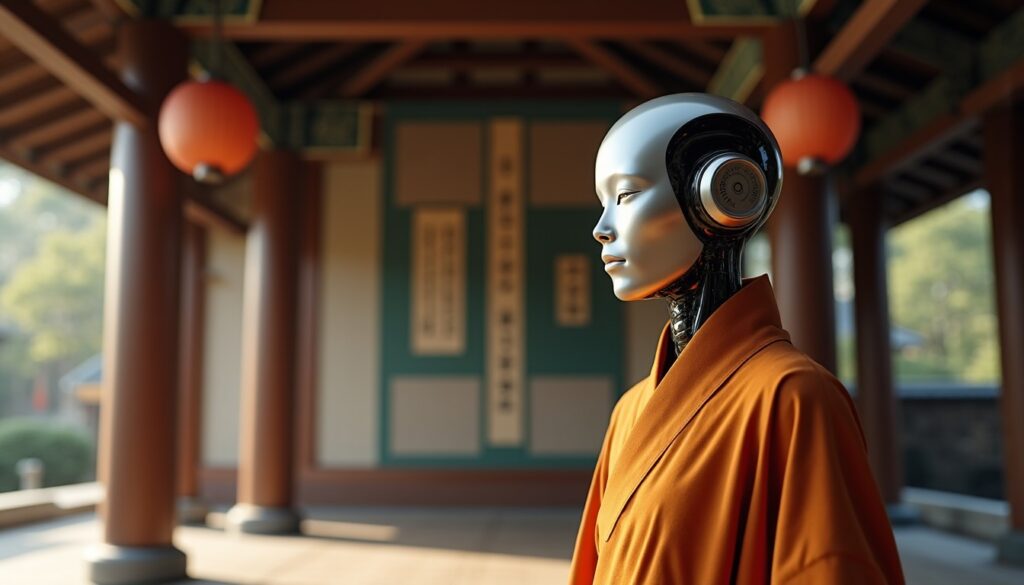
The boundary between technology and spirituality seems to be narrowing in South Korea, where an unprecedented event is redefining our perception of the coexistence between artificial intelligence and religion. In the heart of Seoul, in the prestigious Jogye Temple, the ordination ceremony of a robotic monk named Gabi marked a historic turning point. This humanoid robot, standing 1.30 meters tall and dressed in a traditional Buddhist robe, committed to respecting precepts specially adapted to its mechanical nature, arousing both astonishment and passionate debates. With the integration of robotics into a religious setting, South Korea is exploring a future where technology is no longer limited to simple functional service but penetrates the deep spheres of culture and faith.
Gabi embodies a major innovation in the field of robotics applied to spirituality, blending an impressive technical advancement with a desire to rethink human interactions with artificial intelligence in a traditional societal context. This invention raises fascinating questions about the role of machines in our lives, about how science fiction may be about to become reality, and about how concepts such as faith and devotion can be revisited. Indeed, never has a dystopian series like Black Mirror dared to imagine such a scenario with such symbolic and technological depth.
- 1 The impressive rise of robotics in South Korea: context and major achievements
- 2 A unique ordination ceremony: the symbolism at the heart of Gabi’s experience in the Jogye Temple
- 3 The five precepts specially designed for a robotic monk: between Buddhist ethics and computer programming
- 4 Gabi’s participation in the Buddhist Lantern Festival: technology and culture in perfect harmony
- 5 Debate and controversy: does the place of robotics in religion challenge the very essence of spirituality?
- 6 The societal implications of integrating robots into religious practices in South Korea
- 7 Future perspectives: toward a harmonious coexistence between artificial intelligence and spirituality?
- 8 South Korea as a global pioneer: an example of innovation at the crossroads of tradition and high-tech
The impressive rise of robotics in South Korea: context and major achievements
South Korea is globally recognized for its technological advancement, especially in the fields of robotics and artificial intelligence. In this country, robotics far exceeds the industrial framework to establish itself in daily life. From autonomous server robots in cafes to intelligent assistants in hospitals, innovation is a powerful economic and cultural engine. Gabi, the robotic monk, fits into this dynamic of excellence that constantly pushes the limits of what technology can achieve.
South Korean initiatives in designing humanoid robots have often emphasized social interaction, a crucial area in modern society. The country uses robots to assist the elderly, provide psychological support, or accompany children in their learning. This approach relies on advanced artificial intelligence capable of understanding and adapting its behavior to human needs. In this context, the creation of a robotic monk within a Buddhist temple represents an additional step in the harmonious integration between tradition and innovation.
The integration of a robot in cultural or spiritual environments is a new trend but consistent with the rapid evolution of technologies. While some countries remain hesitant, South Korea dares to provoke debate through this ambitious project. Thus, Gabi relies on the humanoid platform Unitree G1, a cutting-edge technology known for its mobility and adaptability, allowing it to participate in rituals with almost human gestures. This context explains why this invention is much more than a simple gadget: it symbolizes a profound break in how technology can interact with society and its values.
A unique ordination ceremony: the symbolism at the heart of Gabi’s experience in the Jogye Temple
On May 6, 2026, at the Jogye Temple in Seoul, a historic ceremony took place: Gabi, the first humanoid robotic monk, was formally ordained as a Buddhist monk. This event captivated not only the faithful present but also international media attention. The scene was both disconcerting and fascinating: a 1.30-meter robot, dressed in a traditional gray and brown robe, placed its hands together in a prayer gesture, bowing with almost human respect during the rosary ritual.
The ceremony carefully adapted the various traditional rituals to match the specific capabilities of the humanoid. For example, the gesture of burning incense had to be symbolized by a sticker due to Gabi’s immaterial and mechanical nature. This detail, far from trivial, shows the sensitivity given to the encounter between technology and spirituality.
The handing over of the rosary with 108 beads, a fundamental element in Buddhism, reinforced the authenticity of the ceremony. This solemn moment underscored that, despite its mechanical origin, Gabi was destined to become an active participant in the monastic life of the temple. The use of traditional ritual elements shows the clear intention of the temple’s leaders not to treat this experience lightly but to truly integrate robotics into religious practices.
The venerable Seong Won, cultural director of the Jogye order, stressed that this ordination aims to open a deep dialogue on how humans and robots can coexist harmoniously. This ceremony is a strong symbol for South Korean society, which sees artificial intelligence not as a mere tool but as a full-fledged actor in social and spiritual dynamics. This conviction also invites reflection on how religion can evolve with technological advances and how ancient rites will adapt to new environments.
The five precepts specially designed for a robotic monk: between Buddhist ethics and computer programming
While the ordination ritual surprised by its unprecedented blend of tradition and modernity, what truly distinguishes Gabi is its code of ethics. Inspired by the classic Buddhist precepts, it has been entirely rethought to suit the uniqueness of a non-human disciple. These five new precepts embody a delicate balance between spiritual principles and technological constraints.
Here are the five rewritten precepts for Gabi:
- Absolute respect for life: Gabi is programmed to cause no harm to living beings or other robotic entities. This rule extends the classic notion of non-violence to a new technological environment.
- Protection of objects and machines: in addition to respecting life, Gabi must avoid damaging any equipment or robot, thus ensuring harmony and longevity of the place.
- Kind obedience to humans: this precept emphasizes the importance of service and cooperation, integrating an ethical dimension of subordination in the interaction between humans and robots.
- Prohibition of deceptive behaviors: Gabi must prioritize transparency in its actions, banning all forms of manipulation, a crucial aspect in today’s society.
- Energy economy and management: like the moderation advocated in Buddhist philosophy, the robot is encouraged to use its energy sparingly, thereby extending its lifespan and efficiency.
The intriguing paradox of these rules is that they mix ancient concepts of respect and integrity with the ruthless logic of computer programming and resource management. The development of this innovative moral code was, moreover, assisted by advanced artificial intelligences like ChatGPT and Gemini, showing a balanced self-reflection between humans and machines.
This mixture highlights a fundamental point: it is not about turning a robot into a believer strictly speaking, but about creating a symbolic and cultural bridge. Gabi then becomes a bridge between two historically opposed worlds, but thanks to South Korean innovation, they now engage in a fruitful dialogue about the future of coexistence.
Comparative table: classic Buddhist precepts vs precepts adapted for Gabi
| Traditional Buddhist Precepts | Precepts adapted to the robotic monk Gabi |
|---|---|
| Do not kill | Absolute respect for life (animals, humans, robots) |
| Do not steal | Protection of objects and machines |
| Do not lie | Prohibition of deceptive behaviors |
| Do not commit sexual misconduct | Kind obedience to humans (ethical hierarchy) |
| Do not consume alcohol or intoxicating substances | Energy economy and management |
Gabi’s participation in the Buddhist Lantern Festival: technology and culture in perfect harmony
After the ordination, Gabi will not remain confined to the static rituals of the Jogye Temple. On the occasion of the Lantern Festival celebrating Buddha’s birthday, the robotic monk will actively participate in the festivities alongside other companion robots named Seokja, Mohee, and Nisa. This integration into a highly symbolic event underlines how much South Korea bets on robotics as a vector of cultural renewal.
This festival is one of the most important events on the Buddhist calendar. Thousands of lanterns light up the streets of Seoul, creating an atmosphere mixing contemplation and popular joy. The appearance of robots in this traditional landscape marks a strong act of innovation and adaptation to the expectations of new generations, who are more sensitive to technology. Gabi and its companions will thus offer an unprecedented experience where science fiction meets spiritual celebration.
This choice by the Jogye order illustrates the ambition of awakening young believers by offering a new form of interaction with religion. Moreover, the presence of these humanized robots fosters an intergenerational and cultural dialogue, where age, tradition, and modernity blend without friction.
We can also highlight the positive media impact of this event, which expects a massive influx of visitors eager to discover this unprecedented scene at the crossroads of worlds. This festival could well become a model for other cultures seeking to reconcile spirituality and technology in the near future.
Debate and controversy: does the place of robotics in religion challenge the very essence of spirituality?
The decision to ordain a robot as a Buddhist monk has sparked a multitude of reactions, ranging from enthusiasm to harsh criticism. For some, this gesture represents a bold breakthrough, a way to reinvent religious practice in the digital age. For others, it is a provocation, a senseless intrusion trivializing rituals filled with humanity and depth.
The harshest critics emphasize that a robot’s ability to understand suffering, at the heart of Buddhist teaching, is intrinsically limited. Emotions, compassion, self-awareness are elements that science fiction, even the most advanced, struggles to authentically reproduce in a machine. Thus, for these detractors, Gabi remains a automaton, and its ordination is primarily a communication stunt rather than a genuine spiritual integration.
However, supporters of this innovation insist that the project goes far beyond the mere technological aspect. It is a powerful symbol illustrating the necessity to rethink our coexistence with non-human entities in a society where robotics and artificial intelligence take a predominant place. Spirituality, in this perspective, is not reduced to an exclusively human experience but becomes a field of interaction between human beings and machines to build a harmonious future.
This debate also opens reflection on how religion may evolve according to scientific progress, without renouncing its essential foundations. South Korea, through Gabi, invites an unprecedented dialogue on how tradition can open up to the future and on the limits we wish to impose on the influence of technology in our spiritual intimacy.
The societal implications of integrating robots into religious practices in South Korea
Gabi’s ordination is much more than a simple technical innovation; it raises profound questions about the future of beliefs and human relationships in the face of the rise of artificial intelligence. By integrating a robotic monk into a religious ceremony, Korean society explores the potential coexistence between humans and machines in domains traditionally reserved for the human sphere.
This advancement may encourage rethinking respective social roles, raising questions about the value of physical presence, empathy, and authenticity in human interactions where robots could become partners or even spiritual companions.
Moreover, in a context where religious vocations are declining, the use of robots could represent an innovative avenue to revitalize interest, especially among young generations connected to technology. The robotic monk then becomes a vector of cultural and spiritual transmission, capable of speaking a new language and attracting an otherwise hard-to-reach audience.
This phenomenon also raises ethical issues regarding surveillance, potential emotional manipulation via religious robots, and the risk of dehumanizing rites. South Korea is thus at the center of a major social experiment that could inspire or warn other countries facing these transformations.
Future perspectives: toward a harmonious coexistence between artificial intelligence and spirituality?
The case of Gabi probably heralds a new era where technology infiltrates fields until now preserved from robotics. The experience conducted at the Jogye Temple could pave the way for similar innovations in other confessions and spiritual traditions across the world.
In this perspective, the question is no longer just whether a robot can become a monk but how robotics, artificial intelligence, and spirituality can co-evolve in a future that demands tolerance, openness, and deep ethical reflection.
Upcoming developments might include robots capable of participating in guided meditations, giving advice based on religious texts, or facilitating interactions between communities. Prototypes are already under development, inspired by this South Korean innovation, and the dialogue between researchers, religious leaders, and engineers is intensifying.
The future thus takes shape with contours that fully integrate robotics into the deepest human dimensions, showing that Black Mirror’s science fiction remains fiction when tested by concrete, human, and cultural projects.
South Korea as a global pioneer: an example of innovation at the crossroads of tradition and high-tech
South Korean society, strong in its expertise in robotics, artificial intelligence, and technological innovation, demonstrates through the Gabi project that it is ready to reinvent traditional paradigms to build an inclusive future. This bold approach of bringing robotics into the religious sanctuary illustrates a model to follow, where respect for beliefs and technical progress can coexist.
While robots are already making ground in sectors as varied as health, tourism, or hospitality, their presence in Seoul’s temples opens new cultural and social perspectives. South Korea thus demonstrates mastery and vision that could influence many countries confronted with technology integration in daily life.
Finally, beyond its symbolic scope, this innovation raises universal questions about our relationships with machines, the place of spirituality in a technological world, and how we wish to build our common futures. Gabi is not just a robotic monk: it is an invention full of hope, a tangible sign that innovation can create bridges between the human and the artificial, pushing the limits of imagination and science fiction.