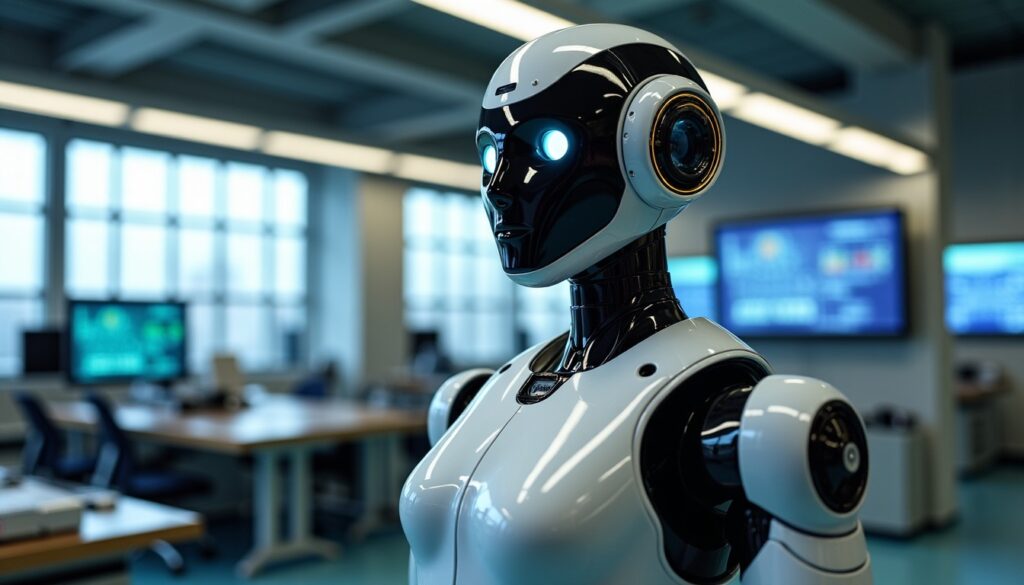
SoftBank, the Japanese technology investment giant, is ushering in a new era in the industry of the future with the launch of Roze AI, an innovative company dedicated to robotics and data center automation. This initiative marks a major strategic shift for the group, which no longer limits itself to supporting high-growth start-ups but is directly engaging in the industrial field, relying on technological advances in artificial intelligence to profoundly transform the value chain. The gem of this ambition? A spectacular valuation of around 100 billion dollars, or several billion euros, anticipated as early as 2026 during its IPO in the United States.
At the heart of this revolution is the automation of physical platforms serving as the foundation for artificial intelligence. With the rise of generative models and autonomous agents, the demand for high-performance infrastructures continues to grow, exacerbated by the need to rapidly deploy sophisticated server farms. Roze AI thus aims to drastically reduce traditional costs and timelines by integrating autonomous robots to build large-scale data centers. This project, which follows a logic of technological disruption, makes SoftBank a key player in the development of future technologies.
- 1 Roze AI: robotic innovation serving the industry of the future
- 2 A strategic bet: valuation of 100 billion euros targeted from the IPO
- 3 The challenges of data center automation by Roze AI
- 4 Economic and industrial impacts on the global market
- 5 Roze AI facing competition and technological challenges
- 6 A new era for the physical infrastructure of artificial intelligence
- 7 SoftBank: pioneer in investment in robotics and technological innovation
- 8 Roze AI’s prospects in a market undergoing transformation
Roze AI: robotic innovation serving the industry of the future
The creation of Roze AI perfectly illustrates SoftBank’s bold strategy to establish itself at the crossroads between robotics, artificial intelligence, and heavy industry. Unlike traditional passive financing approaches, the Japanese group here chooses to invest directly in the construction of IA-essential infrastructures, thus transforming how data centers are designed and operated.
Traditionally, building a data center is a complex, laborious process highly dependent on human resources. Construction, assembly, deployment, and maintenance require months, even years, with margins of error and considerable costs. Roze AI focuses its efforts on automating this chain, integrating advanced robotic technologies capable of executing physical tasks with increased efficiency and precision.
The autonomous robots developed by Roze AI are not mere mechanical aids but intelligent systems, capable of interacting with their environment, adapting their operations in real time, and coordinating with each other to accelerate industrialization. This next-generation robotics relies on machine learning and advanced sensors to reduce risks and ensure optimal performance in building data centers.
The impact on the supply chain and industrial productivity is considerable: Roze AI is demonstrating that seamless integration between artificial intelligence and robotics can revolutionize a sector until now scarcely automated and particularly sensitive to logistical constraints.
A strategic bet: valuation of 100 billion euros targeted from the IPO
The announced valuation for Roze AI represents an extraordinary challenge in the universe of start-ups and industrial spin-offs. SoftBank aims to make this entity an unavoidable player on the global stage by carrying out an IPO of exceptional scale. 100 billion dollars, or nearly 100 billion euros, is an estimate that underlines SoftBank’s confidence in the future of robotics applied to the digital infrastructure sector.
However, this valuation, impressive as it is, also raises questions. Skeptics, including within the group itself, question the precocity of this timetable and the project’s readiness. Roze AI is still a young company, with technology in full development. The Financial Times and the Wall Street Journal report internal tensions and some skepticism about the feasibility of such a valuation in the short term.
Yet, considering market dynamics and the exponential demand for data centers worldwide, SoftBank’s approach appears as a visionary investment, aiming to capture a vast share of a rapidly expanding market.
| Criterion | Description | Estimated Impact |
|---|---|---|
| Robotic automation | Reduction of construction times and costs | Increase in industrial productivity from 30% to 50% |
| AI integration | Optimization of operations through machine learning | Improved accuracy and safety |
| Technological innovation | Development of next-generation autonomous robots | Durable competitive positioning against rivals |
| Ambitious IPO | Valuation estimated at 100 billion dollars as early as 2026 | Major attraction for investors and partners |
The challenges of data center automation by Roze AI
In a context where digital and artificial intelligence are becoming key drivers of global economic transformation, the ability to build and maintain efficient data centers becomes crucial. Roze AI tackles a fundamental problem: how to reduce construction costs and times in order to keep pace with the relentless demand for computing power?
The use of autonomous robotics helps reduce dependence on labor, which is often costly and subject to human constraints (availability, errors, fatigue). Shortened timelines enable faster production deployment, ensuring a quicker return on investment for market players, whether hyperscalers or public institutions.
This industrial revolution represented by Roze AI responds to several priorities:
- Accelerate the construction of essential digital infrastructures to remain competitive.
- Standardize processes to guarantee consistently high quality despite large volumes.
- Reduce the carbon footprint of construction sites thanks to less use of traditional heavy machinery.
- Lower operational and human costs while maintaining high flexibility.
By deploying these innovations in its operations, SoftBank sets an example of industrial modernization that could inspire other sectors facing similar automation and scaling challenges. The complementarity between software AI and physical robotics thus propels the industry of the future towards new horizons.
Economic and industrial impacts on the global market
The launch of Roze AI can only be understood in the light of the spectacular rise of the digital economy and the increasing dependence on cloud infrastructures. In terms of investment and innovation, SoftBank highlights a model that could disrupt the dynamics of electricity, telecom, and data storage.
At a global scale, several major trends reinforce SoftBank’s vision:
- The exponential growth in AI needs: the development of generative AI and the multiplication of applications massively increase the demand for computing power.
- The diversification of players: not only hyperscalers like Google, Amazon, or Microsoft, but also governments and institutions seek to develop their own infrastructures.
- A context of geopolitical uncertainty pushing to strengthen digital sovereignty through local automated infrastructures.
Within this framework, Roze AI appears as a key piece capable of offering an innovative response to critical supply and speed execution challenges. For the global industry, this model opens the door to broader automation, combining advanced robotics and artificial intelligence, which could reshape the production and deployment contours of digital infrastructures.
Roze AI facing competition and technological challenges
While SoftBank’s initiative is attracting much attention, it is also part of a fierce race where several global players bet on automation and AI to transform industry. Projects like Project Prometheus, backed by Jeff Bezos, show that robotics in heavy industry is a trend to watch.
Roze AI’s ability to impose its solutions will depend on its aptitude to meet several challenges:
- Technological mastery: developing truly high-performing autonomous robots in often complex and evolving environments.
- Integration of artificial intelligence: being able to connect physical systems with decision-making intelligences in real time for immediate responsiveness.
- Cost reduction: finding a balance between innovation and economic profitability to attract a wide range of clients.
- Industrial ecosystem: building a solid partnership network encompassing suppliers, operators, and end customers.
However, the complementarity of technologies and the capacity to adapt will be decisive. Roze AI will have to leverage SoftBank’s past lessons, including failed investments like Zume, to embark on a more sustainable and robust model.
A new era for the physical infrastructure of artificial intelligence
The rise of AI technologies is no longer limited to algorithms and software platforms. In 2026, the true frontier is now physical infrastructure capable of supporting these tools. Roze AI embodies this shift by enabling intelligent industrialization of data centers, which until now suffered from high costs and interminable delays.
This challenge goes beyond the simple technical scope. It also involves rethinking logistics, industrial standards, and the supply chain around a unified vision where technology optimizes every step. This revolution could pave the way for similarly significant innovations in other sectors, such as medical robotics, aerospace, or ecological construction.
SoftBank: pioneer in investment in robotics and technological innovation
SoftBank’s trajectory testifies to an ambitious and often visionary investment strategy. With a portfolio including dozens of promising start-ups, the group has gradually established itself as a key player in robotics and the industry of the future.
Its ability to detect and value innovations has allowed it to invest early in several major trends, including physical robotics and industrial automation. The creation of Roze AI fits this logic, positioning SoftBank not only as a financier but also as a direct creator of industrial value.
This approach carries risks, as some past failures show, but it remains a source of inspiration for the sector. The bet on Roze AI is all the more strategic as it seeks to define a new standard likely to transform the global landscape of robotic infrastructure dedicated to artificial intelligence sustainably.
Roze AI’s prospects in a market undergoing transformation
As the AI and robotics market continues to intensify, Roze AI positions itself as a key element of the upcoming industrial transformation. Autonomous robotics for data center construction represents a true field of opportunities where technical innovation rhymes with gains in economic efficiency.
Investors, whether institutional or private, are closely monitoring this development. With an expected valuation of 100 billion dollars, Roze AI could well become SoftBank’s next gem, symbolizing the success of an investment strategy based on the union of high technology and traditional industry.
In conclusion, SoftBank’s initiative with Roze AI illustrates the profound mutation of the industry towards intelligent automation and an explosion of infrastructural capacities. This dynamic marks the advent of a new era where robotics and artificial intelligence shape the industry of the future on a global scale.