
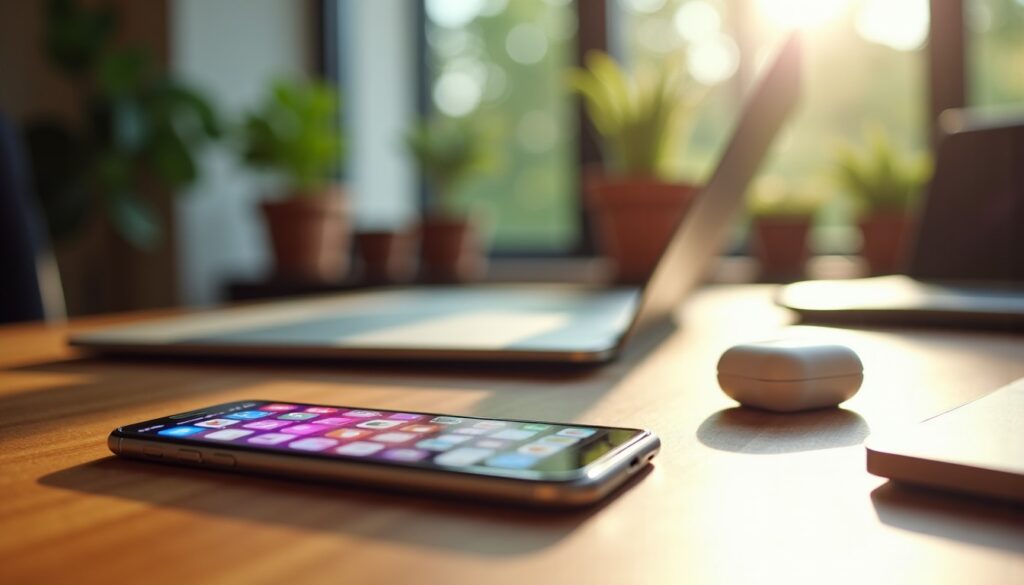
For more than 18 years, iOS has established itself as one of the most influential and innovative mobile operating systems on the market. Initially launched with the very first iPhone in 2007, it has undergone numerous evolutions to adapt to the growing expectations of users in terms of performance, ergonomics, features, and especially privacy protection. If in 2026 the popularity of iOS remains strong, it is largely thanks to Apple’s technological mastery, its secure App Store, and the regular iOS updates that continuously enrich the user experience.
With its ability to integrate advanced artificial intelligence technologies while ensuring iOS security and personal data protection, the system today stands as an essential platform for both individuals and professionals. At the same time, the user interface has evolved to offer optimal accessibility, while Apple’s extended ecosystem, notably including the iPad and connected watches, revolves around this same core software.
In this article, we dive deeply into the complete world of iOS, exploring its origins, technical specifics, recent innovations, as well as its impact on how we use our mobile applications every day. We also reveal why this platform remains an undisputed leader in the mobile operating systems market.
- 1 The historical foundations and evolution of Apple’s iOS operating system
- 2 User interface: the Liquid Glass design, immersion, and tactile experiences in 2026
- 3 The central role of mobile applications in the Apple ecosystem and their development under iOS
- 4 Integrated artificial intelligence and Core ML: the silent revolution in iOS
- 5 Major perspectives and innovations presented in iOS 26.3
- 6 iOS security: best practices and innovations to protect your data
- 7 The Apple ecosystem and the complementarity between iPhone, iPad, and other iOS devices
- 8 Siri and voice assistants: voice innovations and enhanced privacy under iOS
The historical foundations and evolution of Apple’s iOS operating system
The iOS adventure truly begins in January 2007, when Steve Jobs presents the very first iPhone to the public at Macworld. At that time, the system, then named iPhone OS, dazzled with its innovative touch interface and multi-touch interaction, a real turning point compared to the physical keyboards and resistive screens predominant on smartphones of the time.
Despite limited features at the start and the absence of a true app store, Apple revolutionized the market by launching the App Store in 2008. This virtual store initially had about 500 applications, but its growth proved exponential. By the end of 2025, more than 1.9 million applications compatible with iOS are counted, covering all imaginable categories: productivity, games, health, education, and many others.
The continuous integration of technologies, such as the arrival of voice recognition with Siri in 2011, or the adaptation of the system for derivative products like the Apple Watch (launched in 2015 under watchOS, based on iOS), demonstrates Apple’s desire to build a coherent and powerful ecosystem. In parallel, education around iOS development has structured itself, notably with the creation in 2016 of the iOS Developer Academy, accessible for free and responding to the growing demand for developers specialized in this environment.
These historical evolutions have shaped a robust system but always in motion, where each major update, like the current iOS 26.3 released in February 2026, brings its share of improvements, both visually and in terms of performance and security.
User interface: the Liquid Glass design, immersion, and tactile experiences in 2026
One of the strengths of iOS since its inception is its user interface, designed to be intuitive, fluid, and pleasant to use. The latest update, iOS 26.3, introduces the Liquid Glass technology, a specific cutting-edge visual interface that pushes even further the immersive experience offered by Apple.
Based on a semi-transparent and deformable interface, Liquid Glass dynamically responds to gestures and content displayed on the screen. Transitions are thus more natural, while the screen now hosts spatial scenes, transforming 2D photos into interactive 3D images thanks to the powerful Neural Engine integrated in Apple Silicon chips. This innovation offers users new ways to interact with their memories and applications.
On the home screen, users find the ability to easily manage icons, widgets, and shortcuts, adapted to optimize productivity and user enjoyment. Accessibility has also been improved, with enhanced options for visually or hearing-impaired users, thanks to features such as VoiceOver, which reads screen content aloud, as well as expanded Bluetooth pairing with all compatible accessories, strengthening universal connectivity.
Finally, iOS 26 offers several ways to easily access important content via Spotlight, whether through simple gestures on the home or lock screen, or via the Home button available on certain models. These small optimizations help make the system even smoother and better adapted to contemporary uses.
- Liquid Glass: Semi-transparent and deformable interface for a smooth visual experience
- Spatial scenes: Transformation of 2D images into interactive 3D views
- Improved accessibility: VoiceOver and expanded support for Bluetooth accessories
- Multiple Spotlight access: Gestures on home screen, lock screen, and Home button
The central role of mobile applications in the Apple ecosystem and their development under iOS
The heart of the iOS experience is based on the richness of its catalog of mobile applications. Thanks to the App Store, Apple rigorously controls the available software, ensuring their compliance with high quality and security standards, which contributes to user trust.
iOS applications can be developed with Apple’s official software development kit (SDK), mainly using Swift and Objective-C languages. The creation process is assisted with the Xcode environment, now in version 18, which offers advanced tools such as the real-time 3D viewer of Core ML to optimize artificial intelligence models integrated into applications.
In 2026, Apple also gives particular attention to promotional push notifications. These are possible only if the user gives informed consent through a clear opt-in interface, which must also allow easy opt-out. This approach demonstrates Apple’s commitment to user data protection, while leaving the door open to respectful marketing.
The potential offered by the iOS platform is not limited to native apps but extends to integrated services, such as Spotlight, allowing quick searches of documents, emails, or applications, and Siri which, with its enhanced natural contextual voice in 2026, offers a more human and personalized voice interaction. The latter retains its on-device processing, ensuring better data privacy.
Integrated artificial intelligence and Core ML: the silent revolution in iOS
The integration of artificial intelligence is now a central pillar of iOS. Apple designed Apple Intelligence, an engine that exploits machine learning and natural language processing to improve not only the system’s operation but also the applications running on it.
One of the decisive tools is Core ML, Apple’s machine learning platform, revamped with Xcode 18. This update introduces a real-time 3D interface that allows developers to observe neural metrics and the performance of the Neural Engine directly during testing and deployment phases. A key point is the new API for dynamic deployment of Core ML models that allows updates independently from app updates themselves, thus facilitating maintenance and evolution of AI services.
To strengthen the security of data trained into these models, Apple introduced encryption of Core ML models, previously vulnerable to illicit retrieval. This encryption ensures that models embedded in apps remain protected against unauthorized extraction, in line with the importance given to iOS security.
These technologies enable an infinite number of practical possibilities. For example, PencilKit, a drawing framework added since iOS 13, now benefits from machine learning to offer a more responsive and intelligent drawing experience, adapting handling to each user’s habits.
- Core ML 3D live preview and Neural Engine metrics
- Dynamic deployment API for independent updates
- Encryption of Core ML models for confidentiality
- Improved apps with machine learning (e.g. PencilKit)
Major perspectives and innovations presented in iOS 26.3
Version 26.3, distributed from February 2026, brings significant developments that position iOS even further ahead in the mobile technology race. One of the most visible is the simplified integration of the universal transfer function to Android, a first for Apple, which facilitates migration for users wishing to switch ecosystems.
Furthermore, the expansion of third-party watch compatibility in the European Union under the MFi program demonstrates an effort to respect European standards of interoperability and ease of use. This is a significant advance for consumers who want to diversify their accessories while remaining within the Apple universe.
The Liquid Glass design and immersive wallpapers constitute a major aesthetic evolution, making the visual experience more attractive while benefiting from the increased capabilities of the A17 Pro chip, now required to fully enjoy the most advanced integrated AI functions.
Finally, the update also includes a series of essential security patches that strengthen protection against classic attacks, notably phishing, which remains a constant threat. This vigilance illustrates that iOS security retains a central place in the continuous development of the system.
| Feature | Description | User impact |
|---|---|---|
| Universal transfer to Android | Simplified migration of iOS data to Android | Reduces barriers between ecosystems, more freedom |
| Third-party watch compatibility in Europe | Expanded access to third-party Bluetooth accessories on iOS | More choice and flexibility for users |
| Liquid Glass and immersive wallpapers | Enhanced visual interface with 3D effects | Richer and more immersive user experience |
| Security patches | Improved protection against phishing and malware | Strengthens trust and usage peace of mind |
iOS security: best practices and innovations to protect your data
The reputation of iOS in terms of iOS security is based on strict principles and a software architecture designed to isolate applications and protect sensitive information. But faced with increasing threats, users and professionals must adopt certain good practices.
First, enabling two-factor authentication (2FA) is an essential mechanism to secure access to Apple accounts and other related services, drastically limiting identity theft risks. This second identification step reduces targeted attacks and improves defense against hackers.
Limiting the number of installed applications also helps control the attack surface, as each additional app can potentially expose vulnerabilities. It is crucial to favor recognized solutions that are regularly updated by their developers.
Biometric authentication methods – Touch ID and Face ID – remain among the recommended methods, offering a good balance between security and quick access. As the latest iOS versions attest, Apple also invests in the robustness of these mechanisms.
For professional users, there are dedicated solutions, such as mobile application management (MAM) platforms. These solutions allow deployment and management of specific apps in enterprises without going through the public App Store, thus reducing risks of attacks linked to installation of unsecured apps.
Finally, remaining vigilant against phishing attempts is indispensable. There are several warning signs to recognize, such as suspicious links, unsolicited requests for personal information, or errors in message wording. Apple recommends verifying sources before interacting with suspicious content, or even contacting the referring entity directly to validate message authenticity.
- Enable two-factor authentication (2FA)
- Limit applications to reduce attack surface
- Use biometric authentication (Face ID, Touch ID)
- Use MAM platforms for enterprise applications
- Be wary of phishing attempts and verify sources
The Apple ecosystem and the complementarity between iPhone, iPad, and other iOS devices
Apple’s strength is not only based on the power of a mobile operating system like iOS, but also on the seamless interconnection between its various devices. The iPhone, iPad, Apple Watch, and even Macs work together within a coherent and synchronized ecosystem, sharing data, notifications, and applications.
While iOS remains the base, iPadOS specialized in 2019 to offer an improved experience on tablets, with advanced features to exploit multitasking and optimize the use of the Apple Pencil. The standard mobile operating system keeps its focus on simplicity and responsiveness for smaller-sized devices.
This complementarity allows users to start a task on the iPhone and continue it on the iPad or Mac thanks to the Handoff feature, for example. Calls and messages can also be transferred between devices. This synergy is a major advantage for Apple compared to competitors by offering a smooth and integrated experience.
Moreover, updates are deployed synchronously, ensuring feature consistency across the entire ecosystem. The introduction of Apple Intelligence also enables leveraging AI capabilities across all devices, enhancing personalization and productivity.
| Apple device | Operating system | Major features |
|---|---|---|
| iPhone | iOS | Ergonomic interface, calls, messaging, Siri |
| iPad | iPadOS | Advanced multitasking, Apple Pencil, large screens |
| Apple Watch | watchOS | Health tracking, notifications, Siri voice commands |
| Mac | macOS | Productivity, development, multimedia creation |
Siri and voice assistants: voice innovations and enhanced privacy under iOS
Siri, Apple’s iconic voice assistant, has undergone a fundamental transformation since its debut in 2010. Initially available as a standalone app, it was integrated from the iPhone 4S in 2011, becoming an indispensable companion for many daily tasks.
In 2026, Siri version 4.0 benefits from a neural voice enriched with more than 20 intonations and local accents. This technology improves context understanding, expressing emotions for more natural responses. The assistant is now capable of performing entirely on-device processing, meaning your voice data does not leave your device, thus enhancing privacy.
The gradual opening to third-party services since iOS 10 allowed integrating Siri into many messaging, payment, or transportation apps, although under Apple’s strict control to avoid compromising security or privacy. Today, this balance between innovation and protection is perfectly embodied in the use of Apple Intelligence, enabling continuous learning of user habits while respecting the highest privacy requirements.
This marriage between advanced voice technology and respect for privacy sets Apple apart in a market where massive data collection has become a sensitive issue, offering users a reliable and efficient solution they can use daily.