
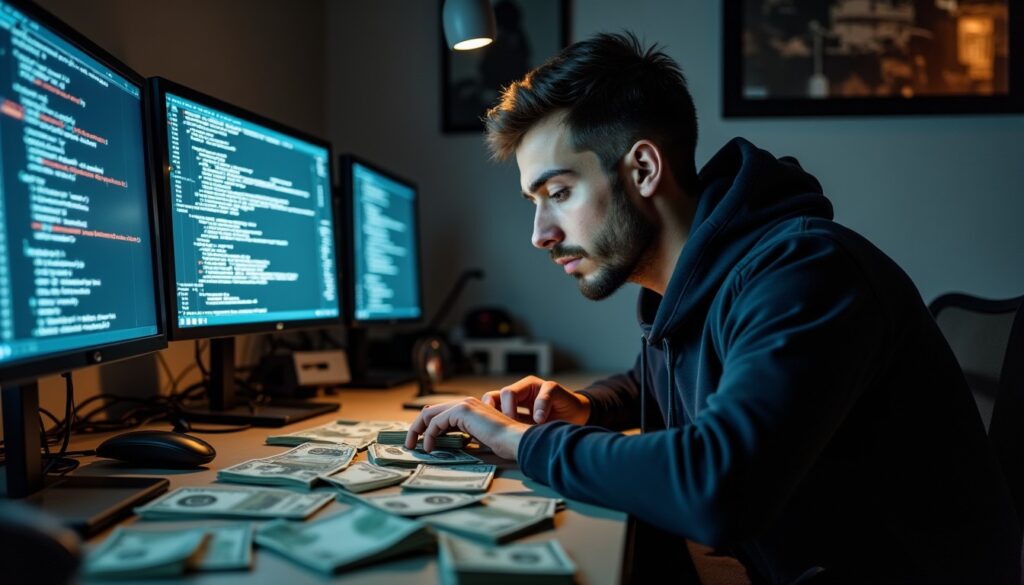
In a context where technology evolves rapidly, cybercrime adapts its methods to bypass IT security systems. Hackers now exploit artificial intelligence (AI) to create counterfeit banknotes with impeccable appearance, exacerbating the phenomenon of banking and monetary fraud. In 2026, this advanced use of AI raises a major alert among cybersecurity experts and financial institutions. Between digital counterfeiting and sophisticated manipulations, consumers find themselves at the crossroads of a still little-known but extremely effective danger. Scams continue to diversify, notably by combining fake invitations or falsified documents to better trap victims. This threat broadens the spectrum of risks related to counterfeit banknotes and calls for increased vigilance around all cash or digital transactions, demonstrating that the fight for IT security is more crucial than ever.
AI-generated counterfeit banknotes: a new threat to economic security
The exponential development of artificial intelligence has enabled hackers to perfect the creation of counterfeit banknotes, blending impressive realism to the point of deceiving even seasoned professionals. These digital forgeries are no longer simply crude copies; AI is capable of reproducing the smallest details of authentic banknotes: the paper texture, watermarks invisible to the naked eye, specific colors, and even some dynamic security elements. This sophistication leads to an increase in monetary fraud and complicates the task of controllers in exchange offices, banks, and shops.
A recently reported case in Maine-et-Loire illustrates this worrying evolution. An exchange office in Angers reported six victims in one week, all trapped by counterfeit banknotes whose resemblance to real euros was striking. These incidents underline the growing ingenuity of cybercriminals, who use complex algorithms to generate banknotes in series, reducing costs and risks related to traditional counterfeiting methods.
It is essential to note that the probability of encountering a counterfeit banknote is still low compared to the total number of legal banknotes in circulation. In 2024, approximately 554,000 counterfeit banknotes were withdrawn from the European monetary circuit, a minority figure but sufficient to inspire vigilance and prevention.
How AI revolutionizes counterfeit banknote creation
Artificial intelligence transforms not only the quality but also the distribution of counterfeit banknotes. For example, coordinated cybercriminal networks exploit AI-powered image generators to create models that are nearly undetectable. These files are then printed using professional equipment that reproduces the texture and holograms. Added to a perfect digital forgery, this technique sometimes includes QR codes or encrypted traceability devices to simulate banknote authentication.
This ultra-refined digital counterfeiting also relies on public and private databases concerning banknote security in order to feed AI with increasingly precise models. This process intensifies the technological arms race between hackers and cybersecurity services.
Recognizing a counterfeit banknote: traditional methods and limits facing AI
In the context of transactions, detecting counterfeit banknotes is a necessary skill for merchants, individuals, and authorities. Traditionally, the so-called touch-look-tilt method allows identifying several clues: a firm texture and a crisp sound of the paper, watermarks visible when tilting the note, as well as sharp and non-blurred prints. These principles remain relevant to discourage classic counterfeiters.
However, with the advent of AI in counterfeit banknote manufacturing, these manual checks show their limits. Banknotes generated with sophisticated AI supports can present textures very close to the original or imitate holograms with such fidelity that the naked eye is no longer enough. Consequently, many establishments are now equipped with electronic devices, such as UV readers, watermark detectors, and optical validators, which automatically analyze the banknotes’ authenticity.
Technological tools and practices to fight AI counterfeiting
To reinforce IT security around banknotes, several tools have emerged:
- Automatic UV readers: they reveal invisible marks integrated into the paper.
- Microprint analyzers: detect details too fine and precise to be reproduced by simple machines.
- Network scanning: identification of serial codes via databases to ensure traceability.
- Staff training: education on the recognition of authentic features and reflex gestures.
However, these devices are expensive and not accessible everywhere, particularly in small businesses. This leaves room for hackers who rely on low probability and victims’ ignorance to place their counterfeit banknotes without raising immediate suspicions.
| Traditional techniques | Limitations facing AI | Technological solutions |
|---|---|---|
| Touch the texture of the banknote | Texture mimicking the original by printing on special paper | UV readers and hologram analyzers |
| Look at watermarks | Holographic watermarks digitally reproduced | Automatic optical validation and databases |
| Tilt to see visual effects | Holographic and iridescent effects falsified by AI | Microprint analysis and specific luminance |
These innovations in security must be accompanied by personal vigilance to minimize the risk of fraud. This requires increased awareness both among the general public and professionals.
The rise of AI-generated fake invitations: a new trap by hackers
While the counterfeit banknote fraud is worrying, cybercriminals also exploit AI to launch new forms of scams. Recently, fake invitations created by artificial intelligence have been spreading massively in mailboxes. These messages feign a known origin — a former colleague, a forgotten friend, an acquaintance — and encourage clicking to discover an event or party. This method, described by Rachel Tobac, cybersecurity specialist, is particularly widespread during festive periods, exploiting the strong human need for social connection.
John Lantigua, a former journalist, was one of the victims of this tactic. Believing he was responding to a legitimate invitation, he clicked on a link promising additional details. In reality, this action introduced malicious software, compromising his personal data and allowing hackers to access his private network.
Clues to differentiate a legitimate invitation from an AI trap
Fake messages often resemble authentic platforms such as Paperless Post, Evite, or Punchbowl. However, they stand out by a lack of precise details in the event description, contenting themselves with vague or generic titles. Another warning comes from the sender whose profile does not exactly match usual contact habits. For example, an invitation coming from a former classmate you haven’t seen for years may seem suspicious.
Alexa Hirschfeld, founder of Paperless Post, emphasizes that this new form of fraud is not purely technical but exploits a psychological need: the desire to be included in a community or event. This natural vulnerability is the key used by hackers to propagate their attacks, making cybersecurity a battle against social manipulation.
The consequences of these scams often go beyond mere financial loss: they cause a sharp social divide, with widespread distrust towards invitations and a progressive isolation of suspicious individuals, which undermines the social fabric.
Best practices to protect yourself effectively against these AI scams
Faced with the rising power of counterfeit banknotes and AI-generated invitations, concrete measures can help limit risks. Whether in terms of IT security or individual vigilance, certain basic rules are indispensable to respect daily.
Here is an essential list of precautions to adopt:
- Never immediately click on a link received in an unexpected invitation, even if it seems to come from a known contact. First verify its authenticity by calling or sending a direct message.
- Use up-to-date antivirus and antispyware software to detect threats possibly hidden in links or attached files.
- Regularly train on new forms of phishing and digital scams to better identify the tactics used.
- Check suspicious banknotes by going to establishments equipped with specialized detection devices.
- Report scam attempts to concerned platforms or competent authorities to contribute to the collective fight against these frauds.
- Restrict access to personal data on social networks in order to limit hackers’ possibilities to replicate your identity or relationships.
| Preventive measures | Detailed description |
|---|---|
| Manual verification | Confirm any suspicious invitation by phone or in person before clicking on a link. |
| Software update | Regularly install the latest antivirus versions to benefit from improved protections. |
| Reporting | Inform platforms like Paperless Post and law enforcement about detected scam attempts. |
| Continuous education | Participate in workshops or follow educational content about new forms of cyberfraud. |
| Data protection | Limit the visibility of personal information on the Internet and social networks. |
These habits, durably integrated into our digital and monetary daily life, constitute the key to resisting traps devised by hackers using artificial intelligence.




