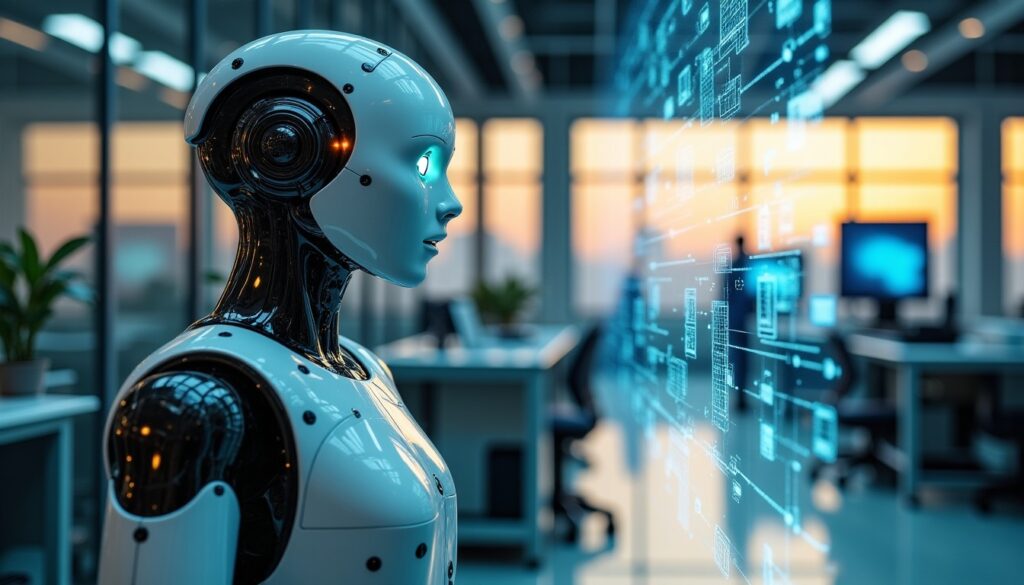
In a world where robotics and artificial intelligence are redefining every aspect of our reality, the year 2026 marks a decisive turning point with the introduction of Gemini Robotics-ER 1.6 by Google. This technological advancement is no longer limited to a simple execution of orders managed by fixed lines of code. It embodies the birth of a new generation of intelligent systems capable of integrating the physical complexity of their environment to act with unprecedented autonomy and precision. The software development of Gemini Robotics-ER 1.6 breathes a form of robotic thought, where the machine is no longer just a simple automaton but becomes a true active agent capable of embodied reasoning. This evolution revolutionizes automation in industrial sectors and beyond, pushing the boundaries between the machine and human intelligence.
While until now, robots were limited to following predefined instructions without awareness of their physical context, Gemini Robotics-ER 1.6 offers deep spatial understanding and visual logic that allow autonomous machines to navigate, analyze, and interact with their environment in a more adaptive way. Relying on cognitive science and advanced computer vision methods, this technological innovation offers unprecedented perspectives to improve the reliability, safety, and efficiency of robots in complex and realistic situations.
- 1 The foundations of robotic thought: how Gemini Robotics-ER 1.6 rethinks embodied artificial intelligence
- 2 A revolution in computer vision: multi-angle detection and instrument reading
- 3 Advanced integration for complex industrial applications
- 4 Enhanced safety and reliability thanks to Gemini Robotics-ER 1.6
- 5 Opening to developers and democratization of Gemini Robotics-ER 1.6
- 6 Concrete examples of using Gemini Robotics-ER 1.6 in various sectors
- 7 Future challenges of autonomous robotics with Gemini Robotics-ER 1.6
- 8 The secrets of successful automation thanks to the combination of Gemini Robotics-ER 1.6 and cognitive science
The foundations of robotic thought: how Gemini Robotics-ER 1.6 rethinks embodied artificial intelligence
Gemini Robotics-ER 1.6 represents a major breakthrough in robotics by integrating the concept of embodied reasoning, or “embodied reasoning”. Unlike previous generations, where robotic programming focused only on abstract calculations or logical chains, the ER 1.6 model combines digital intelligence with enhanced physical perception. This approach merges cognitive science with spatial manipulation, allowing the machine to understand and interpret its environment in real time.
The core of this technology relies on multi-view analysis and deep visual logic. For example, a robot equipped with the Gemini Robotics-ER 1.6 module can observe an object from different angles and identify the most effective grasping points with remarkable precision. This capability is far from anecdotal: in industry, choosing the right grip point directly influences the success of an assembly or handling operation, impacting the speed and safety of operations.
Beyond simple manipulation, the system also anticipates environmental constraints. It builds a dynamic mapping of possible trajectories taking into account obstacles, restricted access areas, and even interactions with other robots or humans. This cognitive-spatial ability marks a new step toward machines that think and adapt their actions, thus embodying intelligent robotic thought.
This dynamic is not limited to visual perception. Gemini Robotics-ER 1.6 also integrates a temporal dimension where the results of actions are continuously evaluated to validate the success of a task. This immediate learning loop makes machines more autonomous and enables them to refine their action strategy based on feedback received, optimizing every movement.
For example, in an automotive assembly line, a robot equipped with this technology can recognize a misplaced part, recalculate its approach, and adjust its gesture without human intervention. This progressive autonomy paves the way for smoother collaboration between humans and machines, where the robot actively participates in operational complexity.
A revolution in computer vision: multi-angle detection and instrument reading
Computer vision represents one of the cornerstones of Gemini Robotics-ER 1.6. In 2026, while most robots still rely on a single view or partial sensory data for their decisions, this new system exploits a network of cameras and sensors capable of providing a panoramic and simultaneous view of environments.
This multi-view technology brings increased precision in reading visual scenes. Thanks to the aggregation of data from multiple perspectives, robots can build a faithful and complete 3D representation of their operational framework. The real-time processing of these images makes it possible to detect and locate objects with unprecedented accuracy, whether it is a moving part, a tool, or even a moving obstacle.
An equally crucial aspect concerns the integration of an advanced ability to read instruments and gauges, previously reserved for trained human operators. This functionality is based on a partnership with Boston Dynamics, and now allows robots to visually interpret analog and digital indicators during delicate operations.
This is a strategic advancement in the industrial domain, as fine reading and monitoring of instruments are essential to maintain quality, safety, and compliance in production processes. For example, a robot can now adjust a machine in real time based on pressure or temperature measurements on a dial, acting with increased responsiveness and reliability.
This ability to combine visual instrument tracking with the system’s decision logic opens the way to more flexible and autonomous automation scenarios, bringing machines closer to fine human expertise.
| Feature | Description | Industrial impact |
|---|---|---|
| Deep visual logic | Precise identification of multi-angle grasping points | Optimization of handling and reduction of errors |
| Synchronized multi-view vision | Dynamic 3D reconstruction of environments | Better robotic planning and navigation |
| Reading of analog instruments | Real-time interpretation of gauges and indicators | Precise automation of critical adjustments |
| Task success detection | Autonomous validation and adjustment of actions | Continuous improvement of operational performance |
Advanced integration for complex industrial applications
The software development of Gemini Robotics-ER 1.6 does not just improve perception; it also brings superior logic in robotic task planning and execution. Thanks to high-level reasoning modules, the system can orchestrate a complete sequence of actions, taking into account previous results and environmental forecasts.
In sophisticated industrial environments, where coordination of multiple machines is critical, this advancement enables robots to adjust their behavior to the slightest change or unexpected event. Take the example of an automated pharmaceutical factory: if a component is non-compliant or an upstream machine slows down, Gemini Robotics-ER 1.6 automatically recalibrates the pace and operations, avoiding costly blockages and ensuring product quality.
This intelligent system also uses external tools, such as real-time search functions, specialized databases, and expert modules to integrate refined domain knowledge. This interoperability makes automation more robust and adaptable to the unique challenges of each industrial sector.
For example, in logistics, robots equipped with Gemini Robotics-ER 1.6 not only manage package handling but also anticipate storage conditions and flux dynamics to ensure optimal sequencing of operations.
This new generation of autonomous machines represents a major step for Industry 4.0, where the convergence of robotics, artificial intelligence, and connectivity promotes more agile and sustainable production.
Enhanced safety and reliability thanks to Gemini Robotics-ER 1.6
In the field of robotics and artificial intelligence, one of the major issues remains safety, especially when machines operate in shared spaces with humans. Gemini Robotics-ER 1.6 addresses this concern by integrating advanced mechanisms to ensure safe and reliable interaction.
Real-world testing shows that this model reaches a higher level of compliance during complex spatial reasoning scenarios. The system is capable of anticipating ambiguous or delicate situations and adapting its actions without losing control. For instance, a robot operating near a human operator instantly detects the presence and modifies its trajectory to avoid any collision.
This improvement is all the more crucial in industrial environments where human-machine collaboration becomes the norm to optimize performance and maintain safety. Gemini Robotics-ER 1.6 thus reduces the risk of accidents related to calculation errors or perception failures.
The device also benefits from continuous diagnostic systems, an innovation that enables proactive monitoring of robotic components and decision algorithms. This allows anticipating malfunctions before they occur, thereby minimizing interruptions and operational risks.
For example, in an automotive production line, a robot that detects an anomaly in its control circuit can immediately suspend its actions and report the situation to operators for intervention, preventing a potential incident.
Opening to developers and democratization of Gemini Robotics-ER 1.6
Google has made the strategic decision to make Gemini Robotics-ER 1.6 accessible to developers via a powerful and intuitive API. This choice encourages rapid experimentation and integration into a wide variety of projects, from domestic robotics to advanced industrial robotics.
Thanks to this interface, development teams can customize the model’s features to meet specific needs, test scenarios in real conditions, and continuously deploy tailored updates. The tools offered by Google AI Studio complement this approach by providing a graphical and collaborative platform to explore the model’s capabilities and accelerate innovation.
This democratization strengthens the intelligent robotics ecosystem by facilitating access to cutting-edge technology. For example, a start-up specializing in automated logistics has improved its systems thanks to the Gemini API, increasing the accuracy of robotic gestures while reducing downtime.
This openness also stimulates collaborative research, promoting advances at the crossroads of robotics, cognitive science, and applied artificial intelligence.
Concrete examples of using Gemini Robotics-ER 1.6 in various sectors
To better understand the concrete impact of the intelligent robotic thought embodied by Gemini Robotics-ER 1.6, it is interesting to observe current use cases in several fields:
- Automotive: assembly robots capable of detecting subtle variations in parts’ positions, adjusting their action in real time to guarantee perfect assembly.
- Precision agriculture: autonomous machines monitoring crops, adapting to soil and plant conditions to optimize irrigation and harvesting.
- Logistics: intelligent robots managing stocks in dynamic warehouses, anticipating flow variations and reorganizing their movements to maximize efficiency.
- Energy: inspection robots capable of reading pressure and temperature indicators on critical installations, intervening quickly in case of anomaly.
- Domestic robotics: intelligent assistants capable of manipulating complex objects and interacting with humans in varied and changing environments.
These illustrations show how technological innovation driven by Gemini Robotics-ER 1.6 is transforming the way machines collaborate with humans, bringing a new dimension to embodied artificial intelligence and automation.
Future challenges of autonomous robotics with Gemini Robotics-ER 1.6
The introduction of Gemini Robotics-ER 1.6 also triggers deep reflection on the ethical, regulatory, and social challenges of autonomous robotics. With the emergence of machines capable of reasoning and adaptation, it becomes essential to define clear frameworks to govern their use and interactions.
On the technological front, the push toward ever smarter systems raises the question of responsibility in case of malfunctions or incidents. Safety is currently at a very high level with Gemini Robotics-ER 1.6, but dialogue between designers, users, and regulators must continue to anticipate new challenges.
Moreover, the rise of autonomous machines questions forms of collaboration between artificial intelligence and human intelligence. The focus is now on thinking about coexistence and intelligent interaction rather than simple substitution.
In this respect, research in cognitive sciences accompanies the development of Gemini Robotics-ER 1.6 to more finely model decision-making and emotional processes, leading robotics toward horizons where empathy and social understanding could also be integrated.
Finally, the rise of this technology highlights the importance of investing in training for the jobs of tomorrow, emphasizing the skills needed to supervise, program, and collaborate efficiently with these new autonomous machines.
The secrets of successful automation thanks to the combination of Gemini Robotics-ER 1.6 and cognitive science
At the heart of the exceptional performance of Gemini Robotics-ER 1.6 lies the convergence of several disciplines, notably cognitive science, which provides the key to understanding and modeling the complex structures of human reasoning applied to robotics.
Traditional robotics relied on strictly logical programs without integrating the flexibility needed when facing unforeseen situations. Gemini Robotics-ER 1.6 introduces a framework where machines learn to reason contextually, solve concrete problems, and adapt to evolving conditions on the ground.
This model is supported by advanced algorithms that use sensory data to create a dynamic representation of the environment and simulate the consequences of each proposed action. This cognitive loop enables anticipatory reasoning, critical in complex tasks such as assembly, maintenance, or navigation.
A decisive step toward intelligent automation lies in the machine’s ability to instantly validate the success of each step, a feature that drastically reduces trial-and-error cycles and optimizes processes. This guarantees increased fluidity and robustness in the execution of operations.
Here are some key elements illustrating this approach:
- Enhanced perception: multi-modal integration of visual, tactile, and spatial data.
- Integrated reasoning: cognitive modeling allowing cause and effect association in action.
- Adaptive learning: automatic adjustment of strategies over experience.
- Precision control: real-time adjustment of movements and actions.
- Proactive safety: anticipation and management of risks in shared environments.
These components, combined with the power of Gemini Robotics-ER 1.6, radically transform the possibilities offered by industrial robotics and beyond, establishing a true intelligent robotic thought.