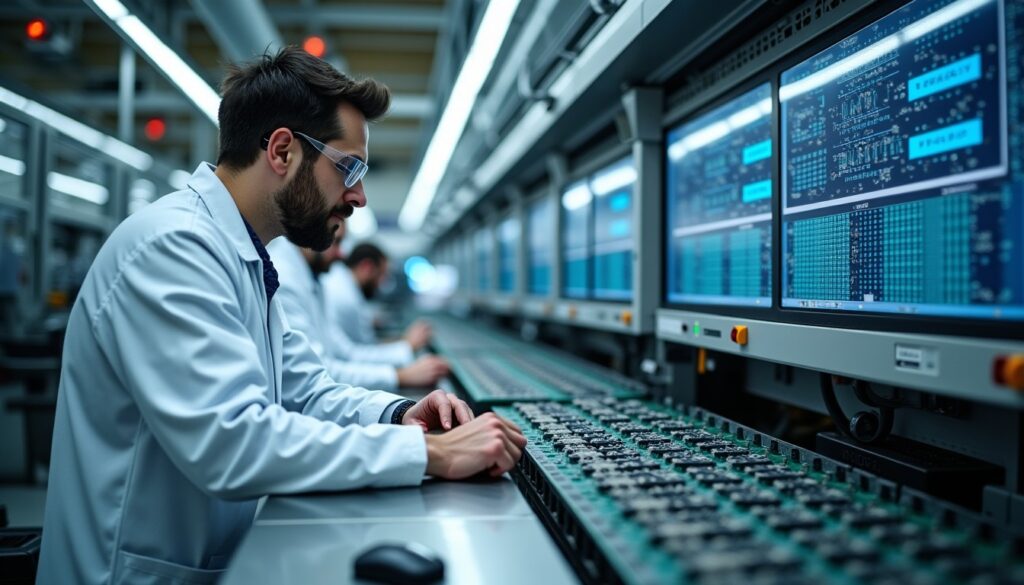
In a world where digital technology imposes itself at every moment, the random access memory, or RAM, has become the invisible yet indispensable pillar of our technologies. Whether to support generative artificial intelligence models whose demand is exploding, power the cloud servers driving the global economy, or boost the responsiveness of our gaming consoles and personal computers, RAM ensures a phenomenal data access speed. Yet behind this performance lies extreme industrial complexity, a true microelectronic feat where each RAM stick is the result of a sequence of gigantic processes, defying the limits of physics and requiring extraordinary expertise. This odyssey begins with a humble grain of quartz to transform into components capable of performing billions of operations per second with exceptional reliability. In 2026, as technologies continue to evolve and geopolitical issues impact production, understanding the steps, constraints, and innovations in RAM manufacturing sheds light on the reasons for soaring prices and colossal challenges faced by the industry.
RAM production today is dominated by a few industrial giants, concentrated in a handful of colossal factories called Fabs, true technological cathedrals costing tens of billions of dollars. This concentration, combined with the sophistication of techniques like extreme ultraviolet (EUV) lithography, explains not only the high costs but also the rigidity of the market. Each wafer, cut into ultra-thin slices and polished to atomic roughness, must be engraved with unimaginable precision to guarantee memory density, circuit integration, and component reliability. In this article, we explore these technical and industrial challenges in detail, revealing how the conquest of silicon and the concern to reduce energy consumption will undoubtedly limit future advances while paving the way for new generations of memory.
- 1 The RAM manufacturing process: absolute mastery of microelectronics at the atomic scale
- 2 RAM manufacturing plants: industrial giants at the heart of cutting-edge technology
- 3 Physical constraints and economic challenges of RAM production in 2026
- 4 Technological innovations and memory RAM prospects in the face of current limits
- 5 Impact of technical challenges on the global RAM market and its availability in 2026
The RAM manufacturing process: absolute mastery of microelectronics at the atomic scale
The transformation of a simple grain of sand into a RAM stick is far from trivial. It begins with the extreme purification of silicon derived from quartz, an abundant material whose purity must reach almost perfect levels. Indeed, for silicon to withstand microelectronic processing, even one foreign atom per billion can compromise electrical conductivity and thus chip reliability. This level of demand is fundamental because access speed and circuit integration will depend directly on this impeccable purity.
The Czochralski process, an industrial ballet, then produces a monocrystalline silicon ingot, perfectly ordered on an atomic level. This cylinder weighing over a hundred kilos is the essential raw material destined to be cut into wafers—ultra-thin disks 300 mm in diameter. Polished to the extreme, these slices must offer roughness less than the thickness of a molecule to allow photolithographic engraving of unparalleled precision.
Each wafer is the ground for a tough technical battle. By engraving billions of tiny structures using EUV lithography, manufacturers face fascinating optical challenges. Light at 13.5 nanometers is so sensitive that it must operate in a total vacuum environment, shielded from the slightest impurities. The mirrors used are the smoothest ever designed to direct this fragile beam with unmatched acuity. This photolithographic engraving process is the key to achieving ever-higher memory density.
Moreover, engineers display ingenuity to maximize the available space on each chip. As component sizes shrink toward the nanometer scale, the capacitors in DRAM cells develop in three dimensions to preserve sufficient electrical capacity without increasing surface area. This vertical stacking process with trench etching is an industrial goldsmithing feat and represents an additional challenge in circuit integration.
Manufacturing a single chip requires between 50 and 70 delicate steps including oxidation, ion implantation, etching, deposition, metallization, and testing. The pressure to maintain impeccable component reliability is enormous, as any defect invisible at first glance can cause a fatal flaw. This extreme care leads to very high manufacturing costs, partly explaining the price of today’s RAM sticks.
RAM manufacturing plants: industrial giants at the heart of cutting-edge technology
RAM manufacturing requires expertise and extraordinary industrial investment. These factories, called Fabs, resemble technological cathedrals more than typical industrial zones. Designing and building a modern Fab represents a true economic and technical feat, with costs estimated between 15 and 25 billion dollars for a facility capable of producing DRAM according to current standards.
At the heart of these Fabs, ultra-specialized equipment dominates the production chain. EUV scanners, manufactured by the Dutch company ASML, are among the most expensive machines in the world: a single unit can exceed 350 million dollars and requires several Boeing 747 aircraft for delivery. These devices determine the ability to perform nanometric engravings, guaranteeing high memory density while preserving component reliability.
The control of the manufacturing environment is also crucial. Cleanrooms filter the air until it is a thousand times purer than in an operating room, to avoid any contamination that could cause chip defects. Wafers are never handled directly by operators; they circulate in automated, hermetic containers called FOUPs, which move on ceiling rails, ensuring a nearly autonomous chain.
Despite this sophistication, specialized production lines lack flexibility. It is impossible to quickly switch from one type of DRAM to another (such as from DDR4 to DDR5 or HBM) without halting production for several weeks to months, resulting in colossal costs and possible market disruptions. This rigidity partly explains price fluctuations and availability of sticks on the market.
A summary table of Fab costs and requirements reveals the scale of the investment:
| Item | Estimated Cost | Consumption / Usage | Description |
|---|---|---|---|
| Fab Construction | 15-25 billion $ | N/A | Ultra-modernized site with strict environmental control |
| EUV High-NA Machine (ASML) | 350 million $ | Total vacuum environment | Extreme precision photolithographic engraving |
| Electricity Consumption | N/A | Equivalent to a small city | Continuous power supply for equipment and cleanroom |
| Ultra-pure Water Usage | N/A | Millions of liters per day | Wafers rinsing to avoid any contamination |
Physical constraints and economic challenges of RAM production in 2026
In addition to technical challenges, RAM production is subject to physical constraints imposing strict limits on miniaturization. The more technology advances towards ever smaller nodes, the more fragile the circuits become. At the atomic scale, the tunneling effect allows electrons to “jump” from one electrical path to another, causing data errors known as bit-flips. These incidents can compromise component reliability, a risk engineers must systematically anticipate.
Chips that do not meet strict criteria are often sold to less demanding segments, while those that support higher speeds and temperatures are reserved for high-end ranges. Consequently, the effective yield of a wafer can vary considerably, directly impacting manufacturing costs and the availability of RAM modules.
Added to this are energy consumption challenges. A Fab generates an electrical demand comparable to that of a medium-sized city, notably to power indispensable cooling systems. These facilities also use millions of liters of extremely pure water daily, essential for circuit rinsing and quality control. These aspects significantly influence overall production costs.
The global concentration of RAM production among a few giants (Samsung, SK Hynix, Micron) also intensifies geopolitical and economic stakes. With nearly 90 to 95% of the market controlled by these players, they adjust production to avoid overproduction and price crashes while navigating a tense international context. Disruptions such as the war in Ukraine, which affected the supply of neon gas (a key component for engraving lasers), show how vulnerable the production chain is.
A list of the main economic and technical challenges faced today:
- Yield limited by defects at the nanometer scale
- Physical fragility of circuits causing quantum errors
- Massive energy cost and environmental requirements
- Rigidity of production lines hindering industrial flexibility
- Geopolitical risks affecting raw material supplies
Technological innovations and memory RAM prospects in the face of current limits
In a context where memory demand is exploding, notably driven by artificial intelligence and high-performance computing, the industry pushes towards new architectures and technologies. HBM (High Bandwidth Memory) is among the major advances, with its vertically stacked chips connected by TSVs (Through Silicon Via), significantly improving access speed and memory density.
This type of memory is, however, even more costly and demanding in terms of silicon area than classic DDR5, thus multiplying production challenges and manufacturing costs. DDR5, for its part, now includes a PMIC (Power Management Integrated Circuit) directly on the stick, allowing better energy management and increased stability while boosting access speed.
Beyond classic performance increases, research laboratories also explore alternative materials to silicon, such as graphene, or new memory system architectures like MRAM or ReRAM. These technologies attempt to overcome the physical barriers reached by traditional DRAM, especially concerning energy consumption and access speed.
The question of miniaturization hits physical limits where quantum phenomena disrupt classical designs. These constraints push industry players to reinvent microelectronics and circuit integration, also exploring hybrid solutions combining different types of memory and innovative materials.
Impact of technical challenges on the global RAM market and its availability in 2026
The inherent difficulties in RAM manufacturing—be it the rigor required in photolithographic engraving, the complexity of 3D stacking, or the colossal energy consumption—translate concretely to the market. The cyclical RAM shortage is partly due to the concentration of production in a few highly specialized Fabs, which cannot easily increase production without risking price crashes or quality loss.
The rigidity of production lines, as well as the intensity of capital investments, means that relocating or creating new industrial sites is difficult and slow. Efforts, notably the American CHIPS Act and similar initiatives in Europe, aim to diversify sources and reduce dependence on certain strategic countries. Yet, technical barriers and prohibitive costs remain major hurdles.
The constant increase in memory density and RAM access speeds remains an unavoidable goal. End-users, whether gamers, companies, or researchers, directly suffer the effects of these constraints: high prices, uncertain supply delays, sometimes rushed technological choices. Thus, each purchased stick reflects the immense cost of a virtuous but fragile logistical and industrial chain.
The following table summarizes the factors that directly influence RAM availability and cost in the global market:
| Factor | Market Impact | Description |
|---|---|---|
| Industrial concentration | High supply rigidity | Few players dominate global production, limiting flexibility |
| Colossal investment | Barrier to entry | Creation and modernization of Fabs cost several billion |
| Technical fragility | Variable yields | Miniaturization causes risks of errors and production losses |
| Geopolitical constraints | Supply instability | Conflicts or tensions can cut critical supply chains |
| Growing demand | Pressure on capacities | Increased use in AI and cloud accentuates scarcity |